

Does the Distance Between Flash and Model Matter?
Saturday 28 January 2023, 20:20 by Liesbeth van Asselt | 3,585 views | 2 commentsThis article was translated from Dutch with the help of AI. Read the original.
In flash photography, moving your light closer or further away has two important effects. You need to take these into account while shooting, and they are actually slightly different from what you might expect.
The distance between the flash and the subject affects two things:
1. The amount of flash light that falls on the subject
2. How hard or soft the shadows are
The inverse square law
Suppose you have placed the flash 1 metre from your model. Looking back at your camera, you see that it just comes into the frame. You walk back to the flash and place it two metres from the model. Problem solved, you might think.
That is true when it comes to the flash being in the frame. But another effect of moving the flash further away is that your subject gets less light. The further away it is, the more the light spreads out and the less light falls on the subject.
You might think that when doubling the distance from the flash, you also need to 'double' the flash or camera settings to get the same amount of light on the subject again.
And that is where the catch lies. This catch is called 'the inverse square law'. According to this law, when you double the distance, you are left with not half, but only a quarter of the amount of light on your subject.
If you move the flash from 1 to 3 metres, you are left with only 1/9 of the light (the square, meaning 3 x 3 metres = 1/9), and at 4 metres 1/16, and so on.

If you increase or decrease the distance between your light source and your subject, remember that the light increases or decreases more than you might initially expect. You also need to adjust your flash power or camera settings accordingly.
Hard or soft shadows
The smaller the light source is relative to your subject, the harder the shadow edges are. In everyday speech, we call this 'hard light', but it is the shadow edges that show you this.
We get soft light when we use a relatively large light source. In the portrait with the blue background, you can see the shadows on the left side of the face gradually blending into the light on the cheek. That is what we call 'soft light'. With hard light, this transition is very abrupt.
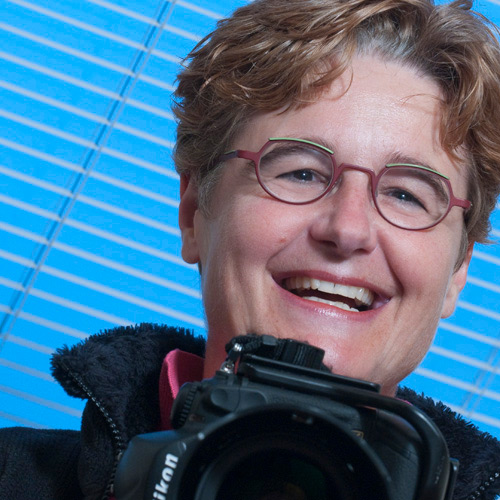
A small or large light source does not always have to be genuinely small or large. If you place a large light source very far away, it becomes relatively smaller compared to the model. Just think of the sun and the moon. Enormous in reality, while we see them as small balls.
For light painting, we use a small flash as the light source, to prevent the flash light from hitting the painting. This means that we get hard shadow edges. Because we need to frame quite widely to get the entire painting in the frame, the light source is also far away from the model. So the light source becomes relatively even smaller. And the shadow edges become harder.
There is little else you can do about this other than have your model look more towards the light. If you do not, you get a hard, dark shadow next to the nose. Some people forgivingly call this 'loop light', but in my view it simply does not look good.
You can of course soften the edge slightly in post-processing.
About the author
Liesbeth fotografeert met haar bedrijf stapfoto.nl voor websites van bedrijven. Daarnaast verzorgt ze al sinds 2004 (vooral creatieve) workshops zoals lightpainting, flitsen in de natuur, fine art, frozen flowers, paintsplash, infrarood, icm en multi exposure. Daarnaast is er een Stapfoto vakgroep voor de meer gevorderde fotografen.
You might also like
-
 Portrait photography tip: Get closer
by Elja Trum
-
 Photographing children: Get closer
by Elja Trum
-
 Composition tip: Get closer to your subject
by Elja Trum
-
 Does the Shape of Your Catchlight Matter?
by Elja Trum
-
.jpg "Nature photography tip: Look closer to home too") Nature photography tip: Look closer to home too
Nature photography tip: Look closer to home tooby Rob Dijkstra
2 comments
-
 Chantal wrote on Tuesday 31 January 2023 at 18:47 | reply
Clearly and clearly explained because it is a difficult subject for me to understand that square,
Translated from Dutch.
the cusus creative light art is one close to my heart,
thank you Liesbeth -

 Liesbeth van Asselt
wrote on Wednesday 1 February 2023 at 11:42
| reply
Liesbeth van Asselt
wrote on Wednesday 1 February 2023 at 11:42
| reply
Thank you for your response Chantal!
Translated from Dutch.
Have your say
Please note: Articles older than a week can only be commented on by signed-in visitors.Would you still like to comment? sign in or create a free account.
Become a better photographer every week
A practical photography tip in your inbox every week.
39,079 photography enthusiasts already receive the tips! More about the weekly mail. Or keep up to date via  Facebook.

Elja Trum
Photofacts; everything to do with photography!
Would you like to take better photos and keep up with what is happening in photography? Photofacts publishes articles that teach you something about photography — from a product announcement to a practical shooting tip or a look at a website. Photofacts covers photography every day and is a hobby project of Elja Trum's that got out of hand. The articles are written by a team of volunteer authors. If you would enjoy writing one or more articles for Photofacts, do get in touch.More about PhotofactsPhotofacts is made possible in part by
