

What makes a photo iconic?
Wednesday 18 July 2018, 13:26 by Michelle Peeters | 9,967 views | 4 commentsThis article was translated from Dutch with the help of AI. Read the original.
What makes you keep looking at a photo and see more in it each time? One that is, as it were, etched on your retina. And that goes down in history as a prize-winning image? The photo by Jesco Denze of the G7 summit is one such example. It has only just been published and is already iconic!
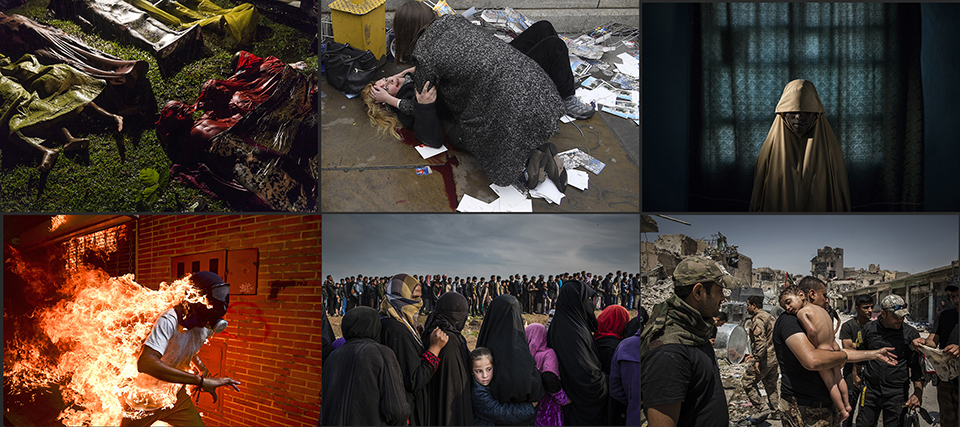
The World Press Photo criteria
But to return to what makes a photo iconic, here is the following. Every year, a jury at World Press Photo considers a large number of (often) very good entries.
A winning photo must above all be recognisable. You must be able to put yourself in the situation. A little direction or manipulation is allowed. A news photo, however, must not be edited or changed. The photo must be of high technical quality and also tell a particular story.
The context gives the photo meaning, but the photo also says something about the situation in which it was taken.
Recognisability is important. Photos of human drama often become iconic. They appeal to people and they are uncomfortable. You get the feeling that you ought to do something, and you may even feel guilty that you cannot.
Iconic photos also often have a political dimension: they stand for greater suffering in the world.
Photos that appeal to the imagination are often seen as iconic. It helps enormously if a competition jury selects the photo, so that it then becomes known around the world almost automatically.
When you see an iconic photo, you often know immediately that it is 'a stunner'. A caption is not really needed, the photo speaks for itself.
Learning from Steve McCurry's iconic photo
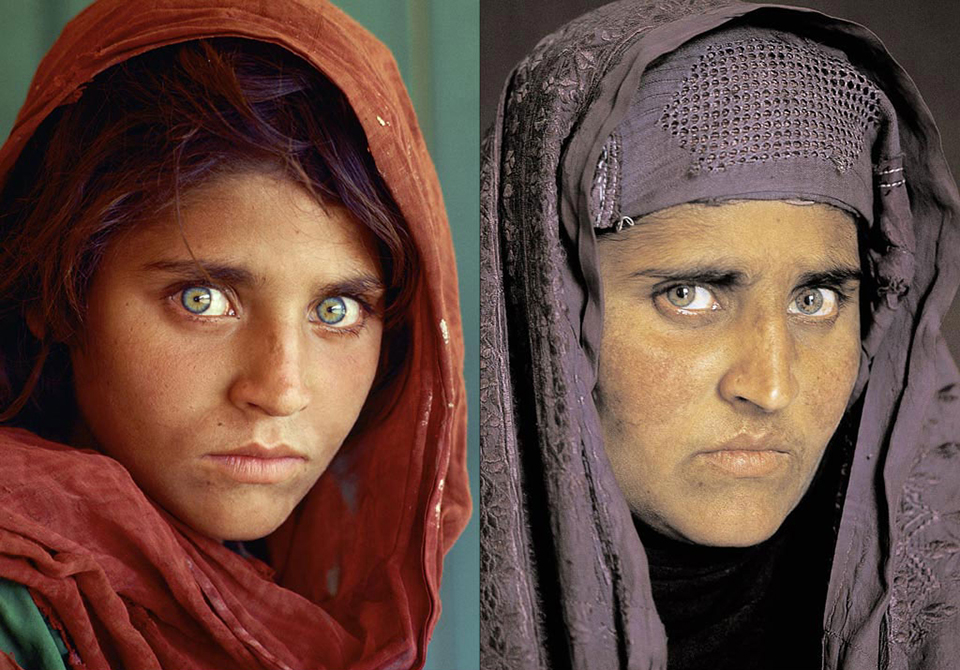
What can you learn, for example, from Steve McCurry's iconic photo 'Afghan Girl' at Steve McCurry? His strong use of colour and his ability to tell a story visually have earned him a place in some of the world's most celebrated magazines, galleries and photographic collections.
YouTuber Ted Forbes from The Art of Photography has just started a new series about the photographer's intention and what we can learn from the work of others.
In the video below, he talks about using colour with a particular intention. The main example he gives is McCurry's 'Afghan Girl' and how the limited colour palette helps make the image so striking.
Once the yellow box from National Geographic has been removed from the image, there are really only two dominant colours left, green and red, and that really helps you focus on the model's penetrating gaze.
In the follow-up video below, Ted Forbes looks at the story behind the creation of this iconic photo, as well as an alternative version that Steve McCurry made of the girl in the photo in a very short time. Steve McCurry really is a master of his craft, and there is a lot you can learn from him.
About the author
Michelle Peeters is fotografe en oprichter van DeuxBleus Fotografie. Michelle herkent het bijzondere in het gewone en het gewone in het bijzondere. Ze heeft zich nooit willen specialiseren en is daardoor van alle markten thuis.
You might also like
-
 The story behind Ansel Adams' iconic moon photograph
by Michelle Peeters
-
 5 ways to interpret a photograph
by Michelle Peeters
-
 How NASA's iconic 'Earthrise' photo was taken
by Michelle Peeters
-
 The Rise and Fall of Camera Giant Kodak
by Michelle Peeters
-
 What goes wrong when you look at a photo
by Elvira Smit

4 comments
-
 R K wrote on Thursday 19 July 2018 at 13:31 | reply
In these times of social media and web journalism - see that NRC link - something is very quickly hyped up to "iconic" or "epic" ("hilarious" is another one of those, for something that is no more than moderately funny).
Translated from Dutch.
In my view, you can only say after some time, perhaps even after several decades, whether a photo turns out to be iconic; defining for a particular period or event. You can now call Ed van der Elsken's photos iconic, because they show Amsterdam in the 1960s so beautifully. At the time Van der Elsken took those photos, nobody called them "iconic" yet.
Incidentally: Steve McCurry has tumbled quite a way from his pedestal as a documentary photographer, after he was caught cutting and pasting in some photos. Not done in photojournalism. -

 Michelle Peeters wrote on Thursday 19 July 2018 at 14:00
| reply
@R K: it’s not just the expressiveness that makes a photo iconic, but also the composition, use of colour, lighting, et cetera. How all of this is used is precisely to make that expressiveness as great as possible. Often an unconscious process. I also don’t find all the selected and award-winning World Press photos iconic. They often quickly disappear into oblivion... So in that respect you’re right; that you can only really determine after dozens of years whether an image ‘sticks with you’.
Translated from Dutch. -
 martinphili wrote on Thursday 19 July 2018 at 19:04
| reply
No, composition, use of color, lighting, et cetera make a photo technically sound but not iconic. The story of the photo makes it iconic. Just think of the photos Capa took of the Allied landing on D Day. Technically speaking, they are not great photos. The fact that he took them is great. And the results are documents of a major moment in history. That makes them iconic.
Translated from Dutch.
And besides, I think you shouldn't analyze photos too much. Then you take the soul out of them. -
Michelle Peeters wrote on Thursday 19 July 2018 at 20:05
| reply
@Martinphili: it is of course becoming increasingly difficult to take a distinctive and iconic photo (at the risk of your own life, right in the middle of the heat of battle, just like Martin Parr) with all those ‘photographers’ who are always present at the striking locations just before you arrive. And so much is happening in the world at the same time that really beautiful pictures disappear from your memory faster than they used to (I think..)
Translated from Dutch.
Have your say
Please note: Articles older than a week can only be commented on by signed-in visitors.Would you still like to comment? sign in or create a free account.
Become a better photographer every week
A practical photography tip in your inbox every week.
38,889 photography enthusiasts already receive the tips! More about the weekly mail. Or keep up to date via  Facebook.

Elja Trum
Photofacts; everything to do with photography!
Would you like to take better photos and keep up with what is happening in photography? Photofacts publishes articles that teach you something about photography — from a product announcement to a practical shooting tip or a look at a website. Photofacts covers photography every day and is a hobby project of Elja Trum's that got out of hand. The articles are written by a team of volunteer authors. If you would enjoy writing one or more articles for Photofacts, do get in touch.More about PhotofactsPhotofacts is made possible in part by
