

Review: Inspiration by Ap Dijksterhuis
Friday 2 December 2022, 11:33 by Erik van Rosmalen | 4,492 views | 0 commentsThis article was translated from Dutch with the help of AI. Read the original.
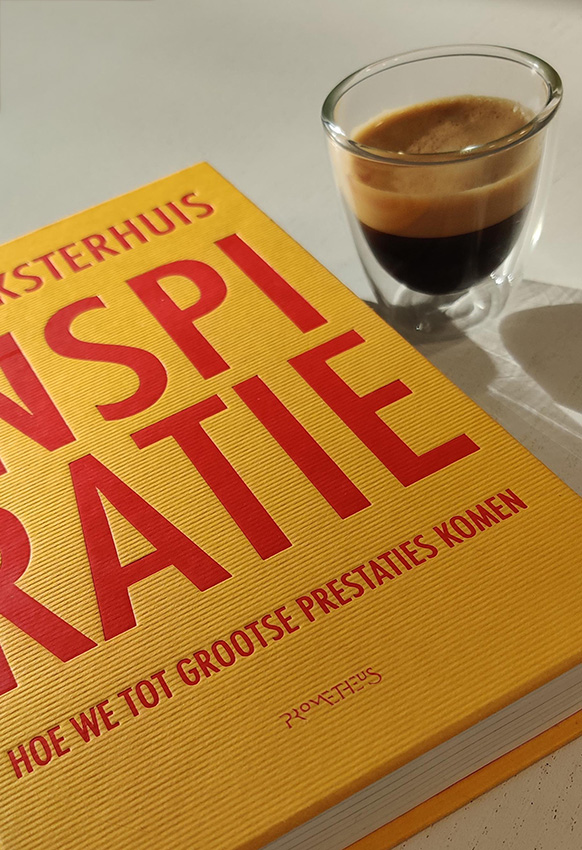
Most of the books we review on Photofacts are about 'technique'. For example, photography styles, flash or post-processing. 'Inspiration' by Ap Dijksterhuis explores a different, but oh so essential, perspective. Where do our creative ideas come from?
Creativity. That means seeing the same thing as someone else, for example, but turning it into your own story or image. How you do that? It's different for everyone. And where does that difference come from? We call that inspiration.
Ap Dijksterhuis is Professor of Psychology at Radboud University Nijmegen. He also writes many books on all sorts of subjects. He also does a lot of (travel) photography, by the way.
Of course, he also writes popular science books. One of them was 'The Smart Unconscious', a book from 2007 in which he explored the power of that unconscious part of our brain. A power we often underestimate. It was a good prelude to his latest book, 'Inspiration'. Because that inspiration often turns out to originate in that unconscious part.
In the book, Dijksterhuis explains this in a very accessible and enjoyable way, using examples of all kinds of geniuses. In the broadest sense of the word, from Mozart to Einstein, but also from top athlete Pieter van den Hoogenband to photographer Rineke Dijkstra and Soundgarden singer Chris Cornell.
Inspiration, in phases
So how does that inspiration work? Dijksterhuis distinguishes three 'phases', or parts. They do, incidentally, flow seamlessly into one another.
The first 'phase' is evocation. A fancy word that can also be described as a calling. When you photograph a deer in the woods as a child, or stand in a concert hall as a teenager and suddenly think, 'this is great, I want to become a nature or concert photographer'.
What happens next? You get a camera, you practise, you read, and you practise some more.
The big moment
Then there is 'the' moment. The click, the Eureka moment, the big idea. This is what people often describe as real inspiration.
The best-known examples are Isaac Newton, who saw an apple fall and had the idea for the theory of gravity, and Archimedes, who saw the idea for his law of 'Archimedes' force' in front of him while sitting in the bath. And, according to legend, he jumped out of the bath and ran naked into the street shouting, 'Eureka'.
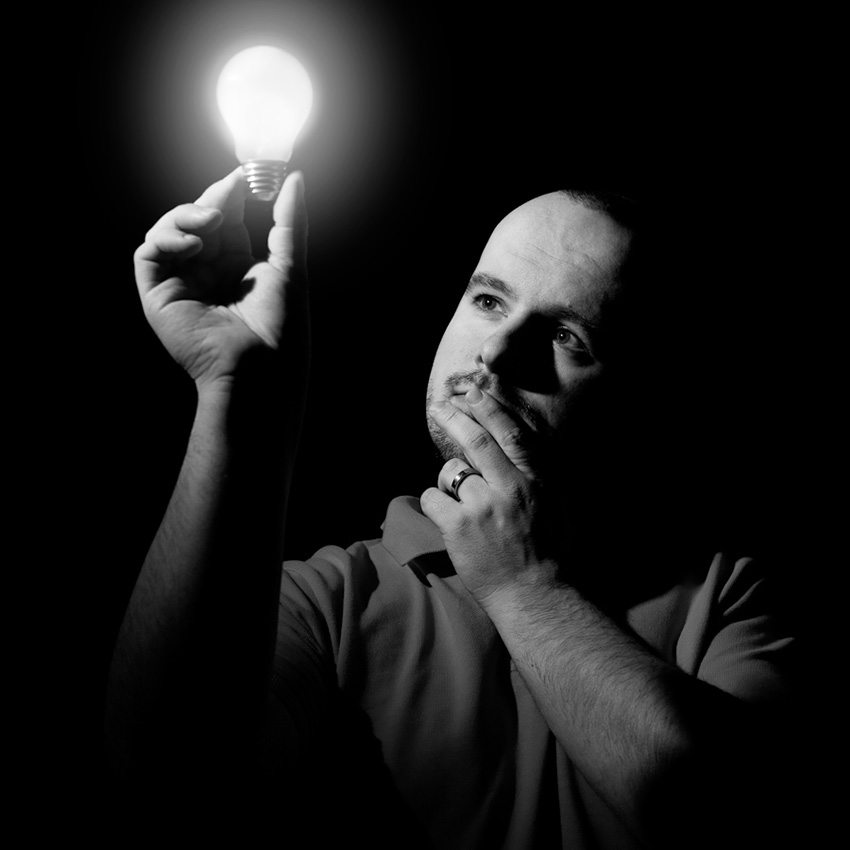
That big moment can, incidentally, be completely separate in time from the moment when the article, photograph or piece of music sees the light of day. That is because the third phase described by Dijksterhuis is needed first.
J.K. Rowling had an idea during a train journey, which formed the basis for the story of wizarding student Harry Potter. But it was only through the third phase that seven Harry Potter adventures appeared and hundreds of millions of books were sold.
That phase, in which inspiration is turned into something concrete, is at least as important. For Rowling, that period lasted almost 20 years. And Dijksterhuis himself took 14 years to complete his book about inspiration...
An example from photography is Jeroen Swolfs. The photographer started a photography project in 2009, Streets of the World.
His aim was to photograph street life in every country in the world, 'to show what connects us as people rather than what divides us'.
It took years and eventually resulted in a photo series, a book, a travel novel and a documentary on National Geographic.
Where does it come from?
We are all creative, really. Whether it is something you photograph, a recipe you adapt because you happen to have no garlic in the house, or giving a presentation at work. But how do you help that inspiration along?
Dijksterhuis describes in an enjoyable way, with plenty of examples, how inspiration 'rears its head'. He compares the unconscious in our brain with the crew of a ship below deck, steering us in a particular direction in all kinds of ways, or steering us away from it.
Again, based on stories from chefs, entrepreneurs and artists, or on scientific research.
Perspiration
Despite all the conscious and unconscious processes, and however many divine inspirations or Eureka moments there may be, Dijksterhuis clearly points out that hard work is also an important factor. Research shows that highly talented musicians all spent a lot of time with their instruments.
It made me think of a famous quote from photographer Henri Cartier-Bresson: 'Your first 10,000 photographs are your worst'. It doesn't sound very motivating, but it does fit this theme. And related to that is a quote from another famous photographer, Edward Weston: 'There are no shortcuts in photography'.
Do a lot, practise a lot and keep trying. This doesn't just train your technical skills, it also opens up systems in your conscious and unconscious mind. Or, as Dijksterhuis puts it so nicely: 'Art begins with wanting. You have to want something, then work hard, practise and try, then you get better and wanting turns into art.'
Practise and look
Practice makes perfect, then. But experiencing other people's art does too. By experiencing art, and photographers should therefore look beyond photography, you stimulate certain parts of the brain that experience beauty.
You are then training that 'muscle' that is essentially our brain, in the area of creativity. So it really is worthwhile looking at paintings or exploring music instead of only reading books about photographic equipment.
Challenge and restrict yourself
What else can you do? Challenge yourself. Writer Ilja Leonard Pfeiffer does this very deliberately. With every book, he imposes restrictions on himself. By working in a different style, imposing restrictions on himself and making it more difficult. It gives him new insights into where his story needs to go.
Can you do that as a photographer too? Certainly. The tip has appeared here on Photofacts before: limit yourself. Go out with just one lens (with a fixed focal length).
Or restrict yourself to one location. Or set yourself the task of capturing just one colour. It may not immediately produce the photo of your life, but it will train your creative eye.
.jpg "Inspiration")
In conclusion
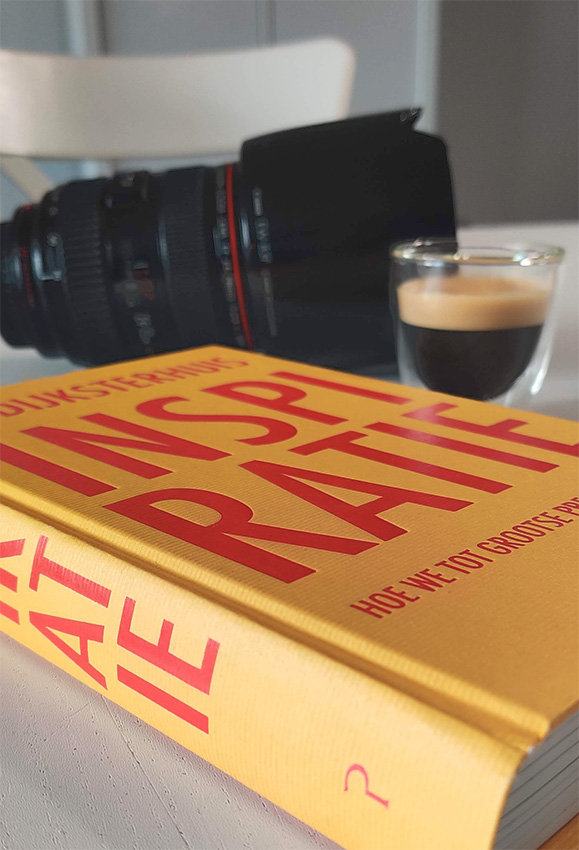
If you are in a creative lockdown and think you are buying a self-help book to get out of it, unfortunately, that's not what this is. But you do get a very enjoyable book that offers insight into how 'greats' from all kinds of disciplines work. And that in itself is already very inspiring!
Want to 'hear' more from Ap Dijksterhuis? In September this year, he was interviewed on the VPRO programme Nooit meer slapen.
» Order 'Inspiratie' (25 euros)
About the author
Erik werkt als content specialist. Daarnaast is hij freelance tekstschrijver en fotograaf. Mensen vormen daarbij het hoofdonderwerp: portret- en reportage-fotografie. Volg Erik ook op Instagram!
You might also like
-
.jpg "Inspiration, essential for your photography!") Inspiration, essential for your photography!
Inspiration, essential for your photography!by Laura van der Burgt
-
 Inspiration for Multiple Exposures
by Nando Harmsen
-
 Review: Practical Nature Photography Book NXTLVL
by Michelle Peeters
-
 Make an Inspiration Scrapbook: 3 Rules
by Elvira Smit
-
 Who inspires you, and why?
by Elvira Smit
-
 Review: Blurb photo books via Lightroom Classic
by Nando Harmsen
0 comments
Be the first to share what you think!
Have your say
Please note: Articles older than a week can only be commented on by signed-in visitors.Would you still like to comment? sign in or create a free account.
Become a better photographer every week
A practical photography tip in your inbox every week.
38,943 photography enthusiasts already receive the tips! More about the weekly mail. Or keep up to date via  Facebook.

Elja Trum
Photofacts; everything to do with photography!
Would you like to take better photos and keep up with what is happening in photography? Photofacts publishes articles that teach you something about photography — from a product announcement to a practical shooting tip or a look at a website. Photofacts covers photography every day and is a hobby project of Elja Trum's that got out of hand. The articles are written by a team of volunteer authors. If you would enjoy writing one or more articles for Photofacts, do get in touch.More about PhotofactsPhotofacts is made possible in part by
