
Street photography theme: face masks and the big bad wolf
Saturday 3 October 2020, 14:41 by Jan Poldervaart | 5,484 views | 14 commentsThis article was translated from Dutch with the help of AI. Read the original.
Street photography is usually about ordinary people, like you and me, going about their daily lives in the street. The photos you take are never staged. What happens is always real.
Street photography has many faces, and there are countless ways to practise it. Each time, I will present a way for you to go out and take photos in the street.
One way to go out with your camera or mobile phone is to choose a theme beforehand.
This could be people with a dog, people with a yellow bag, men wearing a hat or unusual people on bicycles. You name it, you can turn it into a theme or project.
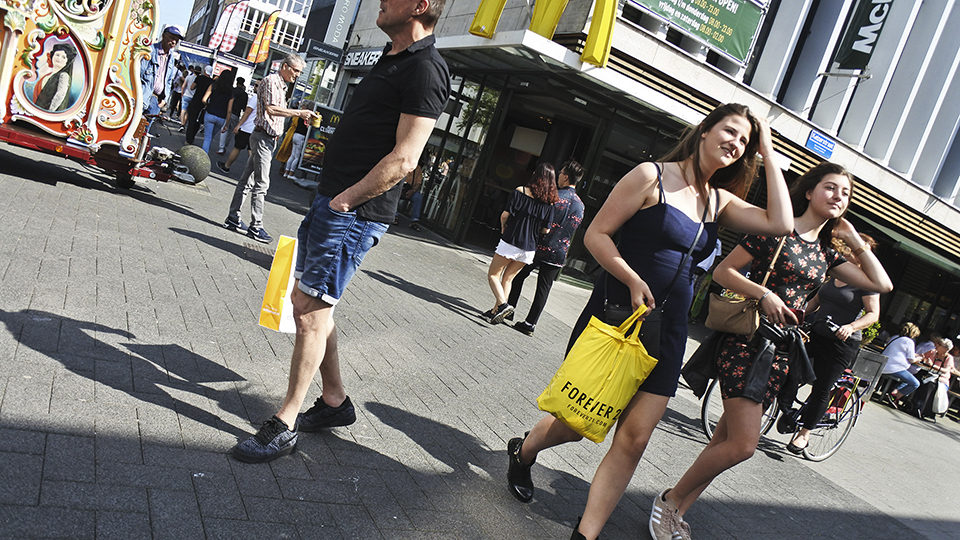
At the moment, during the coronavirus crisis, the call to wear face masks is getting louder. The advice now is to wear a face mask in public spaces.
Mayor Aboutaleb of my favourite city, Rotterdam, had already carried out an experiment in the city, asking people to wear a face mask in busy places.
As a street photographer, this is a unique opportunity to respond to this theme and see whether people follow the advice.
In my previous blog, I already showed a photo of a bicycle trailer with two little boys in it, and behind them a mother comforting her daughter and a boy in a red shirt.
There was a large spider on the shirt. That boy belonged with the mother and daughter, as the photo below clearly shows. They are also all wearing a face mask.
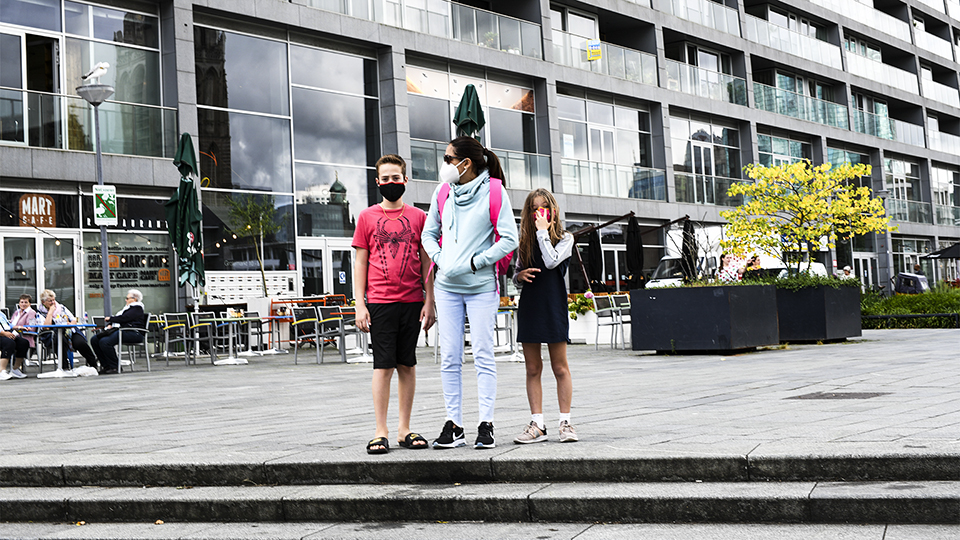
So who is the big bad wolf? For many people in Rotterdam, it was the mayor. Why? He told them they had to start wearing a face mask.
Of course, having one of those things over your mouth is not much fun. But you do not want a BOA breathing down your neck and giving you a hefty fine either. You can buy a lot of shopping at the market in Rotterdam for that money.
Of course, the real big bad wolf is that virus: Covid 19. With the lovely name Corona, as if it were the prettiest girl in town.
The virus that keeps many people in its grip and often in their homes too. But not everyone, as became clear during my street photography trip through Rotterdam city centre.
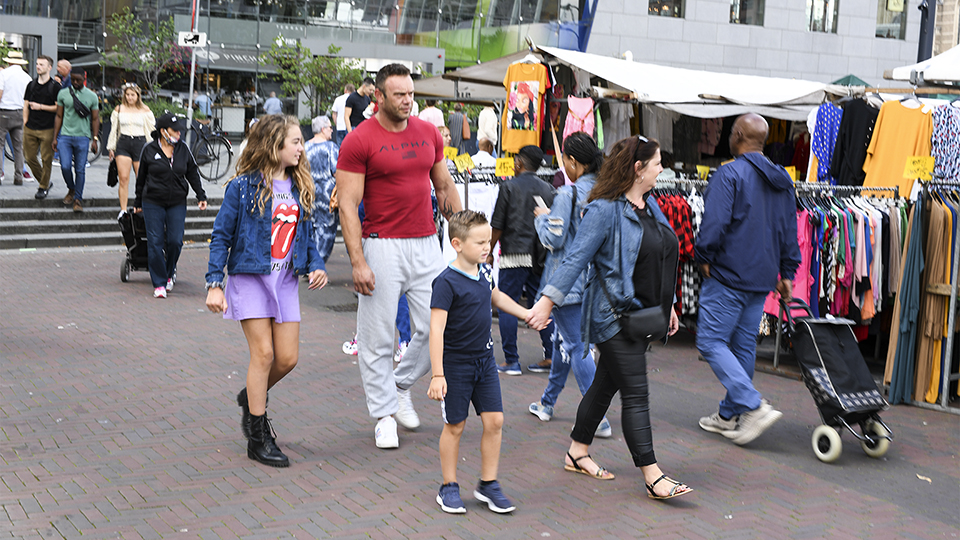
A family without a single face mask. A father who could pass for Schwarzenegger, a daughter who is a fan of the Rolling Stones, and a mother and son walking hand in hand, comrades. In the photo, there is, literally, just one woman wearing a face mask.
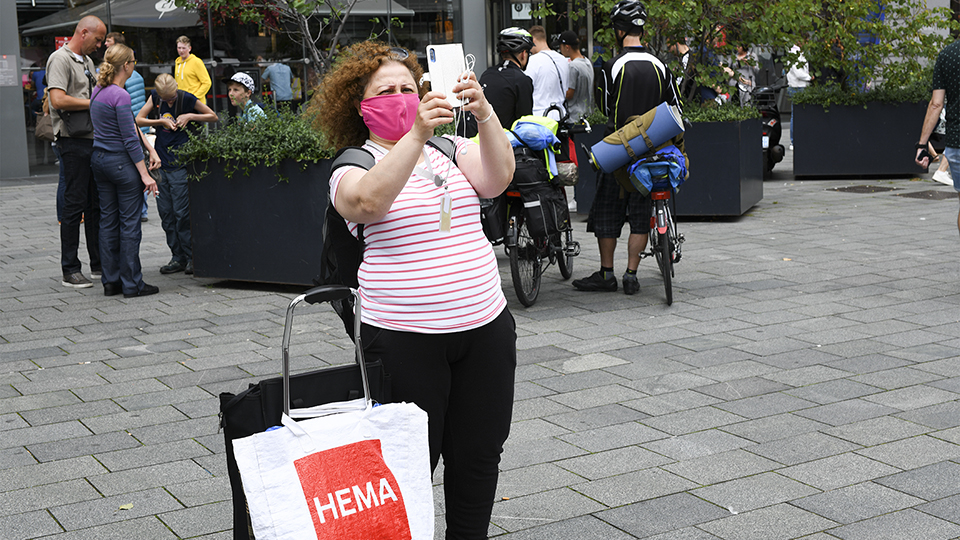
Some people were also very happy with that face mask. Apparently so happy that they thought, hey, I could take a selfie with that. So, grab your phone and take a selfie.
But there could be more going on. Perhaps she was secretly taking a photo of the people behind her. There, got them, they are not wearing a face mask.
Or perhaps she saw something in front of her. Something we cannot see. That is what makes street photography so much fun. Everyone can make up their own story. But first, you have to see it. Look, look, look, as I already explained last time. Then you will automatically see the stories in the street.
Sneezing into your elbow and the 1.5-metre distance
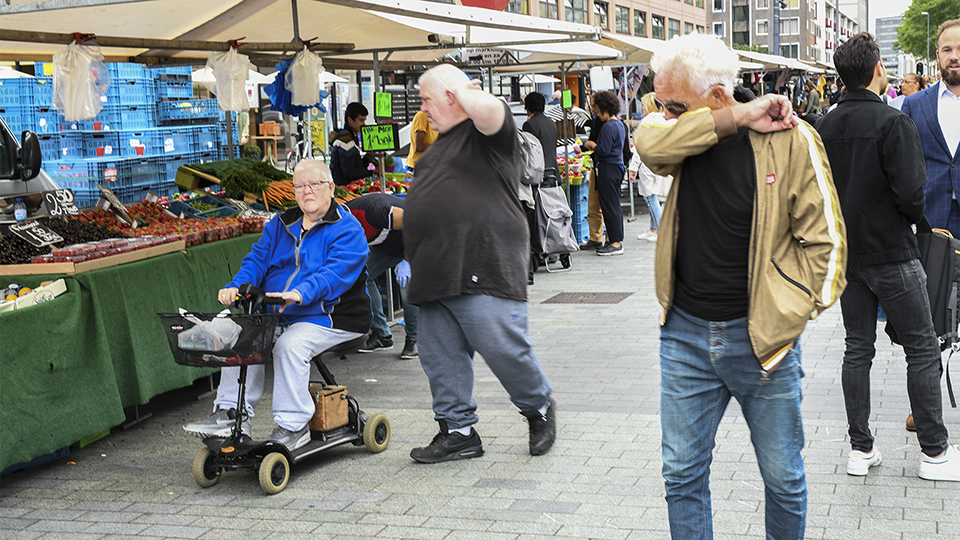
Prime Minister Rutte's credo is that you should sneeze into your elbow and keep 1.5 metres away from each other. I was lucky that this political statement came right in front of my lens.
That is also a characteristic of street photography, that you sometimes need to be lucky. Right in front of me, a man suddenly had to sneeze. I saw it coming. And yes, into the elbow. What a lucky shot.
So proper and neat, doing that in the street. If this man had been wearing a face mask, it would now be full of... Yes, you can guess what.
The man next to him recoils slightly. You can almost hear the sneeze in the photo.
Once I started paying attention to it, I also wanted to see whether the 1.5-metre distance was being observed.
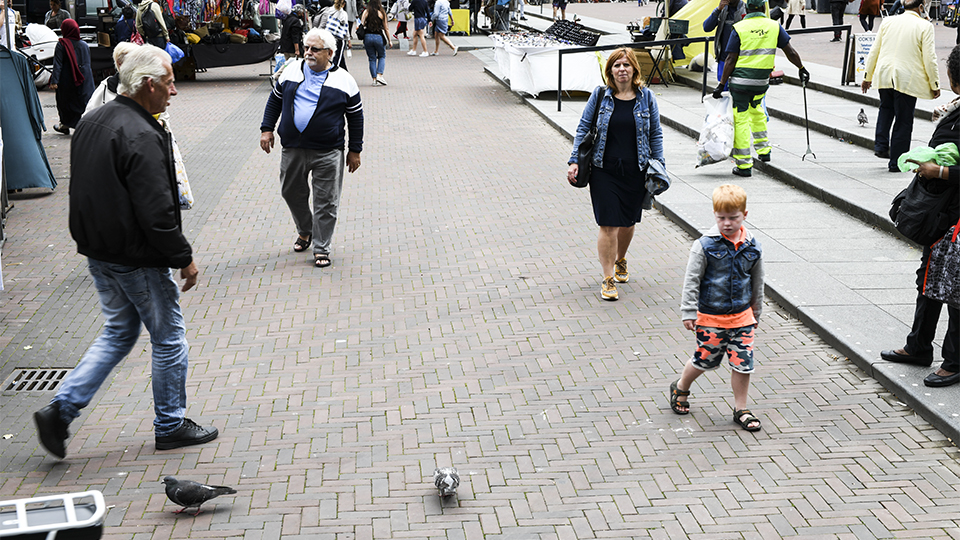
At one point, I saw a little boy looking at a pigeon. There were also some people around him. And if you look closely, you can see that those people are keeping a proper distance from each other. In a sort of circle.
Even the two pigeons are keeping their distance. Because if a bat can transmit the virus, why not a pigeon? The only downside is that none of them is wearing a face mask. This was allowed for children.
So if you are also going to do street photography, or perhaps you already do, come up with a theme and follow your subject. You will probably come home with better street photos than if you just randomly fire away with your camera.
And do you find it difficult to photograph strangers just like that? Then take photos with a theme where you can see the influence of people.
Take shop windows and window mannequins, for example, and if you are lucky, you will also photograph the people walking past the window.
Go out, get outside. I would love to see one of your street photos.
Send it in or share your thoughts on this blog.
About the author
Jan Poldervaart is straatfotograaf en fotografeert met name in Rotterdam. Jan is lid van fotoclub de Phoenix in Rotterdam, huiskamerclub Focus17en het fotografencollectief Rotterdamstreets. Bekijk zijn werk op dutchartandphotographer.
You might also like
-
 Street photography tip: Capture a snapshot of an era
by Michiel Heijmans
-
 Review: Photo book 'Voor altijd Rotterdam'
by Erik van Rosmalen
-
 Look, look, look in street photography, and you will see more
by Jan Poldervaart
-
 Street photography: a red balloon, a fabric stall and the girl in yellow
by Jan Poldervaart
-
 Street photography: follow your street heroes
by Jan Poldervaart
-
 Friendship between grey wolf and brown bear captured
by Michelle Peeters
14 comments
-
 Jaap van Emmerik wrote on Saturday 3 October 2020 at 17:30 | reply
Nice article Jan. Photographing thematically is a good tip for when I no longer know what to photograph
Translated from Dutch. -
 Jan wrote on Sunday 4 October 2020 at 13:57 | reply
Dear Jaap,
Translated from Dutch.
Thank you for your response. There are many ways to practice street photography. Having a theme for yourself gives you something to hold on to. Then you know what you want to photograph. In any case, have lots of fun with street photography.
Regards: Jan -
 John wrote on Tuesday 6 October 2020 at 11:40 | reply
What about the G.D.P.R. with street photography???
Translated from Dutch. -
 Jan wrote on Tuesday 6 October 2020 at 14:10 | reply
Hi Jan, how does privacy actually work. Because that keeps me from doing street photography I believe you aren't allowed to post the photos anywhere. Or are you? And thank you for your wonderful contribution. Nicely written too. Regards Jan
Translated from Dutch. -
 Jacobs wrote on Tuesday 6 October 2020 at 15:08 | reply
Here too, questions regarding privacy.
Translated from Dutch.
Have the people above given their permission to be published here in this article? -
Jan wrote on Tuesday 6 October 2020 at 15:27 | reply
Dear John and Jan,
Translated from Dutch.
As far as privacy is concerned, in general you are simply allowed to take photographs in public spaces on the street. In shopping areas or, for example, on public transport and such, it is often prohibited or house rules apply. In many museums it is allowed again nowadays. Publishing in the media is also allowed, provided it is not an offensive photo or there is a portrait interest, for example with well-known persons. So go ahead and enjoy photographing on the street and follow many other well-known and unknown street photographers.
greetings: Jan -
guest wrote on Tuesday 6 October 2020 at 15:56 | reply
Hi Jan, I see that this question has already been asked a few times.
Translated from Dutch.
So does what I found on the beautiful website (where you are also a participant) of https://rotterdamstreets.nl/recht/ still apply below? Thanks and Kind regards Henk
If the image was not made on assignment from or for the benefit of the person depicted, portrait rights are limited. The person depicted can only object to reproduction or publication insofar as that person has a reasonable interest in objecting to it, as described in the Copyright Act 1912. -

 audb wrote on Tuesday 6 October 2020 at 16:55
| reply
Unfortunately, I do have to make a comment about the second photo: you mention that the lady is wearing a face mask, however, if you look very closely, it seems that she has it sitting on her chin!.
Translated from Dutch.
But unfortunately I see all too often that people take the name "face mask" too literally and do not cover their nose.
I would therefore like to give the urgent advice to do so.
Corona can infect you through your mouth, but it is mainly through your nose that you become infected.
You could also put on (safety) glasses, but only in very crowded areas where you cannot stay 1.5 and preferably 2 metres apart. -
audb wrote on Tuesday 6 October 2020 at 17:03
| reply
Dear John and Jan,
Translated from Dutch.
You are allowed to take photographs in public, however if the person you are photographing directly indicates that they do not want to be in the photo, then you have two choices.
1. You delete the photo on the spot, with the person present.
2. you indicate that you will make the person in the photo unrecognizable.
If you do not do that, the person can indeed make use of the AGV and file a report for violation of privacy.
Unfortunately, it has been the case for years that people have started to consider their "privacy" extremely important.
Just imagine that they see you walking around with a bag from Hema instead of an overly expensive brand or one from Aldi, while they do see a Tesla parked in front of the door of their 65-square-metre home worth three and a half tons.(Amsterdam and such) -
Jan wrote on Tuesday 6 October 2020 at 18:08 | reply
Dear people,
Translated from Dutch.
My street photography blog certainly gets people talking. The subject of face masks is more topical than ever. So it's always good to get sensible advice here as well.
The privacy aspect is also a topical subject in these times. You can assume that as a street photographer I respect the people in the street. Here again, useful tips and advice from readers of my blog. Thank you for your great responses, everyone. For me, an incentive to create even more beautiful street stories with nice supporting photos.
Regards: Jan -
Jan wrote on Tuesday 6 October 2020 at 20:57 | reply
Thank you Jan. It's clear to me. Blog on, you inspire enormously.
Translated from Dutch.
Finne evening, Jan -
 Mars van den Heuvel wrote on Thursday 8 October 2020 at 09:31 | reply
Nice article & well written!
Translated from Dutch.
Do you actually get many nasty reactions when people see that you're photographing them?
The aplha male didn't come after you?
(he was actually breaking the rules, right? because no face mask)
Greetings from Mars. -
Jan wrote on Thursday 8 October 2020 at 13:57 | reply
Hello Mars,
Translated from Dutch.
Actually, I never get unpleasant reactions from people on the street. I always remain friendly and often give people a smile or thank them. If there is someone who really does find it unpleasant, I will always delete the photo at his or her request. A photo is not worth an argument to me. The Alpha male did not follow me, by the way.
And yes, those face masks....even the cabinet still hasn't finished discussing them.
In any case, thanks for your response.
Regards: Jan -
 primefoto.nl wrote on Monday 12 October 2020 at 12:15
| reply
The GDPR remains a tricky thing. As a street photographer, however, you do need to know something about it, even as an amateur.
Translated from Dutch.
disclaimer:
I am not a lawyer and have no legal background. I may be mistaken. Everyone remains responsible for their own actions!!
I have read the GDPR and also read the manual that accompanies it, in which various things are explained. So I am not relying on other people's explanations. You can download both via the government website or that of the Dutch Data Protection Authority, which supervises this law.
I will try to clarify it somewhat.
In accordance with the GDPR, you do not fall under the GDPR if you publish purely as an amateur and in a small group. So if you are a pro or semi-pro and do street work for fun on the side, then that no longer applies and you fall under the GDPR. The pros know that, if all is well.
The GDPR only concerns storing, keeping and publishing, and not taking the photo. You can always take photographs from public space. However, if you put the pictures on a website that is accessible to everyone, then you do fall under the GDPR again and you must meet the requirements. One of those requirements is having a legal basis and collection purposes that you must establish beforehand. There are 6 legal bases, one of which you may choose, one that suits you, with a number of corresponding collection purposes. You must publish those beforehand on your website or in your documentation. An inspection may also follow, and then you must be able to show that you had already met the requirements before publishing. You must be able to prove it!
One of the legal bases is consent. You ask the subject whether you may take and publish the photo. However, that consent can also be withdrawn at any time. If that happens, you must immediately remove the picture from your website remove it. So that is not the most convenient method.
For us photographers, another legal basis is much better, namely legal basis F, legitimate interest. Taking photographs is not a criminal offence and is always allowed, as long as you are standing in a public space when you take the picture. Nobody can prohibit that and nobody can demand the removal/destruction of the photo. That is contrary to copyright law. Prohibiting publication in advance is also not possible. That is contrary to Article 7 of the constitution, which prohibits censorship. After publication, one can make a claim regarding portrait rights through civil law, but that will not be easy. It also applies only if someone is recognisable in it. In short, it is justified to take photographs and practise your hobby in this way.
In private spaces, the operator determines the rules and can prohibit photography. This includes shopping centres, among other things, but also public transport, hospitals and even government buildings. Then you must first ask for permission. If you want to photograph a station, you can call NS. They have a special telephone number for that.
Back to the GDPR.
If you cite legitimate interest as a legal basis, there must also be collection purposes connected to it. Collection purposes are the reasons why you make, collect and process those images. Among them are some very strong arguments such as artistic expression, freedom of expression, historical and or journalistic value. If you put forward these arguments, it becomes very difficult to have a photo removed by a judge via portrait rights because, among other things, artistic expression, freedom of expression and or journalistic value are held in rather high regard in a democracy. A judge will not readily brush that aside.
There is, however, an important note indicated in the GDPR. You must weigh your interest against the interest of the person portrayed. Portrait rights still apply. You do have to take that into account.
Actually, not much has changed, but you do need to know it and adhere to it.
There are still other rules for pros that must be complied with, but as an amateur I do not feel the need to look into that as well.
The purpose of the GDPR is to protect citizens from the large companies that have frequently abused people's data and metadata. In principle, nothing has changed regarding photography, except that you have to start putting some things down on paper/website before publishing them publicly.
My advice is therefore to read the GDPR yourself in that regard. It takes some effort, but is also very enlightening. Hopefully you can do something with this.
Have your say
Please note: Articles older than a week can only be commented on by signed-in visitors.Would you still like to comment? sign in or create a free account.
Become a better photographer every week
A practical photography tip in your inbox every week.
38,938 photography enthusiasts already receive the tips! More about the weekly mail. Or keep up to date via  Facebook.

Elja Trum
Photofacts; everything to do with photography!
Would you like to take better photos and keep up with what is happening in photography? Photofacts publishes articles that teach you something about photography — from a product announcement to a practical shooting tip or a look at a website. Photofacts covers photography every day and is a hobby project of Elja Trum's that got out of hand. The articles are written by a team of volunteer authors. If you would enjoy writing one or more articles for Photofacts, do get in touch.More about PhotofactsPhotofacts is made possible in part by
