

The Hunger
Tuesday 8 September 2026, 16:32 by Michiel Heijmans | 884 views | 5 commentsThis article was translated from Dutch with the help of AI. Read the original.
Michiel Heijmans photographed on the streets for years, then moved into the studio for portraits and now wants to return to the streets more actively. But not to the way things were. In this two-part column, he explores where that feeling comes from, and why taking more photos may actually have been the problem.
Last week I was looking for one photo. An image from Paris, sometime around 2021, a man with an umbrella against a white wall. I was sure I had it. So I opened the hard drive with my street archive and started scrolling.
I didn't find the photo. What I did find was tens of thousands of images that look alike. Shadows of people at a crossroads. Someone walking past an advertising board. A silhouette in a doorway. Nijmegen, Paris, London, Rotterdam, Wijchen. Different city, different year, same photo.
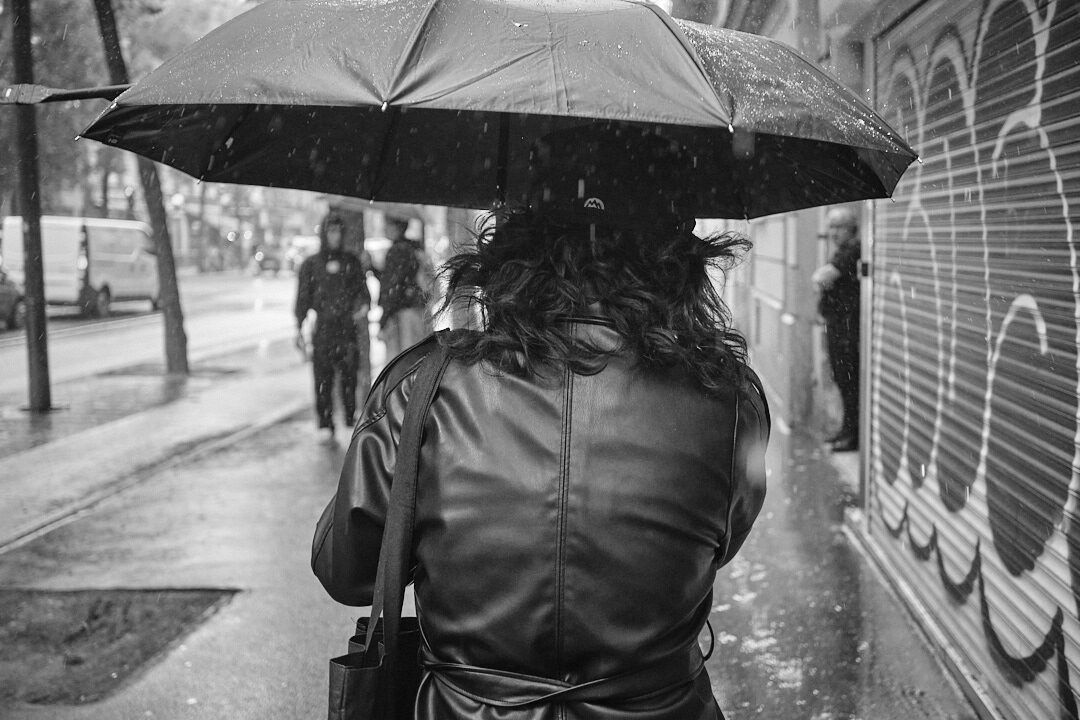
Scouting walk in Paris in the rain © Michiel Heijmans
I sat there for an hour. Not because I was searching, but because I saw something I didn't want to see. A large part of my street work is interchangeable. Not bad, that's not what I mean.
Technically, it is usually right, the composition is tidy, the light is good. But if you put ten of them next to each other, you can mix them up and it doesn't matter. That's an unpleasant realisation for someone who has written books about it.
Let me explain how that happened, because I don't think this is just about me.
Street photography as a sport
Street photography was a sport for me for years. You go outside, you walk, you look, you react. It's fast. It's hunting. The best feeling I know is that half-second when you see something is about to happen and your camera is already up before you realise it yourself. You want that rush again. And again. So you keep walking, and make more, and more. Closer, quickly.
Quantity became my method. Not consciously, but that's how it was. I believed that by making a lot, I would automatically find better images. Shoot a thousand times, keep ten good ones, one really good one.
It worked too, for a while. You learn an incredible amount from it. You learn to look, you learn light, you learn timing. I wouldn't advise anyone to skip that.
But there is a limit. At some point, you are no longer making new images, but making the same images again. You recognise a situation and already know what the photo will be. You take it anyway. It feels productive, but it is repetition. The archive doesn't lie.
The contrast with portrait photography
A little over a year ago, I started working actively in portrait photography. Corporate portraits, studio portraits, people paying me to capture a moment, TFP shoots, polaroids.
I'll be honest, it was partly a practical choice. A photographer has to eat too. But it taught me something the street never had: standing still.
In the studio, you can't hunt. There is nothing to run after. There is one person facing you, and you have limited time. You have to look. Really look, at how someone holds their shoulders, at what happens in their face when the conversation briefly falls silent.
You have to wait. You have to direct, while allowing the moment to happen. And at the end of the shoot, you go home with one really good image, or one coherent series. Shot consciously, chosen consciously. With photos of one subject, and that's enough.
That was terrifying at first. One subject? I was used to abundance. But you get used to it, and it became the way I now look at photography. One image that works is often worth more than a hundred that almost work.
And then the hunger returned
I've been noticing it for a while. I walk through the city with my family and see light falling in a way I would have captured immediately in the past. I'm on the train and see a man sitting in exactly the right place in the window. I miss it. Not the sport, not the hunting, but the street itself. The unposed world. People who don't know they're in my photo.
So I slowly started walking again. Literally, because I tore a ligament in my ankle during a studio shoot two weeks ago. I took a light camera with me, a Fujifilm X-E4 with 27mm, my old routine. Amsterdam, an afternoon at Hungry Eye Fair, a bit of metro, walking through the rain. And then something happened that I hadn't expected: I took almost nothing.
I saw more than I used to. That isn't the problem. I saw the composition before it was there, I saw where the light would be in five minutes, I saw which person would and wouldn't fit in the frame.
All that knowledge from the past few years was switched on. But every time I wanted to raise the camera, I thought: I've already got this. It's already on that hard drive, twenty times.
I came home with about nine photos. Nine. In the past, I would have had four hundred. And I felt almost like a failure, as if I had forgotten how to do it. As if all that portrait work had taken away my reflexes. But those nine, I was actually quite pleased with them.
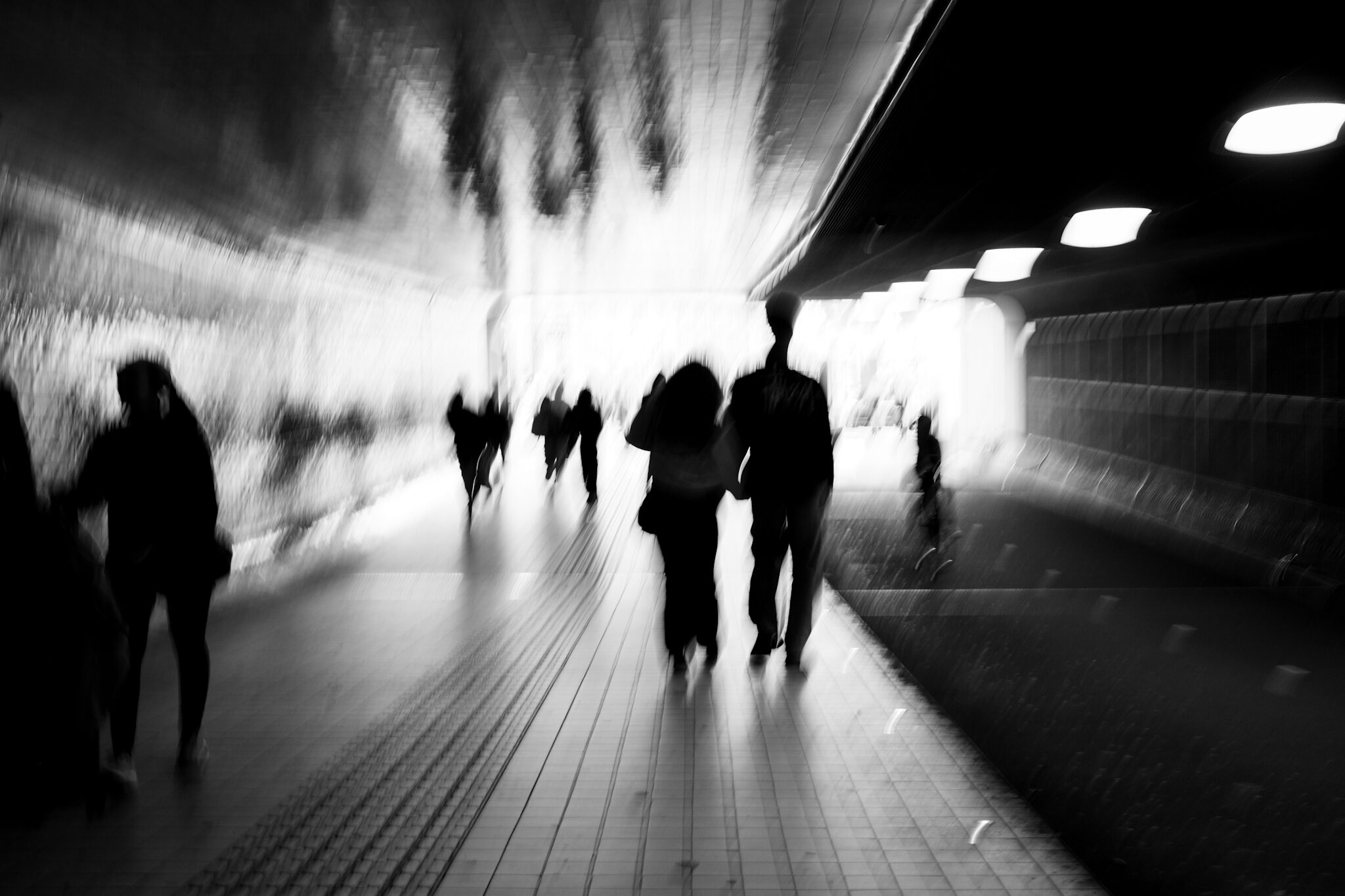
Amsterdam, cycle tunnel. f/5, 1/15s, 320 ISO @ 27mm © Michiel Heijmans
I lived with that for a while. And then I returned to that hard drive, to those tens of thousands of images that look alike, and something fell into place.
Maybe it's not about unlearning (the hunt). Maybe I was actually unlearning it.
Maybe the problem isn't that I make fewer images. Maybe the problem is that I still rely on quantity, even though I've known for a long time that quantity won't take me any further. I was standing in the street with the method from five years ago, and with today's eyes. Those two don't fit together.
So the question is: what does fit?
That's what part two is about, which you can read next week. About what happens when you go out onto the street with the patience of the studio. About having a plan, while the street is all about chance. And about the hardest step of all: choosing what you don't make.
About the author
Michiel is professioneel straatfotograaf en geeft workshops en lezingen over straatfotografie. Hij schrijft columns voor Focus Magazine en is erg actief op Instagram. Daar vind je dagelijks inspiratie en tips voor je eigen straatfotografie!
You might also like
-
 From the street to the treehouse
by Michiel Heijmans
-
 Street photography tip: Night photography on the streets?
by Michiel Heijmans
-
 Street photography tip: Use the city's advantages
by Michiel Heijmans
-
 Street Photography Tip: The Ease of Aperture Priority
by Michiel Heijmans
-
 Street photography tip: Add layers to your street photo
by Michiel Heijmans
-
 Street photography tip: Embrace the shadow
by Michiel Heijmans
5 comments
-
 Rik wrote on Tuesday 15 September 2026 at 14:54 | reply
Very cool how you explain that you're not taking new photos but taking the old ones again. I myself walk around for days with my camera on me and take 0 photos.
Translated from Dutch. -

 Michiel Heijmans
wrote on Tuesday 15 September 2026 at 16:40
| reply
Michiel Heijmans
wrote on Tuesday 15 September 2026 at 16:40
| reply
Thanks for your response, Rik! Aren't you in a "photography rut"? Be sure to also read part two of this column, live now.
Translated from Dutch. -
 Eduard wrote on Wednesday 16 September 2026 at 15:54
| reply
Eduard wrote on Wednesday 16 September 2026 at 15:54
| reply
Know that feeling, nicely described. I understood that you work with the Fuji X-E4. I'm planning to switch to this camera because of its small size, but the rotary push button has been left out here, Is this a drawback for you? Kind regards Edu@rt
Translated from Dutch. -
Michiel Heijmans
wrote on Friday 18 September 2026 at 13:01
| reply
Hi Eduard,
Translated from Dutch.
I don't quite understand your question, but I have to say that I work with the XT5, XE4 and X100V. All a little different, but largely the same. I adapt easily. -
Eduard wrote on Sunday 20 September 2026 at 11:56
| reply
Thanks for your response, The fuji camera,s I have worked with so far have a button on the front and on the back that you can press and turn. And you can assign a function to this one. With the X-E4 fuji left out the button on the back. And that seems like a shortcoming to me.
Translated from Dutch.
Have your say
Please note: Articles older than a week can only be commented on by signed-in visitors.Would you still like to comment? sign in or create a free account.
Become a better photographer every week
A practical photography tip in your inbox every week.
39,083 photography enthusiasts already receive the tips! More about the weekly mail. Or keep up to date via  Facebook.

Elja Trum
Photofacts; everything to do with photography!
Would you like to take better photos and keep up with what is happening in photography? Photofacts publishes articles that teach you something about photography — from a product announcement to a practical shooting tip or a look at a website. Photofacts covers photography every day and is a hobby project of Elja Trum's that got out of hand. The articles are written by a team of volunteer authors. If you would enjoy writing one or more articles for Photofacts, do get in touch.More about PhotofactsPhotofacts is made possible in part by
