

Should I use a large or a small softbox?
Sunday 1 September 2024, 20:02 by Frank Doorhof | 3,498 views | 3 commentsThis article was translated from Dutch with the help of AI. Read the original.
'Which softbox should I buy?' I regularly get this question from (beginning) flash photographers. There is so much choice that you can no longer see the wood for the trees. Almost every brand has many types and sizes. What should you look out for? And which one is best?
I can't tell you which softbox is best for you. It depends on what you photograph, what your preferences are and so on.
For example, I like smaller light sources, often fitted with a grid, to get really nicely focused light on my model. There is also much more to it than just the size. Let's take a look at two of our own Geekoto softboxes, for example.
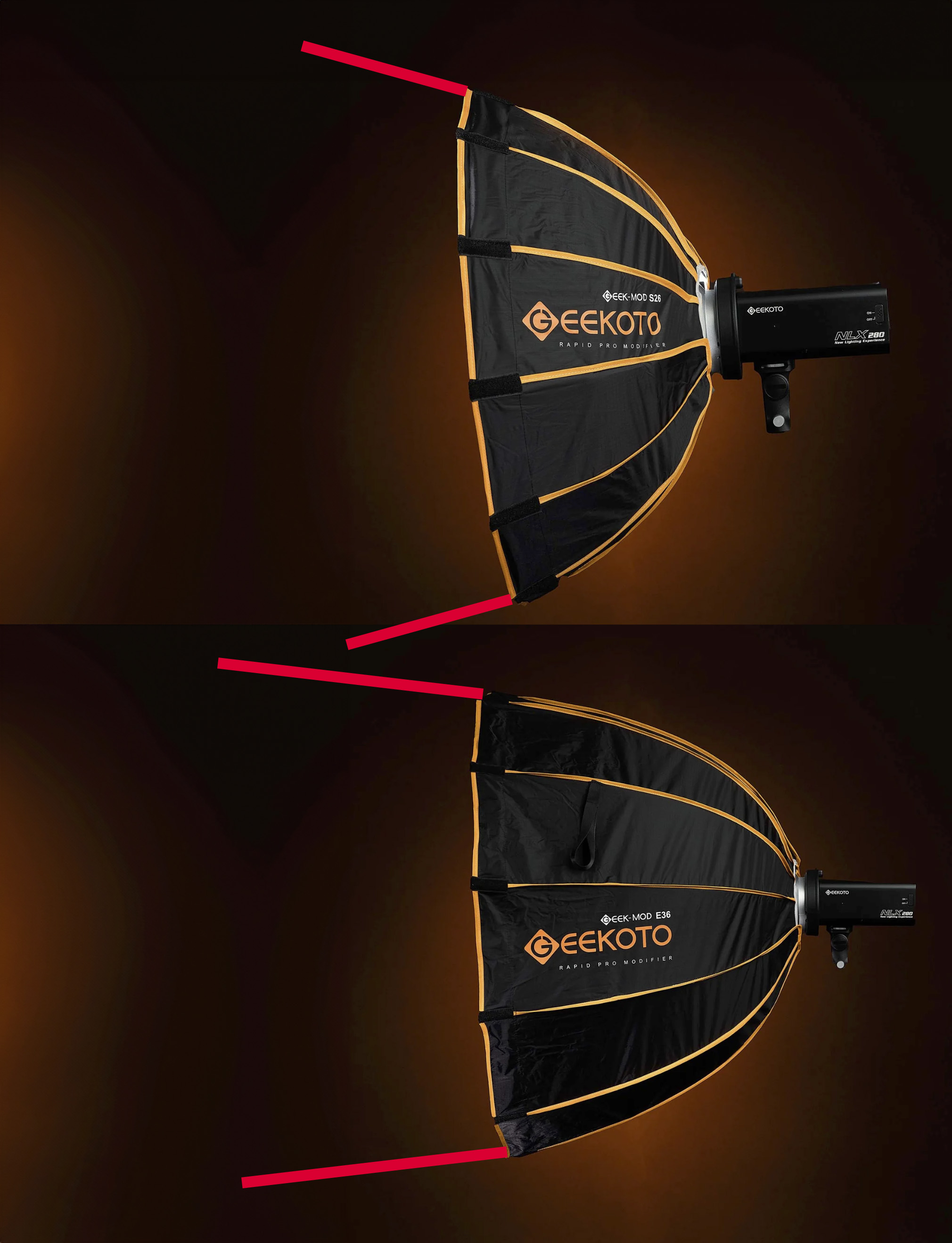
As you can see, both softboxes are different sizes, namely a 26" (the diameter is approximately 66 centimetres) and a 36” (approximately 91 centimetres).
You might say that the 36” illuminates a much larger area, but if you look closely at the construction of the softbox, you can already see that this isn't quite right. As an example, I have added some lines to the photo to show how the light spreads.
So...
When looking at a softbox, check the 'depth' of the softbox. You will often find that the smaller softboxes spread the light a little more widely, but because there is less material and the diffuser is often closer to the flash tube (or not present at all), the quality of the light is different.
The somewhat shallower softboxes often give a somewhat wider beam of light, but the light is slightly harder. For portrait work, for example, or on location, this can be a great advantage compared with the often somewhat more expensive larger softbox.
So always check the beam of light coming from the softbox in your mind, simply by imagining lines running out from it.
About the author
Frank Doorhof blogt dagelijks in het Engels op zijn website en geeft wekelijks workshops model fotografie in zijn studio in Emmeloord, maar ook op locatie in binnen en buitenland. Van beginners tot gevorderde, iedereen kan bij Frank terecht. Ook voor specifieke 1 op 1 workshops, of maatwerk voor groepen.
You might also like
-
 Review: Geekoto LS-28A Pro Autostand light stand
by Elja Trum
-
 Review: Geekoto Y-Wing Reflector
by Elja Trum
-
 10 lighting setups with a huge softbox
by Elja Trum
-
 Flash photography tip: Find an easy-to-carry softbox
by Elja Trum
-
 Flash photography tip: Use a softbox
by Elja Trum

3 comments
-
 Donald Willemsen wrote on Tuesday 3 September 2024 at 11:04 | reply
Apart from the fact that it is a good story, I have not become much wiser. In a smaller studio where you cannot place the light far from your model (1à1.5mtr.), the light beam is narrower than when you can place the light further away. In addition, you of course also have to deal with the light intensity. It decreases as the light is further away. If the light source is close by, a fullbody is also more difficult, or you would have to work with 2 light sources on the same side.
Translated from Dutch.
In your article you only talk about octaboxes, but there are so many more light modifiers that also have a different kind of light beam.
So if you want to have multifunctional light sources, you cannot avoid purchasing different light modifiers and therefore not just octaboxes. -

 frank doorhof
wrote on Tuesday 3 September 2024 at 12:43
| reply
frank doorhof
wrote on Tuesday 3 September 2024 at 12:43
| reply
Hi Donald
Translated from Dutch.
The article is intended to explain that the "neck" of the softbox or of your other light shaper determines the beam behavior and how you can therefore "predict" in advance how the light will fall on your subject by looking at the shape of your light shaper.
You don't want to know how many people who are just starting out have difficulty with that, and this way it actually immediately makes clear what the light does. After that it's just a matter of how many diffusion panels you use, whether you place a grid and of course always measuring the light falloff :D
Of course this also applies to strips, umbrellas etc. :D
And if you are limited in space this is especially useful because then you should use a light shaper for example that has a somewhat more tapered front. -
Donald Willemsen wrote on Tuesday 3 September 2024 at 13:41 | reply
Hi Frank, this explanation makes things a bit clearer for me, at least. Thank you very much for that. I conclude that, unconsciously, I’m actually doing reasonably well with my current light shapers. It could of course still be better, but my wallet is asking me to be patient a little longer ??
Translated from Dutch.
Have your say
Please note: Articles older than a week can only be commented on by signed-in visitors.Would you still like to comment? sign in or create a free account.
Become a better photographer every week
A practical photography tip in your inbox every week.
39,009 photography enthusiasts already receive the tips! More about the weekly mail. Or keep up to date via  Facebook.

Elja Trum
Photofacts; everything to do with photography!
Would you like to take better photos and keep up with what is happening in photography? Photofacts publishes articles that teach you something about photography — from a product announcement to a practical shooting tip or a look at a website. Photofacts covers photography every day and is a hobby project of Elja Trum's that got out of hand. The articles are written by a team of volunteer authors. If you would enjoy writing one or more articles for Photofacts, do get in touch.More about PhotofactsPhotofacts is made possible in part by
