

Create a mini-lens effect in a droplet
Tuesday 9 June 2020, 23:32 by Michelle Peeters | 9,869 views | 0 commentsThis article was translated from Dutch with the help of AI. Read the original.
I came across an interesting article on the Canon website describing how you can use your macro lens to photograph flowers reflected in water droplets. By using the specific light refraction in your macro lens, you can quickly create breathtaking close-up photos. I decided to give it a try!
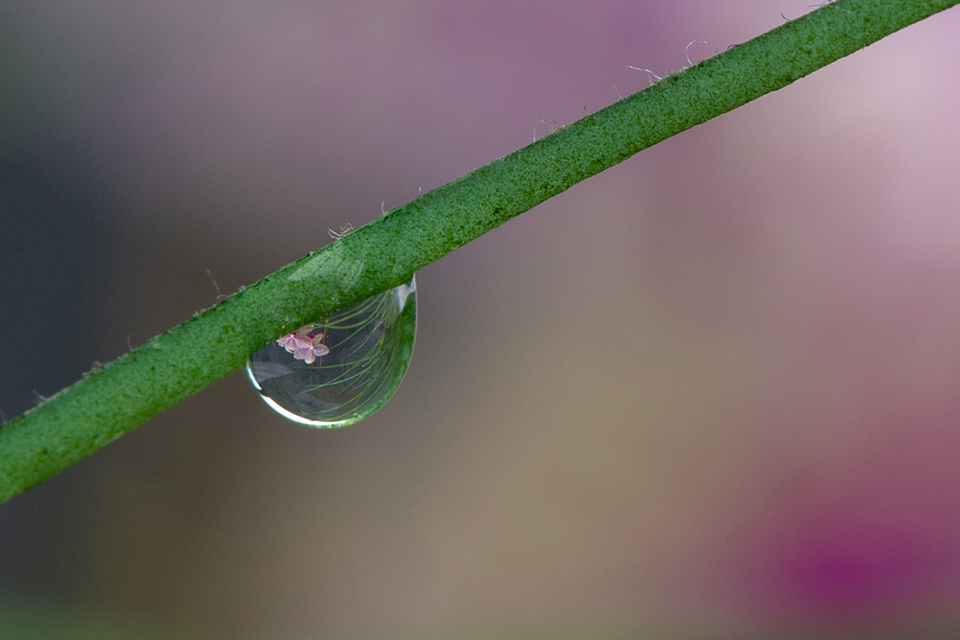
Glycerine works much better than water for making droplets. The droplets become thicker, shinier and stay attached to the stem for longer. This saves you a lot of shooting time.
What you need for this technique:
- A camera with a macro lens
- A tripod
- A remote control
- A flash, if needed (I used daylight)
- A flower
- A twig to hang some droplets from
- Glycerine (available from Kruitvat or a pharmacy) for making droplets
- A toothpick to attach the droplets to the twig
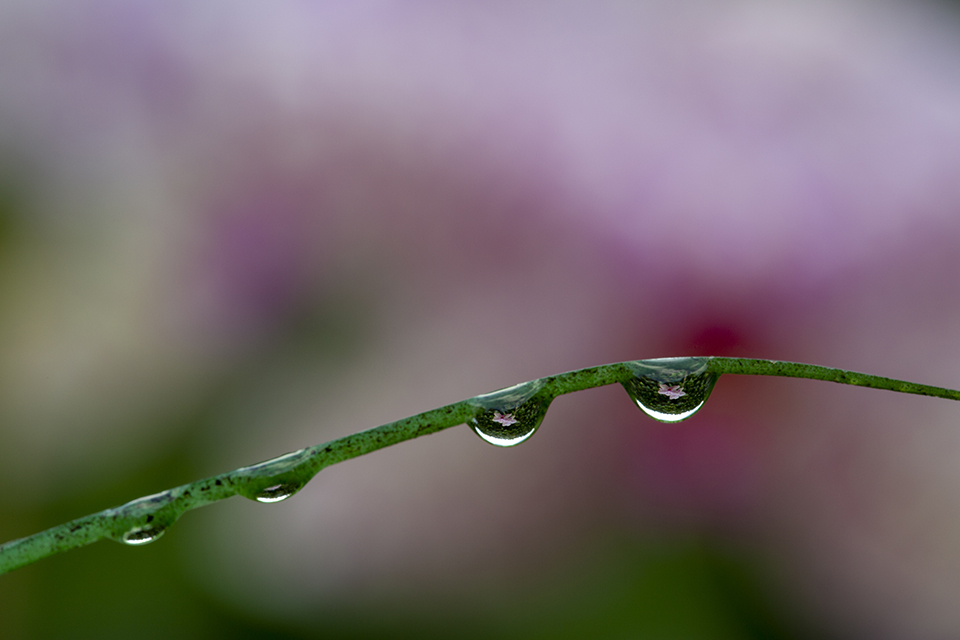
Method
Turn off image stabilisation, as you are working from a tripod. You can use live view if needed, so that the movement of the mirror does not cause camera shake. Also use a remote control, camera connect app or self-timer for maximum sharpness.
Next, position your camera with macro lens as close as possible to the droplet(s), at the shortest focus distance, so you get the best possible magnification. Water droplets remain small, even with the magnifying effect of a macro lens. I had to crop my image a little too.
See how close you can get while still being able to focus with autofocus switched on. Use a not-too-wide aperture, starting with f/8, so that you have at least one droplet in focus, with a beautiful reflection of the flower and sometimes the entire room in all its detail.
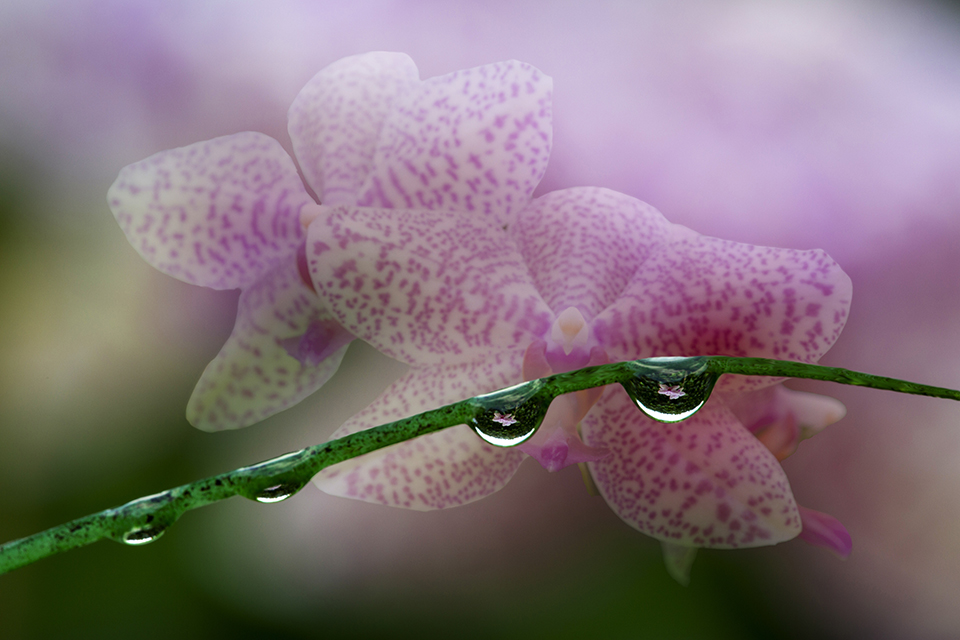
Then turn off autofocus and focus manually on the droplets. Move the flower in the background until the light refraction is shown sharply in the liquid.
The trick is to keep the flower in the background out of focus while the light refraction is sharp in the image. So keep moving the position of the flower in the background until it looks right. Keep the droplets parallel to the camera so that all the droplets stay sharp.
About the author
Michelle Peeters is fotografe en oprichter van DeuxBleus Fotografie. Michelle herkent het bijzondere in het gewone en het gewone in het bijzondere. Ze heeft zich nooit willen specialiseren en is daardoor van alle markten thuis.
You might also like
-
 High-speed water droplets photography
by Tromp Willem van Urk
-
 From drip... to a real water droplet 💧
by Rob Zwart
-
 The new Godox MF12 macro flash
by Nando Harmsen
-
 Review: SmallRig RM-03 Macro Photography LED lights
by Nando Harmsen
-
 Waterfalls and water droplets
by Nando Harmsen
-
 Should you list photography prices on your website?
by Wilmar Dik
0 comments
Be the first to share what you think!
Have your say
Please note: Articles older than a week can only be commented on by signed-in visitors.Would you still like to comment? sign in or create a free account.
Become a better photographer every week
A practical photography tip in your inbox every week.
39,023 photography enthusiasts already receive the tips! More about the weekly mail. Or keep up to date via  Facebook.

Elja Trum
Photofacts; everything to do with photography!
Would you like to take better photos and keep up with what is happening in photography? Photofacts publishes articles that teach you something about photography — from a product announcement to a practical shooting tip or a look at a website. Photofacts covers photography every day and is a hobby project of Elja Trum's that got out of hand. The articles are written by a team of volunteer authors. If you would enjoy writing one or more articles for Photofacts, do get in touch.More about PhotofactsPhotofacts is made possible in part by
