

The iPhone 7 Plus and computational photography
Thursday 8 September 2016, 14:41 by Elja Trum | 6,596 views | 8 commentsThis article was translated from Dutch with the help of AI. Read the original.
Yesterday, Apple announced the iPhone 7 Plus. This smartphone has two 12-megapixel cameras positioned next to each other. This lets you zoom in at higher quality, but it marks the start of something more important: Computational photography.
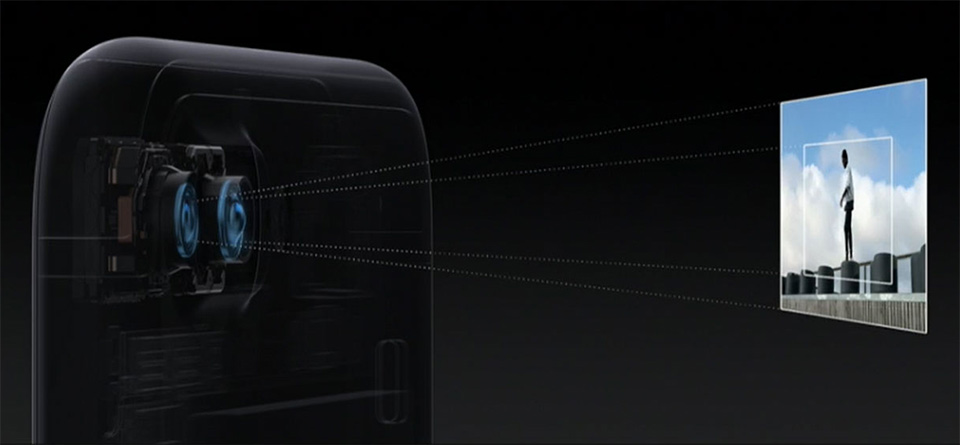
Computational photography uses software to improve the image. You already know a simple version of computational photography from, for example, your camera's panorama mode or in-camera HDR capabilities. More advanced are the possibilities we previously saw in light-field cameras, such as the Lytro.
With the iPhone 7 Plus, Apple is bringing computational photography to the masses. The first important possibility is simulating a shallow depth of field. This option will become available on the iPhone 7 Plus this autumn through a software update.
The camera's internal software is used to take a portrait photo with a shallow depth of field, in real time. Previously, you would actually have needed an interchangeable-lens camera or DSLR for this.
In the video below, you can see the announcement of the iPhone 7's camera capabilities in yesterday's presentation.
Personally, I do think it is a shame that these two cameras are only available on the 7 Plus. I am not really waiting for the larger size, but I would appreciate the extra possibilities offered by the dual camera.
The iPhone 7 Plus is of course not the first camera to work with multiple sensors and lenses. But it is the first that will probably be sold to millions of people. In my view, that is the big difference compared with earlier cameras that offered these kinds of possibilities.
Also read this article on Tweakers about the usefulness of dual cameras in smartphones.
Light L16
A fine example of the future of computational photography is the Light L16. This camera, which is not yet on the market, has 16 lenses. When taking a photo, 10 of these are used simultaneously to capture the image. The built-in software then combines them into a single photo.

About the author
Elja Trum is the founder of Photofacts and online photography course website Photofacts Academy. He has been writing about photography since 2006. Elja is also the author of (Dutch) books on composition, black-and-white photography, flash photography and portrait photography.
You might also like
-
 Apple announces iPhone 11 Pro
by Elja Trum
-
 Review: iPhone 7 Plus camera
by Lars Paymans
-
 Review: iPhone XS, the latest iPhone camera
by Lars Paymans
-
 New iPhone X with OLED display, Portrait Lighting and 4K
by Michelle Peeters
-
 Portrait Lighting on iPhone X and iPhone 8 Plus
by Michelle Peeters
-
 Useful iPhone camera tips from Apple
by Michelle Peeters
8 comments
-

 Arthur Wittendorp
wrote on Thursday 8 September 2016 at 15:03
| reply
Interesting technique. If this is the future of photography, then the question is how much reason the major camera manufacturers still have to exist.
Translated from Dutch.
-
 martinphili wrote on Thursday 8 September 2016 at 21:51
| reply
Indeed.
Translated from Dutch.
The thought that went through my head was "There you go with that heavy SLR of yours" -
 Mordicus wrote on Friday 9 September 2016 at 10:14 | reply
"Computational" perhaps?
Translated from Dutch. -

-
 R K wrote on Friday 9 September 2016 at 13:14 | reply
For me the same objection: an by now outdated 5s that easily fits in your trouser pocket, and that won't work with the 7 plus (quite apart from the hefty price tag, even with a subscription).
Translated from Dutch.
Incidentally, I think some photographers won't be very happy about the disappearance of the headphone jack. I know quite a few street photographers who use the volume button on their headphones as an alternative, inconspicuous shutter release. -
Elja Trum
wrote on Friday 9 September 2016 at 13:22
| reply
@R K; I considered the 7 Plus, but this morning I decided to order the 7 after all. I have the iPhone 6 now and that's a great size, the 7 Plus really does seem too big to me.
Translated from Dutch.
Fortunately, I also still have a DSLR for when I'm specifically going to take photos.
I think pressing via the headphones also still works with the included headphones for the Lightning connection. -

-
R K wrote on Tuesday 13 September 2016 at 13:42 | reply
Sports photographers Landon Nordeman and David E. Klutho tested the 7 Plus during the US Open and an NFL game.
Translated from Dutch.

Have your say
Please note: Articles older than a week can only be commented on by signed-in visitors.Would you still like to comment? sign in or create a free account.
Become a better photographer every week
A practical photography tip in your inbox every week.
38,729 photography enthusiasts already receive the tips! More about the weekly mail. Or keep up to date via  Facebook.

Elja Trum
Photofacts; everything to do with photography!
Would you like to take better photos and keep up with what is happening in photography? Photofacts publishes articles that teach you something about photography — from a product announcement to a practical shooting tip or a look at a website. Photofacts covers photography every day and is a hobby project of Elja Trum's that got out of hand. The articles are written by a team of volunteer authors. If you would enjoy writing one or more articles for Photofacts, do get in touch.More about Photofacts Photos





Photofacts is made possible in part by
