

The wild bluebells of Hallerbos
Friday 21 April 2017, 15:51 by Michelle Peeters | 11,042 views | 7 commentsThis article was translated from Dutch with the help of AI. Read the original.
In a country not so far away there was once a forest, Hallerbos. I felt as if I had stepped into a fairy tale. And it was so close, in Belgium just south of Brussels, next to the town of Halle.
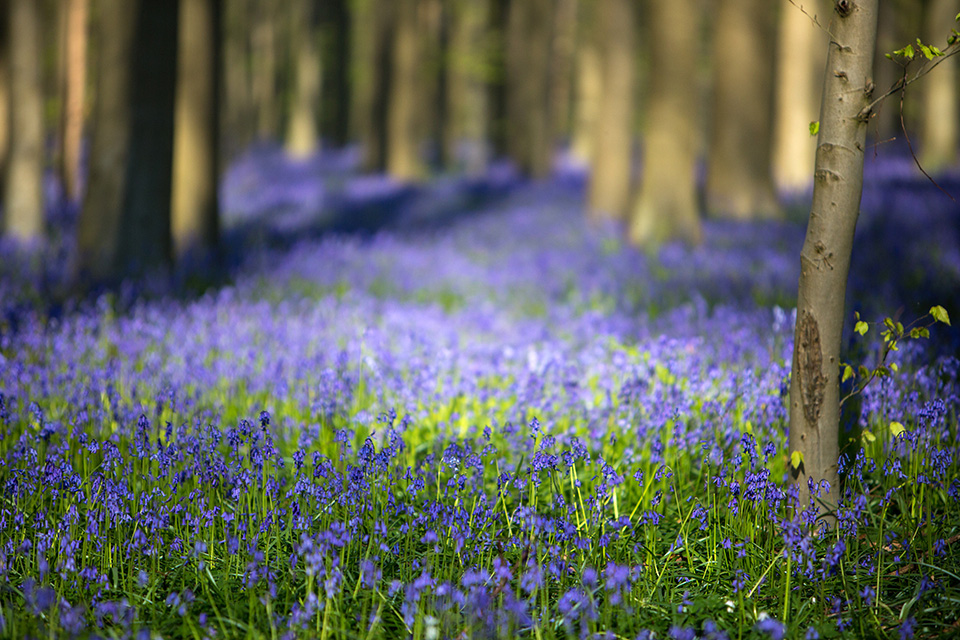
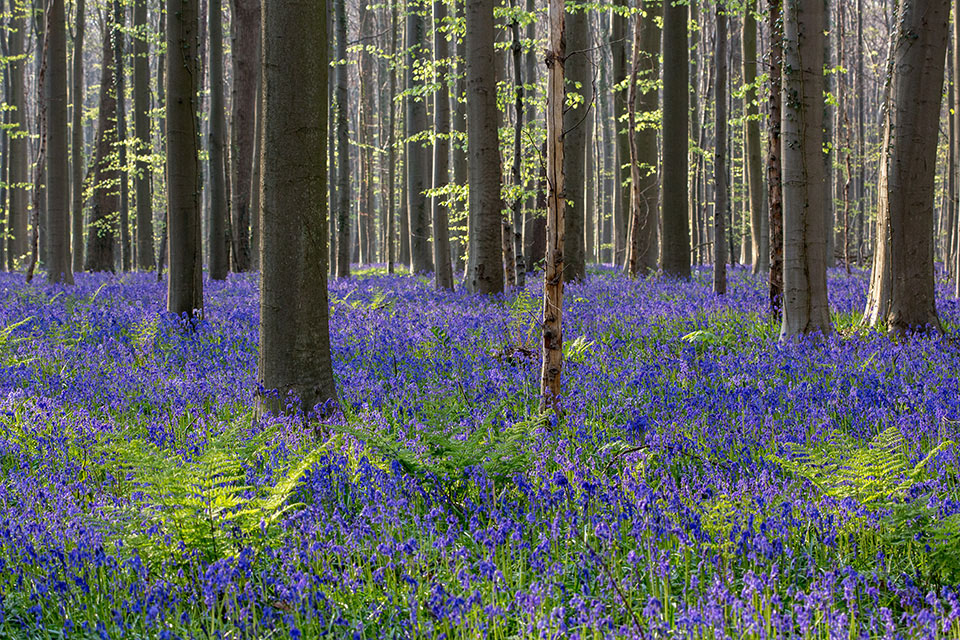
After putting it off a few times, I finally got around to photographing here. The forest is nicknamed "Blue forest", and for good reason. For a short period in spring, usually the second half of April, the forest floor is covered in wild hyacinths.
A fantastic blue carpet, which contrasts beautifully with the fresh green of the young beech leaves.
Busy motorway
Hallerbos, near the town of Halle, is 148 kilometres from Eindhoven, south-west of Brussels. It is a good two-hour drive along a busy motorway, first having to go around Antwerp and then Brussels to get there.
Crowds
For a beautiful sunrise, you have to get up very early. We did not arrive until around 14:00 and were shocked by the huge rows of cars parked along the side of the road because the car parks were full. And that was on a weekday! You can imagine how busy it must be at the weekend.
But Hallerbos is a forest covering 552 hectares, so the crowds are not really a problem because people quickly spread out across the area. We did not arrive until 14:00, and by 17:00 the forest was already 'emptying out.'
The middle of the morning is the busiest time in Hallerbos. You see people walking and photographing everywhere, as well as mountain biking and jogging! At the start of the walk, the landscape is gently rolling, which shows the hyacinths off even better. You also see photographers everywhere, and it seems they are all photographing the same things.
Three walking routes through Hallerbos
There are three marked routes: the Achtdreven walk (1.8 km), the Sequoia walk (4 km) and the Reebok walk (7 km). The last route runs through the hyacinth area for just over half its length and takes you past three of the four valleys.
Blue and golden hour
The advantage of our fairly late visit was that we were able to catch both blue hour and golden hour. At this time of year, these fall between 20:00 and 21:20 according to my Photographer's Tools app.
Experimenting
Photographing in Hallerbos is quite difficult. There are many photos online showing the area in all its glory. So it is difficult to take distinctive photos. But it is a great way to experiment with viewpoints, perspectives, different exposures, and so on.
Do you prefer taking super close-ups, macro photography, or would you rather capture the whole scene, landscape photography? Hallerbos is a fantastic location for both disciplines.
Lenses
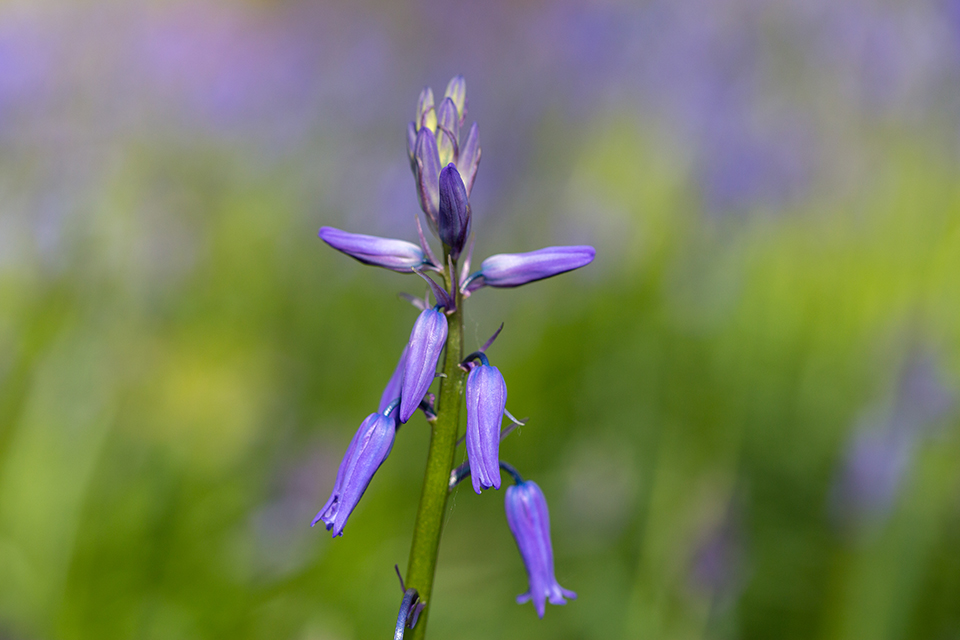
I brought my complete range of lenses and used them all. My macro lens in particular, 100mm, fixed focal length, fast at f/2.8, proved very useful. But my 24-55 and 70-200mm lenses were also very useful for overview shots and capturing the rays of light between the trees.
Sunbeams and mist
The beautiful backlight from the low sun created a lovely dreamy atmosphere. Because the ground is quite damp, you might also have a chance of mist in the morning, which can create a very nice effect. Once the sun rises higher, it becomes more difficult, or even impossible, to take this kind of photo.
Macro photography
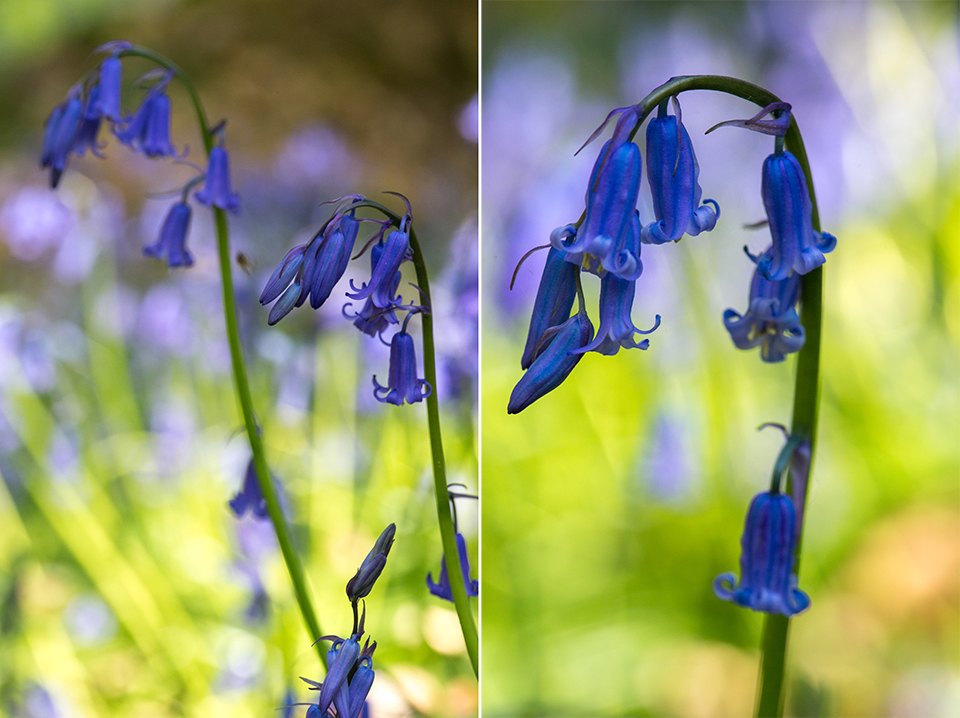
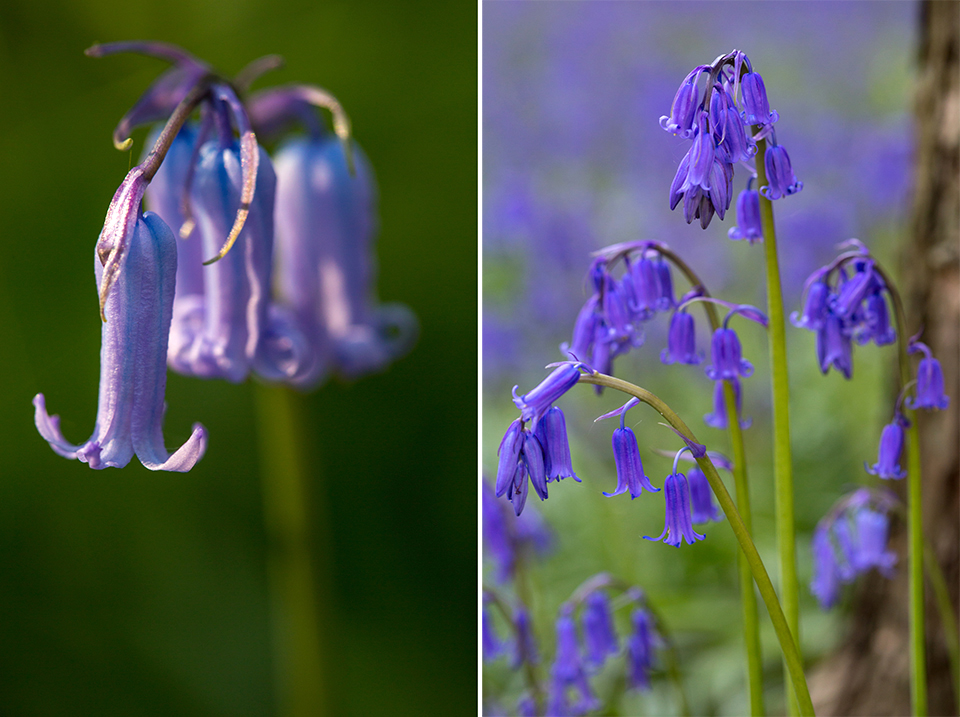
If you can no longer see the wood for the trees, swap the telephoto lens for the macro lens, because all these flowers are also the perfect subject for close-up images.
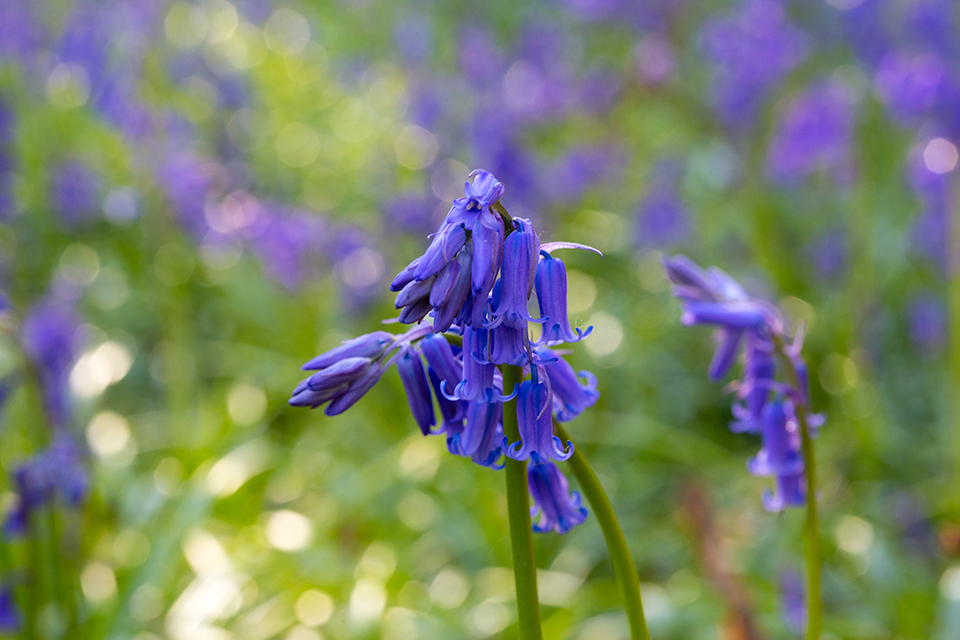
It gets really fun when you start experimenting with depth of field and bokeh. By photographing between the flowers with a shallow depth of field, for example f2.8, and focusing on one particular flower, the subject gets all the attention and a beautiful bokeh forms in the foreground and background.
Try focusing on the 'heart' of the flower. You can also look for wood anemones growing among the hyacinths, so their beautiful purple colours appear in the photo. Light and dark spots in the background can also create interesting patterns, and backlighting often produces surprising results.
Low viewpoint and telephoto lens
Here and there, you will find carpets of purple flowers, and you can look for a beautiful tree trunk completely surrounded by these purple gems.
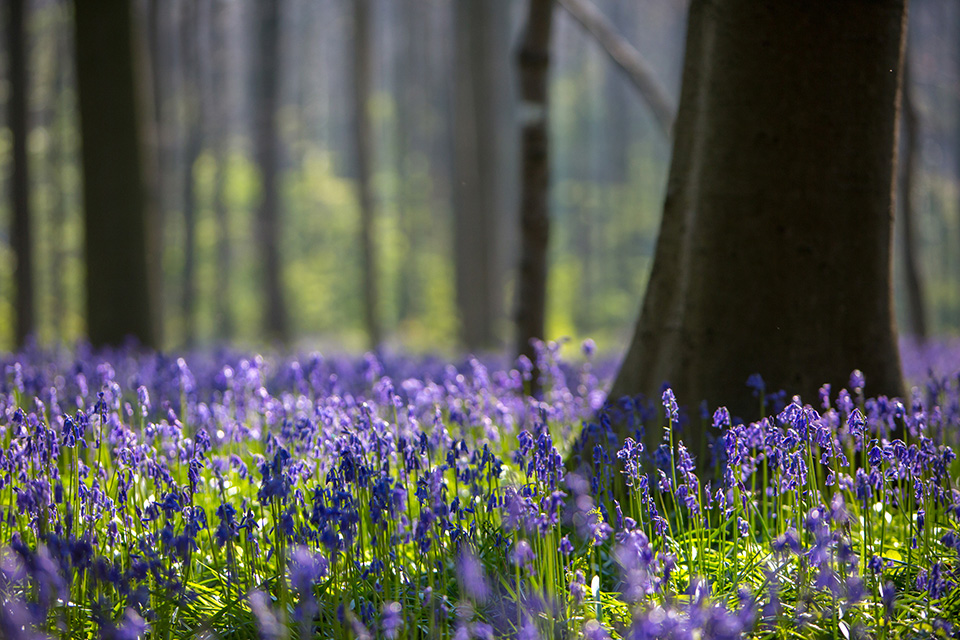
You will achieve the best results by photographing from a low viewpoint with a short telephoto lens. This not only avoids distracting elements, the long focal length also reduces the distance between the different objects, making the flowers appear much closer together.
Details
As well as a general atmospheric shot, you can also look for interesting details: a fern lit up by the morning sun, a young maple emerging from the ground, or a walker or cyclist appearing between the trees.
Viewpoint
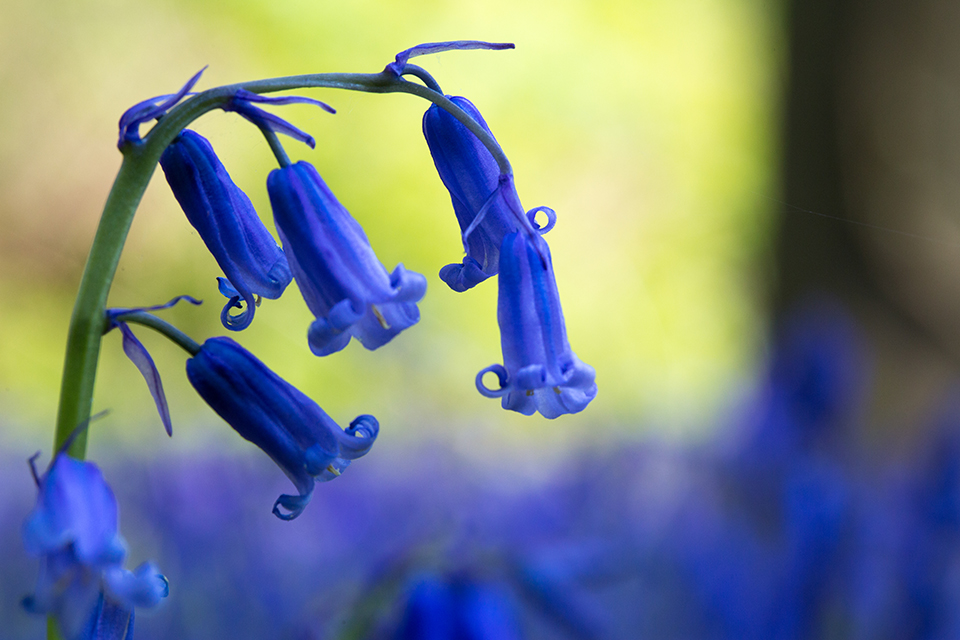
By choosing your viewpoint carefully, you can photograph between the green beech leaves and get a beautifully blurred foreground that frames the subject and gives it all the attention.
You get the most beautiful effects by photographing with a shallow depth of field, or in other words a low aperture number. You can also lie on your stomach and photograph between the bluebells to introduce beautiful purple spots into the image.
Flowering period
The best period is generally between 20 and 27 April, but because spring has been so cold and wet, nature has suffered a lot of delay and the forest only came into bloom much later, and only partially. So it is different every year.
On the Hallerbos website, you can follow the flowering and decide when the best time has arrived to head out. Also keep an eye on the weather forecast. A beautiful sunny spring day is ideal, but even in grey weather there is generally plenty to do.
About the author
Michelle Peeters is fotografe en oprichter van DeuxBleus Fotografie. Michelle herkent het bijzondere in het gewone en het gewone in het bijzondere. Ze heeft zich nooit willen specialiseren en is daardoor van alle markten thuis.
You might also like
-
 The ship lifts in la Louvière (Belgium)
by Bernard Veerman
-
 How do you find and photograph owls in the wild?
by Tanja Thomas
-
 Photographing in a forest
by Nando Harmsen
-
 Sunlight and forest photography
by Nando Harmsen
-
 Photographing a forest with a telephoto lens
by Nando Harmsen
-
 Wild Photo Adventures now complete and free on YouTube
by Michelle Peeters
7 comments
-
 Iedje Visser wrote on Friday 21 April 2017 at 22:12 | reply
Beautiful article Michelle, it was fun exploring this beautiful forest with you and fun to read your engaging article.
Translated from Dutch. -

 Tanja Thomas
wrote on Saturday 22 April 2017 at 05:19
| reply
Beautiful Michelle!And thank you for your clear explanation, which I totally agree with. However, this forest is like my long driveway! Nature is a month later this year, but normally my long " driveway" in the middle of nowhere in Washington State, USA looks like this this month. The almost identical flowers are called Brodiaea Lily here. I wrote about them in my article. Not only beautiful and fairytale-like, but the little bulbs they have are edible and incredibly tasty!
Translated from Dutch. -
 Michelle Peeters wrote on Saturday 22 April 2017 at 12:23
| reply
@Iedje: great (your) idea!
Translated from Dutch.
@Tanja: Aha, so those are the edible tubers! They must also be quite difficult to photograph. But they are indeed stunning! -
 Donald Willemsen
wrote on Tuesday 25 April 2017 at 10:38
| reply
A great article with good tips. Buuuuut, one bad tip 😜. Don't go to Hallerbos. It's become so popular by now that you can walk over people's heads. There are 5 other forests in Flanders where you can also find wild hyacinths in large numbers. These forests are less well-known and therefore also much less busy. There you can photograph in peace without being overrun by tourists. In any case, stay on the paths and don't disturb the soil outside the paths. Where the soil has been walked on, no more hyacinths grow.
Translated from Dutch. -
Michelle Peeters wrote on Tuesday 25 April 2017 at 11:11
| reply
@donniebelg: I had indeed heard about other (and less busy) forests near the Hallerbos. However, I don't have any locations. You? And are you willing/allowed to share them?
Translated from Dutch. -
Donald Willemsen
wrote on Tuesday 25 April 2017 at 12:21
| reply
@Michelle, the 5 other forests are:
Translated from Dutch.
1. Kluisbos near Kluisbergen (Flemish Ardennes)
2. Kemmelbos on Kemmelberg (Flemish Ardennes)
3. Muziekbos near Ronse
4. Brakelbos in Brakel
5. Bos van Ghlin near Mons (Mons) province of Hainaut.
See also http://deredactie.be/cm/vrtnieuws/binnenland/1.2951398 -
Michelle Peeters wrote on Tuesday 25 April 2017 at 12:52
| reply
@Donniebelg: awesome, thank you!
Translated from Dutch.
Have your say
Please note: Articles older than a week can only be commented on by signed-in visitors.Would you still like to comment? sign in or create a free account.
Become a better photographer every week
A practical photography tip in your inbox every week.
38,764 photography enthusiasts already receive the tips! More about the weekly mail. Or keep up to date via  Facebook.

Elja Trum
Photofacts; everything to do with photography!
Would you like to take better photos and keep up with what is happening in photography? Photofacts publishes articles that teach you something about photography — from a product announcement to a practical shooting tip or a look at a website. Photofacts covers photography every day and is a hobby project of Elja Trum's that got out of hand. The articles are written by a team of volunteer authors. If you would enjoy writing one or more articles for Photofacts, do get in touch.More about PhotofactsPhotofacts is made possible in part by
