
How do you find and photograph owls in the wild?
Thursday 13 December 2018, 12:27 by Tanja Thomas | 15,757 views | 9 commentsThis article was translated from Dutch with the help of AI. Read the original.
Photographing owls in a zoo or bird sanctuary can produce beautiful results. A tame owl will often pose for the lens exactly as you want. They are beautiful animals, and who wouldn't want to photograph that wise and fierce look up close?
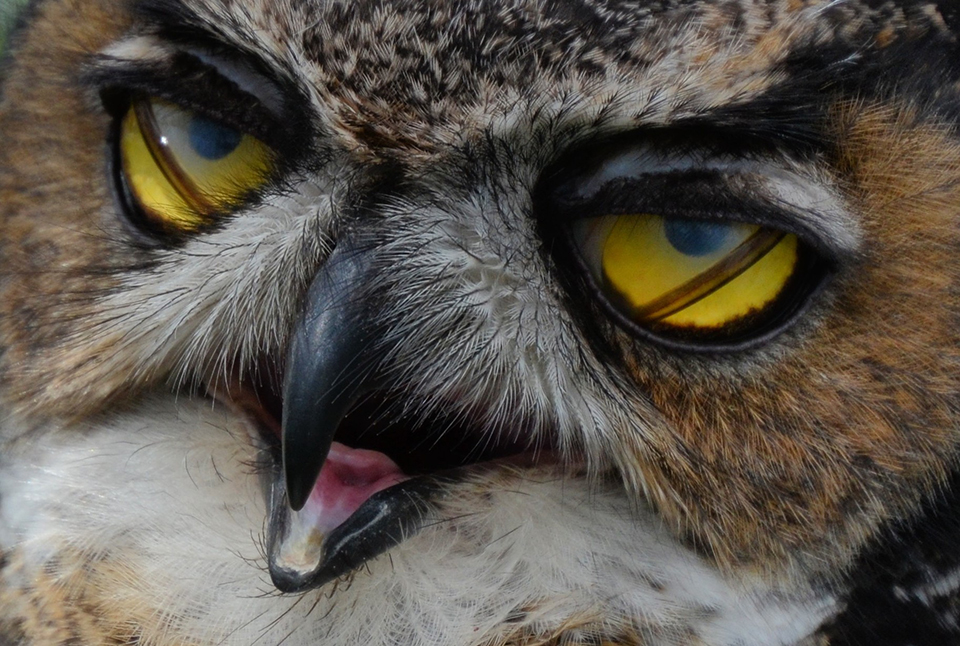
A wild owl is much more difficult to photograph. Photographing an owl in its natural surroundings is quite a challenge. This article contains a number of tips.
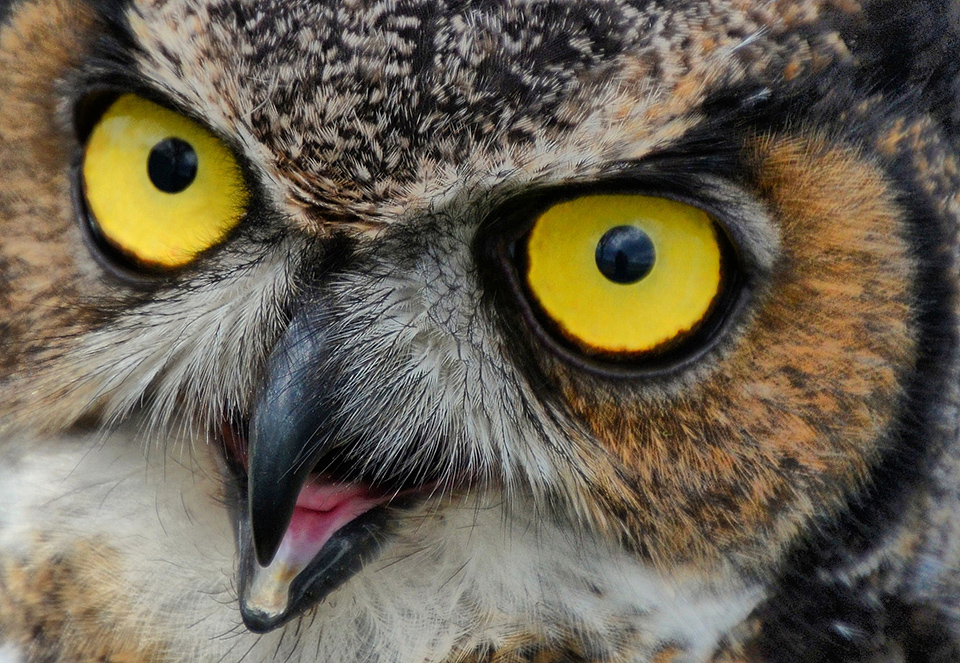
With good preparation and plenty of patience, you can dramatically increase your chances of photographing owls. Knowledge and study of these birds can certainly increase your chances of success.
Studying natural behaviour
Learning as much as possible about the natural behaviour of an owl species can be the key to taking good photos of these birds. Research on the internet, talking to owl experts, bird clubs and so on all help with this. But you learn the real daily behaviour of these birds through field observation. You do need to find them first, of course.
One way to find them is by listening. If you don't know what owls sound like, particularly their territorial, loud calls, you can listen to their 'calls' on the internet, for example. There are many ornithology sites on the internet with an 'audio guide' where you can listen to bird sounds.
Once you know what they sound like and where they stay, you could carefully go and have a look. Do bear in mind that you might come across a nest with young, so caution is needed. Naturally, don't deliberately disturb this nest just for that perfect shot.
Pellets
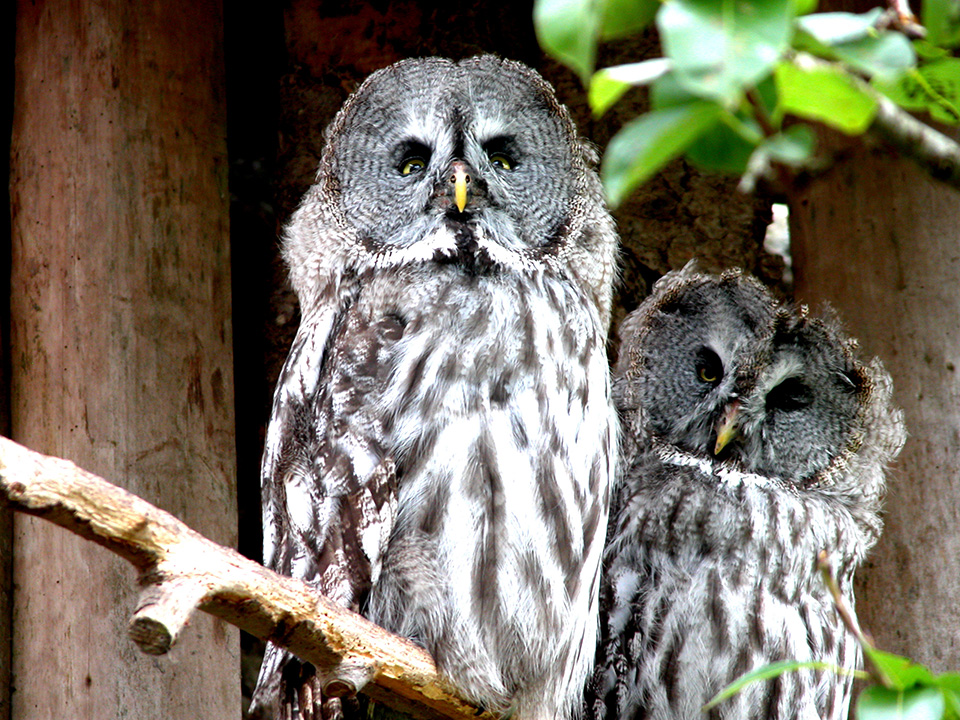
Another way to find owls in the wild is by looking for owl pellets. An owl pellet or cast is a round or oval lump containing the undigested remains of small animals. These include hairs, bones and claws. Here, I usually find them under a large solitary tree.
Or under trees in a more open area of the forest. There is a good chance that an owl keeps returning to this spot. Picking apart the pellet is in itself an interesting activity, allowing you to investigate what owls have on their menu in that area.
Once you have found a nest, you could visit it more often to see whether adult owls come there. The best way to do this is to keep your distance and slowly move closer. I always say: become one with the landscape and don't disturb the animals.
I have already described this in my blog: Wildelife and nature photography in 'Quickdraw'. Do the owls sleep in the nests you have found and, if so, when do they go hunting, for example?
If owls are present in the nest, also pay close attention to their body language so that you know when they are about to stretch and fly away, or produce an owl pellet or cast with a sort of yawn.
Don't disturb!
Whether they feel threatened quickly or not depends on the owl species. Some owls fly away and never return, while others behave as if they don't care and simply carry on sleeping.
So find out which owl you are dealing with and what behaviour it will display. That way, you can be sure you are not disturbing an adult owl that is feeding its young. It can happen that the adult owl never returns.
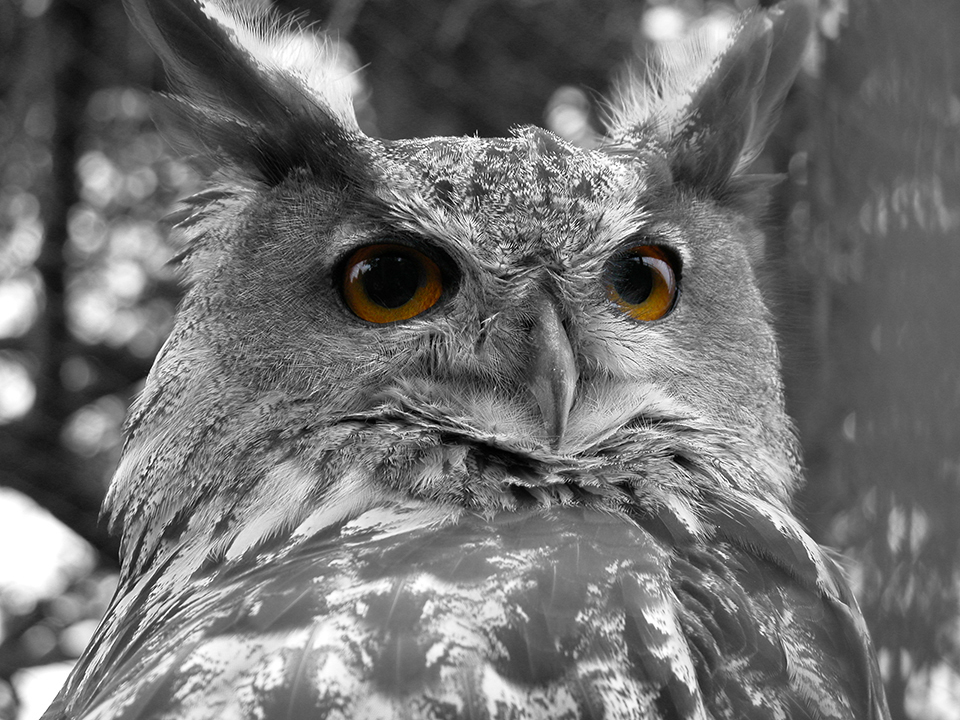
Pointing upwards means backlighting
Many owls, depending on the species, have their nest in a tall tree. If you want to take a photo of an owl sitting high in a tree, this often results in a photo with a lot of backlighting. The owl will not look very flattering either.
I think most photographers would like to photograph owls looking straight ahead, with their beautiful eyes fully visible. Not easy in their natural surroundings.
One way to do this is to find a nest that is lower down, for example. You can then take your photo from a nearby hill or slope, which also means less overexposure in the background.
Many bird photographers I know take their photos from a great distance, using lenses with a range of up to 600mm, with or without an extender. Tripods are also often used with such lenses to prevent motion blur.
I see many bird photographers taking photos from a car or another vehicle, leaning and finding support on the door window. There are also tripods available that you can attach to your car window, very handy! This can be a good method for owls that hunt on the ground, for example.
Burrowing owls/Steenuilen
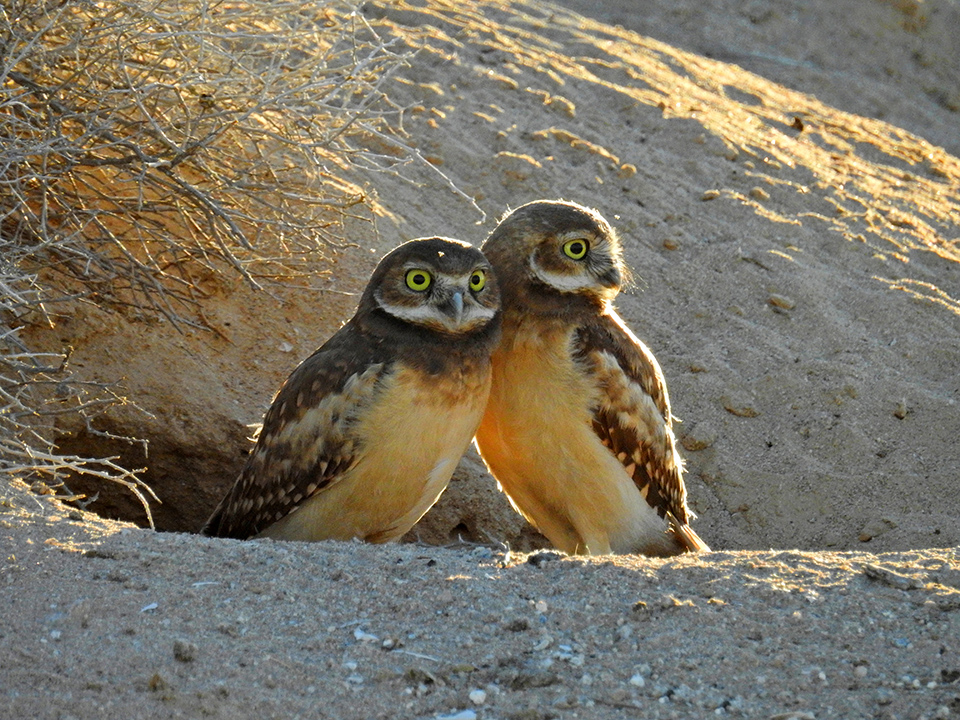
John Wise took the photo below of two young Burrowing owls on the beach at Choya Bay, Sonora in Mexico, from his 4x4 car at a distance of about 30 metres. This was the closest distance from which he could approach the owls.
He rested his camera on the edge of the window. The car itself acted as camouflage. It is rare for parents of this type of owl to let their young come out of the burrow. John took this photo facing into the sun late in the day. He said: You take it as you can get it.
Know your camera and the light
Of course, you never know when an owl will take off, and you want a nice sharp photo then too. You therefore need to take your shutter speed and the amount of light falling on the owl into account, which also depends on the time of day.
A popular time for beautiful light is the so-called 'golden hour'. During the rising morning sun and the soft evening light, you have the greatest chance of seeing owls. Knowing your camera, fast shutter speeds and ISO values are important to avoid underexposure or motion noise in your photos.
Lens with a wide range
Every day I walk through the landscape around Methow. We live remotely in the mountains and are, as it were, already one with nature. Accompanied by one or more dogs and usually just a single (Nikon) camera with a lens range of 16 to 300mm, I always come across some wildlife, large or small.
Because I follow and document the changes in nature every day and photograph landscapes as well as wildlife and plants, a lens with this range is ideal and very useful, without having to carry too much weight.
The macro function of this lens also meets my expectations sufficiently. Still, in some situations this lens leaves me just a little short.
Nests by a dumping pit
That was also the case when I walked to a nearby deep, large pit in our area. In the past, this pit was used by a family as a dumping pit for discarded materials. There was no landfill or recycling centre at that time, and certainly not so far from the inhabited world.
The family left many decades ago, and four years after a major forest fire in our area, the landscape looks wild again despite the many burnt trees, because of the huge growth of new plants.
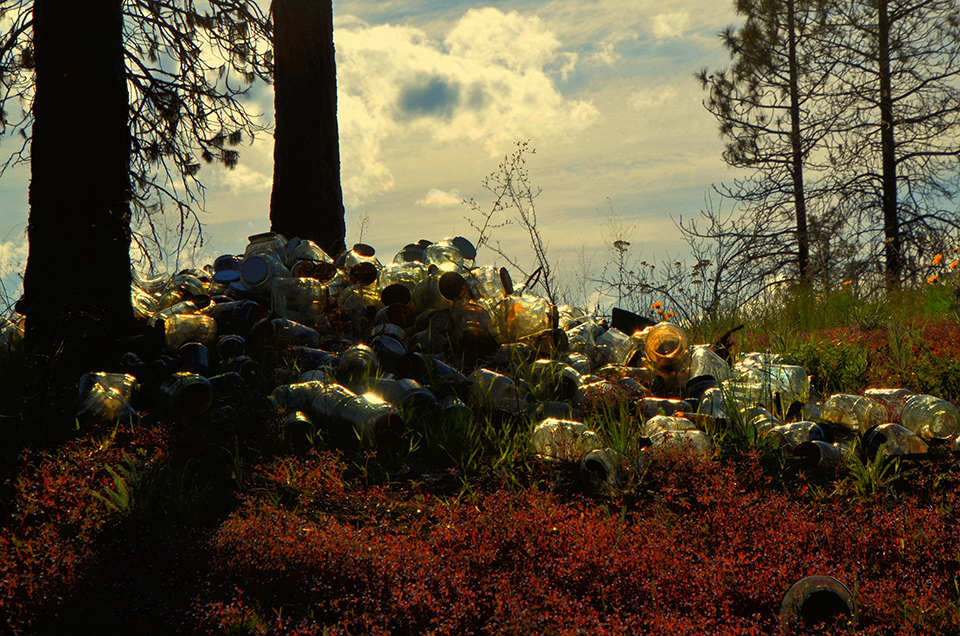
Many fallen pine needles, covering the potentially sharp objects, meant that I did not go too close to this large pit with my dog. So I stayed on the edge of the slope and looked around at the large burnt trees standing deep in the pit.
Black and charred, their tops reached high into the sky. A somewhat eerie sight. So I did not expect any wildlife in this lost piece of landscape. Yet suddenly I saw a dark shape stand out against the bright daylight, high in a burnt tree. Clearly a large bird.
Great Horned owl/Ransuil
Because of the way it made itself longer and thinner as camouflage, I knew it was an owl. A large one: the Great Horned owl!
These owls are nocturnal hunters and, according to experts, not the most intelligent. That is not my opinion, by the way. They simply fall asleep in places where they stop hunting, for example, and apparently this was one of their resting places.
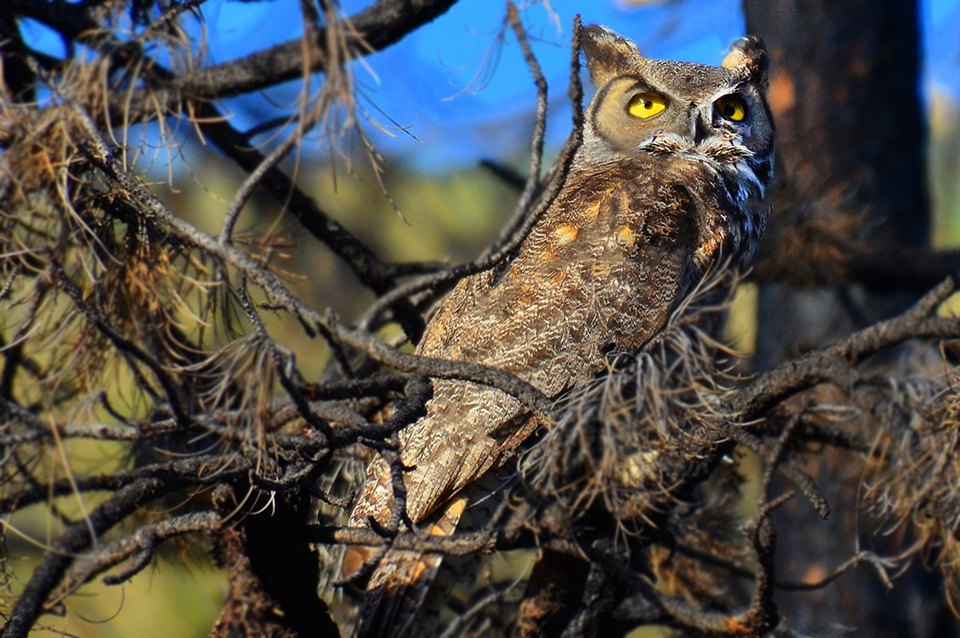
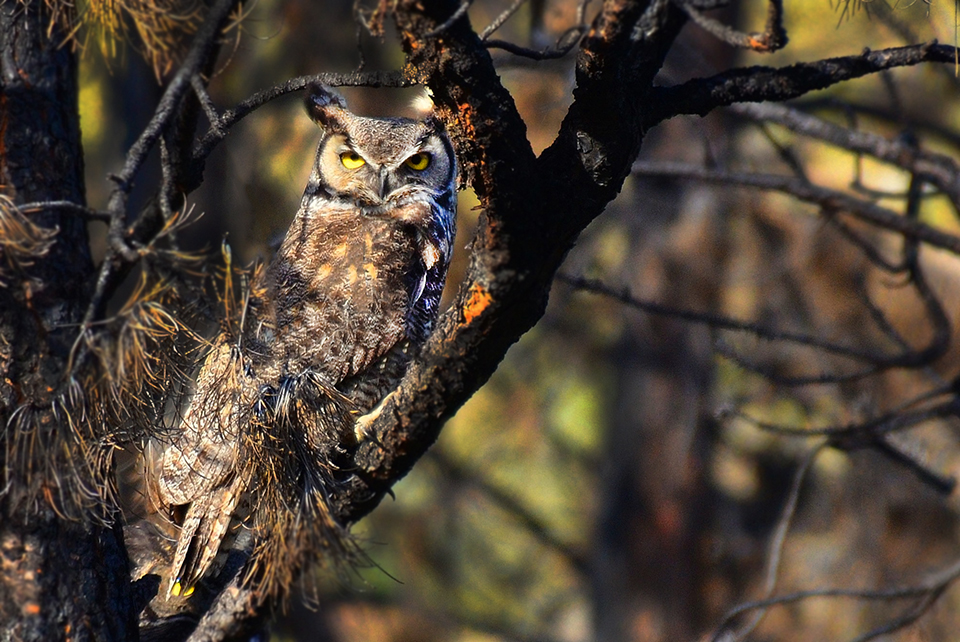
The situation with strong backlighting was exactly what I described above. A bird sitting high in a tree, standing out like a black shadow against the bright daylight. Indeed, not really flattering for taking a good photo. I was already standing at the highest point of the slope and did not expect to be able to take many good photos.
Despite the fact that my trained large dog and I remained very still, the owl flew to another tree at a much more suitable height for taking photos. Still, it was slightly too far away for my lens. So I had to zoom out as far as possible, which usually does not produce a completely sharp photo.
Twigs and focusing
The twigs in front of the owl also meant that I had to focus manually with a 1-point focus point that I kept moving. I tried to focus on the owl's eyes and used a faster shutter speed, also for the moments when the owl was not really moving.
The owl could fly away at any moment, and I also wanted to capture the owl's eye movements sharply, even though I could not really see them with the naked eye. I could see that they were beautifully yellow, though.
While taking the photos, I saw that there was another bird sitting there, hidden behind a branch. I suspected it was the frequently seen Redtail hawk, because both birds have the same ingredients on their menu. Also something to think about when looking for owls
I must admit that it was only at home, on my computer, that I saw my owl was accompanied by another Great Horned owl and that these were relatively young birds, judging by their beautiful and still immature feet.
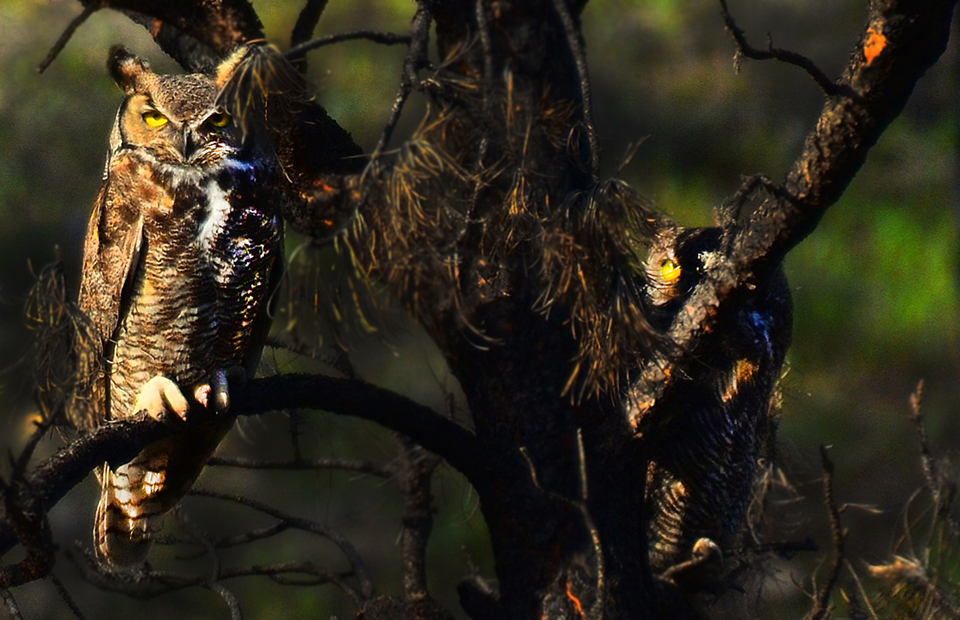
These young owls can remain in the area where they were born until they are five months old and are fed by their parents. However, I was never able to find a nest during one of my later hikes.
Sometimes really close-up
Still, it is not completely impossible to take a good owl photo with a relatively short lens for bird photography. A Northern Saw-Whet owl landed in a tree shrub right next to our house, for example.
The Northern Saw-Whet owl/Zaaguil is one of the smallest owls I know. Despite its small size, this nocturnal hunter is known for being fearless. Some even describe this owl as cruel, because it immediately tears captured rodents apart roughly.
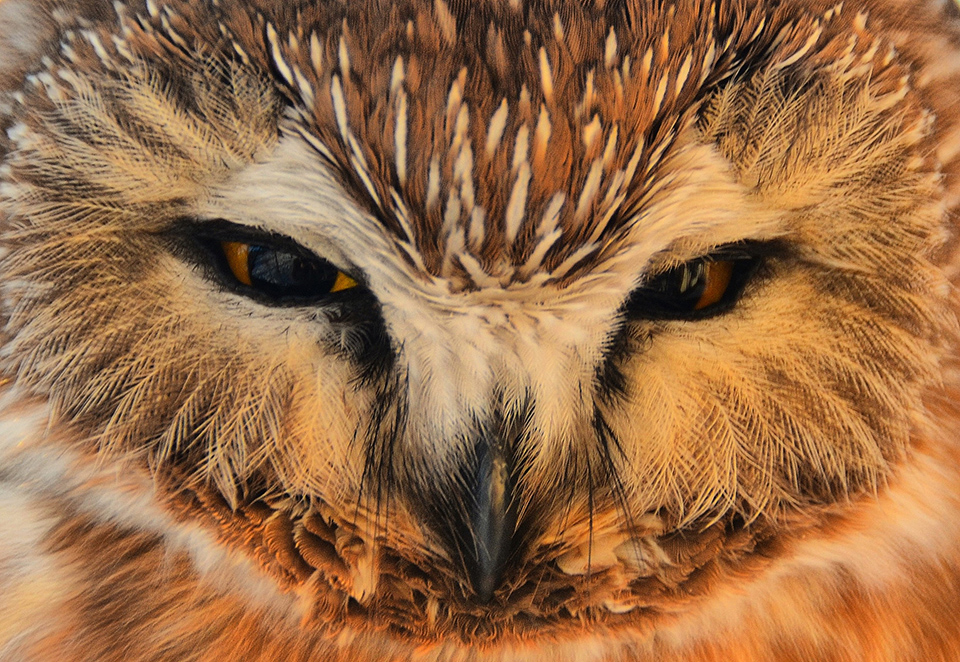
I was able to photograph this resting owl in full daylight from a distance of 30 cm, which gave me a nice close-up photo of this small bird of prey with its eyes open.
Any other tips?
This is how I go about finding and photographing owls. There must be more ways to do this effectively. If you know of any, I would of course be very interested!
Bird photography course
And if you really want to learn more about photographing owls and other birds too, take the Bird Photography Course by Daan Schoonhoven and Arno ten Hoeve at Photofacts Academy.
About the author
Altijd 'ready and alert' en gewapend een fotocamera wandelt Tanja Thomas dagelijks in het ruige landschap van Methow (Washington State). De kansen op het spotten en fotograferen van wildlife liggen hier voor het grijpen, maar je moet alert zijn. 'Quick draw!' is hierbij haar motto.
You might also like
-
 Photographing owls nearby
by Erik Veldkamp
-
 Are you a species hunter or a wildlife photographer?
by Nando Harmsen
-
 Crash course in bird photography
by Michelle Peeters
-
 Equipment needed for wildlife and bird photography
by Michelle Peeters
-
 7 Tips for Unique Wildlife Photos
by Michelle Peeters
-
 8 tips for photographing in a zoo
by Michelle Peeters
9 comments
-

 Michelle Peeters wrote on Saturday 25 August 2018 at 21:12
| reply
Great article Tanja, as an ‘owl freak’ I find this super fun and educational!
Translated from Dutch. -
 Tanja Thomas
wrote on Saturday 25 August 2018 at 21:59
| reply
Thank you Michelle Peeters; owls are beautiful and very interesting birds, which certainly deserve some attention.
Translated from Dutch. -
 Bernard wrote on Tuesday 28 August 2018 at 13:37
| reply
Three years ago I opened the curtain of our bedroom and looked a long-eared owl straight in the face at 2.5 m, or perhaps she looked into mine, that could also be the case. It turned out she was a female, the female long-eared owl is larger than the male. It was a pair and I had heard them before when they let out their oohhh oohhh call in the evening at dusk. In an old magpie/crow nest high up in a black alder they had three owlets, which grew up in our garden. Later, in autumn, the family had grown and there were ten of them in total in the alders, maples and weeping willows. Wonderful to have experienced them. As Tanja already describes, look for the pellets and you have a good chance that they are sitting above your head. Another indication that there are owls is that you find large white streaks of poop on the ground. They are certainly not sparing. They stayed with us for two years and left again. Such a shame, but wonderful to have experienced it from so close by. Photos? Yes, lots of photos fortunately.
Translated from Dutch. -
Tanja Thomas
wrote on Tuesday 28 August 2018 at 18:12
| reply
What a wonderful story Bernard! Watching owls grow up in your garden must have been an amazing experience. I am of course also very curious about your photos. Thank you for your response!
Translated from Dutch. -
 Kirsten wrote on Wednesday 29 August 2018 at 03:12 | reply
Many years ago I had heard through the grapevine about a nest of Long-eared Owls in a local nature reserve. One day the juvenile owls flew out and did not yet really know where to go, so they just flew around a bit. A few days later they had found a nice spot to wait until darkness fell. And how wonderful it was to cycle past them one time while no fewer than specimens were sitting high high up in the undergrowth!
Translated from Dutch. It was on the dike along the Rupel and the undergrowth was therefore somewhat lower, giving you a very nice view of the four of them. Unfortunately, it was just a little too dark to shoot decent images, but being able to admire four clumsy juvenile Long-eared Owls from 10 metres away is an experience I will never ever forget. In the years afterwards there were still some broods, but unfortunately I never again experienced the same circumstances.
-
Tanja Thomas
wrote on Wednesday 29 August 2018 at 19:00
| reply
Nice to read that you enjoy seeing owls just as much as I do. They are beautiful birds to see and photograph; preferably in their natural environment and behavior. Too bad Kirsten that it was just a little too dark, but I hope that despite this you did take some photos.Want even if it is technically not ideal it is always nice to see your experiences captured in images. Even for studies, a less than perfect photo can still be very valuable.
Translated from Dutch. -
Tanja Thomas
wrote on Thursday 30 August 2018 at 21:45
| reply
Bernard, your owl photos were forwarded to me. What beautiful photos of the beautiful owl family! In one of the photos I noticed that half of a young owl's face was in the shade and half in the sun. Looking at the eyes of that owl, the sun pupil was also smaller than that of the eye in the shade. It gave a funny effect. Thank you for sharing!
Translated from Dutch. -
Bernard wrote on Friday 31 August 2018 at 22:24
| reply
A tip in case you get the chance to photograph an owl in the wild. I’ve noticed that the feathers on the crop (throat - chest) are always vibrating. To get the chest feathers sharp, you soon need to use 1/250 sec. or faster. At first I thought it was due to my photos, but I see it in more photos of owls.
Translated from Dutch. -
Tanja Thomas
wrote on Saturday 1 September 2018 at 04:19
| reply
Thank you Bernard for this good tip! I even think that this applies to several species of birds and personally I will always choose a faster shutter speed because of the fast, possibly unexpected movement of the bird's eyes, wings etc.
Translated from Dutch.
Have your say
Please note: Articles older than a week can only be commented on by signed-in visitors.Would you still like to comment? sign in or create a free account.
Become a better photographer every week
A practical photography tip in your inbox every week.
38,890 photography enthusiasts already receive the tips! More about the weekly mail. Or keep up to date via  Facebook.

Elja Trum
Photofacts; everything to do with photography!
Would you like to take better photos and keep up with what is happening in photography? Photofacts publishes articles that teach you something about photography — from a product announcement to a practical shooting tip or a look at a website. Photofacts covers photography every day and is a hobby project of Elja Trum's that got out of hand. The articles are written by a team of volunteer authors. If you would enjoy writing one or more articles for Photofacts, do get in touch.More about PhotofactsPhotofacts is made possible in part by
