

7 common mistakes in portrait photography
Monday 19 September 2016, 20:20 by Elja Trum | 31,020 views | 27 commentsThis article was translated from Dutch with the help of AI. Read the original.
A photo is quickly taken. But many (beginning) photographers often make mistakes that can make a photo disappointing afterwards. In this article, you will discover how to avoid 7 common mistakes.
1. Letting something grow out of the head
A real classic. Many photographers only pay attention to their subject when taking a photo. Not surprising, because of course you want to take a nice photo of that person. However, it is important to look at the background too.
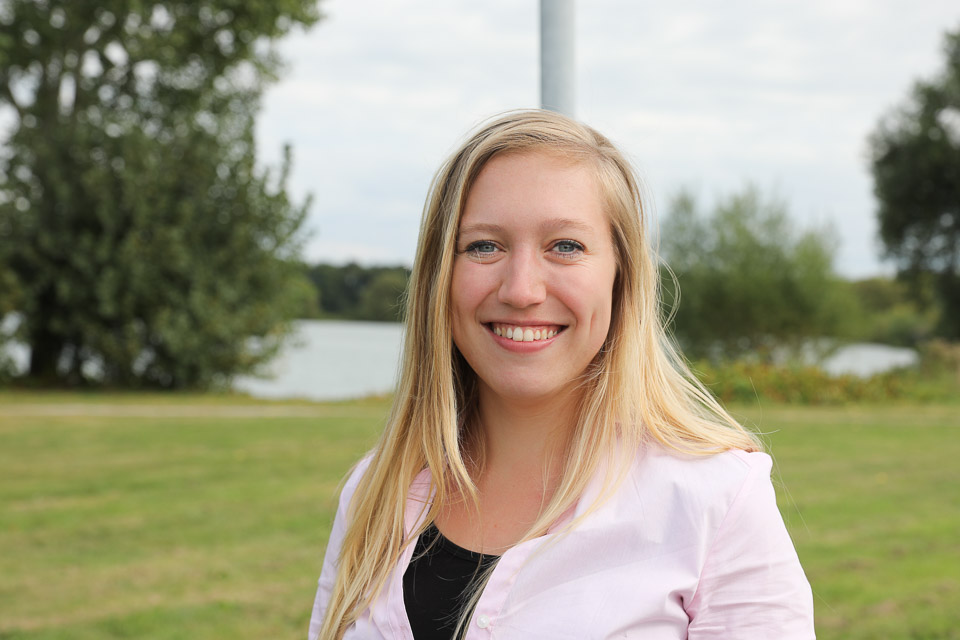
By also taking a quick look at the background, you can prevent, for example, a pole or tree from growing out of someone's head. Simply taking a small step to the side makes the pole fall completely next to your model.
2. Standing too far away
Photographers also often tend to stand too far from their subject. That can be useful, for example if you want to get a wedding dress fully in the photo (the bride will not forgive you if you did not take that photo).
Often, though, there is no added value in getting someone fully in the photo. Quite the opposite. Think about what your photo is about. If it is about a person, a portrait where you stand close to your subject is often best.
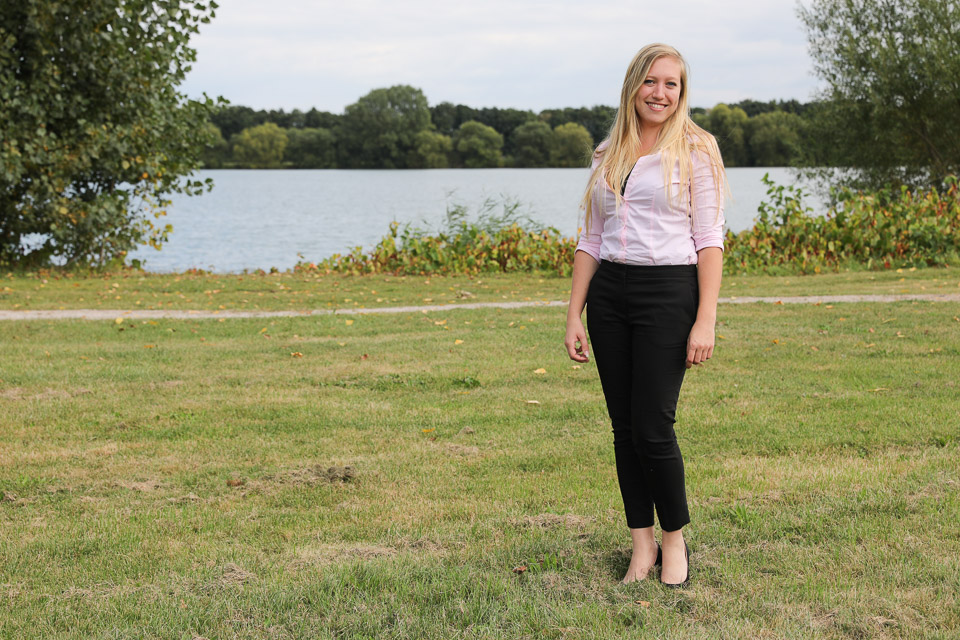
In the photo above, Anne is shown in full. That can be nice if it is about the clothes she is wearing. If it is about Anne herself, however, it is better to take a few steps closer so that her face almost fills the frame.
3. Placing the subject in the centre
It is very tempting to place your model exactly in the centre of the photo. Many photographers use the central point, which is the most sensitive and therefore the most accurate, to focus. That works fine too, but it is wise to adjust the composition after focusing.
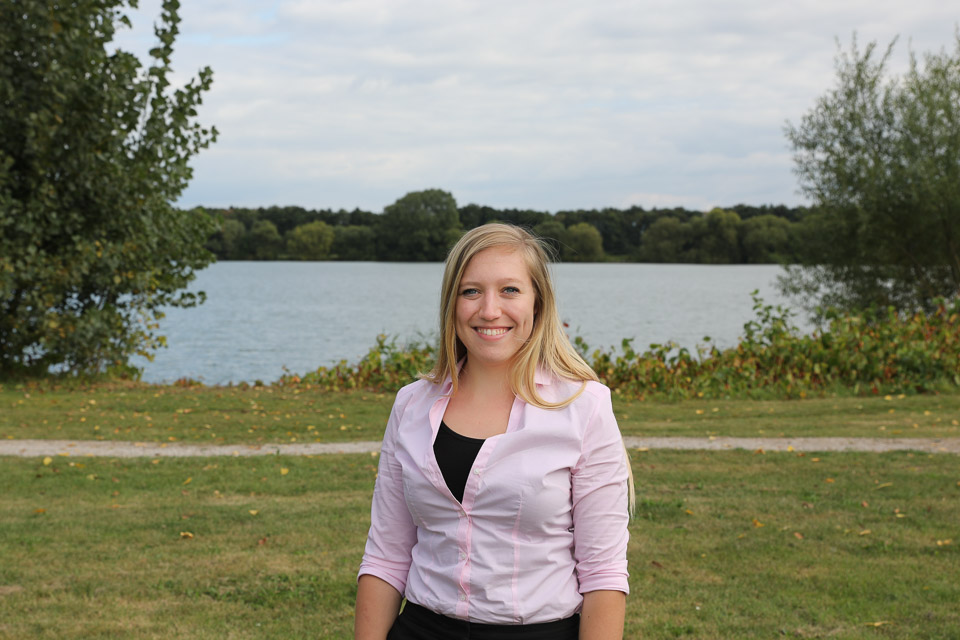
After all, you focus on the eyes. If you do not reframe then, you get a great deal of empty space above your subject. A shame, because in the example above, this crop would have been much more pleasant if you had shown a little more of Anne and a little less of the boring sky in the background.
Your composition also becomes more dynamic when you move the subject away from the centre. By applying the rule of thirds in your photo, you can create some really nice compositions that make your portrait much more interesting to look at.
4. Not leaving space to look into
Your model does not always have to look at the camera. It can also be great when a model looks away. Do make sure that there is space for them to look into.
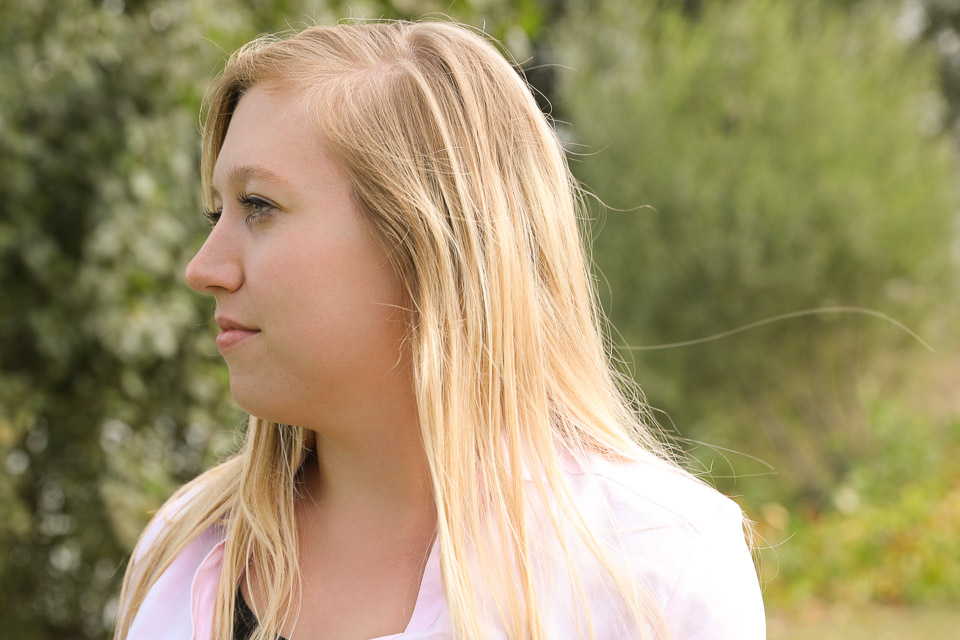
When you look at a photo, you naturally look in the same direction as the person in the photo. It is then nice to have space in the photo to follow their line of sight. Otherwise, you immediately 'bump' into the edge.
5. Blurred eyes
The eyes are the most important part of a portrait. That is what someone looking at a photo always looks at. If the eyes are not (completely) sharp, it is immediately noticeable.
With a portrait, you often want to work with a shallow depth of field, so that the background is nicely blurred. The disadvantage is that the depth of field is often so shallow that you quickly end up with blurred eyes in the photo.
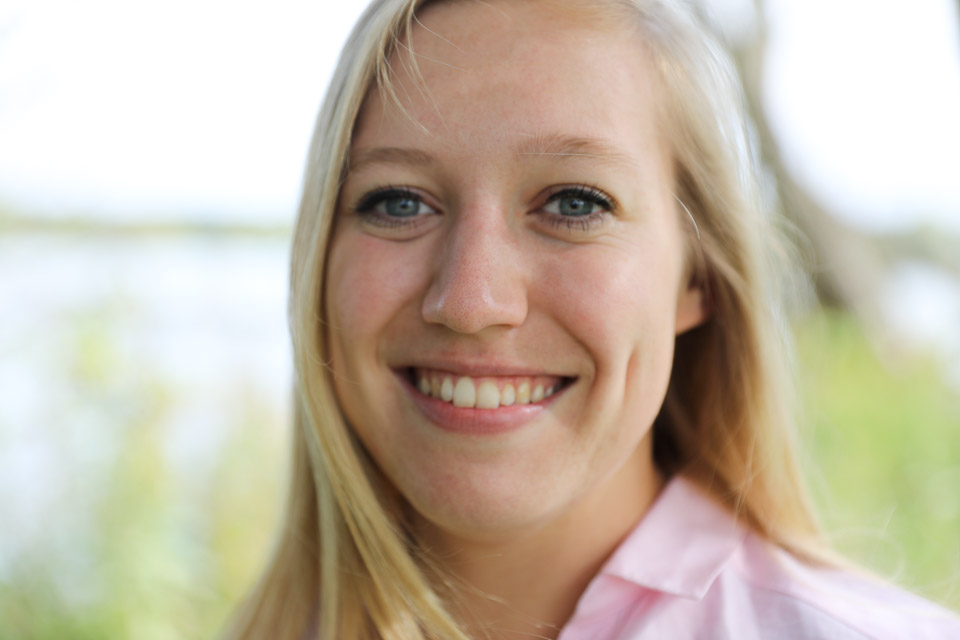
In the photo above, for example. The focus was on the nose. That is sharp too. However, the depth of field is so shallow at f/2.8 and when you are close to your subject that the eyes are already blurred.
So always focus on the eyes and preferably use a slightly greater depth of field. If the photo above had been taken at f/8, the background would still have been blurred, but both Anna's face and her eyes would have been sharp.
6. Shutter speed that is too slow
When there is less light, you quickly need to pay attention to your shutter speed. A shutter speed that is too slow gives you blurred photos. Of course, it does not always have to be as severe as in the example photo below, but even if your photo is only slightly blurred, the portrait has usually already failed.
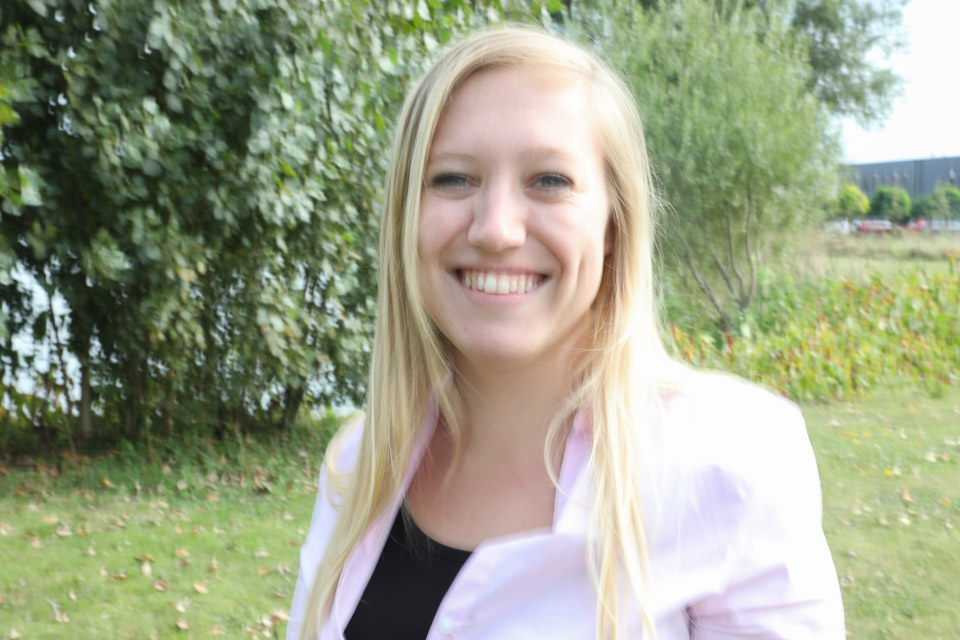
So it is important to keep a close eye on your shutter speed. The basic rule is that your shutter speed should be equal to or faster than 1/focal length. So if you are shooting at 100mm, use at least 1/100th.
Usually, it is smarter to allow a little more leeway and avoid going below 1/60th of a second. Your shutter speed will then almost always be too slow to take sharp photos handheld.
7. Distortion from a wide-angle lens
Be careful when shooting with a wide-angle lens. When you get close to your subject with a wide-angle lens, you get distortion in your image. This is not exactly flattering for your model (my apologies to Anne for the example photo below).
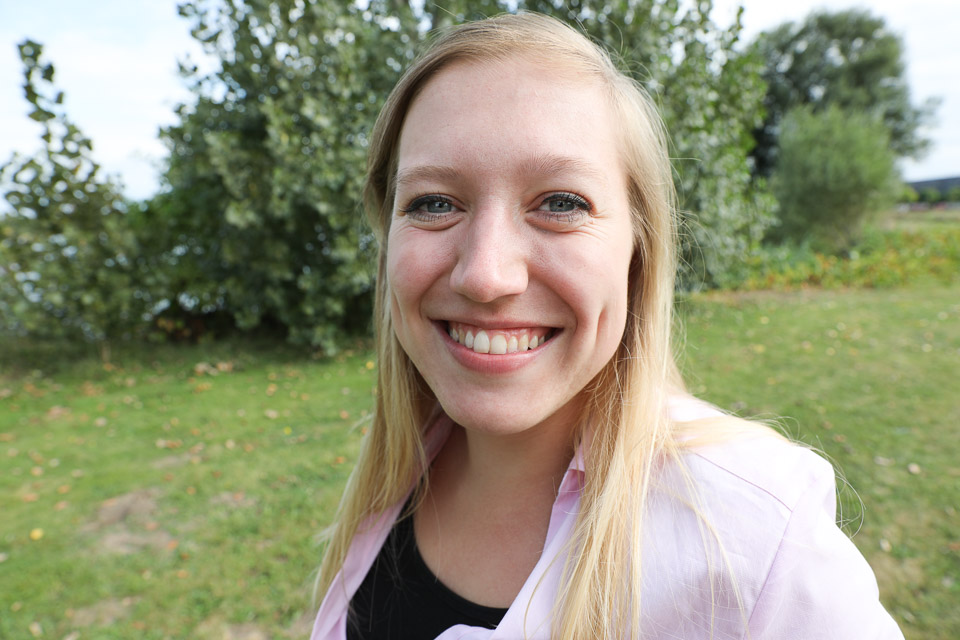
For portraits, therefore, preferably use a 50mm lens or longer. With a full-frame sensor, 85mm is considered ideal. With a crop camera, which covers most affordable models, 50mm is fine. The example photos in this article were taken with a full-frame Canon 5D mark IV, by the way.
Are there any mistakes you used to make often when taking portraits?
Let us know in the comments!
About the author
Elja Trum is the founder of Photofacts and online photography course website Photofacts Academy. He has been writing about photography since 2006. Elja is also the author of (Dutch) books on composition, black-and-white photography, flash photography and portrait photography.
You might also like
-
 8 Common Mistakes Photographers Make
by Elja Trum
-
 13 Common Photographic Mistakes and Tips to Avoid Them
by Michelle Peeters
-
 5 Common Photography Mistakes and How to Avoid Them
by Elja Trum
-
 7 common composition mistakes
by Elja Trum
-
 Stupid mistakes you can make as a photographer
by Nando Harmsen

27 comments
-

 Hoicks
wrote on Monday 19 September 2016 at 20:51
| reply
What is important to mention is that with a non-full-frame (crop) camera you also have to take that factor into account in your shutter speed. A 100mm lens is a 150mm lens on a Nikon APS-C sensor, with the same shutter speed that you then have to use. 1/150th
Translated from Dutch. -
 guest wrote on Monday 19 September 2016 at 21:17 | reply
Interesting article. Small tip: a slow shutter speed doesn't exist. a shutter speed is short or long. Slow is poorly translated from English, where they talk about a shutterSpeed
Translated from Dutch. -
 Arthur Wittendorp
wrote on Monday 19 September 2016 at 21:42
| reply
@Hoicks,
Translated from Dutch.
Your reasoning that the shutter speed increases proportionally with the crop factor of the sensor is not correct. 100mm is also 100mm on an APS-C camera. Only a crop of the image is made. The focal length is therefore not extended to 150mm (Nikon) or 160mm (Canon) by the crop factor. So even on an APS-C camera, using the rule of thumb that the minimum shutter speed is equal to the focal length (100mm = 1/100), you should be able to take a sharp photo. (I have left the effect of image stabilization out of consideration for now) -
guest wrote on Monday 19 September 2016 at 21:45 | reply
i notice myself that I often want to fill the frame too much, I see more people doing this maybe also a common mistake.
Translated from Dutch.
furthermore I can agree with what you say -
Hoicks
wrote on Monday 19 September 2016 at 21:48
| reply
Arthur, Then this article from Photofacts isn't correct either.
Translated from Dutch. -
 Elja Trum
wrote on Tuesday 20 September 2016 at 09:33
| reply
@Hoicks and Arthur; Personally, I don't think the exact number is ultimately that important. If you choose 1/160s with a 100mm lens, you're at least on the safe side. It's better to choose a slightly faster shutter speed than a slightly slower one. It also depends on how steadily you can hold the camera, so it's smart to determine for yourself what works well for you.
Translated from Dutch.
@gast; By 'too filling the frame', do you mean that you get too close to your subject? -
 Donald Willemsen
wrote on Tuesday 20 September 2016 at 11:52
| reply
Nice article, but for the more experienced photographers it is like kicking in an open door. Still, it is good to name the pitfalls. There is some confusion, though: The title talks about 7 frequently made mistakes and in the text there is suddenly talk of 10 frequently made mistakes. The photos serving as examples are therefore all photos that contain errors . I miss the good photos for comparison. By the way, with Photoshop, a pole growing out of someone's head can be removed perfectly.
Translated from Dutch. -
Elja Trum
wrote on Tuesday 20 September 2016 at 11:58
| reply
@Donniebelg; Good point about the number. I corrected it. I had initially come up with ten tips, but I wasn't satisfied enough with my example photos. So it became a seven-tip article.
Translated from Dutch.
The article is indeed aimed more at beginner photographers.
A pole like that is often quite easy to remove in Photoshop, especially when it's standing so separately like here. However, it's much easier to just take a step to the side when taking the photo. -
guest wrote on Tuesday 20 September 2016 at 12:18 | reply
With the ever-increasing sensor, that claim is no longer true (100mm, so shutter speed 1/100th).
Translated from Dutch.
The slightest movement by the photographer is then punished brutally. Just play it safe and use the fastest possible shutter speed -
 Rien wrote on Tuesday 20 September 2016 at 12:36 | reply
@Hoicks and Arthur. An image made with a crop camera is indeed a sort of crop compared to an image from full frame taken with the same focal length. However, to print that image at the same size (e.g. 20/30 cm) or show it at 30/40 on a screen, the crop image therefore has to be enlarged more than the full-frame image, and by that crop factor. By enlarging it, you also enlarge motion blur that occurred during the shot. To counteract that, you therefore have to shorten the shutter speed by that crop factor. Compare it to binoculars: you can easily hold a 4x opera glass steady, a 20x binoculars for birds you are better off putting on a tripod. A normal pair of binoculars is about 8x.
Translated from Dutch.
In other words: the smaller the sensor, the more it has to be enlarged to show something at the same size.
In optical laws, this is about the size of the circles of confusion, but that goes rather far.
I’ll leave the story about focal lengths and depth of field aside for now. -
 Robert Vogels wrote on Tuesday 20 September 2016 at 13:06 | reply
Also pay attention to 'chopping off' hands. And the same goes for the legs, ...just above the knee instead of just below it. Below it gives such an 'amputation' appearance. Common mistake. With photo-shooting greetings, Robert
Translated from Dutch. -
 bbb wrote on Tuesday 20 September 2016 at 13:19 | reply
What you unfortunately see very often is a crooked horizon, which apparently isn't corrected later either. A good photo thus becomes a mediocre photo. An ordinary photo becomes bad.
Translated from Dutch. -
 Paul wrote on Tuesday 20 September 2016 at 15:59 | reply
This is useful to me as a hobby photographer. Thanks for that!
Translated from Dutch. -
 KEES wrote on Tuesday 20 September 2016 at 16:29 | reply
hello very informative but I use an 18 - 270 mm so what is the best setting then I need to take portrait photo;s soon
Translated from Dutch.
thanks in advance -
 Jan wrote on Tuesday 20 September 2016 at 16:33 | reply
With a smartphone, in 90% of the photos and videos you see the camera in portrait orientation, probably intended for future vertical-screen TVs. With cameras, 90% of the images are in landscape orientation, including portraits.
Translated from Dutch.
Maybe it's good to mention that you can turn these devices a quarter turn. -
-
Rien wrote on Tuesday 20 September 2016 at 20:00 | reply
@KEES: is a photo book that covers the basics something for you? The tip from Elja will surely be in there too. If you soon have to photograph groups instead of individuals, it also contains the right focal length... and the right shutter speed.. and the right iso... and the right distance between you and your group....and the right white balance.... and whether and how you can possibly add fill light... with flash or reflector.....etc etc. BUY A GOOD BOOK!
Translated from Dutch. -
 Mieke wrote on Wednesday 21 September 2016 at 07:52 | reply
I always have to pay close attention to the background myself. And when photographing men, I often ask them to bend their knees slightly.
Translated from Dutch.
Another mistake that still occurs for me from time to time is that the eyes are in shadow. Sometimes I add just a tiny bit of flash. Or do you have another tip for that. -
Jan wrote on Wednesday 21 September 2016 at 09:20 | reply
Using a reflector screen to get rid of the harsh shadows, that also works well with a white Styrofoam board used for insulation.
Translated from Dutch.
Directly flashing does not make the portrait any prettier. -
 Maes Hugo wrote on Wednesday 21 September 2016 at 11:45 | reply
What has also helped me is the height of the lens relative to the model. If you take photos where the lens is at eye level, the result seems more pleasant to look at than when you are too low or too high. Think of double chins, forehead enlargement or nostrils.
Translated from Dutch. -
 Hans wrote on Wednesday 21 September 2016 at 15:00 | reply
another tip, every face is asymmetrical. There is a large and a small side. In a three-quarter portrait, keep the small side at the front. When the large side comes forward it becomes a "bare Buttocks" face
Translated from Dutch. -
 Rob de Joode wrote on Thursday 22 September 2016 at 09:44 | reply
I agree with many statements. I do think that a wide-angle lens can be used for creative portraits. Portrait photography with a 'wink'
Translated from Dutch. -
Elja Trum
wrote on Thursday 22 September 2016 at 10:01
| reply
@Rob; Indeed, you can also use the wide-angle lens creatively for a portrait. It can often produce hilarious images.
Translated from Dutch.
That of course applies to more 'mistakes'. You can also use motion blur (slow shutter speed) for a creative portrait or a lack of looking space to convey a trapped feeling.
@Hugo, Hans and Jan; Thanks for the additional tips!
@Mieke; Using fill flash can be a good option for the dark eyes. Using a reflector or choosing a spot in the shade can also help with dark eyes caused by harsh shadows. -
 Leo van Vliet wrote on Thursday 22 September 2016 at 14:48 | reply
It might also be a good idea to use the camera's portrait orientation for portraits. So rotate 90 degrees. Better for the overall composition and fewer distracting things in the photo.
Translated from Dutch. -
 wim hoppenbrouwers wrote on Thursday 22 September 2016 at 15:13
| reply
Actually all very logical. However, it is quite good sometimes to see such a list lined up.
Translated from Dutch.
Thanks Wim -
Donald Willemsen
wrote on Thursday 22 September 2016 at 15:45
| reply
@ Leo van Vliet. Your tip is not a law of the Medes and Persians. The position of the camera is determined by the composition you want to create as well as by the focal length and the distance to the model. If desired, you can also make a crop in portrait orientation during post-processing.
Translated from Dutch.
Have your say
Please note: Articles older than a week can only be commented on by signed-in visitors.Would you still like to comment? sign in or create a free account.
Become a better photographer every week
A practical photography tip in your inbox every week.
38,783 photography enthusiasts already receive the tips! More about the weekly mail. Or keep up to date via  Facebook.

Elja Trum
Photofacts; everything to do with photography!
Would you like to take better photos and keep up with what is happening in photography? Photofacts publishes articles that teach you something about photography — from a product announcement to a practical shooting tip or a look at a website. Photofacts covers photography every day and is a hobby project of Elja Trum's that got out of hand. The articles are written by a team of volunteer authors. If you would enjoy writing one or more articles for Photofacts, do get in touch.More about Photofacts Photos

Photofacts is made possible in part by
