
Street photography is changing, but sadly not always for the better
Saturday 21 September 2019, 13:13 by Huub Keulers | 9,738 views | 31 commentsThis article was translated from Dutch with the help of AI. Read the original.
Toen ik (Huub) een jaar of twintig terug nog volop straatfotografie beoefende, was het een genot om met mijn camera door de straten te lopen. Bijna niemand keek vreemd op als je portretten van mensen of interessante situaties maakte. Het kwam ook maar sporadisch voor dat iemand het een probleem vond om gefotografeerd te worden.
Hoe anders helaas is het anno 2019. Dit merken mijn vrouw en ik (met wie ik dit artikel geschreven heb) steeds meer.
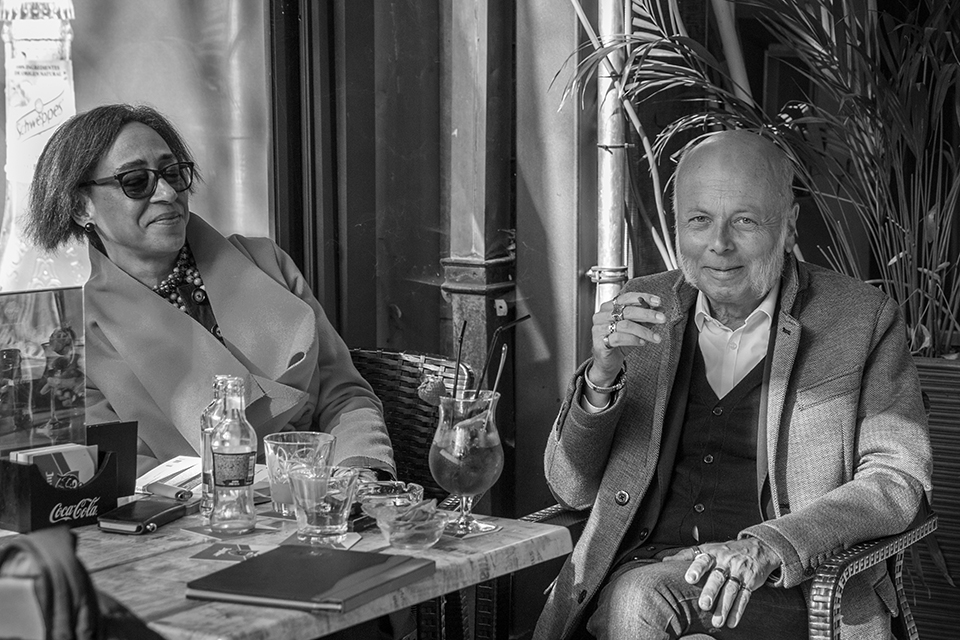
Of je nu op een vriendelijke manier vraagt om een foto te mogen maken, daarbij zelfs vaak een compliment gevend, of dat je zo onopvallend als mogelijk fotografeert, het komt steeds vaker voor dat men afkeurend of zelfs agressief reageert.
Het is jammer genoeg iets wat bij deze tijd hoort. Mensen zijn vaak afstandelijker, voelen zich snel geïntimideerd en reageren geagiteerder dan ooit. Men is helaas uiterst argwanend naar iedereen die met een met camera rondloopt.
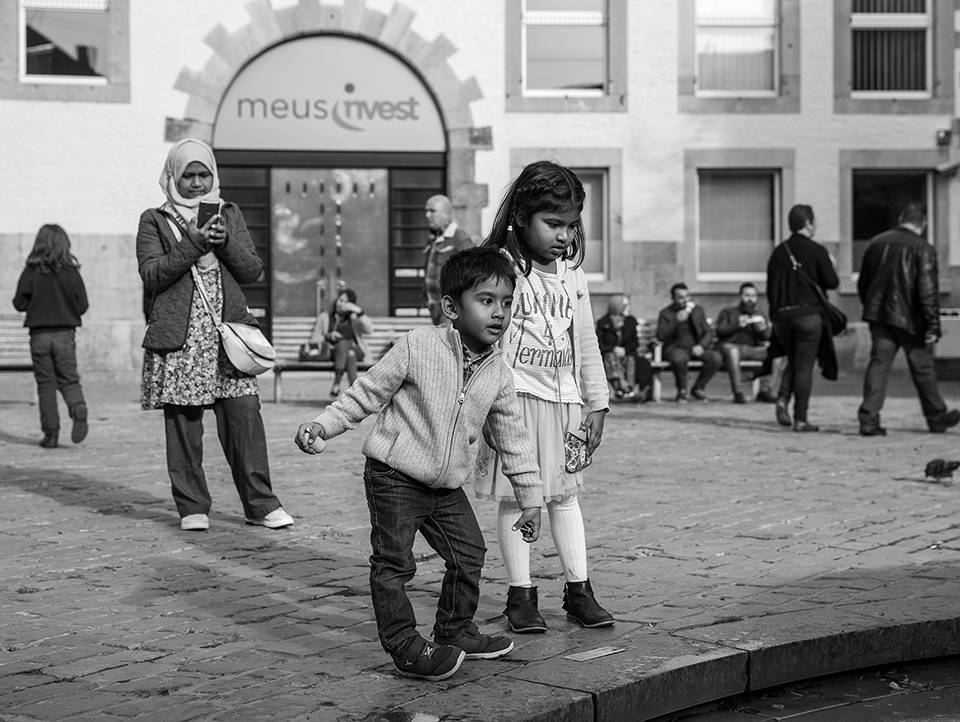
In het tijdperk waarbij privacy en alles daarom heen onder een vergrootglas ligt, wordt het er voor de straatfotograaf niet gemakkelijker en leuker op. Zelfs in publieke ruimten, waar het fotograferen in bijna alle omstandigheden gewoon geoorloofd is, wordt je vaak aangesproken en afkeurend gevraagd waarom je foto's maakt.
En het vreemde van alles is dat dit ook door de jongere generatie gebeurt. Of Nederlanders van een andere afkomst of genationaliseerd maar met een andere culturele achtergrond. In dit laatste geval kan ik het nog enigszins begrijpen. Naar mijn idee is het, net als veel dingen tegenwoordig, behoorlijk doorgeschoten.
Maar wat te doen als je toch graag straatfoto's maakt? Deze vraag stellen mijn vrouw, die de laatste jaren ook fotografeert, en ik ons steeds vaker af. Hierop antwoorden is niet eenvoudig maar we willen toch graag verwoorden hoe wij dit aanpakken.
Als straatfotograaf probeer je het alledaagse leven zo pakkend mogelijk vast te leggen en wil je deze portretten en situaties graag met zoveel mogelijk mensen delen. Hij of zij heeft in ieder geval niet de intentie om wie dan ook te kwetsen of om met voorbedachten rade compromitterende foto's te maken en te verkopen om er zelf rijk van te worden.
Eigenlijk is het een kunstzinnige vorm van fotografie waarin iedereen wel iets herkent en bij menig persoon ook nog een mooie herinnering oproept. Helaas hebben veel mensen een heel ander beeld van de maker tijdens deze memorabele momenten en moet de straatfotograaf praktische oplossingen bedenken om deze vorm van fotografie te kunnen blijven beoefenen.
- Our first piece of advice is to behave as inconspicuously and naturally as possible. So don't act secretive, just blend in with the crowd, smile and be friendly. First see whether you can observe as inconspicuously as possible and get the job done by walking around or standing still.
- A large telephoto lens does not really fit this picture. It makes you stand out and is intimidating. A smaller camera with a prime lens (fixed focal length) is certainly a better option here. The Canon 35mm or 40mm F2.8 STM is a good option.
- If you have a DSLR with a battery grip, remove it. The smaller the camera, the less conspicuous you are.
- Cover up noticeable elements on your camera or lens, such as a colourful logo, with tape.
- Take your photos quickly and don't follow people with your camera for too long. That comes across as intimidating.
- After each photo, immediately look at the person you photographed, with a look of acknowledgement. It doesn't have to be a smile and it must not be a tense grimace, just a moment of natural eye contact, as long as they look back themselves.
Then immediately return to your photography. This is not the moment to look at your camera's LCD screen, by the way. Or show them the photo you have taken. - To prevent unpleasant reactions, you can also create a distraction by, for example, pointing your camera somewhere else and looking out of the corner of your eye to see when you can take your intended shot. Pretend you are taking photos of something else. Distracting people can also be easier when you are photographing with several people.
- If your camera has an LCD screen that you can turn or flip, use it. This allows you to photograph inconspicuously from the hip, if you are someone who does not dare to photograph openly.
- Of course, you can also ask for permission, but if you don't want to miss that spontaneous moment, it is better not to do so beforehand. It is then no longer really street photography, but a posed street portrait.
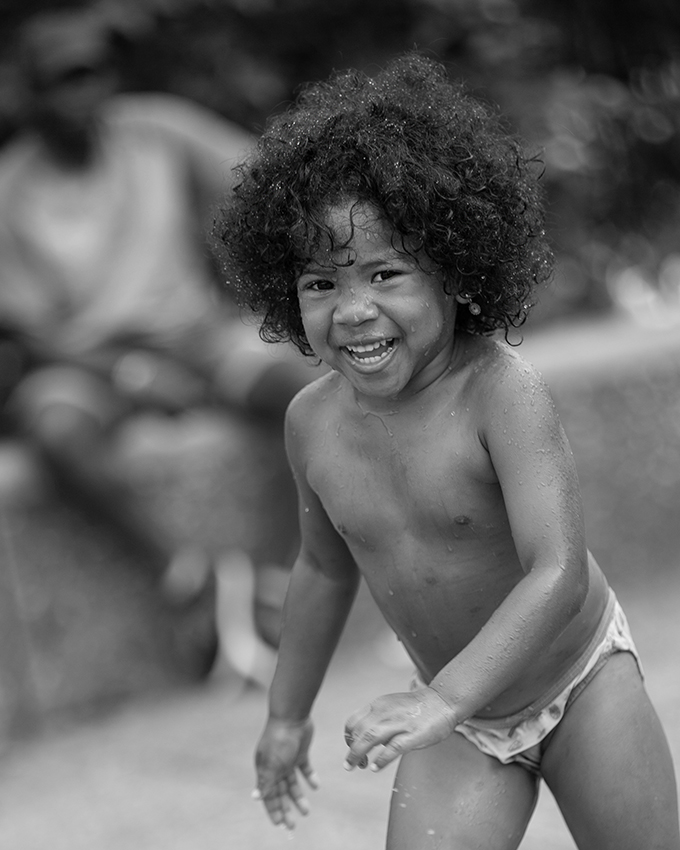
- If you would like to photograph children in the street, it is quite useful to have a woman with you. One or more male photographers come across as more threatening when children are involved, while that is of course not the intention.
- Also try what is known as shooting from the hip, also called guerrilla photography. You set your camera in advance, for example to f/8, and focus at a particular distance, usually somewhere around 2-3 metres. Then turn off your autofocus.
You then carry your camera casually at hip height and press the shutter “unseen” when something interesting happens within that focus area. It is a fun technique that can produce a wonderfully surprising result, but it will also disappoint you quite a few times. Keep going, though, because practice makes perfect. - Or visit tourist locations where people with a camera simply stand out much less.
- If you notice that someone explicitly objects, respond in the right way: do you mind that I took a photo of you? Would you like me to delete it? Show that you respect their feelings. However, don't apologise. It will not help improve your own confidence. Or simply explain honestly why you take street photos.
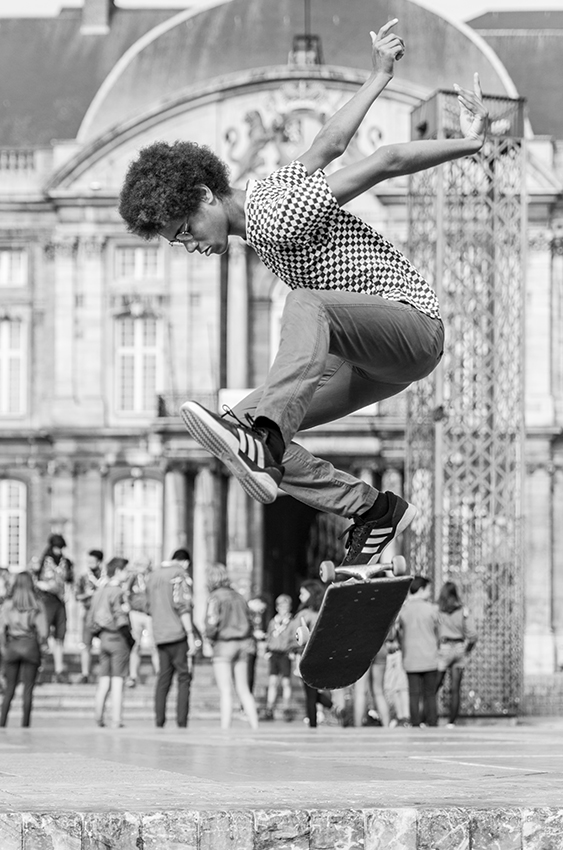
Laat ons artikel je absoluut niet weerhouden van het beoefenen van straatfotografie. Het blijft een hele leuke manier om het dagelijkse leven vast te leggen.
Probeer wel alles zo puur, eenvoudig en oprecht mogelijk te houden, hetgeen ook de essentie van de echte straatfotograaf is. Ga de stad of je dorp in, observeer en leg mooie, interessante of humoristische momenten vast.
Foto's: Lorette Janssen
About the author
Huub Keulers is een enthousiasmerende veelzijdige freelance fotograaf woonachtig in Elsloo (Li). Hij is gespecialiseerd in sport-, bedrijfs-, straat-, honden en portretfotografie. Daarnaast is Huub auteur van diverse educatieve fotografieboeken en verzorgt hij allerlei fotoworkshops, masterclasses en lezingen.
You might also like
-
 Street photography: follow your street heroes
by Jan Poldervaart
-
 Street photography tip: Taking photos while walking
by Michiel Heijmans
-
 Street photography tip: Embrace the shadow
by Michiel Heijmans
-
 Street photography tip: Photograph minimalism in the countryside
by Michiel Heijmans
-
 Street Photography Tip: Blurry Isn't Always Bad!
by Michiel Heijmans
-
 Street photography tip: Start with a safe telephoto lens
by Michiel Heijmans
31 comments
-

 martinphili wrote on Saturday 21 September 2019 at 14:29
| reply
If you notice that people no longer feel comfortable being photographed on the street, you could also ask yourself whether you should still be doing it.
Translated from Dutch. -
 Tom wrote on Saturday 21 September 2019 at 16:30 | reply
The question is whether anything can still be kept secret. Your phone is always being tracked, Google knows where you are. You have already sold the photos on Facebook through "free" software. You put the contents of your living room on Funda. When people then start talking about the Privacy law then I know enough. From now on I will take photos with an almost invisible camera.
Translated from Dutch. -
 cees wrote on Saturday 21 September 2019 at 20:37
| reply
I have a great deal of appreciation for Huub's article and agree with most of it.I too am an avid street photographer but haven't really had any problems yet.In my opinion, the big problem is that people are becoming camera-shy because nowadays everyone walks around taking photos with their phone.On one of my outings I saw that two ladies were photographing me with their phone.The way they did it,I didn't like and reacted by taking a photo of them.The comments were flying thick and fast.After this "little exchange" I could get back to my hobby.
Translated from Dutch. -
 Marjan wrote on Monday 23 September 2019 at 08:02 | reply
In addition to Cees's reaction: indeed, everyone nowadays walks around taking photos with a smartphone, but a lot is also put online. The rise of social media contributes to a certain distrust, people are thinking more and more about privacy and possible misuse of photos.
Translated from Dutch.
And while it used to be somewhat 'special' to see people walking around with an (analogue) camera, nowadays the number of photographers with a digital camera has multiplied. And with digital photography, people look less critically at what they photograph. You sometimes see people literally being 'framed', for example there was recently a photo in a photography group on Facebook of people sunbathing on the beach, accompanied by a comment intended to be funny about the figure of the somewhat fatter person in the photo.
So you can imagine that not everyone is still pleased to appear in a photo. Most street photographers probably handle their photos properly and exercise care towards the people portrayed, but it is not always possible to gauge how good the intentions are. I think that as a street photographer, you would do well to make your intentions clear anyway (even if it is afterwards) when you capture people very recognisably, especially when it concerns children. -
 A.Gooier wrote on Monday 23 September 2019 at 12:38
| reply
People have become more distant compared to “the past”. Street photography as Ed van der Elsken practiced it will no longer be possible.
Translated from Dutch. -
 Piet Nicolaas wrote on Tuesday 24 September 2019 at 10:56 | reply
I can well imagine that people have problems with it more often, especially when it concerns children. How often do you read that posted photos of children are misused by third parties and "adjusted" . I can imagine that, if parents see this, they find it appalling. Photos of people are also often used as profile pictures for dating sites. All the more reason to be wary of being photographed by just anyone. Ultimately, you cannot tell from the photographer's appearance whether he has honorable intentions with the photos.
Translated from Dutch. -
 Peter van Dinther wrote on Tuesday 24 September 2019 at 12:26 | reply
Another useful thing is to set your camera to ‘silent mode’, if you have that option of course.
Translated from Dutch. -
Tjaard wrote on Tuesday 24 September 2019 at 12:43 | reply
I've been photographing on the street for years. And apart from a few questioning looks, I've never had any trouble. You do have to know what you're doing, maybe that's the reason? And isn't it about time you learned to write proper Dutch?
Translated from Dutch. -
 Johan Pronk wrote on Tuesday 24 September 2019 at 13:32 | reply
Recently, on a Saturday in the center of Amsterdam, worked out staged street photography with a few photographers and a few models.
Translated from Dutch.
The advantage of this is that you have the situation under control yourself.
Passers-by see you at work and calmly walk through the frame and absolutely don't mind if they end up in the photo. Sometimes they deliberately stand in the frame. There is nothing secretive about it, everyone can see that you are at work. That makes working very easy, even if you point the camera at someone other than the models for once. -
 Gerard Bruins wrote on Tuesday 24 September 2019 at 14:49 | reply
The photographer Tomas Leuthard has put a number of eBooks online for free in which he describes his way of doing street photography with enough good examples
Translated from Dutch.
https://www.thomas-fuengerlings.de/thomas-leuthard-ebooks-free/. -
 Frea Kroese wrote on Tuesday 24 September 2019 at 15:26 | reply
I notice that it makes a difference where and when I photograph on the street. On King's Day, for example, it is definitely appreciated. Almost nobody reacts negatively then. I always walk around my city centre then because there is so much beautiful stuff to see! On the other hand, sometimes I wish it were possible to place a hidden camera in a public space by a bench further down in my neighbourhood. There are very often all kinds of colourful people sitting on that bench for all kinds of reasons. That would produce some amazing shots. Yesterday I saw an older man and a younger man looking at an image on a mobile phone together and smiling in a very warm way. I store it in my heart. That is just pure love.
Translated from Dutch. -
 Cindy wrote on Tuesday 24 September 2019 at 16:58 | reply
In that regard, I’m lucky, many people know me and at events they clearly know that I’m a female photographer. I sometimes give the parent a look, if I want to take a photo of a child. And indeed also show a photo. I pay attention to people’s expressions, looking away already says enough.
Translated from Dutch. -
 Erik Klaver wrote on Tuesday 24 September 2019 at 20:31 | reply
This is what I learned from Patrick Mollema: Find a good place to take photos. Sit down there. Choose the exact spot where you want to take photos and make sure you have your settings sorted out for that spot. You don't have to act inconspicuously. The people are, as it were, entering your space now and they rarely have a problem with that. I like this approach
Translated from Dutch. -
Peter van Dinther wrote on Tuesday 24 September 2019 at 21:09 | reply
Great response from Erik Klaver, I completely agree.
Translated from Dutch. -
A.Gooier wrote on Tuesday 24 September 2019 at 22:32
| reply
The type of camera can also help.
Translated from Dutch.
"Back then" a Rolleiflex didn't come across as intimidating as an SLR. With a Rolleiflex you didn't stand out as much. -
 Stefanie wrote on Wednesday 25 September 2019 at 08:18 | reply
Point 1 says 'don't act sneaky' and then follows with a whole string of tips for taking photos sneakily (?) My idea is that if you act more like a tourist than a photographer, you can get a long way without disapproving looks or reactions. A photographer colleague I know actually takes a very brazen approach, he just jumps in people's path, takes a straightforward portrait of them, and gets away with it 99% of the time. His approach: if they really don't want it, I'll just delete the photo anyway, and he does have a point there too, right
Translated from Dutch. -
 Bie Eng Sciarone wrote on Wednesday 25 September 2019 at 10:06 | reply
Hi Huub, thanks for your article and Loretta for the beautiful photos. It might also be nice to have a Polaroid camera with you. Sometimes there are still people in villages and streets who never see a photo of themselves, and then getting a print is all the more fun.
Translated from Dutch. -
 Nico Orie wrote on Wednesday 25 September 2019 at 23:06 | reply
I completely agree with Huub and I am therefore also concerned about the fact that children are no longer shown recognizably. Street photographers like Cartier Bresson, Doisnaux, Wiliam Klein etc. captured entire generations of children playing in the street. But nowadays that is no longer possible because you are immediately viewed as suspicious as a photographer. The news channels also go along with that, you only see anonymized images, unrecognizable children, empty playground equipment and so on. An entire generation of children is no longer spontaneously captured in images to later show how children played in this era.
Translated from Dutch. -
A.Gooier wrote on Thursday 26 September 2019 at 11:33
| reply
Under the GDPR, a great deal is no longer allowed.
Translated from Dutch.
Another factor is that people are less open to others. It is almost dangerous to greet or look at a random person on the street. -
A.Gooier wrote on Thursday 26 September 2019 at 11:35
| reply
More about GDPR https://www.nvj.nl/privacy/avg/avg-en-fotografie
Translated from Dutch.
Quote:
Photography in public spaces
For photos taken in public spaces that show people, you must always ask yourself whether personal data is involved. Think of street photography, spectators at a football match, people at a fair, etc. Can the people shown be identified without disproportionate effort? If so, then it is personal data and the GDPR applies. -
Peter van Dinther wrote on Thursday 26 September 2019 at 11:40 | reply
As far as I know, you can photograph anything in public spaces. What you can't do is publish it, for example on Facebook or your website.
Translated from Dutch. -
guest wrote on Thursday 26 September 2019 at 11:48 | reply
@Peter van Dinther, so that's not allowed under GDPR.
Translated from Dutch. -
Peter van Dinther wrote on Thursday 26 September 2019 at 11:58 | reply
From the NVJ website:
Translated from Dutch.
Legal basis
The GDPR recognises 6 legal bases for the processing of personal data. As a photographer, you will generally use the legal basis of ‘consent’, ‘contract’, ‘legal obligation’ or ‘legitimate interest’.
A legal obligation refers to obligations you have under tax legislation. For example, the customer’s name must be stated on an invoice. That can be personal data, and its processing then falls under the legal obligation.
For your VAT return, you are required to keep records and there is a retention period for that data. The customer data you process in your VAT records is therefore processed on the basis of a legal obligation.
Your business interest falls under legitimate interest. The processing of personal data, taking photos, is necessary to carry out your regular business activities as a photographer. That does not mean that every activity is permitted. A balancing exercise must always take place with the legitimate interests of the data subject, the person in the photo. Data processing for business purposes is only lawful if it is necessary for that purpose and the interest or fundamental rights of the data subject do not outweigh it. A balancing exercise must therefore take place between your business interest and the privacy interests of the person in the photo.
Data processing for journalistic purposes or artistic expressions also falls under legitimate interest. -
guest wrote on Thursday 26 September 2019 at 12:01 | reply
I did a quick search online: https://www.charlotteslaw.nl/mag-je-nog-fotos-maken-en-publiceren-na-de-avg/
Translated from Dutch. -
Tom wrote on Thursday 26 September 2019 at 15:25 | reply
According to the minister's explanation of the implementation of the GDPR, a photographer cannot always be expected to ask a portrayed person for permission. This would apply in particular to larger groups of people, crowded environments, etc. Different arguments apply to publication: does the interest of the portrayed person outweigh the interest of the photographer (journalistic interest, the arts). That then touches on portrait rights again.
Translated from Dutch. -
Peter van Dinther wrote on Thursday 26 September 2019 at 15:38 | reply
Fortunately, I’ll be less bothered by that in Cuba soon...🤓
Translated from Dutch. -
guest wrote on Thursday 26 September 2019 at 15:46 | reply
@Tom, to clarify your response, https://www.nvj.nl/privacy/avg/avg-en-fotografie
Translated from Dutch.
Quote:
The following question was included in the Report on the GDPR Implementation Act. A person is standing on Dam Square in Amsterdam and takes a photo of the palace on Dam Square. Other people are also recognizably depicted in the photo. The photo is then posted online. Is this processing of personal data within the meaning of the GDPR?
The Minister for Legal Protection (Dekker) answered as follows. First, it must be established whether there is any personal data at all. To that end, the people visible in the background of such a photo must be directly or indirectly identifiable. The starting point here is that a person is identifiable if their identity can reasonably be established without disproportionate effort. That seems highly questionable in the case of random passers-by on Dam Square. -
 Huub Keulers
wrote on Saturday 28 September 2019 at 16:21
| reply
Dear Tjaard, great that you have only received questioning looks a single time during your street photography activities and good that you know what you are doing. You will enjoy your photography and I am happy about that. Everyone is entitled to an opinion, but could you please explain what you mean by your comment about learning to write better Dutch. Let’s not do this on this photography platform, but you can always email me (huubkeulers@ziggo.nl) or call me (0646741111).
Translated from Dutch. -
Huub Keulers
wrote on Saturday 28 September 2019 at 16:23
| reply
We want to thank everyone who has provided tips and additional information. It's always nice to share experiences and knowledge.
Translated from Dutch. -
 nienke
wrote on Sunday 30 July 2023 at 21:31
| reply
These days there is indeed a noticeable hardening. I also photograph with fairly large cameras and every now and then people ask what I'm up to. I do think that as a woman you can more easily take photos of situations than when you are a man? Do you experience that the same way? I usually get fairly reasonable reactions.
Translated from Dutch.
Kind regards, Nienke
https://www.sharpfocus.nl -
A.Gooier wrote on Monday 31 July 2023 at 11:10
| reply
Since the discussion in 2019 about the GDPR, there is a new phenomenon: deepfake. Do you still want to and can you put people in photos and on the internet? The question is: are you jointly guilty if you take a photo of someone without asking and put it on the internet, and the person in question is used for a deepfake?
Translated from Dutch.
What I have found about deepfake so far.
Have your say
Please note: Articles older than a week can only be commented on by signed-in visitors.Would you still like to comment? sign in or create a free account.
Become a better photographer every week
A practical photography tip in your inbox every week.
38,981 photography enthusiasts already receive the tips! More about the weekly mail. Or keep up to date via  Facebook.

Elja Trum
Photofacts; everything to do with photography!
Would you like to take better photos and keep up with what is happening in photography? Photofacts publishes articles that teach you something about photography — from a product announcement to a practical shooting tip or a look at a website. Photofacts covers photography every day and is a hobby project of Elja Trum's that got out of hand. The articles are written by a team of volunteer authors. If you would enjoy writing one or more articles for Photofacts, do get in touch.More about PhotofactsPhotofacts is made possible in part by
