

But do you really need that new camera?
Wednesday 11 November 2026, 16:32 by Michiel Heijmans | 28 views | 0 commentsThis article was translated from Dutch with the help of AI. Read the original.
A new Fujifilm X-T6 is on the way. And I've ordered one, even though the launch hasn't been announced yet. Not because my current X-T5 is no longer good enough.
In fact, I suspect the differences between the two cameras won't be that great for my photography. My X-T5 takes fantastic photos, the autofocus is fine and I really don't feel I'm missing anything in terms of image quality.
Yet I want that new camera. Why? Because new stuff is fun. Because unboxing a new camera, setting all the buttons and becoming familiar with a camera again does something to my enthusiasm. I feel like going outside. Taking photos. Discovering things all over again.
Perhaps that's the most honest explanation of Gear Acquisition Syndrome, better known as GAS. Sometimes you don't buy a new camera because you want to take better photos, but because you want to take more photos again.
And there's nothing much wrong with that in itself. Photography isn't just my work, it's also something I get an enormous amount of pleasure from. If a new camera rekindles that enjoyment, why shouldn't I allow myself that?
At the same time, there's something uncomfortable about that reasoning. Because how long does that new feeling last? A week? A month? And what happens afterwards?
Then that new camera suddenly becomes just the camera you use to take photos. Until a successor appears, with a new sensor, a few extra megapixels and autofocus that should be able to recognise eyes before the owner of those eyes even appears in the frame.
So the question isn't just whether you want a new camera. The main question is why.
The grass is always greener
During the photo walks I organise, I regularly see GAS in the wild. We meet in a square, I tell people something about street photography and set the first assignment.
But before everyone starts taking photos, they look around. Not at the street, but at each other's cameras. What make have you got? Which lens is on it? Isn't that heavy? And what have I actually brought with me?
I often shoot on the street with a small Fujifilm, such as my X100V or X-E4. Sometimes with a 23mm, sometimes with a tiny 27mm pancake. These are cameras that barely attract any attention and that I can carry around all day without any effort.
I regularly hear: 'Yes, but you've got such a lovely little camera.' That comment usually comes from someone who has brought a camera with a zoom lens about the same size as my entire camera bag. They probably have more photographic options than I do, but in the meantime they're looking wistfully at my modest kit.
That's the curious thing about GAS. We're constantly convinced that someone else has exactly what we're missing.
The photographer with the heavy zoom longs for a small camera. The photographer with a compact camera longs for a mirrorless camera with interchangeable lenses. The owner of a beautiful 35mm would rather have a 50mm, while the person with a 50mm wonders whether 40mm might not be the perfect focal length.
The grass is always greener on the other side. Or, in photographic terms, the sharpness is just a little better there and the background blur just a little softer. Better bokeh balls.
Thirty centimetres behind the camera
What I regularly tell people during my workshops is that the most important part of your photography is about thirty centimetres behind your camera. You. I have no idea who came up with that saying, but it wasn't me.
Of course, equipment makes a difference. A fast lens gives you options that a basic kit lens doesn't. Fast autofocus can genuinely make a difference in sports photography.
And someone who takes portraits can consciously choose a 56mm f/1.2 because of its shallow depth of field. But let's not pretend that those technical possibilities automatically produce better photos.
Ultimately, photography is still about looking. About light, composition, timing and recognising a moment.
The basics are shutter speed, aperture and ISO. The rest is often supportive. Even something like white balance can still be adjusted perfectly well afterwards when you shoot in RAW.
Much more important to me is having a camera that you know inside out. That you know where the buttons are without thinking. That you don't have to search for a setting while the moment is unfolding in front of you.
A camera should become an extension of yourself. You should be able to read and write with it.
And that's exactly where GAS causes problems. Because when you constantly switch equipment, you keep having to get acquainted with it. You learn a new camera every time, without ever truly mastering the previous one. At some point, the camera controls you instead of the other way round.
Julie's 27 millimetres
Still, it would be hypocritical to claim that new stuff rarely adds anything. I remember a walk through Amsterdam with street photographer Julie Hrudová.
She was shooting with a Fujifilm 27mm pancake. That lens had been on my wish list for a very long time. On a Fujifilm APS-C camera, it gives roughly the same angle of view as a 40mm on full-frame.
And 40mm has something special for me. A 35mm sometimes feels just a little too wide, meaning I have to get closer than I really want to. I often find a 50mm rather detached. That 40mm sits exactly in between.
I watched Julie work with it and a week later I had one myself.
A textbook example of GAS, you might say. And perhaps it was. But the lens really did suit the way I photograph.
On 15 November 2025, I used it to take a photo in London of three men taking a break by a building.
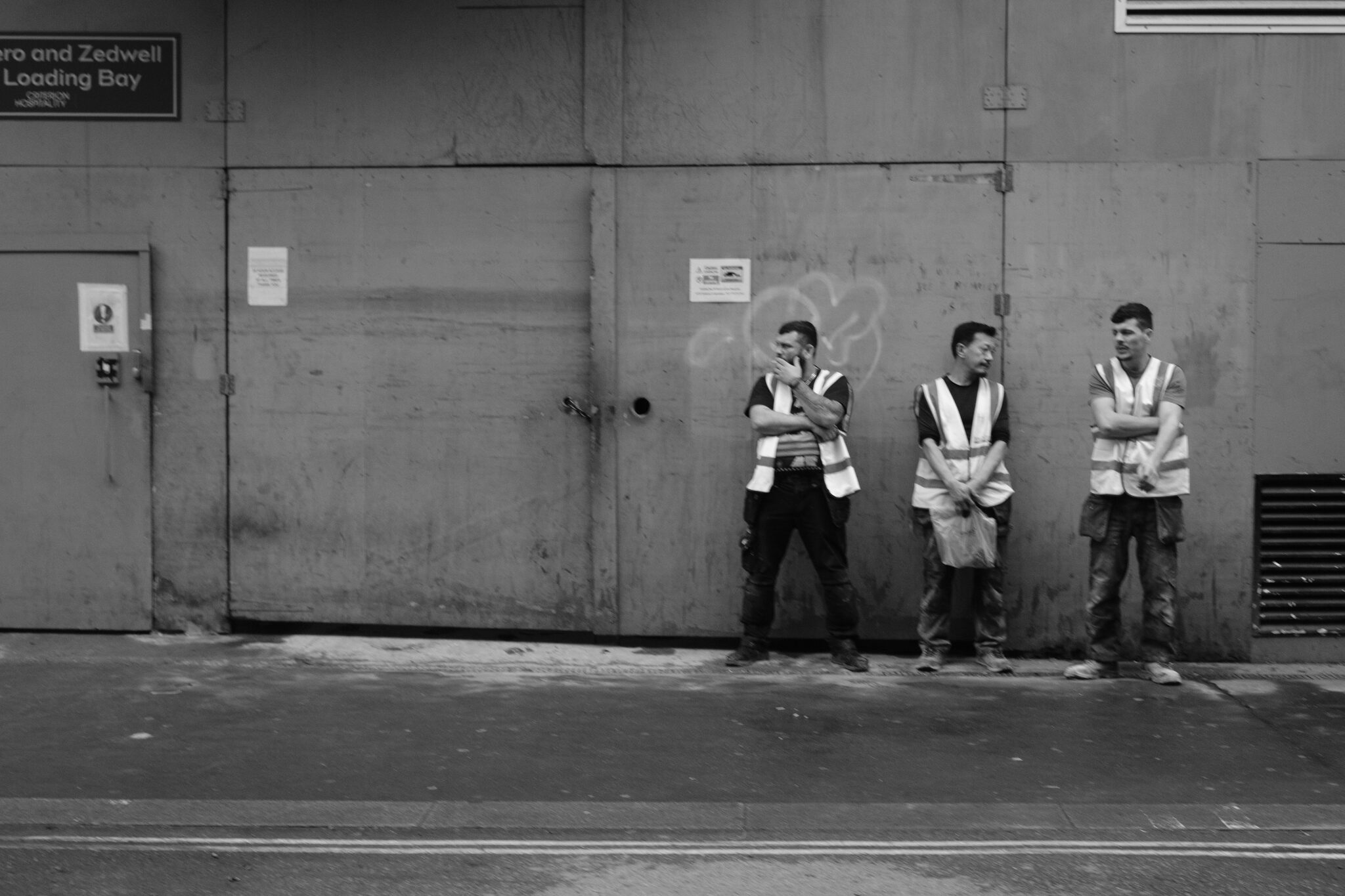
London, 2025 - f/5.6, 1/160s, 1250 ISO @ 27mm
They were on the other side of the street, against an imposing facade. I photographed them with my X-T5 at 1/160 second, f/5.6 and ISO 1250.
It's an image in which the surroundings play an important role, but the men don't get lost in them. With a 35mm, the crop would probably have been just a little too wide.
It's a photo I still enjoy looking at. And that's exactly why I like that lens so much.
If I lose it tomorrow, I'll buy a new one straight away. Not because I happen to fancy another lens, but because I now know what it gives me.
A studio full of possibilities
In my studio, things are no different. Over the past few years, I've invested in continuous lighting, including Godox LiteMons lights. Not because my flashes suddenly weren't good enough, but because continuous light gives me different possibilities.
I can experiment with it, approach light differently and discover new techniques. It challenges me to try things I might not have done before. In that sense, GAS is actually a form of curiosity.
But recently I also saw those new inflatable light tubes. You may know them. Large, elongated light sources that you can deflate and then fold up so small that they easily fit in a bag. Brilliantly designed.
I immediately saw all sorts of possibilities. Until I asked myself what I actually needed them for. Because on location, I can already work perfectly well with a flash and a trigger. At the moment, there isn't a situation where an inflatable light source solves anything essential for me.
So I didn't buy them.
That hardly sounds like an achievement, but for someone who quite likes photographic equipment, it's a pretty decent moment of self-control.
And in the meantime, I am looking at new light stands. My current ones sometimes stick and aren't always pleasant to use. New stands would make my daily work easier.
No spectacular purchase, no new creative revolution, but perhaps a much more sensible investment.
Smaller, lighter, better?
We are also seeing the compact camera return to the streets. After years in which cameras had to become increasingly larger, faster and more impressive, photographers are rediscovering how pleasant it is to head out with very little equipment.
A small camera, a fixed lens and no bag full of alternatives. It's almost liberating. And somewhat ironic too. Because while we spent years buying equipment to have more and more possibilities, we're now willing to spend money again precisely so that we don't have to carry as much.
I completely understand the appeal. Sometimes I think my ideal camera could be even smaller, or at least lighter. But perhaps we should first ask ourselves why we started carrying so much equipment around.
When you set off with one camera and one lens, you no longer have to make decisions along the way about which lens best suits a situation. You look, you move and you take the photo.
You adapt yourself to your camera's possibilities, instead of constantly looking for equipment that can adapt to every situation you can imagine.
That may be the greatest freedom you can give yourself as a photographer.
But do you really need it?
I don't think we should fully want to cure GAS. New equipment can inspire you. A different focal length can make you see differently.
New lighting can challenge you to take better portraits. And sometimes even buying a camera that is technically hardly any better can make you start taking photos with renewed enthusiasm. My ordered X-T6 is an excellent example of that.
But there is a difference between curiosity and dissatisfaction. As soon as you're constantly focused on what you don't have yet, it's easy to lose sight of what you can already do.
And perhaps that's the greatest price you pay for GAS. Not the money, but the attention it demands.
In the end, my best tool isn't necessarily my newest camera. It's the camera I know so well that I hardly need to think about it any more.
The one that may have a few scratches, with slightly worn rubber covering, and that has already been taken outside thousands of times. A camera I no longer have to search with, but only have to look with.
So before you click order next time, ask yourself one simple question.
"But do you really need it?"
And if the answer is no, you can of course always just go outside. With the camera you already have. There are plenty of photos to take out there.
About the author
Michiel is professioneel straatfotograaf en geeft workshops en lezingen over straatfotografie. Hij schrijft columns voor Focus Magazine en is erg actief op Instagram. Daar vind je dagelijks inspiratie en tips voor je eigen straatfotografie!
You might also like
-
 Where do you find your inspiration?
by Nando Harmsen
-
 Review: Inspiration by Ap Dijksterhuis
by Erik van Rosmalen
-
 Inspiration, essential for your photography!
by Laura van der Burgt
-
 Flash photography tip: Get to know your equipment
by Elja Trum
-
 My experience with street photography
by Nando Harmsen
-
 Fujifilm X-E5 announced
by Elja Trum
0 comments
Be the first to share what you think!
Become a better photographer every week
A practical photography tip in your inbox every week.
38,840 photography enthusiasts already receive the tips! More about the weekly mail. Or keep up to date via  Facebook.

Elja Trum
Photofacts; everything to do with photography!
Would you like to take better photos and keep up with what is happening in photography? Photofacts publishes articles that teach you something about photography — from a product announcement to a practical shooting tip or a look at a website. Photofacts covers photography every day and is a hobby project of Elja Trum's that got out of hand. The articles are written by a team of volunteer authors. If you would enjoy writing one or more articles for Photofacts, do get in touch.More about PhotofactsPhotofacts is made possible in part by
