

Photo competition: how do you get the most out of it?
Monday 10 February 2020, 15:51 by Wilmar Dik | 10,842 views | 11 commentsThis article was translated from Dutch with the help of AI. Read the original.
A photo competition! As a photographer, a great reason to challenge yourself to take your very best photo. You could also win some great prizes. And what about the exposure?!
A photo competition can also deliver a great deal for the organiser. Think brand awareness, interaction with the target audience and brand loyalty, promotion of the brand, services and/or products, valuable data and lead generation. And, of course, the very best photos from ambitious and competitive photographers.
So how do you get the most out of a photo competition?
That depends.
Are you organising the competition, or are you taking part as a photographer?
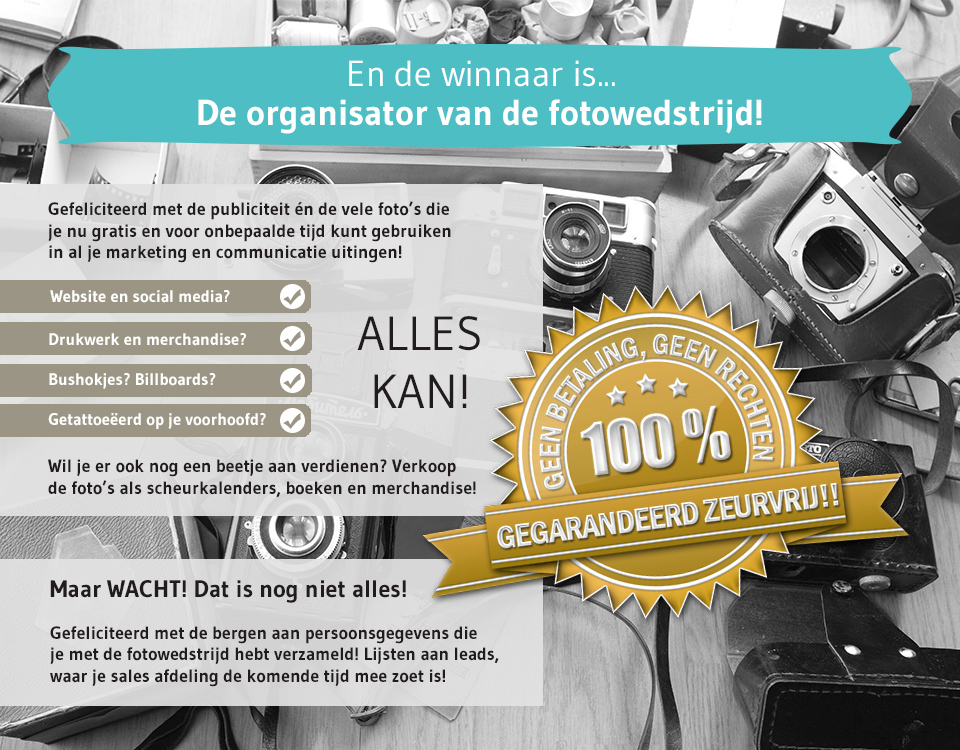
Organiser: Your photo competition is business
As the organiser of a photo competition, the first step is to clearly establish the purpose of the competition. With that as your starting point, you can set about determining the competition rules.
Do you want to collect as much good-quality visual material as possible that you can use free of charge for your upcoming advertising campaigns?
Then choose a photo theme that is relevant to your planned campaign. It is also useful to arrange for unlimited use of the submitted photos, without having to ask permission or offer the photographer payment.
Finally, you need to make the competition attractive to professional photographers, so that you receive the best and most unique images possible. Or you can exclude professional photographers, so that other entrants feel even more that they have a chance of winning.
Do you want to collect as much personal data as possible through the competition? Then it is better to let people vote for photos than to put together a jury. That way, alongside the entrants' details, you can also collect the voters' details!
It is therefore important to create robust and legally valid competition rules. Don't worry, most people do not read the rules all the way through anyway.
Photographer: A photo competition is business
You can see where I am going with this: photo competitions are organised for a reason. And not just to do the photographer a favour. As a photographer, it is therefore sensible to stop and consider why the organiser has set up the competition.
You can find this out by reading the rules carefully. What are you being asked to do? What are you expected to agree to? To what extent are you expected to transfer your rights?
By looking closely at the conditions, you can decide whether the chance of winning makes taking part worthwhile. Right, the competition rules: what should you look out for?
The small print: which rights are you giving up?
Back to basics for a moment: as the creator of the photo, you automatically have copyright. This gives you the exclusive right to publish and reproduce the photo.
If someone else also wants to use the photo you took, they need your permission. In that case, you can ask for payment for using your photo. You also have moral rights. These protect your reputation as the creator of the photo.
Moral rights include the right to object if your photo is published without your name, published under someone else's name, or if your photo is mutilated. You can transfer copyright to another party by means of a deed.
You cannot transfer moral rights. You retain them even after transferring your copyright. There are moral rights that you can waive, however. The right to have your name mentioned when your photo is published is one example.
The competition rules explain what the photo competition organiser expects from you as a participating photographer in terms of copyright and moral rights.
Practice: copyright and moral rights in photo competition rules
Many photo competition rules state that the copyright remains with the photographer and that the photographer grants the organiser a licence to use the photos. More on that later.
There are also photo competition organisers who want the copyright to your photo. The rules often state that by submitting the photo, you transfer the copyright to the organiser. Fortunately, that is not possible. A copyright transfer must be arranged by means of a deed.
You cannot transfer your copyright simply by taking part in a competition and agreeing to general terms and conditions. Some organisations have got everything on this point perfectly sorted. Take a look at this gem:

That is something. If you want to use the photo yourself after the transfer, for example in your portfolio, you have to ask the organiser for permission. Submit it to another competition? Sell it? Supply it to another party? None of that is allowed.
The organiser, on the other hand, can publish, sell and use your photo for its own promotion, et cetera. Without your permission. And that is not all. You cannot transfer moral rights, remember?
With only a copyright transfer, you could still demand that the organisation include your name with the photo. But since you have to waive your moral rights 'as far as possible', they apparently are not interested in that. There goes your chance of gaining name recognition and exposure.
Licence to use your photo
There are also photo competitions where you do not have to transfer your copyright. Instead, you give the organiser a licence to use your submitted photos. That seems somewhat more reasonable, but it depends entirely on the type of licence and what it says.
Types of licences
There are two types of licences that you often come across in competition rules: exclusive and non-exclusive.
With an exclusive licence, you give the organiser the sole right to use the photo. So you can no longer submit the photo to another photo competition. You also cannot give other parties permission to use the photo. So you cannot sell or give away the photo for use, or have it published anywhere.
In short, there is very little you can do with it. If the licence is also perpetual, irrevocable and unlimited in its use, then in effect it is not much different from a copyright transfer.
With a non-exclusive licence, other parties can still use the photo. Here too, you need to look closely at the conditions and ask yourself whether you consider them fair.
Think in particular about:
- What can the photos be used for? Are there restrictions on their use?
- Can the photos be sold? If so, where does the money go?
- Who can use the photos?
- What has been arranged regarding naming the photographer?
Use of your photo for promotional and commercial purposes
In many photo competitions, you give the organiser permission to use your submitted photo for promotional and commercial purposes.
Websites, social media, magazines, brochures, billboards, bus shelters, merchandising, tear-off calendars, postcards, books, exhibitions, you name it. Without payment and sometimes even without naming you.
This right may also be granted to their partners, sponsors and other commercial stakeholders. The use may apply worldwide, for an unlimited period and in any medium.
So if a company or organisation wants to obtain lots of unique promotional photos for relatively little money, they organise a photo competition. Don't just take my word for it, read this testimonial from a satisfied photo competition organiser:
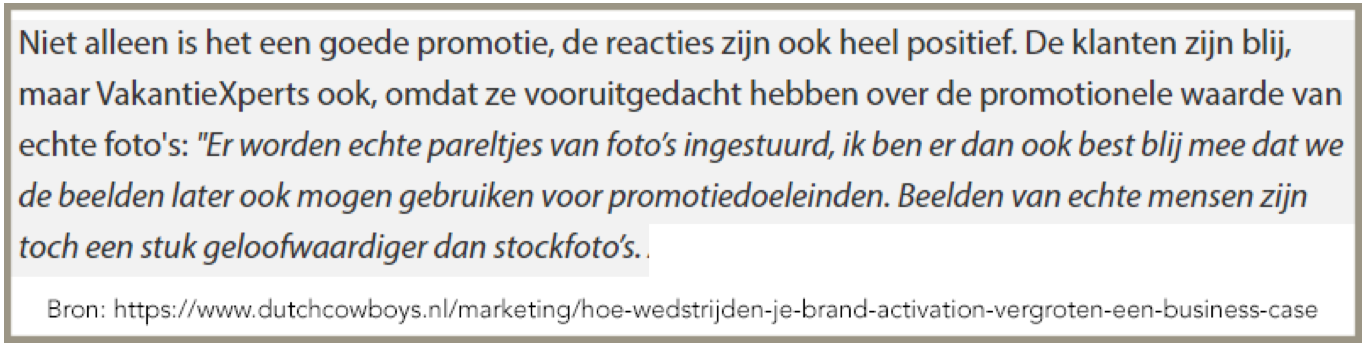
Well, why would they pay for photos if they can obtain a huge number of photos without payment through a photo competition?
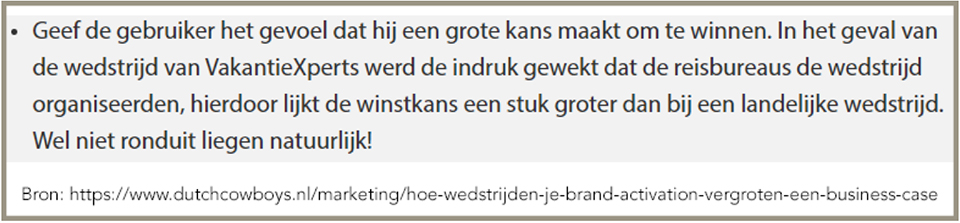
The company that recorded this organiser's customer story also gives some tips for organising a successful competition: through clever wording and leaving out information, you should make the entrant feel that they have a greater chance of winning than is actually the case.
And the more people think they have a chance, the more people take part, and the more photos you can get from the competition. But, it added: don't actually lie, of course!.
Use of the photos limited to competition-related marketing
Some organisers limit the use of the photos to competition-related marketing. They promise not to use your photo to promote their organisation.
No, your photo will really only be used to promote the competition. The competition they set up to promote their organisation.
It is not for nothing that the organiser's name is always part of the competition's name. Every time the competition is mentioned, by entrants, sponsors, partners, in an article, on websites, social media, et cetera, that is promotion for the organiser.
It comes down to participants supplying the organisation with valuable promotional material, for which the vast majority of participants receive nothing in return.
Sale of your photo
That photo book, or the magazines, merchandising, tear-off calendars, postcards, et cetera, in which your submitted photo is published? It can be sold. And, spoiler alert, the proceeds do not go to the creator of the photo. Just like the proceeds from the visitor tickets for the exhibition where your photo is displayed.
In fact, the added value created with submitted photos rarely goes back to the entrants. The people who make the photo book, provide it with text, print it and put it on the market are hopefully paid. Or would they organise a competition to find out which printer can print the best 10,000 photo books?
Collecting your data and lead generation
There is another reason why photo competitions are organised: data collection and lead generation. When you submit your photo, you are asked for details such as your name, email address, telephone number and social media profile. By taking part, you give permission for those details to be processed.
A few weeks after the competition, you can expect an email or phone call from the organiser's sales department. Too cynical? Here is a screenshot of a photo competition case study from a marketing agency:
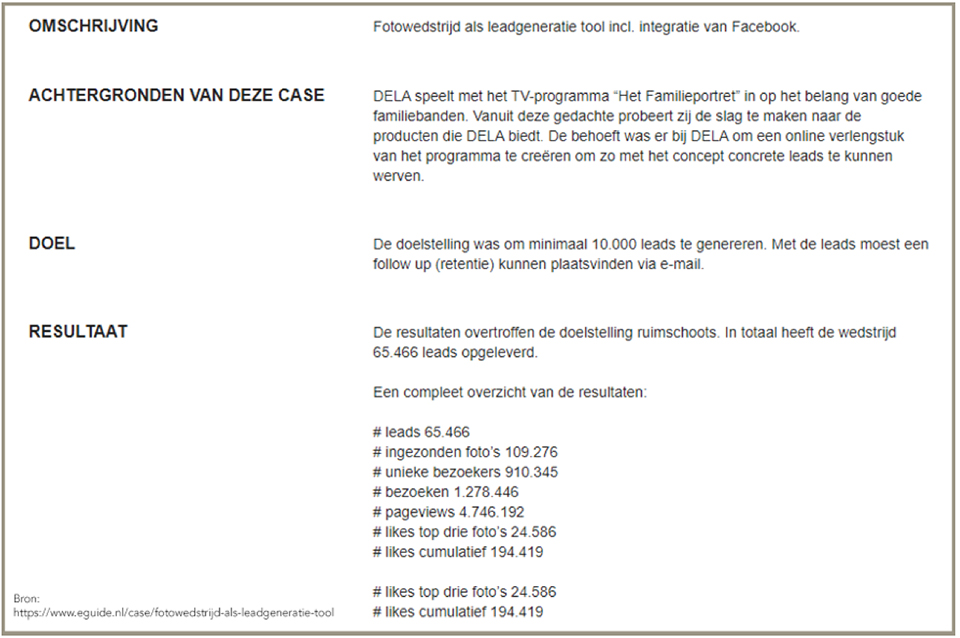
I understand that not everyone has a problem with this, but it is something to be aware of. It can certainly be a factor in your decision whether or not to take part in a photo competition.
Liability for third-party claims
In all the rules I have looked at, liability for third-party claims is shifted onto the entrant. The organisation wants to be able to benefit from your submission, but does not want to bear the burdens that come with it.
So is there someone recognisable in your photo? Make sure that person signs a release. Also do not clearly include someone else's work in the photo if that would infringe copyright. This of course always applies, including outside the context of a photo competition.
Take part or not?
I have a confession to make: I have taken part in a photo competition myself. It was about 15 years ago, when I was not yet a professional photographer. I had to pay an entry fee to take part.
My submitted photo, see below, made the shortlist and was published, among other places, in a book. I was then allowed to buy that book. So I paid to give my photo to a commercial party, which then sold it back to me...
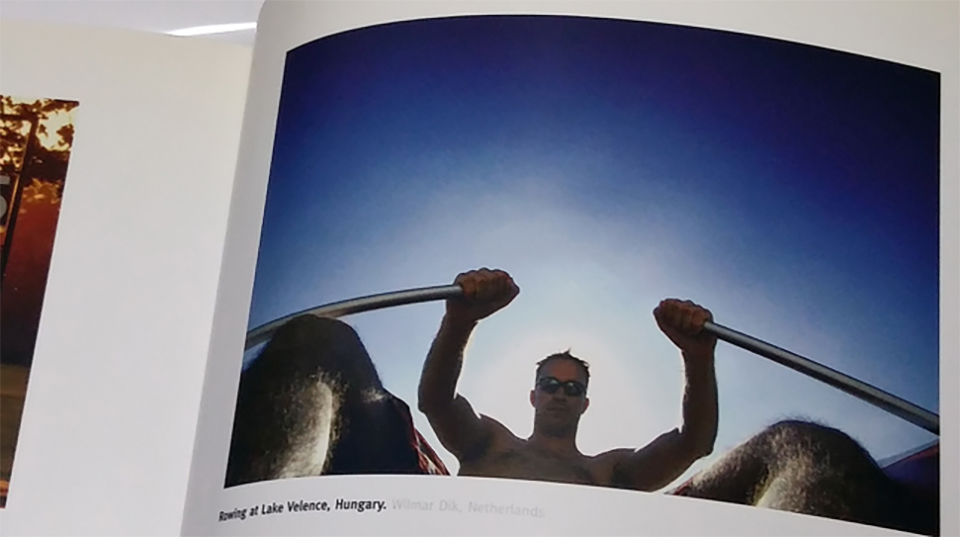
Every photo competition organiser sets its own entry conditions, and some are more or less fair than others. It is therefore important to decide for yourself under what conditions you are prepared to take part.
It is also good to be aware that your photo has commercial value for the party you submit it to.
Photo competition competition
Photo competition organisers, take note! Have you properly watertightened your competition rules? Do your rules really squeeze every last benefit out of the entrants? Congratulations! You have automatically entered the Netherlands' first photo competition competition!
We have seen a great many wonderful sets of rules, but one stood head and shoulders above the rest. We are delighted to announce that the certificate for the most unfair photo competition goes to:
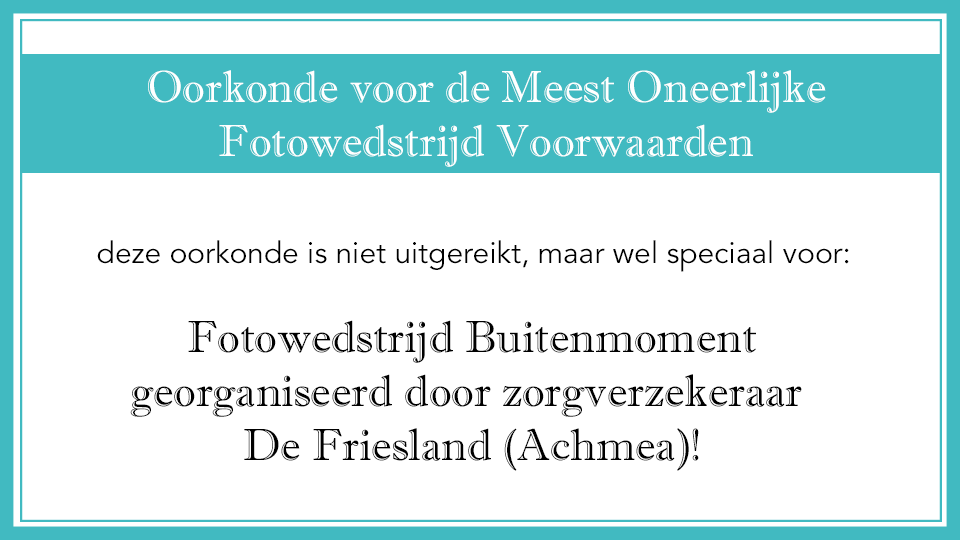
The jury congratulates the photo competition organisation on fine conditions such as:
As a participant, you grant the company an "exclusive, irrevocable licence to publish and reproduce the photos for commercial purposes, whether or not in modified form, without naming the photographer".
As the winner, you must transfer your copyright by means of a deed, and waive your moral rights as far as possible. To this end, you declare that you will "provide all the cooperation necessary to formalise the transfer".
You are expected to give up all your rights, but you still indemnify the company against any third-party claims. By taking part, you give permission for your personal data to be processed and give permission for the company to "provide you with unsolicited advice on health insurance a maximum of four times".
The prize if you win?
An Apple iPad.
About the author
Wilmar Dik is beroepsfotograaf sinds 2008. Ook schrijft hij in diverse media over fotografie en is hij betrokken bij DuPho. Bij NVJ is hij vertegenwoordiger beleidsteam Werkvoorwaarden namens ledengroep NVF/Beeldmakers. Werk van Wilmar:mensen.photo, Reclamebeeld, Portfolio fotograaf en Tasfilms.nl.
You might also like
-
 How to win photography competitions
by Elja Trum
-
 Golden Moment wins the World Sports Photography Award
by Nando Harmsen
-
 Photoshop competition: mix animals with each other
by Michelle Peeters
-
 Why Do You Actually Take Photos?
by Juliette Gribnau
-
 6 Reasons to Stick with a DSLR and One Reason Not To
by Nando Harmsen
-
 5 Reasons to Use Black and White
by Nando Harmsen
11 comments
-
 René Beckerschmidt wrote on Monday 10 February 2020 at 16:47 | reply
An interesting piece, enlightening. Thank you for that.
Translated from Dutch.
But is this according to Dutch law, or does this also apply within the EU.
As you yourself indicate, people do sometimes enter a little contest abroad. -

 Donald Willemsen
wrote on Tuesday 11 February 2020 at 11:01
| reply
And that is exactly why I rarely or never enter competitions.
Translated from Dutch. -
Donald Willemsen
wrote on Tuesday 11 February 2020 at 11:06
| reply
René I would think that the rules in the EU reasonably correspond with each other regarding, privacy, copyright and portrait rights.
Translated from Dutch. -

-
 Bernard wrote on Tuesday 11 February 2020 at 13:52
| reply
Good piece about commercial competitions and rights. However, many competitions (e.g. NRC and National Geographic) are "just for fun". If you participate, the photo or the quality is hardly decisive for the result. It is about the photo with the most votes. First of all, your photo ends up in a pool with thousands of photos. Often there are also duplicate photos because uploading a photo is not clear to everyone. The more votes your photo gets, the higher up the ladder it is placed. It is impossible to leaf through hundreds of pages of photos looking for the most striking photo. The result is that once you are on the first pages, you gather more votes. If you have a large FB circle of friends, it helps to ask them all to vote for your photo. The result is that many good photos remain unknown and are not considered for a prize or mention. For me, a reason not to participate in them anymore.
Translated from Dutch. -
 Michaël Molenaar wrote on Tuesday 11 February 2020 at 15:08 | reply
Are there any genuine non-commercial photography enthusiasts you can turn to?
Translated from Dutch. -
Donald Willemsen
wrote on Tuesday 11 February 2020 at 15:51
| reply
Michaël, every photo contest, organized by whoever, serves a commercial purpose. In many cases, it is about collecting free photos, but above all about collecting personal data. Companies that make prizes available also have an interest in that.
Translated from Dutch. -
Donald Willemsen
wrote on Tuesday 11 February 2020 at 23:17
| reply
Thanks Wilmar for this article. It is a good thing that attention is paid in this way to the how and why of photo contests. I therefore think it is a good idea to carefully read the contest rules/terms and conditions before submitting a photo. Because before you know it, you have nothing left to say about your own photo.
Translated from Dutch. -

-
-

Have your say
Please note: Articles older than a week can only be commented on by signed-in visitors.Would you still like to comment? sign in or create a free account.
Become a better photographer every week
A practical photography tip in your inbox every week.
39,024 photography enthusiasts already receive the tips! More about the weekly mail. Or keep up to date via  Facebook.

Elja Trum
Photofacts; everything to do with photography!
Would you like to take better photos and keep up with what is happening in photography? Photofacts publishes articles that teach you something about photography — from a product announcement to a practical shooting tip or a look at a website. Photofacts covers photography every day and is a hobby project of Elja Trum's that got out of hand. The articles are written by a team of volunteer authors. If you would enjoy writing one or more articles for Photofacts, do get in touch.More about PhotofactsPhotofacts is made possible in part by
