

Atmospheric perspective: what is it and what do you do with it?
Saturday 8 February 2020, 13:31 by Elvira Smit | 8,911 views | 10 commentsThis article was translated from Dutch with the help of AI. Read the original.
I've had subjects I've wanted to write about for years. Atmospheric perspective is one of them. I never had any 'good' photos to show what it was.
Now I do. And a bit of research revealed that I only knew half the story about this phenomenon. I really should have written about it sooner.
My friend started getting a little tired of it during our trip to Taiwan: atmospheric perspective kept appearing. And every time, I said that I really was going to write about it one day.
In short, that perspective followed us around. So it's finally time to explain what it actually is. And what it's useful for as a photographer.
There you go.
What is atmospheric perspective?
Atmospheric perspective is a painting technique in which painters use colour and fading to create depth in their painting. According to Wikipedia, you can also call it aerial perspective, and for the sake of readability, that's what I'll call it from now on.
Back to those painters: what did a painting with aerial perspective actually look like?
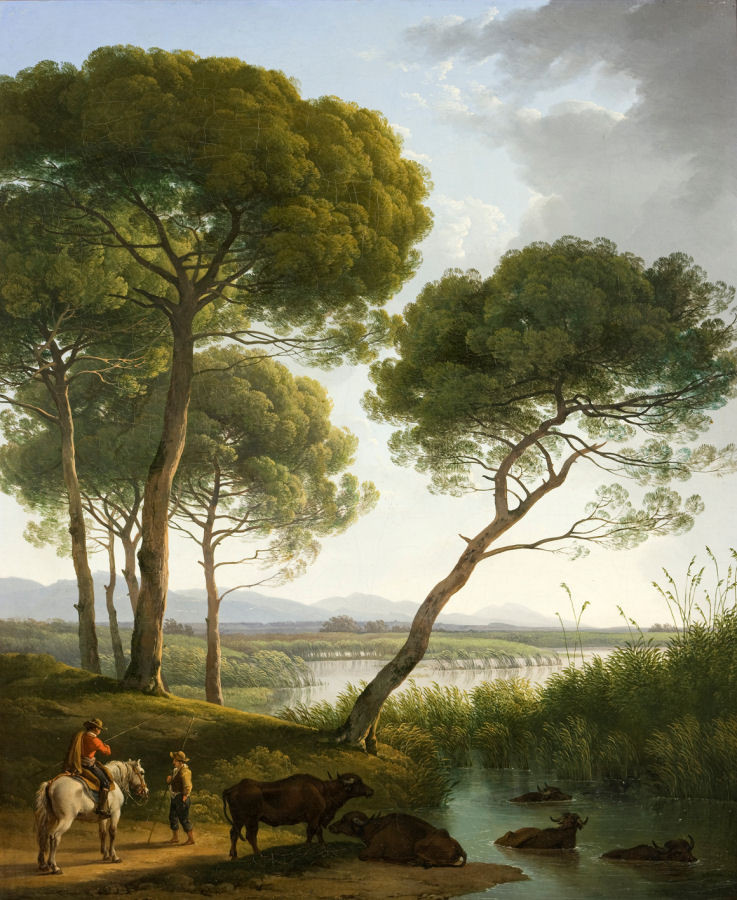
In this painting, Hendrik Voogd uses three elements that contribute to aerial perspective:
1. Contrast: The horse, people and trees in the foreground have plenty of contrast, and you can see lots of detail. The further back you look, the less contrast remains.
2. Saturation: The colours in the foreground are strongly saturated and there are more of them, while the colours in the distance are much less intense, until you see nothing but a pale white sky.
3. Choice of colour: The elements in the foreground have a red and yellow tint, while blue-grey dominates in the background.
And that last point was something I didn't know yet.
I only knew the first two.
So I looked up what exactly the combination of blue and red does. It turns out to be easy to explain, and especially easy to experience.
Take a look at the ovals below:
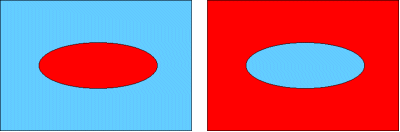
In the figure on the left, the red oval comes forward against the blue background. In the figure on the right, the blue oval recedes behind the red foreground.
This creates the illusion of 'front' and 'back', even though you're simply looking at a flat surface. And that's exactly what you're trying to do with a (flat) painting or photograph.
Back to Voogd's painting: the fact that the man on the left in the foreground is dressed in red is probably no coincidence, but a deliberate way of suggesting depth.
Little red cars
Sonja van Hamel discovered the same trick with red and blue: on old postcards, she kept seeing a little red car in the foreground. And then a blue sky in the background. She thought that couldn't be a coincidence.
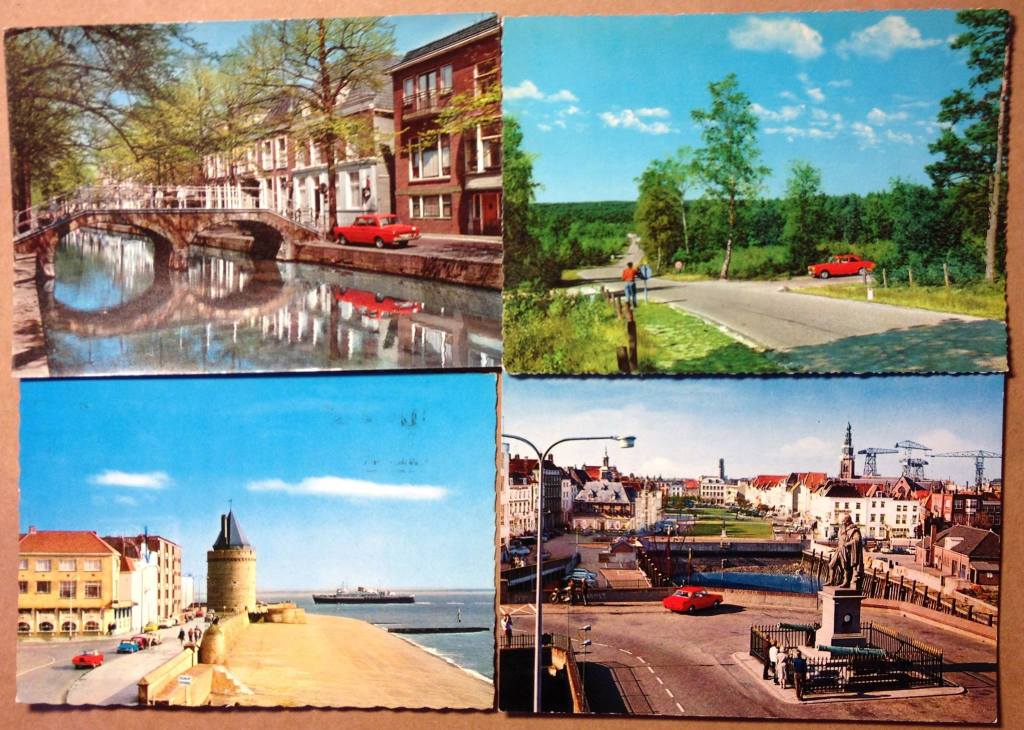
And indeed, it wasn't a coincidence. You can read more about it in this article.
But what do you do with this as a photographer?
A painter applies aerial perspective deliberately. A photographer works differently: they have to wait for the perspective to appear. The first step is therefore recognising it.
As soon as I see aerial perspective somewhere, I instinctively reach for my camera. For me, the photo then starts with the light, after which I look for an interesting scene.
So the light is my starting point, rather than the subject (you can find a step-by-step plan about that here).
An example from Taiwan:
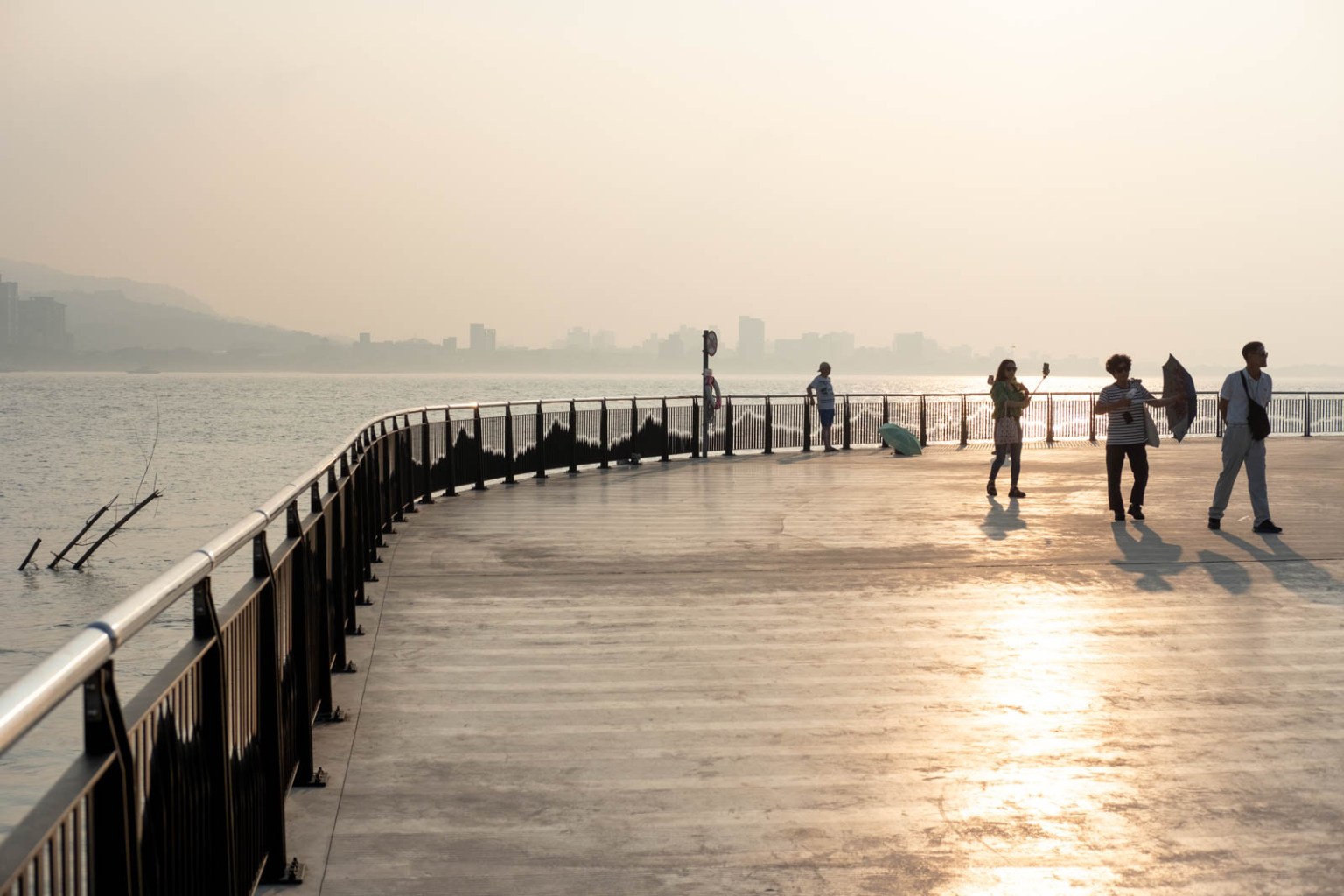
I saw the hills and the faded city in the distance combined with the bright, high-contrast foreground. I then did two things:
I positioned myself so that the railing on the left leads into the frame, creating a pleasant line for the eye to follow.
I waited until the people were standing sufficiently 'separately' and the shapes appealed to me, such as the umbrella being opened and the woman taking a selfie.
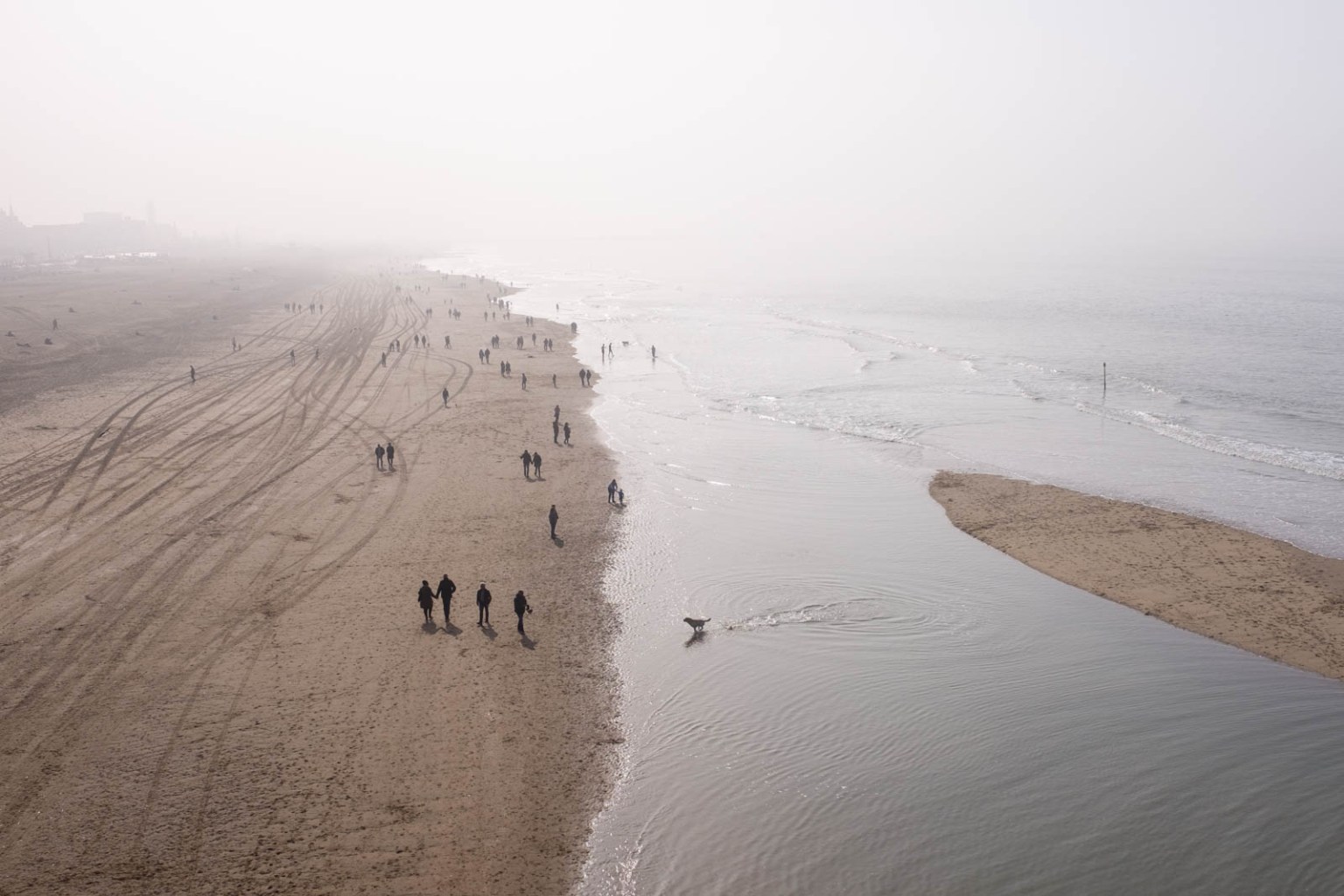
By the way, you don't necessarily need mountains for aerial perspective. I took the photo below in Scheveningen. The air is so full of moisture that it no longer knows whether it belongs with the sea or not. The horizon has completely disappeared. And that fading effect also falls under aerial perspective.
Without a name, it doesn't exist
Thanks to the term aerial perspective, I suddenly discovered something I had never noticed before. I saw it, but didn't register it. Now I do, and I suddenly recognise the blue and red trick everywhere. So I can apply it myself too.
Finally
There are various names for the phenomena mentioned above: colour, aerial and atmospheric perspective. I found a few more online.
Anyway, I don't know what exactly the 'correct' name is, or according to whom. What I do know is that once you're aware of these phenomena, you can recognise them. Only then can you use them in your photography, and that's what matters to me.
About the author
Ik heb een eigen fotografieblog, Kronkeling. Daar schrijf ik om de week twee artikelen. Over hoe je je blik kunt scherpen, je creativiteit kunt aanwakkeren, en over fotografen die mij inspireren. Geen technische zaken, wél over hoe je leert kijken. En dat blijkt nog een hele klus. Een mooi startpunt zijn de Kronkeltips, die vind je hier.
You might also like
-
 Classic paintings recreated as hilarious quarantine photos
by Michelle Peeters
-
 Paintshoot; playing with paint in the studio
by Elja Trum
-
 10 tips for light painting
by Liesbeth van Asselt
-
 Choose the right perspective
by Nando Harmsen
-
 Light painting: a creative form of photography
by Nando Harmsen
-
 Artist creates huge light painting with drones
by Elja Trum
10 comments
-

 Huub Keulers
wrote on Sunday 9 February 2020 at 09:33
| reply
Huub Keulers
wrote on Sunday 9 February 2020 at 09:33
| reply
Very good article, Elvira. I had heard of the term before, but that's where my knowledge ended. Thanks for sharing, you've made me a bit smarter again
Translated from Dutch.
-
 Elvira Smit
wrote on Sunday 9 February 2020 at 16:51
| reply
Elvira Smit
wrote on Sunday 9 February 2020 at 16:51
| reply
@Huubkeulers: always nice to hear, thank you!
Translated from Dutch. -
 Rob_Lisse wrote on Monday 10 February 2020 at 17:06
| reply
Rob_Lisse wrote on Monday 10 February 2020 at 17:06
| reply
I really enjoyed reading your article. I always look out for whether I see a coulisse landscape. I now understand that this is often enhanced by aerial perspective. But from now on I will also pay attention to whether I find aerial perspective without there being a coulisse landscape.
Translated from Dutch. -
Elvira Smit
wrote on Monday 10 February 2020 at 18:34
| reply
@Rob_Lisse: beautiful word, a coulisse landscape! I'll start paying attention to that from now on too
Translated from Dutch. -
 Robert wrote on Tuesday 11 February 2020 at 11:07 | reply
I could already achieve this effect a little, Elvira. Truly beautiful. However, I am always cautious with a red object in my photos. It immediately draws all the attention. Which is okay, if that's what you want.
Translated from Dutch.
By the way, "tasty" pictures...
Photo-shooting greetings, Robert -
 Eduard Kemperman wrote on Tuesday 11 February 2020 at 13:29 | reply
Thanks for your good article Elvira! I like taking photos of the Wadden too and then you get that effect as well. now I am aware of it
Translated from Dutch. -
Elvira Smit
wrote on Tuesday 11 February 2020 at 22:28
| reply
@Robert: Good addition, if you're not careful a red object indeed demands all the attention in a photo. And that is certainly not always the intention.
Translated from Dutch.
@Eduard Kemperman: Thank you! Indeed, the Wadden are perfect for seeing this effect - consciously or unconsciously - -
 guest wrote on Tuesday 11 February 2020 at 23:39 | reply
A good and educational article. Aerial perspective often brings a certain atmosphere to a photo. The question is, however, whether you should always make use of it when it is there. Particularly in landscape photography, you are regularly confronted with that aerial perspective. I often find it extremely annoying when you want to photograph a wide landscape with a lot of depth and then can only vaguely see things in the background. I also want to take photos that are crystal clear from front to back. In my opinion and experience, that aerial perspective occurs almost daily. If it isn't the mist or low-hanging clouds, then it is rising moisture due to the warmth. Aerial perspective, I only use it when I want to give a landscape photo a certain atmosphere. In other cases, I can do without it entirely.
Translated from Dutch. -
Marga wrote on Wednesday 12 February 2020 at 12:22 | reply
Never heard of it, but clearly explained. Nice !
Translated from Dutch. -
guest wrote on Thursday 13 February 2020 at 10:31 | reply
Delightfully readable article. Seeing it named and illustrated so clearly helps me control the effect better.
Translated from Dutch.
Have your say
Please note: Articles older than a week can only be commented on by signed-in visitors.Would you still like to comment? sign in or create a free account.
Become a better photographer every week
A practical photography tip in your inbox every week.
39,023 photography enthusiasts already receive the tips! More about the weekly mail. Or keep up to date via  Facebook.

Elja Trum
Photofacts; everything to do with photography!
Would you like to take better photos and keep up with what is happening in photography? Photofacts publishes articles that teach you something about photography — from a product announcement to a practical shooting tip or a look at a website. Photofacts covers photography every day and is a hobby project of Elja Trum's that got out of hand. The articles are written by a team of volunteer authors. If you would enjoy writing one or more articles for Photofacts, do get in touch.More about PhotofactsPhotofacts is made possible in part by
