
Photographing with a vintage (Helios) lens
Saturday 6 March 2021, 14:41 by Laura van der Burgt | 7,467 views | 4 commentsThis article was translated from Dutch with the help of AI. Read the original.
The fact that spring starts as early as February feels like an extra vitamin pill after a long winter. The snowdrops have barely had time to work their way up through the snow before they are already being pushed aside by the crocuses.
All those purple and yellow flowers in the garden, in the park and on the grass are lovely. You can't help but feel cheerful when you see such a colourful sight.
A great reason to get down lower with your camera.
Crocuses really call out to be photographed in a light and cheerful way. They are very suitable for high-key photography.
You get the best results when the flowers are in the shade and the sun is shining in the background. You then overexpose the flowers by 1 or 2 stops without the background becoming blown-out white.
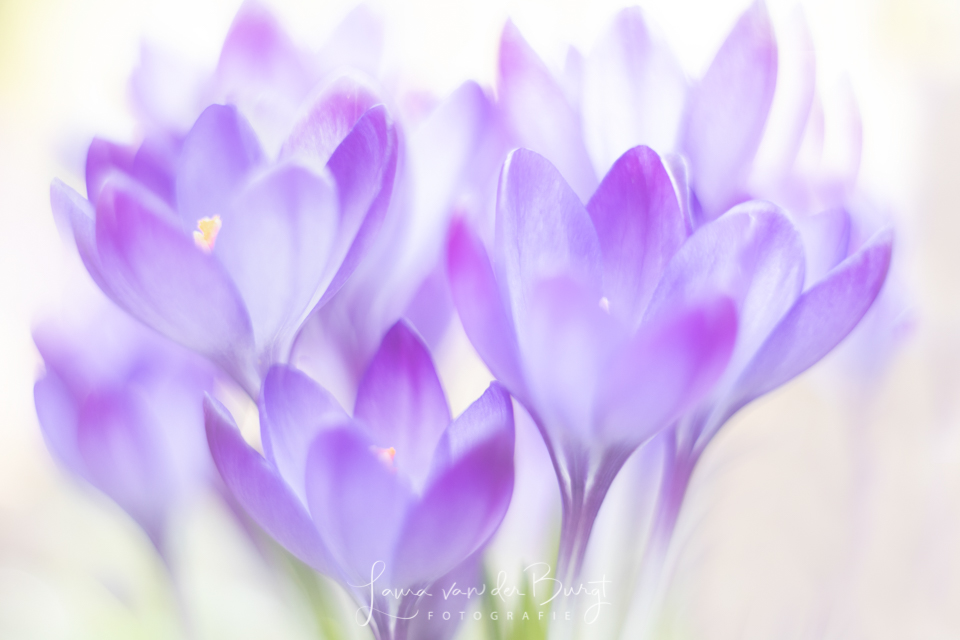
It is useful to photograph handheld, raising the ISO a little if necessary. When you set the ISO to 200 or 400 together with a wider aperture, you can photograph handheld in bright conditions.
This gives you complete freedom to look for beautiful light through your viewfinder.
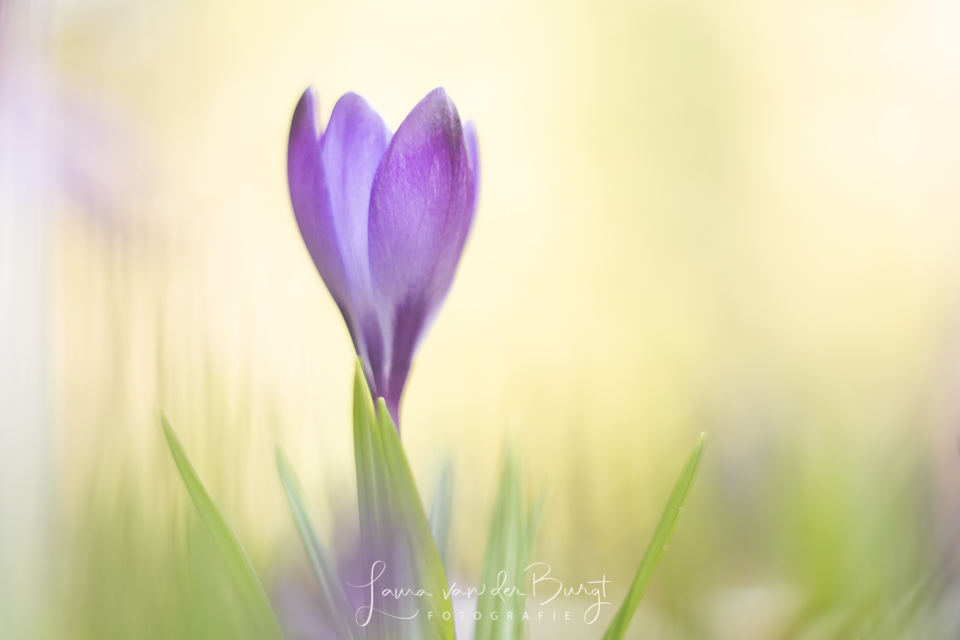
The bokeh balls in the background are particularly pleasing, for example. They give the image a festive and dreamy atmosphere.
It is also fun to hold your lens right up against the crocuses, so that you get distortion or a colour haze in the foreground. This lets you create interesting views through the flowers. But they are also beautiful when photographed in a minimalist way!
Depending on your taste, you can either keep everything sharp in the photo, or play with depth of field and the way the light falls. The aim is to look for images that appeal to you and sit somewhere between a record and the abstract.
It often works best to photograph in that order too. The longer you concentrate on a subject, the more you can vary your viewpoints.
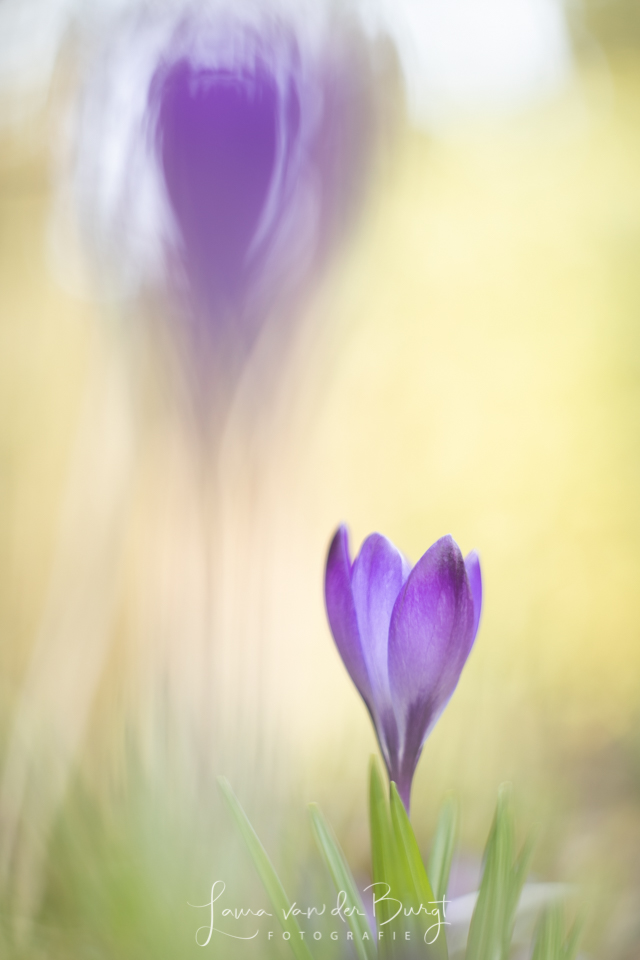
I hardly ever use a tripod for this playful way of working anymore. I enjoy holding the camera between the flowers and looking for an image that appeals to me.
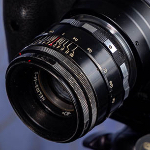
This time I chose to photograph with an old Russian lens, the Helios 44. You can buy these second-hand and pick one up for a reasonable price.
The controls are fully manual. There is no autofocus, and you also set the aperture by hand. The camera does show the correct exposure, so that is a useful bonus.
If you are used to photographing fully automatically, this takes some getting used to. However, this way you go back to the (analogue) basics. The difference is that your images are stored digitally.
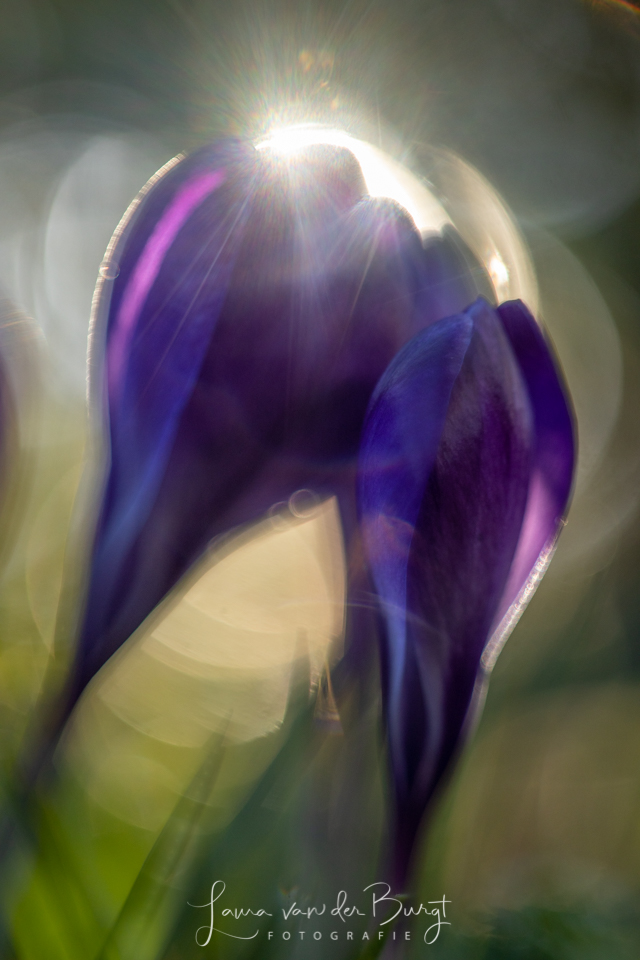
The Helios 44 is known for its soft, dreamy images. The bokeh is especially popular. You get this by making sure that filtered light falls in the background. For example, sunlight falling between bushes or through the canopy of the trees.
At this time of year, you are best looking for your subject near a bush or something similar. Here, the photo is strongly underexposed and the sun gives it a romantic edge.
Hold your camera as low as possible and point the lens slightly upwards. It then takes some searching to get the balls into your viewfinder or onto your screen. The challenge is to mould the whole thing into a beautiful image.
Something I really enjoy doing myself. Every movement of the camera creates a different image. It is wonderful to give your creativity free rein in this way. And if the photos turn out well too, you couldn't be happier.
The Helios is a Russian lens, for which you need an adapter to make it suitable for your camera. The mount on these old lenses is often M42. So you need an M42 to, for example, a Canon mount.
It is a 58mm lens! For macro and close-up photography, it is best to use extension tubes. Either ones that fit your camera or extension tubes with an M42 mount (approx. 10 euros).
If you want more technical background, this article on Tweakers is very enlightening because it explains the symbols on the front of the lenses. This way, you know exactly what to look for.
About the author
Natuurfotografie is voor Laura een samensmelting van het ongelooflijk genieten van in de natuur zijn en haar passie voor fotografie. Het fotograferen met een minimale scherptediepte is favoriet en ook trekt ze er vaak met de lensbaby op uit.
You might also like
-
 Bringing Spring to Life in Photos
by Nando Harmsen
-
 Spring in pictures - photos from our Photofacts Academy community
by Nando Harmsen
-
 Photographing with the Helios 44
by Nando Harmsen
-
 10 tips for photographing with a vintage lens
by Nando Harmsen
-
The follow-up to photographing with a vintage lens
by Nando Harmsen
-
 Review: SmallRig RM-03 Macro Photography LED lights
by Nando Harmsen
4 comments
-
 Anneke van Prooijen wrote on Tuesday 9 March 2021 at 10:47 | reply
Nice, inspiring piece Laura!
Translated from Dutch. -
 Jolanda Bosselaar wrote on Tuesday 9 March 2021 at 14:33 | reply
Hi Laura, very well described. You can really read your passion for photography in it!
Translated from Dutch. -
 Dianne wrote on Tuesday 9 March 2021 at 19:21 | reply
What a delightful set of photos again and an inspiring, certainly challenging story about the Helios. We’re getting back to work with the upcoming flowers and insects. Curious to see what your inexhaustible creativity brings again and how it challenges photographers to experiment with the different lenses, but certainly just as important to experience the feeling of enjoyment while photographing. Great that you also want to share this!
Translated from Dutch. -

 Laura van der Burgt
wrote on Wednesday 10 March 2021 at 11:51
| reply
Laura van der Burgt
wrote on Wednesday 10 March 2021 at 11:51
| reply
@ Anneke
Translated from Dutch.
@ Jolanda
@ Dianne
Always nice and motivating to get reactions from skilled and driven photographers Thanks a lot!
Have your say
Please note: Articles older than a week can only be commented on by signed-in visitors.Would you still like to comment? sign in or create a free account.
Become a better photographer every week
A practical photography tip in your inbox every week.
39,079 photography enthusiasts already receive the tips! More about the weekly mail. Or keep up to date via  Facebook.

Elja Trum
Photofacts; everything to do with photography!
Would you like to take better photos and keep up with what is happening in photography? Photofacts publishes articles that teach you something about photography — from a product announcement to a practical shooting tip or a look at a website. Photofacts covers photography every day and is a hobby project of Elja Trum's that got out of hand. The articles are written by a team of volunteer authors. If you would enjoy writing one or more articles for Photofacts, do get in touch.More about PhotofactsPhotofacts is made possible in part by
