
Seeing and photographing reflections
Monday 20 February 2023, 14:41 by Erik Nevels | 5,640 views | 8 commentsThis article was translated from Dutch with the help of AI. Read the original.
You need a mirror for reflections. In nature, you find one in the form of water. The smoother the surface, the more mirror-like it is.
Yet on a windless day, I often walk past without noticing the reflections. Only when I take the time to really look into the mirror do I see them.
Water
As mentioned, still water makes an ideal mirror. With a perfectly smooth surface, it reflects whatever you can see above the water. The only difference is that everything is upside down.
That is of course disorientating, but that is exactly what makes it interesting to photograph. It makes the viewer think. How can this be? What am I looking at?
Even when the surface is not completely smooth because of movement or wind, it can produce surprising images.
Movement
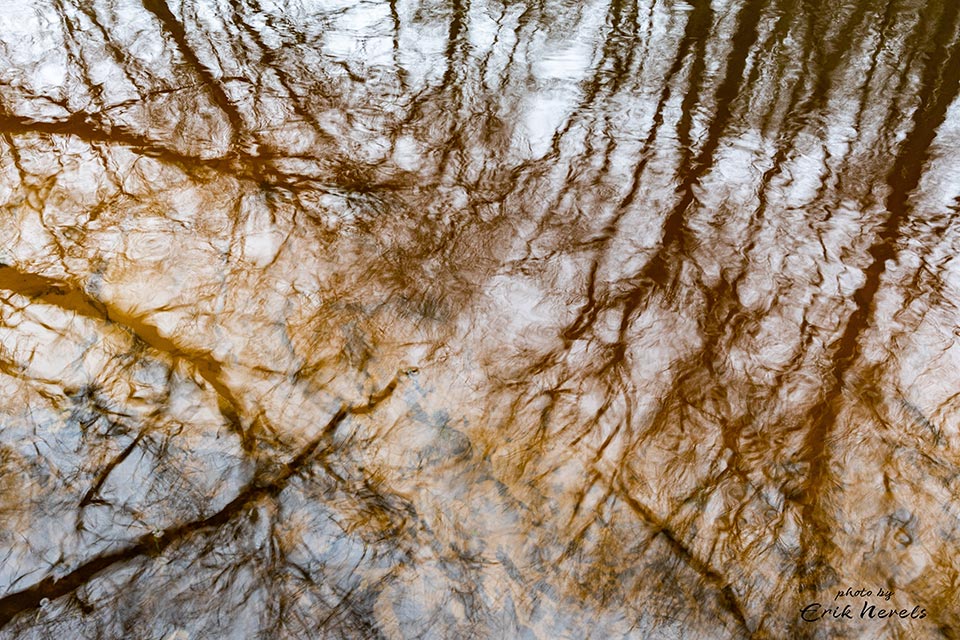
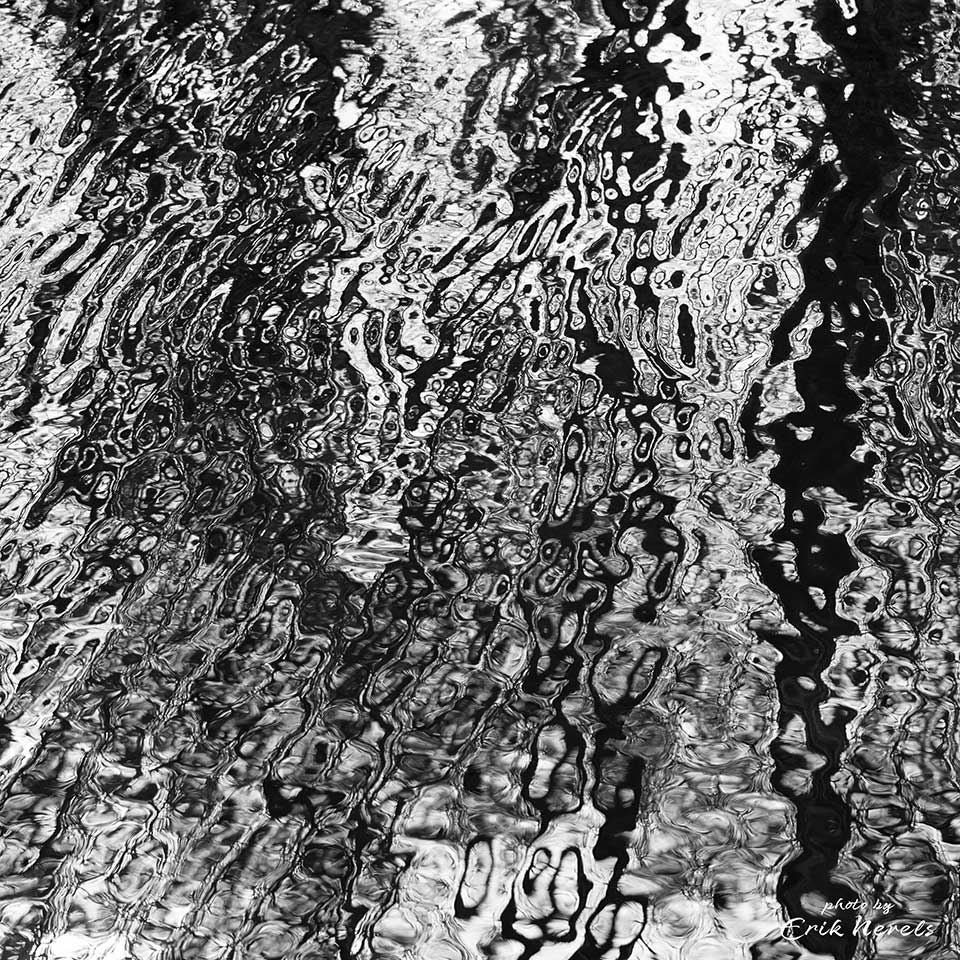
The more movement there is in the water, the less clear the reflection becomes. The actual subject becomes less and less recognisable, while the level of abstraction increases. Eventually, the abstraction becomes so great that the original subject is no longer recognisable.
Upside down
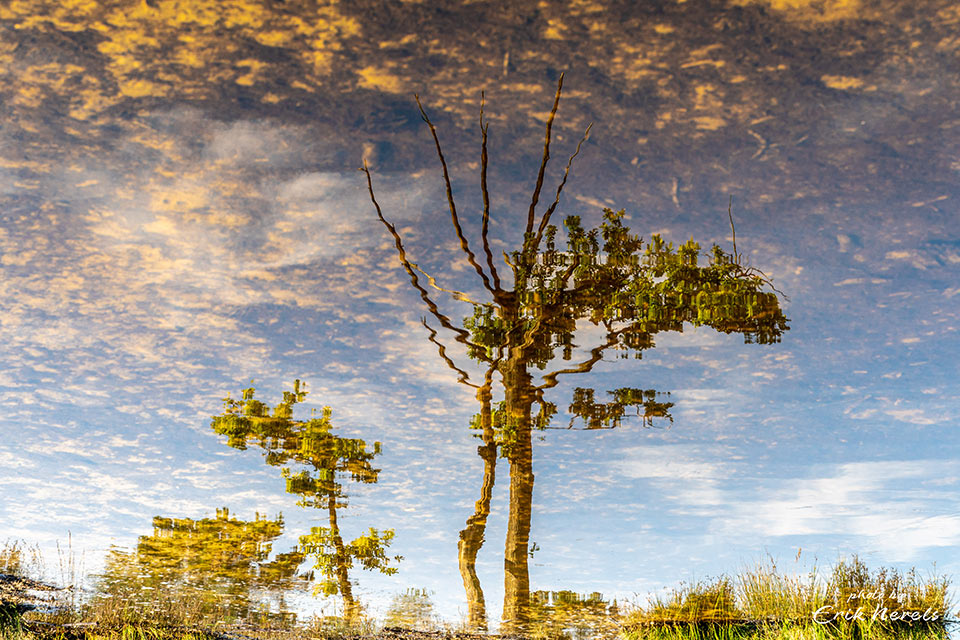
It is also disorientating when I turn the photo upside down. Reality is then being 'violated', but also not really. The tree reflected in the water, which is upside down, is suddenly the right way up.
Especially when the reflection is not perfect, this produces unusual, sometimes slightly surreal images.
Dirty mirror
The chance of getting a perfectly reflective water surface is not very high. It is not just wind, but also movement and objects on the surface that disturb the mirror image, so to speak.
Yet these disturbances do not always stop me from taking a photo. I can remove small objects such as a twig or fallen leaf on the water later in post-processing. I can smooth out movement by using a long shutter speed, as in the following photo.
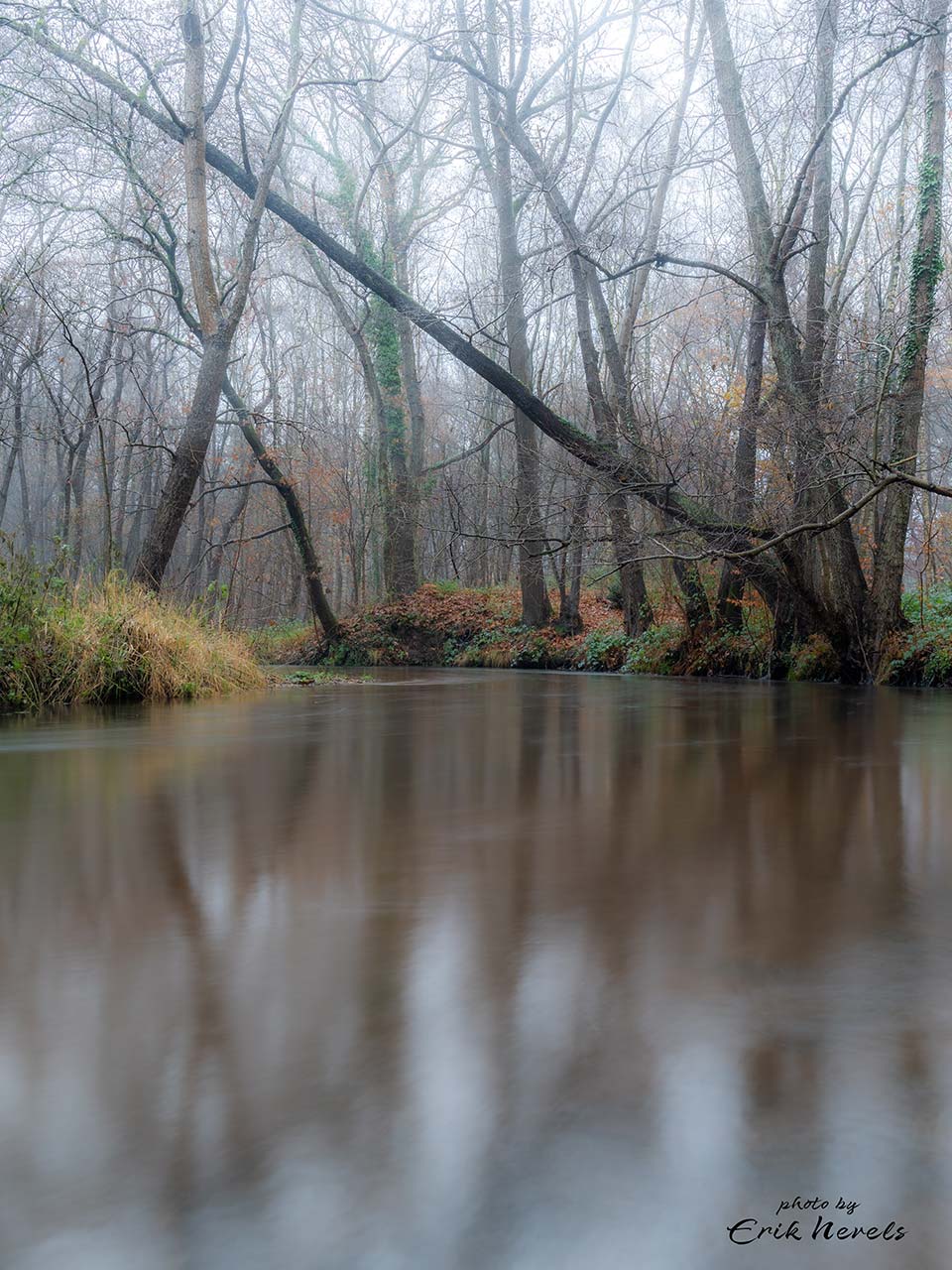
Beegderheide[/imgbox]
Puddles
Puddles that you literally come across on your path can also be very interesting. At first, the puddle I see on the path in front of me after the heavy rain of the past few days seems mainly like an obstacle.
There are a few oak trees beside the path, so I walk around the puddle on the other side. At the height of the oaks, I notice the unusual reflection.
The leaves on the bottom of the puddle reflect differently on the trunks and the sky. Back home, I just turn it upside down and hey presto!
.jpg "Meinweg")
Symmetry
When I see a nice subject in or on the water, I actually have three choices. I can photograph only the subject, such as a beautiful tree standing on the bank. Or I can photograph only its reflection in the water.
The third choice is to capture both in one photo, the subject and its reflection.
If the subject is on the water, choice three is the obvious one, creating symmetry around a horizontal centre line.
You do need to make sure that this line is perfectly horizontal. If I do not, I get a crooked reflection, although I can still straighten the centre line later in post-processing.
.jpg "Dorperheide")
Broken mirror
In winter, water sometimes turns to ice. The mirror effect is often still there, but in a different form. The ice can be perfectly smooth. It can show cracks, as if the mirror were broken.
Only part of the water may be frozen, resulting in two different mirrors. Either way, ice is always interesting when you are looking for reflections.
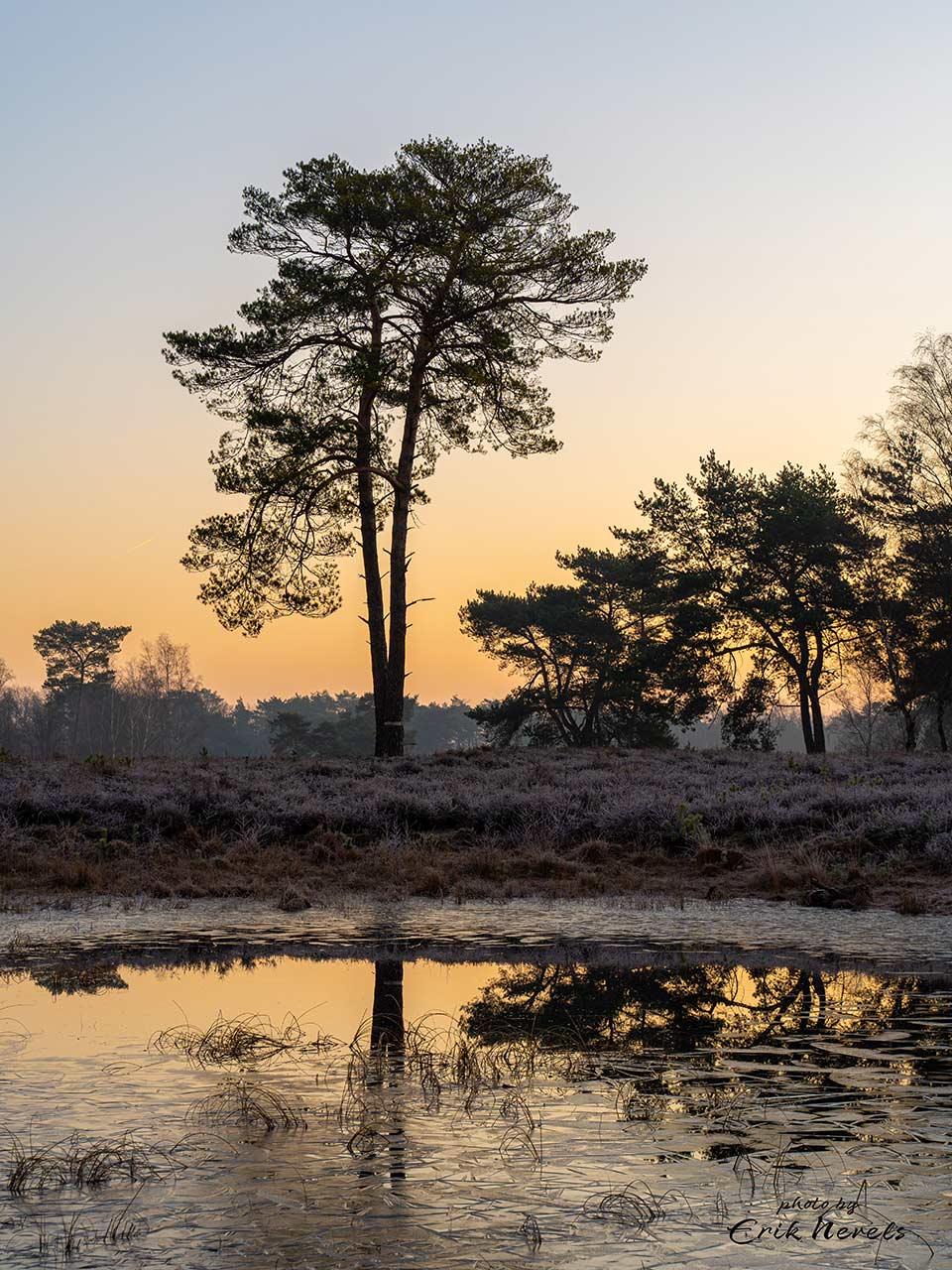
Guessing game
I spy with my little eye! You can also play the old guessing game yourself when you go out taking photos. You can do this not just in nature, but almost anywhere.
There are reflective surfaces everywhere. The art of seeing is what it is all about.
Who knows, after reading this blog you may look more deeply into mirrors. I am sure you will be surprised more than once.
About the author
Steeds weer boeiend en op zoek naar de essentie! Dat is wat fotograferen in de natuur voor mij is. Gefocust op het landschap of het onderwerp in diens omgeving tracht ik meer dan alleen te registreren. Een continue uitdaging waarvan ik elke keer volop geniet. Meer foto's? Volg mij op Instagram en/of kijk op mijn website
You might also like
-
 Photographing reflections in water
by Nando Harmsen
-
 Street photography tip: Reflections are everywhere, use them
by Michiel Heijmans
-
 Control reflections with a polarising filter
by Erik Nevels
-
 Portrait photography tip: use a window's reflection
by Elja Trum
-
 Street photography tip: Use water for surprising compositions
by Michiel Heijmans
-
 Sports photography tip: Creating an abstract sports photo
by Nico Delmeire
8 comments
-
 Guido wrote on Tuesday 21 February 2023 at 10:53 | reply
Beautifully fascinating and well illustratred article.
Translated from Dutch.
I also like making mirrored images. The illustrations with this article and the text give mijk extra motivation for a few new photos. -
 Donald Willemsen wrote on Tuesday 21 February 2023 at 10:57 | reply
A surprisingly nice article to read. It gives you ideas. The illustrative photos are beautiful and surprising, especially if you turn them around.
Translated from Dutch.
But I have another idea that you may not have thought of yet. You know that with a polarizing filter you can completely eliminate the reflection. Precisely because a polarizing filter can be rotated, you can also influence the reflection. It's not about getting rid of the reflections, but about adjusting them. That can then book again produce special effects. -
 Sigrid Cogneau wrote on Tuesday 21 February 2023 at 10:59 | reply
Hello, I think these photos are impressive. I have always been looking for such unusual images. About five years ago I experimented with mirrored effects myself and I really enjoyed it.
Translated from Dutch. -
 Gert van Eck wrote on Tuesday 21 February 2023 at 12:46 | reply
Nice to read and well illustrated. I find it inspiring again. Thank you!
Translated from Dutch. -
 Daan wrote on Tuesday 21 February 2023 at 13:22 | reply
Very nice to read! I never thought to look at the different types of reflections this way.
Translated from Dutch. -

 Erik wrote on Tuesday 21 February 2023 at 21:58
| reply
Erik wrote on Tuesday 21 February 2023 at 21:58
| reply
@Donald. Thanks for your positive response. As for the use of a polarizing filter, what you say is correct. You can (partly) remove the reflection. However, I deliberately did not mention it in this blog because I want to devote a separate blog to it. In this blog I only wanted to discuss and show, so to speak, the pure reflection.
Translated from Dutch. -
 Liesbeth Verkade wrote on Tuesday 21 February 2023 at 22:28
| reply
Liesbeth Verkade wrote on Tuesday 21 February 2023 at 22:28
| reply
Thank you for this fascinating article. I myself enjoy taking photos near water, especially because of the reflections. You have given me some interesting ideas to experiment with.
Translated from Dutch. -
Donald Willemsen wrote on Wednesday 22 February 2023 at 07:07 | reply
@Erik, thank you for your response. I’m curious about your blog on using the polarizing filter to control reflections. What I did miss in your blog about reflections, though, were examples of reflections from windows and other shiny surfaces such as in modern architecture. But you’re more of a nature photographer, so I don’t hold it against you
Translated from Dutch. .
.
Have your say
Please note: Articles older than a week can only be commented on by signed-in visitors.Would you still like to comment? sign in or create a free account.
Become a better photographer every week
A practical photography tip in your inbox every week.
39,077 photography enthusiasts already receive the tips! More about the weekly mail. Or keep up to date via  Facebook.

Elja Trum
Photofacts; everything to do with photography!
Would you like to take better photos and keep up with what is happening in photography? Photofacts publishes articles that teach you something about photography — from a product announcement to a practical shooting tip or a look at a website. Photofacts covers photography every day and is a hobby project of Elja Trum's that got out of hand. The articles are written by a team of volunteer authors. If you would enjoy writing one or more articles for Photofacts, do get in touch.More about PhotofactsPhotofacts is made possible in part by
