

Control reflections with a polarising filter
Monday 17 April 2023, 20:02 by Erik Nevels | 6,150 views | 11 commentsThis article was translated from Dutch with the help of AI. Read the original.
In my previous blog, I wrote about seeing and photographing reflections. This blog is about controlling reflections. I use a polarising filter for this. By turning it, the filter gradually removes the reflections.
Using it
The polarising filter is mainly known for its effect on typical Dutch skies with blue and clouds.
By turning the filter, you can see when the scattered light from the blue sky is blocked the most. The result is more contrast, the blue becomes darker, while the white stays white.
In this blog, I am showing you photos where the sky is not (directly) in view. These are surfaces that reflect light and on which the polarising filter also works.
Discipline
Until recently, I used my polarising filter very little. I simply forgot about it and left it in my camera bag.
Once I was home at my PC, the sometimes distracting reflections could no longer be corrected, so I became more aware of the need to use it and developed the discipline to do so.
Control
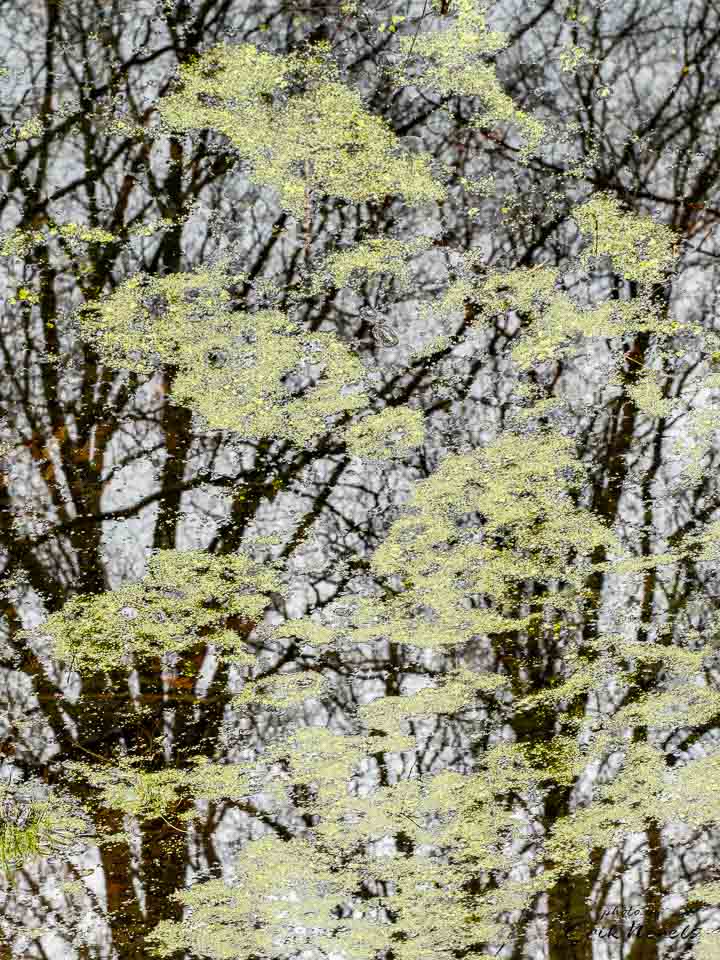
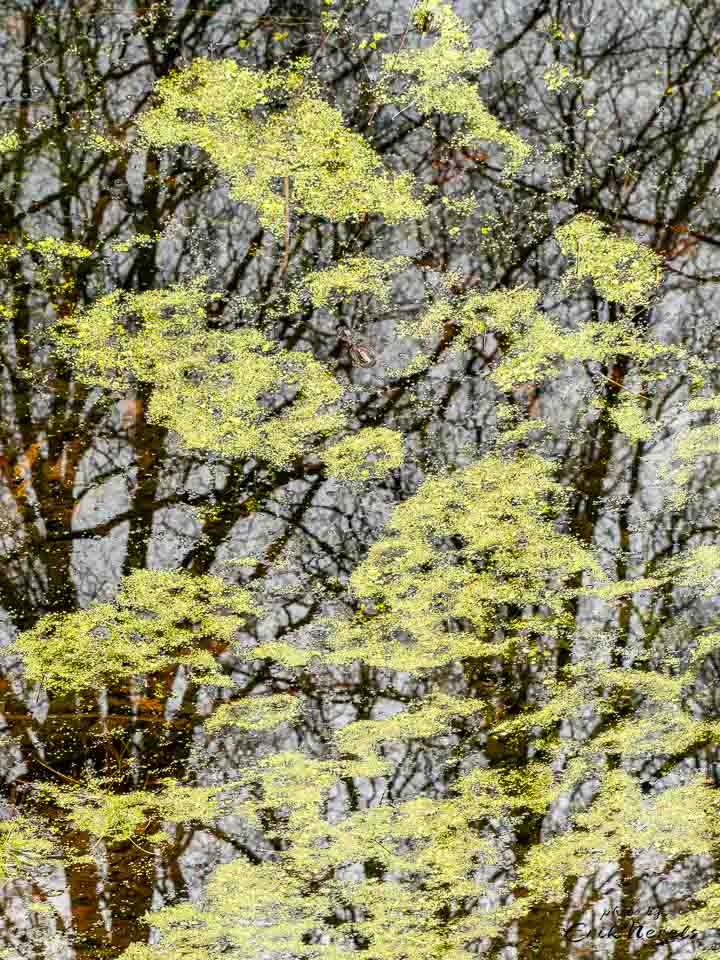
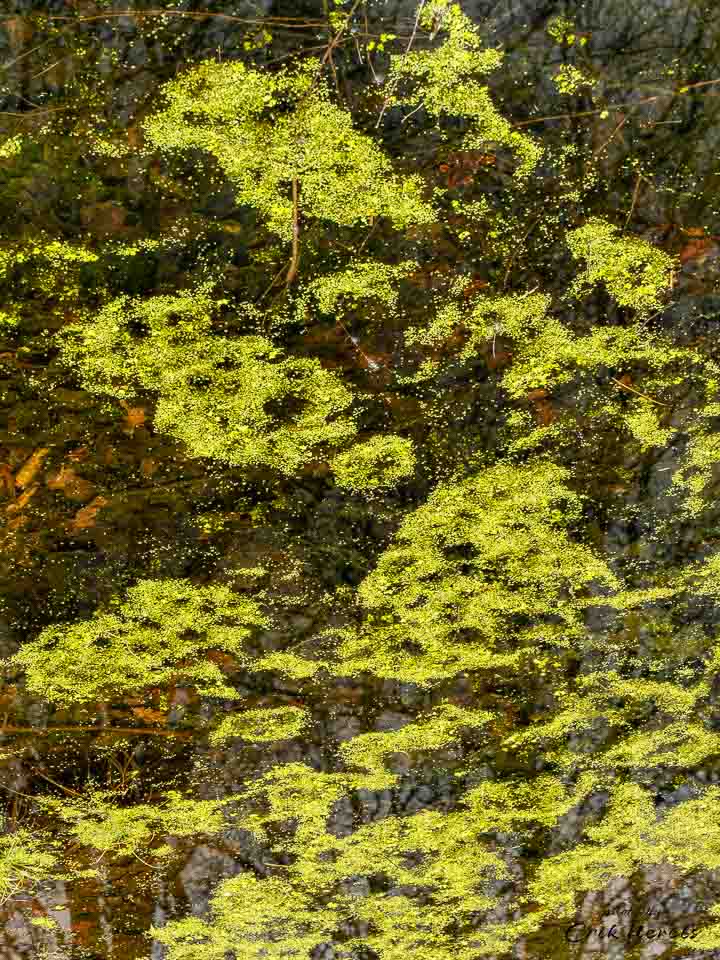
My eye is drawn to the bright green duckweed, with structures that demand a photo. It is already later in the morning. Both the surface of the water and the damp duckweed reflect the light shining through the still bare trees.
It is a scene where using the polarising filter will certainly have an effect. I put the camera on a tripod and carefully screw the filter onto the lens.
Once I have decided on the composition and settings, I get to work with the filter. As I said, I can turn it. More precisely, this applies to the front element, which contains the glass.
Looking at my screen, I turn it slowly and see the reflections disappear, then increase again as I continue turning.
So it comes down to the filter blocking anything from a minimum to a maximum amount of light, depending on its position. By turning it, I control the reflections, and that makes quite a difference in this image. Which do you prefer?
Looking underwater
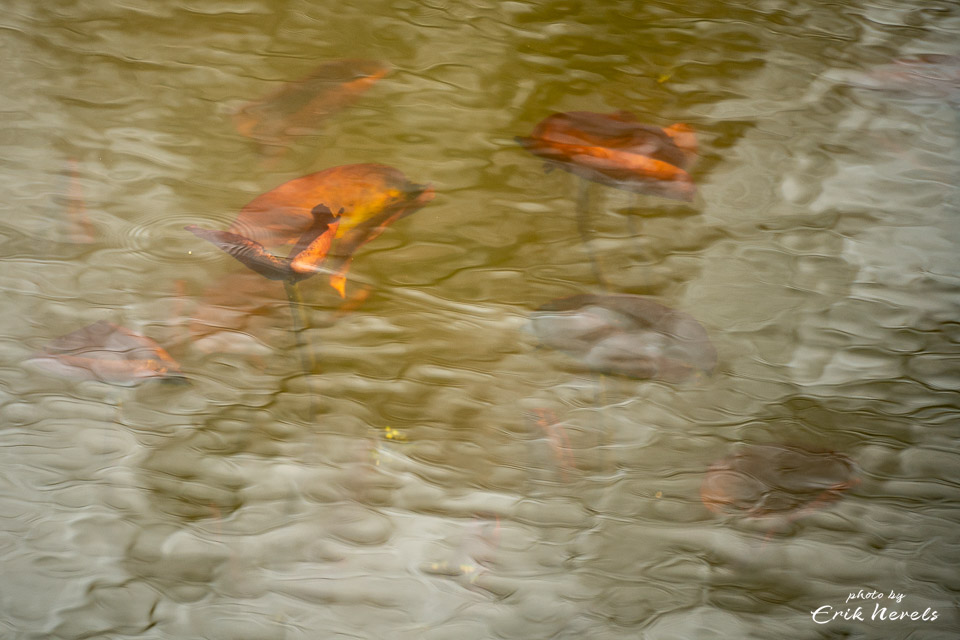
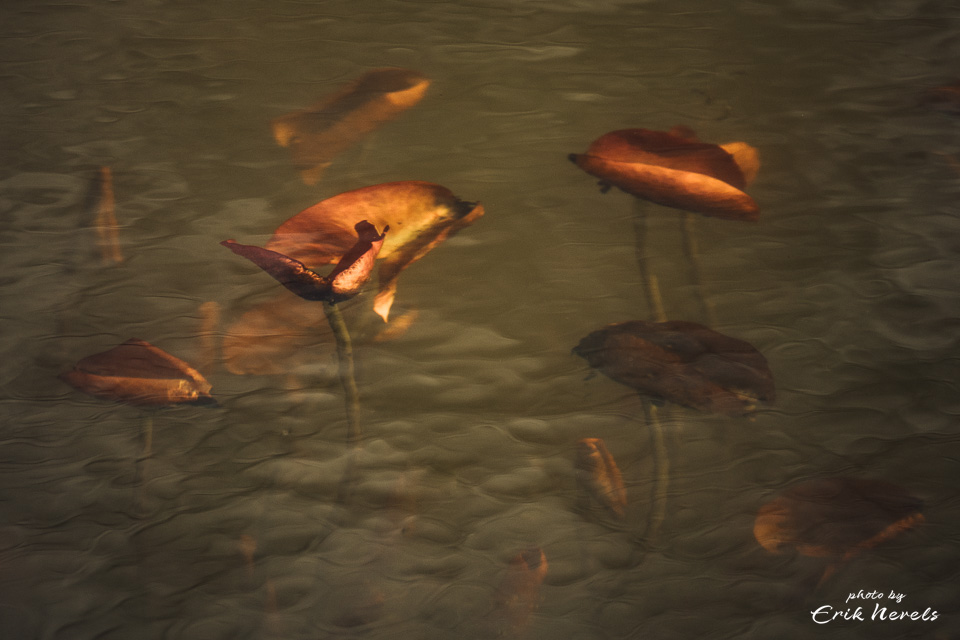
There is hardly any wind and the surface of the pond is fairly smooth. Just below the surface, I see reddish-brown water lily leaves. At the same time, I see the surface reflecting the light from the sky, partly obscuring the view of the lily leaves.
Because the distance to the scene is quite considerable, I get out my telephoto lens, and with the help of an adapter ring, my filter holder also fits this lens.
Once again, I put the camera on a tripod and first make sure I have the desired composition and settings. Then I give it another turn.
I continue to be surprised by the effect of the filter. This case is no different, as I can literally look underwater when the filtering effect is at its maximum.
I do not turn it any further, but before taking the photo I check the exposure. After all, the filter takes away some light. The photo is now darker, but I think the exposure of the leaves is good, so I do not need to adjust the settings.
45° and 90°
The effect of the polarising filter is greatest at an angle of 45° to the water. If you photograph the blue sky, an angle of 90° to the sun is most effective.
So be careful when using a polarising filter with (extreme) wide-angle lenses, because the filtering effect decreases towards the edges.
With a blue sky photographed at 90° to the sun, this means dark blue in the centre and increasingly lighter blue towards the edges. In those cases, you are better off photographing without this filter.
Subtle differences
Smooth, wet, damp or slimy surfaces also easily reflect white daylight. You often find such surfaces in nature. The reflection is often very subtle, and my eyes barely notice it.
Only when I use the polarising filter do the (small) differences become visible. Nevertheless, it is often worth using the filter. Here are a few examples.
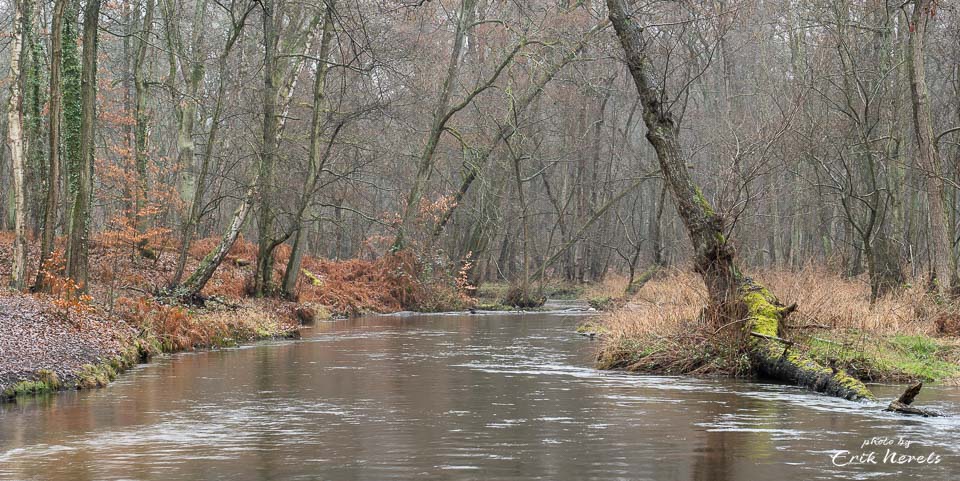
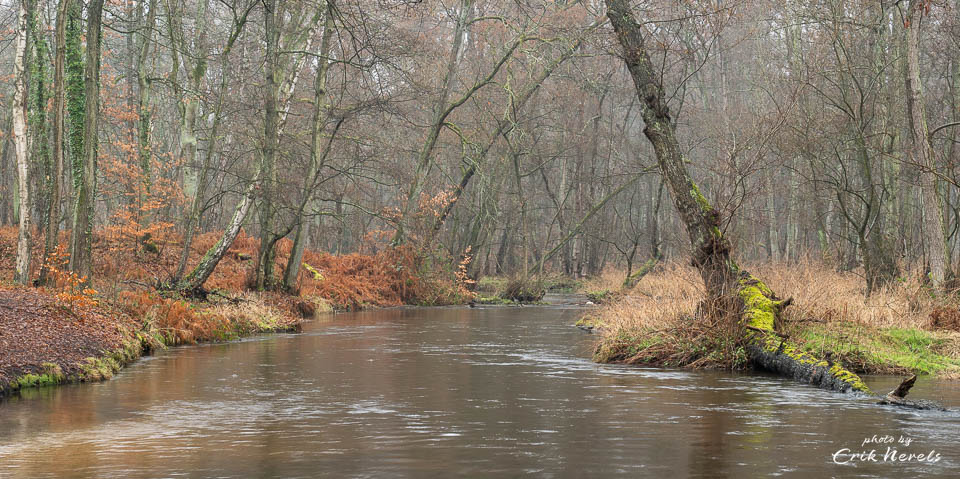
The first photo was taken without a filter. You can see the difference with photo two particularly clearly on the left bank. The damp leaves and the equally damp moss-green surface reflect the white daylight, creating a light sheen.
In photo two, that sheen has been filtered out and the leaves and moss have more colour.
Another example. A small group of fungi on a dead tree trunk. The first photo was taken without a polarising filter, and the smooth black top reflects the light coming from above, giving the cap a white sheen.
Only when I use the filter do I see the difference. It is subtle, but still clearly visible. In this case too, I think using a polarising filter is worthwhile.


Good habit
Do you have a polarising filter, but does it often stay in your bag or even at home? Then this blog might give you the drive to screw it onto your lenses more often.
It takes a little effort, but the effect on reflections can range from subtle to astounding. So if you want to control those reflections, try a polarising filter. Simply turning the filter can definitely give your photo a positive twist.
About the author
Steeds weer boeiend en op zoek naar de essentie! Dat is wat fotograferen in de natuur voor mij is. Gefocust op het landschap of het onderwerp in diens omgeving tracht ik meer dan alleen te registreren. Een continue uitdaging waarvan ik elke keer volop geniet. Meer foto's? Volg mij op Instagram en/of kijk op mijn website
You might also like
-
 Use polarisation for autumn photography
by Nando Harmsen
-
 Take a polarising filter with you more often
by Nando Harmsen
-
 Seeing and photographing reflections
by Erik Nevels
-
 Clearer photos with polarisation
by Nando Harmsen
11 comments
-
 Donald Willemsen wrote on Tuesday 18 April 2023 at 11:08 | reply
A good and clear story. But when is a reflection distracting? It often seems to me to be a personal assessment, a matter of taste too. It of course also depends on the subject.
Translated from Dutch.
That is why I say: Know when to use a polarizing filter and when in doubt, take some more photos with and without the filter. -
 MARCEL wrote on Tuesday 18 April 2023 at 15:56 | reply
I still have a UV filter on all my lenses; would it be advisable to always install a polarizing filter as well?
Translated from Dutch. -

 Erik wrote on Tuesday 18 April 2023 at 17:52
| reply
Erik wrote on Tuesday 18 April 2023 at 17:52
| reply
@Marcel.
Translated from Dutch.
I don't use UV filters myself. They don't improve the quality of the lens, rather the opposite. I also wouldn't recommend using a combination of two filters because that leads to a loss of image quality and also creates a risk of vignetting with wide-angle lenses.
Using a polarizing filter all the time is certainly not advisable. As I already said with the 3 photos of the duckweed, the photographer, or rather the viewer, determines what they like. So choose to use it consciously. If you actually want reflections to be visible, leave it off. If you want to filter them out (partly), use it. Good luck! -
Donald Willemsen wrote on Tuesday 18 April 2023 at 16:35 | reply
@Marcel, you don't always need a polarizing filter on your lens, because you don't always have to deal with reflections. You only use a polarizing filter to remove annoying reflections and glare.
Translated from Dutch.
In my opinion, a UV filter is also completely useless. They are supposed to protect the front lens. That argument is used to sell UV filters and they often then push a cheap filter on you for around €10. If you have a very good quality lens, such a cheap UV filter reduces the quality. If it gets scratched, you can throw it away. A decent lens hood protects your lens much better.
Also keep in mind with a polarizing filter that it cuts out light and may make it necessary to adjust the camera settings to get a good exposure. -
 Jo VP wrote on Tuesday 18 April 2023 at 16:56
| reply
Jo VP wrote on Tuesday 18 April 2023 at 16:56
| reply
Be careful when screwing filters onto each other, you might find that they are difficult or impossible to get apart again. With filter holder systems, you of course don't have this problem.
Translated from Dutch. -
 martinphili wrote on Tuesday 18 April 2023 at 19:10
| reply
martinphili wrote on Tuesday 18 April 2023 at 19:10
| reply
When photographing cars, which is mainly what I do, it is damn useful to have a polarizing filter on your lens. Just keep in mind that it can sometimes cost you two stops in exposure.
Translated from Dutch. -
 Paul wrote on Thursday 20 April 2023 at 09:53 | reply
Good piece.
Translated from Dutch.
Have had polas in my camera bag since the late 60s. Yet I often forget it, actually because I've become too lazy, and because I first have to take off the lens hood, which, if used together, gets quite in the way. In 69 the lens hood, which was still round, was screwed onto the filter, much easier😉 -
Paul wrote on Saturday 22 April 2023 at 11:54 | reply
The other responses already said it too, filters shouldn’t remain permanently attached to a lens (actually, we should say lens) . Certainly not a polarizer, that’s a thicker one with two pieces of glass and a film, if it isn’t needed, it really should be removed, that UV filter, promoted by many photo retailers for years as 'necessary to protect your front element', only makes some sense at high altitudes, e.g. in the mountains, otherwise it’s only in the way.
Translated from Dutch. -
 Lauran wrote on Saturday 22 April 2023 at 20:42 | reply
A polarizing filter can be damn useful in certain situations. Not to be confused with the UV filter. On professional cameras, this is already replaced by leaving out the bypass filter for the sensor.
Translated from Dutch.
If you still want to use a protection filter, get a good multicoated filter. A lot more expensive, of course. -
Donald Willemsen wrote on Saturday 22 April 2023 at 21:01 | reply
@Paul, totally agree.
Translated from Dutch. -
Donald Willemsen wrote on Sunday 23 April 2023 at 20:03 | reply
@Lauran, you're right and I bought such an expensive UV filter for 50€ a few years ago. Yet I noticed a difference between photographing with and without that filter. So I don't use UV filters anymore. You shouldn't do it for the coating, because good lenses often have good coatings too. So it doesn't make sense. Come on, spending a lot of money to protect your front lens is a waste of money if you can also protect the front lens with a decent lens hood?
Translated from Dutch.
Have your say
Please note: Articles older than a week can only be commented on by signed-in visitors.Would you still like to comment? sign in or create a free account.
Become a better photographer every week
A practical photography tip in your inbox every week.
39,077 photography enthusiasts already receive the tips! More about the weekly mail. Or keep up to date via  Facebook.

Elja Trum
Photofacts; everything to do with photography!
Would you like to take better photos and keep up with what is happening in photography? Photofacts publishes articles that teach you something about photography — from a product announcement to a practical shooting tip or a look at a website. Photofacts covers photography every day and is a hobby project of Elja Trum's that got out of hand. The articles are written by a team of volunteer authors. If you would enjoy writing one or more articles for Photofacts, do get in touch.More about PhotofactsPhotofacts is made possible in part by
