

Was the Minox A IIIs Really the Perfect Spy Camera?
Tuesday 8 August 2017, 17:17 by Michelle Peeters | 6,525 views | 0 commentsThis article was translated from Dutch with the help of AI. Read the original.
George Lazenby (as James Bond) uses a Minox A/IIIs spy camera in the film On Her Majesty's Secret Service (1969).
As Blofeld's headquarters on Piz Gloria is destroyed, he photographs a map showing where the girls with the deadly biological weapon have been sent.
Upside down
An expert immediately notices that Bond is holding the camera upside down while taking the photographs. That would not necessarily be too bad in itself, but he does not seem to press the shutter release at all.
Sliding the camera open and shut, as Bond does, only advances the film after taking a photograph. It does not take the photograph.
In the film, we also see the view through the viewfinder. The rectangle looks a little like the rectangle that is actually built into the camera's viewfinder, except that it should be white, not blue.
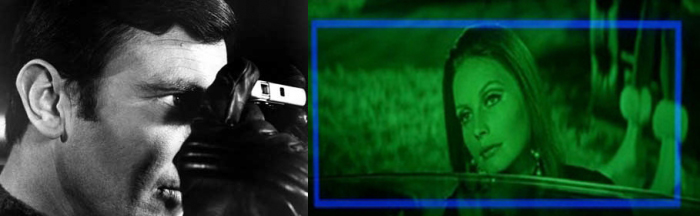
The image Bond sees is green. The camera does have a green filter built in that can be slid in front of the lens, but this should not be visible through the viewfinder, since the filter is only placed in front of the lens, not the viewfinder.
The camera seen in the film could be one of the last models of this type, since production of the A/IIIs was discontinued in the same year the film was released.
Walter Zapp
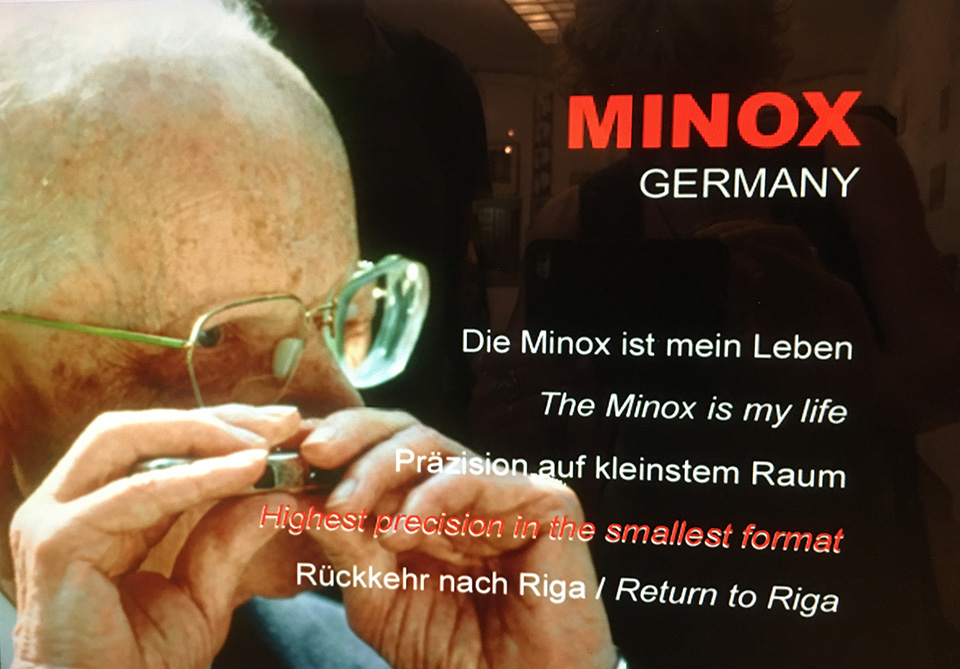
The Minox is the brainchild of Latvian engineer Walter Zapp. I happened to come across the little camera in the photography museum in the Latvian capital Riga, where the factory (VEF) was also located.
Walter Zapp wanted to make a portable camera that would fit easily in the palm of a hand while still being able to take high-quality photographs.
Spy camera
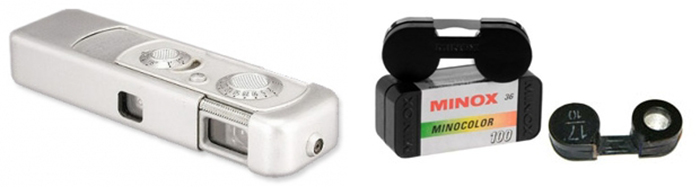
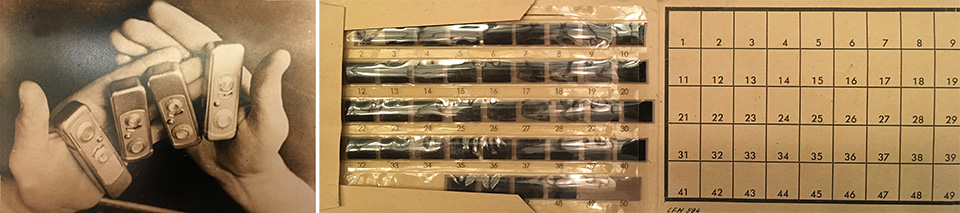
The Minox mini camera, in all its variants, was the most popular camera among spies for many years. The Minox A/IIIs, with its ultra-light aluminium body, was produced from 1955 to 1969.
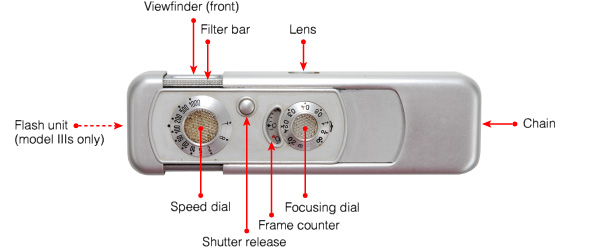
Because of its small dimensions (82 x 28 x 16 mm!), it was easy to hide and operate with one hand. It could take excellent photographs of documents at close range.
The "s" means that the camera has a connection for an external flash. The older A/III model did not have this connection.
Dimensions: 82 x 28 x 16 mm
Serial numbers: 58500 to 147494
No built-in light meter
Unlike later models, the Minox A did not have a built-in light meter. This made it quite difficult to determine the correct shutter speed. To get good-quality photographs, the user needed an external light meter or plenty of experience.
Building a light meter into a later model, the Minox B, came at a price: the camera suddenly became 15 millimetres wider. The Minox C nearly four centimetres!
Still available
If you are interested in this old technology, which is still very good quality, these cameras can still be found on eBay or Marktplaats.
As can the tiny films that go in them, along with accessories such as a magnifying glass to make everything clearly visible.
About the author
Michelle Peeters is fotografe en oprichter van DeuxBleus Fotografie. Michelle herkent het bijzondere in het gewone en het gewone in het bijzondere. Ze heeft zich nooit willen specialiseren en is daardoor van alle markten thuis.
You might also like
-
 Spy photography during the Cold War
by Elja Trum
-
 Review: Canon EOS 1Dx mark III
by Nando Harmsen
-
 Golden ring with rare Soviet camera costs 16,000 euros
by Michelle Peeters
-
 Impressive underwater photographs by George Karbus
by Michelle Peeters
-
 Review: Sony A9 mark III
by Nando Harmsen
-
 Fujifilm X-T30 III announced
by Elja Trum
0 comments
Be the first to share what you think!
Have your say
Please note: Articles older than a week can only be commented on by signed-in visitors.Would you still like to comment? sign in or create a free account.
Become a better photographer every week
A practical photography tip in your inbox every week.
38,764 photography enthusiasts already receive the tips! More about the weekly mail. Or keep up to date via  Facebook.

Elja Trum
Photofacts; everything to do with photography!
Would you like to take better photos and keep up with what is happening in photography? Photofacts publishes articles that teach you something about photography — from a product announcement to a practical shooting tip or a look at a website. Photofacts covers photography every day and is a hobby project of Elja Trum's that got out of hand. The articles are written by a team of volunteer authors. If you would enjoy writing one or more articles for Photofacts, do get in touch.More about PhotofactsPhotofacts is made possible in part by
