

Photographing sundew, Drosera
Saturday 16 September 2017, 13:31 by An Vanden Abeele | 6,125 views | 8 commentsThis article was translated from Dutch with the help of AI. Read the original.
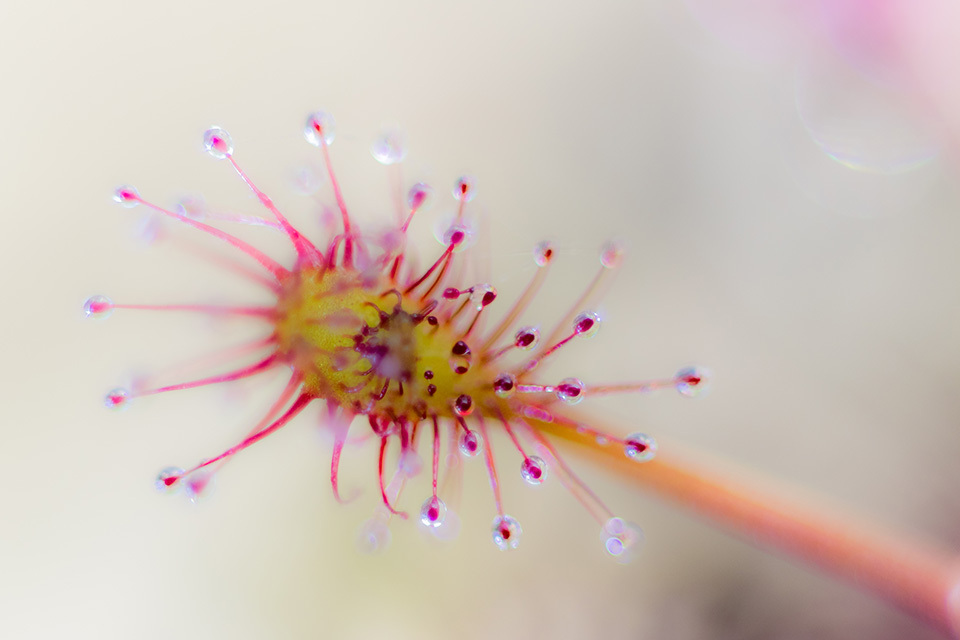
Sundew belongs to the genus of carnivorous plants. The plant forms a rosette with long-stemmed leaves. But long-stemmed does not mean that sundew is large. I have never seen one larger than 5 centimetres.
Trap
The rosette is covered in tentacles with a drop at the end, which looks like a dewdrop. Nothing could be further from the truth. The drop consists of a sticky substance that becomes a real trap for insects that think they can take in some moisture there.
In warm weather, even more of these sticky drops are produced. As soon as an insect gets stuck, the leaf closes around its unfortunate victim.
The tentacles then secrete digestive juices and the insect's proteins are absorbed by the plant.
Once everything has been digested, the leaf opens again and the remains of the insect blow away. The plant then prepares itself for the next catch. This allows it to survive in wet habitats with few nutrients.
Fascinating
Photographing this plant is fascinating. Somehow, I try to photograph sundew again every year, because it is always different.
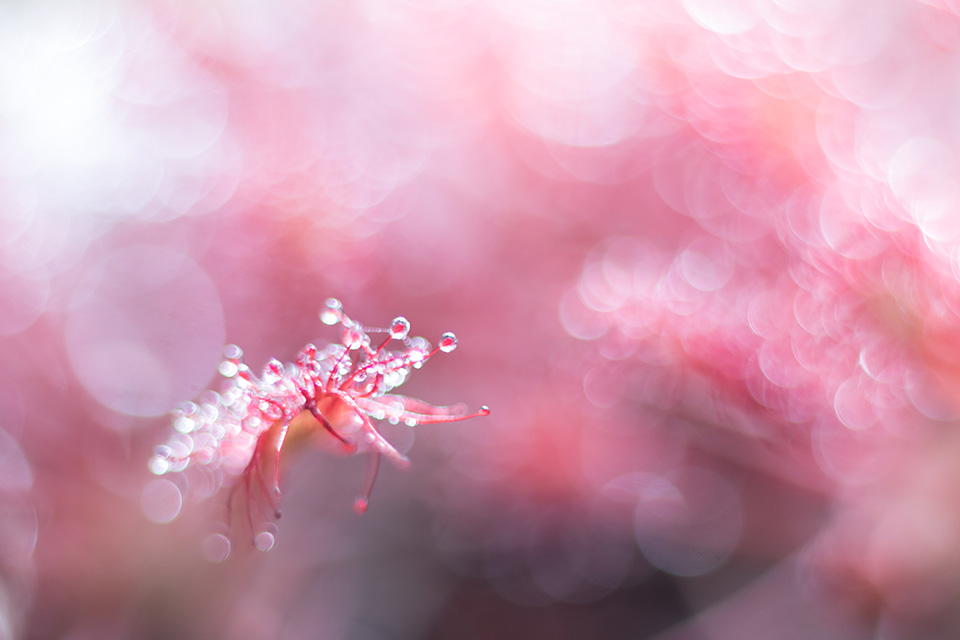
Photographing the plant is not easy, if only because it is so close to the ground. In addition, when you want to photograph a subject from very close up, you are inevitably faced with a tiny depth of field.
Sundew is no different. The closer you get, the less depth of field you have. Even so, you have to try to get something in focus, even if it is only a drop. The slightest movement by you or, for example, by the wind can completely ruin the photo.
Manual focus
Focusing can therefore only be done manually. If you want to zoom in, it is best to do so in Live View mode.
Live View mode makes it easier to take photos from difficult positions. The image can be magnified five or ten times to help with manual focusing.
You can check and adjust the exposure and depth of field before taking the shot. The choice of which part of the plant to focus on is also strongly influenced by the possibilities for creating a good composition.
My aim was to have as little depth of field as possible, which I achieved using the extension rings.
Playing with light
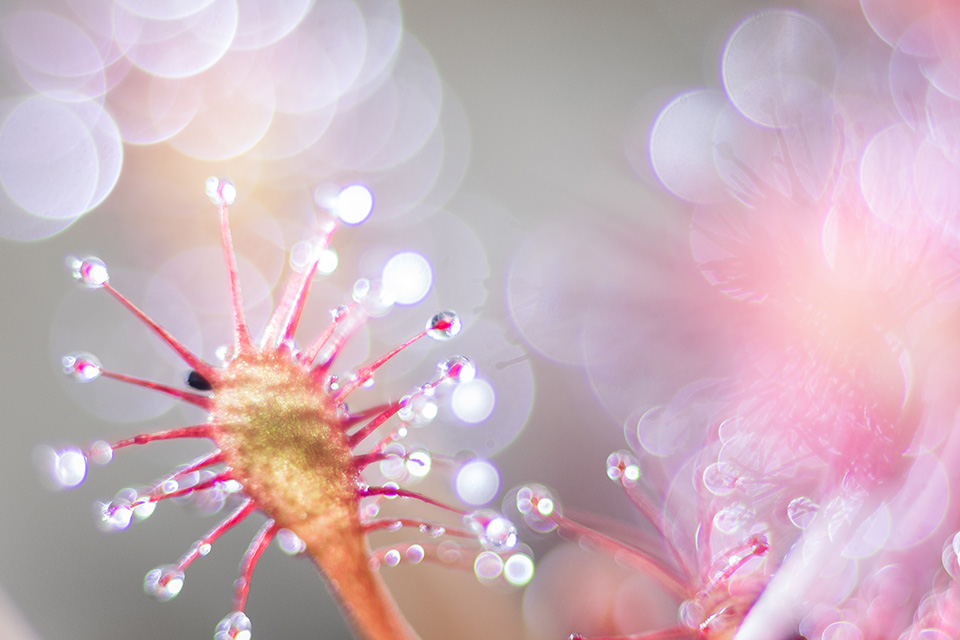
Focusing and composition are two problems you have to solve, but the fun part of photographing this plant is that you can play with light. You can look for sunlight, which gives your photo a beautiful bokeh, or use a small lamp when there is not enough natural light.
Normally, you would not easily photograph in bright sunlight, but with this plant it can add something extra. It makes the plant sparkle.
You inevitably have to twist yourself into all sorts of positions to find the sunlight and get beautiful light falling on the sticky drops.
LED lamp
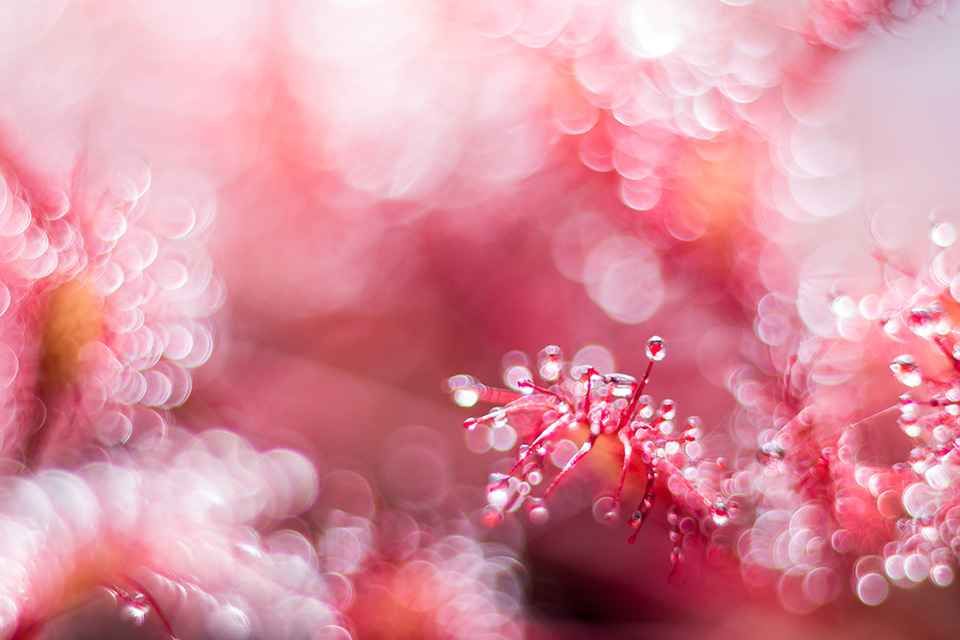
When working with an LED lamp, as I did for the first, second and following photo, make sure the light is not too bright, so that it looks natural.
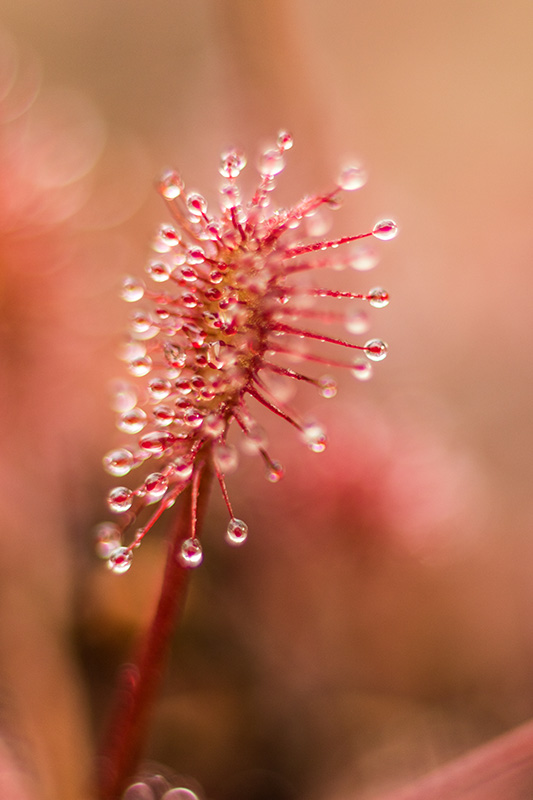
It is quite difficult to capture this elegant carnivorous plant. You mainly have to pay attention to focus and composition, while also taking the available light into account.
But above all, I still enjoy photographing this little plant.
About the author
An komt uit Deinze (Oost-Vlaanderen) en is sinds 8 jaar intensief actief bezig met fotografie. Heeft verschillende workshops gevolgd en natuur- en macrofotografie is nu haar passie en specialiteit. Ze neemt dikwijls deel aan boeiende foto-natuurreizen.
You might also like
-
 Jupiter, Venus and the moon form a smiley on 16 May
by Michelle Peeters
-
 Photo series: everything someone touches in one day
by Elvira Smit
-
 Creative photography with dandelions
by Laura van der Burgt
-
 Light painting: a creative form of photography
by Nando Harmsen
-
 Using your garden as a portrait studio
by Elja Trum
-
 Photographing Poppies!
by Laura van der Burgt
8 comments
-
 Temmerman wrote on Sunday 17 September 2017 at 09:40 | reply
Beautiful photos and interesting and informative info.
Translated from Dutch. -
 Annelore Smet wrote on Sunday 17 September 2017 at 10:10 | reply
Beautiful article with beautiful photos Andrea! Great!!
Translated from Dutch. -
 Kathleen De Temmerman wrote on Sunday 17 September 2017 at 21:41 | reply
An has already proven several times that she knows what she’s talking about, and here too she’s got it right, good explanation and beautiful shots!
Translated from Dutch.
Congratulations An! -
 Maas wrote on Tuesday 19 September 2017 at 11:46 | reply
The depth of field with a DSLR is very small. If you use a bridge camera with an attachment lens, a world opens up to you when taking close'ups, the depth of field is many times greater, the downside is slightly less sharpness than with the SLR.
Translated from Dutch. -
 Michelle wrote on Tuesday 19 September 2017 at 13:06 | reply
@Maas: what exactly do you mean? A DSLR is a single-lens reflex camera and this in itself has nothing to do with your depth of field. A DSLR does have a larger sensor, which has the advantage that you can achieve beautiful bokeh (quality of shallow depth of field).
Translated from Dutch. -
 Rijn wrote on Tuesday 19 September 2017 at 16:19 | reply
Every DSLR has a large sensor and therefore less depth of field than a bridge camera with a much smaller sensor. A small aperture has other disadvantages. You need a high ISO to keep the shutter speed, and therefore the sharpness, right. Diffraction is also a problem.
Translated from Dutch.
Bokeh, oh well: your eyes don't see all those little circles anyway? -
 Michelle Peeters wrote on Tuesday 19 September 2017 at 23:31
| reply
@Rijn: interesting subject matter, I'll look into it! It is indeed true that with a bridge camera you have much more depth of field than with a DSLR. And that enormous zoom range with good stabilizers, I'm very curious....
Translated from Dutch. -
Maas wrote on Wednesday 20 September 2017 at 00:06 | reply
@Rijn put it perfectly, I don't need to add anything to that.
Translated from Dutch.
Have your say
Please note: Articles older than a week can only be commented on by signed-in visitors.Would you still like to comment? sign in or create a free account.
Become a better photographer every week
A practical photography tip in your inbox every week.
38,765 photography enthusiasts already receive the tips! More about the weekly mail. Or keep up to date via  Facebook.

Elja Trum
Photofacts; everything to do with photography!
Would you like to take better photos and keep up with what is happening in photography? Photofacts publishes articles that teach you something about photography — from a product announcement to a practical shooting tip or a look at a website. Photofacts covers photography every day and is a hobby project of Elja Trum's that got out of hand. The articles are written by a team of volunteer authors. If you would enjoy writing one or more articles for Photofacts, do get in touch.More about PhotofactsPhotofacts is made possible in part by
