

Jupiter, Venus and the moon form a smiley on 16 May
Sunday 10 May 2020, 14:41 by Michelle Peeters | 10,352 views | 17 commentsThis article was translated from Dutch with the help of AI. Read the original.
The world needs reasons to smile again and our solar system is about to lend us a hand! On 16 May, a crescent moon below Venus and Jupiter will form a smiling face in the sky. Something to look forward to!
On 16 May, the moon will be a half-moon and the two planets in our solar system, Jupiter and Venus, will line up above the crescent moon. These celestial bodies will form a smiling face in the sky.
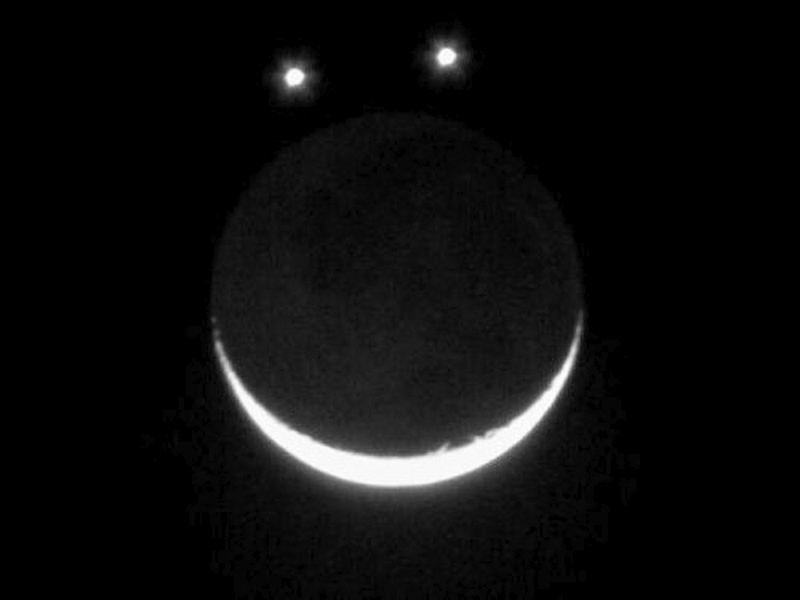
This rare spectacle is called a conjunction and you really should not miss it, as the last time this happened was 12 years ago, in 2008. So it does not happen regularly. The phenomenon also occurred in the Philippines in 2007, when the sky lit up at night.
Giving it a label
What is especially interesting about this special event is how the human brain identifies with it. When we see this phenomenon, our thoughts are focused on taking a photo of it to give it a 'label', and in this scenario it will be a smiling face.
Actually, these are just planets that are aligned during their usual cycle around the sun, but forming a smiley sounds more appealing!
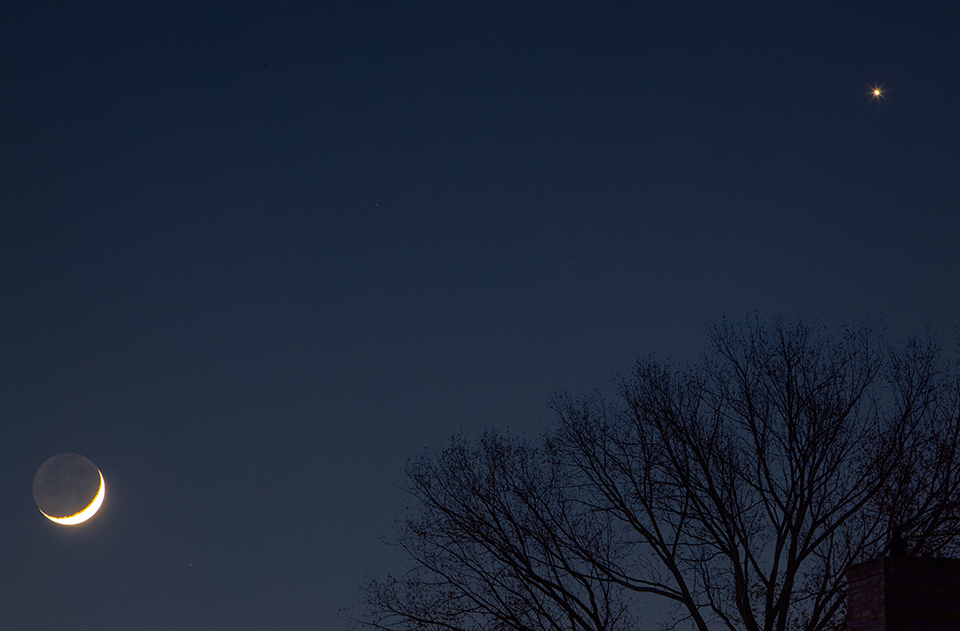
What is rare is that Jupiter is usually not as close to the moon as Venus is once a month. So if Jupiter does that now, it will look like this, with Venus as its two eyes and the moon as the big mouth with a lovely smile. So mark the date in your calendar and set your alarm!
About the author
Michelle Peeters is fotografe en oprichter van DeuxBleus Fotografie. Michelle herkent het bijzondere in het gewone en het gewone in het bijzondere. Ze heeft zich nooit willen specialiseren en is daardoor van alle markten thuis.
You might also like
-
 Photographing the Full Moon creatively
by Nando Harmsen
-
 Night photography tip: photograph all the Moon phases
by Nando Harmsen
-
 Photography tips for the solar eclipse on 10 June
by Nando Harmsen
-
 The Partial Solar Eclipse as a Time-lapse
by Elja Trum
-
 Night photography tip: photograph the moon at twilight
by Nando Harmsen
-
 Are you ready for the solar eclipse?
by Nando Harmsen
17 comments
-

 Donald Willemsen
wrote on Sunday 10 May 2020 at 23:32
| reply
Donald Willemsen
wrote on Sunday 10 May 2020 at 23:32
| reply
Michelle, what time do we have to get up then to capture it? Will you make sure there are no clouds in the sky?
Translated from Dutch.
-
 Michelle Peeters wrote on Sunday 10 May 2020 at 23:47
| reply
Michelle Peeters wrote on Sunday 10 May 2020 at 23:47
| reply
@Donald, that's not entirely clear to me yet either, but I'll find out!
Translated from Dutch. -
 Edwin Mathlener wrote on Monday 11 May 2020 at 16:46 | reply
Unfortunately, this is a misleading message that is currently circulating on the Internet. Venus is now in the evening sky. Jupiter has Saturn as company in the morning sky. On May 12 and 13, the moon is near this pair and this will be a beautiful conjunction, but it certainly won't be a smiley. On May 16, the moon is a long way further away and even with the best will in the world there is no smiley to be seen in it.
Translated from Dutch. -
 Geert Ottenheijm wrote on Monday 11 May 2020 at 17:36 | reply
Strange. Jupiter and the moon are in the morning sky and Venus can be seen clearly in the west in the evening. They are far apart in the sky to form a smiley. So fake news.
Translated from Dutch. -
Donald Willemsen
wrote on Monday 11 May 2020 at 18:02
| reply
This just goes to show that you need to check your sources carefully. At least there are reliable astronomical sources.
Translated from Dutch. -
Michelle Peeters wrote on Monday 11 May 2020 at 18:24
| reply
Well, I don't really know either whether the physics-astronomy.com site is reliable or not. And to be honest, I haven't been able to find anything else about it elsewhere...
Translated from Dutch. -
Edwin Mathlener wrote on Monday 11 May 2020 at 19:36 | reply
Hmm. I didn't really know physics-astronomy.com, but I do think it looks very sensationalist. I think they mainly use sensationalism to lure users to all the advertisements. There are also good Dutch sites: astronieuws.nl, allesoversterrenkunde.nl, www.astronomie.nl, hemel.waarnemen.com and in the US, for example, astronomy.com, space.com. I'm in the field, so I know a bit about where you can get reliable info.
Translated from Dutch. -
 Jan wrote on Tuesday 12 May 2020 at 12:06 | reply
Turns out none of it is correct . On May 12 there is a conjunction of Saturn (so not Venus), Jupiter and the moon, however at around 5 p.m., also not visible from the Netherlands, namely at about 60 degrees behind the horizon.
Translated from Dutch.
wrong three times!!! -
 Tom wrote on Tuesday 12 May 2020 at 16:39 | reply
doesn't seem entirely kosher indeed, that message. I don't see it listed on https://www.frankdeboosere.be/nachthemel/mei.php either. That's certainly a reliable source, which I would expect to definitely report such fun things.
Translated from Dutch. -
Michelle Peeters wrote on Tuesday 12 May 2020 at 17:22
| reply
I think you are right, this does indeed seem to be fake news. My apologies and I should have fact-checked this better. There is a great deal of information to be found on this subject and it remains difficult to check whether or not it is correct. In this case, I failed to check it properly!
Translated from Dutch. -
Jim wrote on Tuesday 12 May 2020 at 17:25 | reply
That post was indeed sent out into the world by physics-astronomy.com on April 1st...
Translated from Dutch.
-
guest wrote on Tuesday 12 May 2020 at 17:41 | reply
the message is incorrect or may be an old message. you can see this very clearly yourself with the Stellarium program. this gives a 100% accurate position of everything (that has been discovered) in the universe. you can simply fast-forward and then see that May 12 and 13 come closest to a smiley. with Saturn and Jupiter, though. what's also fun is that you can simulate telescopes to see what you can see with them. very fun and informative for people interested in astronomy.
Translated from Dutch. -
 Maikel wrote on Tuesday 12 May 2020 at 17:42
| reply
Maikel wrote on Tuesday 12 May 2020 at 17:42
| reply
the message is incorrect or may be an old message. you can see this very clearly yourself with the program Stellarium. this shows the 100% correct position of everything (that has been discovered) in the universe. you can simply fast-forward and then see that May 12 and 13 come closest to a smiley. with Saturn and Jupiter, though. another nice thing is that you can simulate telescopes to see what you can see with them. very nice and informative for people interested in astronomy.
Translated from Dutch. -
Maikel wrote on Tuesday 12 May 2020 at 17:54
| reply
the post is incorrect or possibly an old post. you can see this very clearly yourself with the Stellarium program. this shows the 100% correct position of everything (that has been discovered) in the universe. you can simply fast-forward and then see that on May 12 and 13 it comes closest to a smiley. with Saturn and Jupiter, though. another nice thing is that you can simulate telescopes to see what you can see with them. very nice and informative for people interested in astronomy.
Translated from Dutch. -
Donald Willemsen
wrote on Tuesday 12 May 2020 at 18:06
| reply
@Michelle, you're still forgiven this slip-up 😃😃 But be careful, only this one ☺️
Translated from Dutch. -
Michelle Peeters wrote on Tuesday 12 May 2020 at 18:52
| reply
So apparently it's an April Fools' joke...
Translated from Dutch. -
 Corné wrote on Wednesday 13 May 2020 at 18:50 | reply
This unfortunately isn't going to happen, just look ahead in apps like skysafirie/starwalk.
Translated from Dutch.
Have your say
Please note: Articles older than a week can only be commented on by signed-in visitors.Would you still like to comment? sign in or create a free account.
Become a better photographer every week
A practical photography tip in your inbox every week.
39,023 photography enthusiasts already receive the tips! More about the weekly mail. Or keep up to date via  Facebook.

Elja Trum
Photofacts; everything to do with photography!
Would you like to take better photos and keep up with what is happening in photography? Photofacts publishes articles that teach you something about photography — from a product announcement to a practical shooting tip or a look at a website. Photofacts covers photography every day and is a hobby project of Elja Trum's that got out of hand. The articles are written by a team of volunteer authors. If you would enjoy writing one or more articles for Photofacts, do get in touch.More about PhotofactsPhotofacts is made possible in part by
