

Black clothing on a black background
Friday 25 August 2017, 16:32 by Frank Doorhof | 10,055 views | 4 commentsThis article was translated from Dutch with the help of AI. Read the original.
People often struggle to photograph models dressed in black against a black background. In principle, this really isn't that difficult.
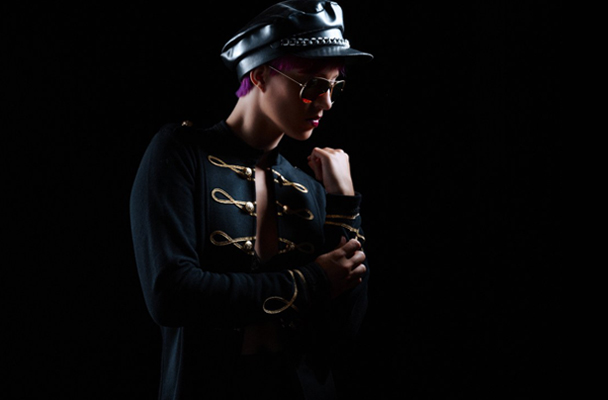
First of all, make sure that no light falls on the background. Also make sure that you meter the light on the background at about 5 stops lower than your main light (reflective).
If you can't get the background properly black, try reducing the distance between the model and the light while keeping the distance between the model and the background the same.
At that point, you are using the 'inverse square law'. This makes it very easy to make the light on the background darker, while the model will still be correctly exposed.
If that doesn't work, use grids, for example, to prevent light spill, or use flags. As long as no light falls on the background.
Personally, I really like light from the side, but of course you don't want the shadow side to disappear completely against the background. That's why I use a small accent light, or sometimes a large accent light, to add light to the side.
Also make sure that the jawline is nicely defined and you have a fantastic photo. It does take a bit of fiddling around to get everything in place, but when it works, the result is fantastic.
About the author
Frank Doorhof blogt dagelijks in het Engels op zijn website en geeft wekelijks workshops model fotografie in zijn studio in Emmeloord, maar ook op locatie in binnen en buitenland. Van beginners tot gevorderde, iedereen kan bij Frank terecht. Ook voor specifieke 1 op 1 workshops, of maatwerk voor groepen.
You might also like
-
 Arranging clothes for shoots
by Elja Trum
-
 Recreating a Room in Your Studio
by Elja Trum
-
 5 Tips for Variety in the (Home) Studio
by Elja Trum
-
 Switching to the Mac Studio or not? Part 1
by Nando Harmsen
-
 A tripod in the studio?
by Leen Koper
4 comments
-
 Robert wrote on Tuesday 29 August 2017 at 13:30 | reply
Clear, Frank. It also depends on whether your background is made of fabric ( little reflection) or paper. I often use the black fabric backdrop, together with a snoot for backlighting. This creates a rim of light or more, around the person and then he 'separates' from the background.Even if the person is wearing black .
Translated from Dutch.
With photo-shooting greetings, Robert. -
 Frank Doorhof wrote on Tuesday 29 August 2017 at 13:38 | reply
Fabric always works better indeed. But if you measure reflected light then the meter indicates this nicely already of course. I'm not really a fan of the snoot myself. I find the light very harsh and you often see some harsh little hairs appearing in a photo.
Translated from Dutch. -
Robert wrote on Tuesday 29 August 2017 at 14:00 | reply
That can be done, Frank. I usually have no more than one or one and a half stops more than my main light when shooting against the light. Then, I think, it's not too bad.
Translated from Dutch.
With photo-shooting greetings Robert. -

 Nicole wrote on Wednesday 31 January 2018 at 14:15
| reply
I also find it difficult when the background is intensely white and (in my case) ballet dancers dance in black. How do I get the right balance?
Translated from Dutch.
Have your say
Please note: Articles older than a week can only be commented on by signed-in visitors.Would you still like to comment? sign in or create a free account.
Become a better photographer every week
A practical photography tip in your inbox every week.
38,763 photography enthusiasts already receive the tips! More about the weekly mail. Or keep up to date via  Facebook.

Elja Trum
Photofacts; everything to do with photography!
Would you like to take better photos and keep up with what is happening in photography? Photofacts publishes articles that teach you something about photography — from a product announcement to a practical shooting tip or a look at a website. Photofacts covers photography every day and is a hobby project of Elja Trum's that got out of hand. The articles are written by a team of volunteer authors. If you would enjoy writing one or more articles for Photofacts, do get in touch.More about PhotofactsPhotofacts is made possible in part by
