
A tripod in the studio?
Friday 21 February 2020, 23:32 by Leen Koper | 6,544 views | 4 commentsThis article was translated from Dutch with the help of AI. Read the original.
‘In the past,’ when I worked as a professional photographer, I took almost all my studio shots from a tripod. A nice, heavy column tripod with matching heavy ball heads.
That way, once your camera was set up, it stayed absolutely fixed. You could walk away, calmly make a cup of coffee if necessary, and when you came back nothing had changed, not even by a millimetre. A tripod you could rely on and comfortably lean on while having a quiet discussion with the person in the photo.
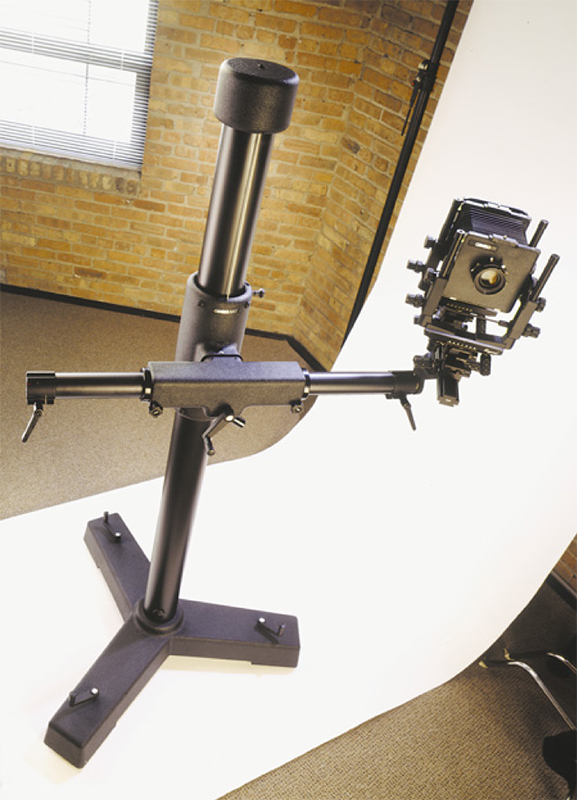
A Cambo tripod like the one below, shown here with a technical camera, is lovely to lean on for a moment, for example.
But time moved on. Using such a heavy tripod went out of fashion. People started taking photographs handheld. After all, with the short flash durations of a flash system that was becoming increasingly affordable and therefore accessible to larger groups, keeping the camera still was never an issue.
So the vast majority simply photograph handheld, which seems logical enough. Why wouldn't you? A tripod like that is only a nuisance after all...
Stubborn...
Still, stubborn as I am, I would like to make a case for using a tripod in the studio. Those who shoot more than 700 files in an hour during a session can stop reading now.
But if you work more carefully, this may be useful, even if only to think about it calmly. In my view, you take a portrait thoughtfully, frame it very carefully, and make only a few shots in quick succession, just to avoid things such as blinking.
Only then do you move on to the next shot, just as carefully. How often does it happen in practice that a few hairs suddenly fall right in front of the face? How often is it impossible to explain a very small but necessary change to the pose, even though it is just a minor detail that makes all the difference?
These are normal things that every studio photographer regularly encounters. In short, you need to put your camera down and regularly step away from it to make small corrections.
Framing it all over again...
And just when you have got everything right, you have to pick up the camera again and try to get exactly the same image on your focusing screen or display as you had before.
And once you have managed that, you see that those few hairs have fallen back into place again, or that the head has meanwhile become slightly too tilted for your liking, and you can start all over again. If you work with a bit of care as a photographer, these kinds of things will be very familiar.
In short, if you leave your camera on the tripod in the meantime, you no longer have the problem of reframing your portrait. Everything is still exactly as it was when you left it. You can take the shot as intended, before you made your changes.
Isn't that a nuisance if you want to include a bit more or less in the frame? You would have to move your tripod every time. Of course, you can still zoom in and out if you use a zoom lens, but with a fixed focal length you have a problem. A problem? Not at all.
Camera dolly
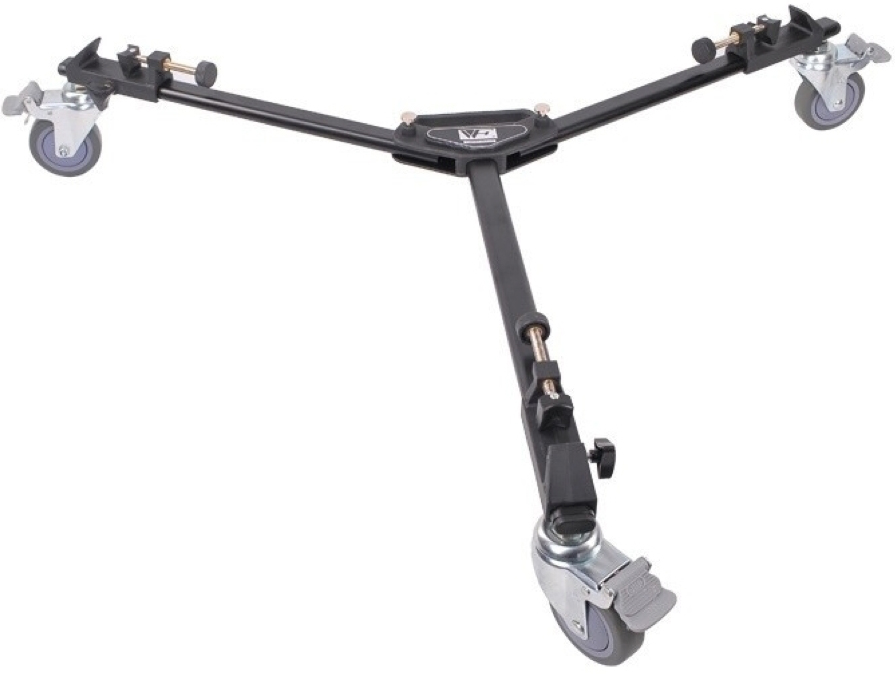
That is exactly what an indispensable tool was invented for: the camera dolly! Its wheels allow you to move it wherever you want with the slightest effort.
You attach a dolly beneath all three of your tripod legs, making sure it is especially secure, otherwise it will regularly pop out of its mount, which is really not what you want. You can then roll it wherever you want with the slightest effort, limited only by the walls of your studio.
You can buy a reasonable dolly for around 50 euros, although you can of course spend more. That does no harm, especially if the tripod mount is a little sturdier. Also, with a reasonably decent dolly, you can almost always lock the wheels by pressing a small brake pedal, fixing your position.
The only thing you still need to consider beforehand is the height setting of your tripod. Outdoors, you usually extend the centre column as little as possible to prevent vibrations caused by wind and suchlike.
But there is normally no wind in the studio. Also, camera movement when pressing the shutter no longer matters because of the short duration of the flash, as was the case in the past. So set your tripod with the legs at the lowest position you think you will need, and extend the centre column if you need to get higher for your shot.
That way, you only need to adjust the height of the centre column to reach the desired viewpoint. And that's a piece of cake.
For a reasonable price, you therefore get almost all the advantages of a real column tripod, provided that you already own a reasonably sturdy tripod, of course. But then, don't we all have one of those by now if we are serious photographers?
About the author
Leen Koper woont en had tot voor kort een fotostudio in Zierikzee. Na ruim 40 jaar als fotograaf gewerkt te hebben, houdt hij zich nu voornamelijk bezig met landschapsfotografie. Als beroepsfotograaf heeft hij in de loop der jaren vele internationale prijzen gewonnen en gaf les en ook regelmatig seminars in Engeland, België, Frankrijk, Duitsland en Oostenrijk.
You might also like
-
 5 Tips for Variety in the (Home) Studio
by Elja Trum
-
 Recreating a Room in Your Studio
by Elja Trum
-
 Photographing dogs in the studio
by An Smedts
-
 Studio photos with natural light in a garage
by Elja Trum
-
 Create your own virtual studio using televisions
by Elja Trum

4 comments
-

 martinphili wrote on Saturday 22 February 2020 at 17:31
| reply
I think you write somewhat disparagingly here about those who use a different method than yours. You write "who work more carefully", as if a photographer without a tripod is not careful. And with that you exclude many great, successful photographers. Photographers who have also made much more of a name for themselves.
Translated from Dutch.
Additionally, you take an enormous amount of spontaneity out of a portrait when you photograph from a tripod. After all, the model has to stand or sit in exactly the same position every time, otherwise they end up outside the camera's frame. Photographing children from a tripod seems completely unworkable to me.
'In the past', as your article begins, is indeed 'in the past'. Past tense! -
 Leen Koper wrote on Saturday 22 February 2020 at 22:33
| reply
I don't think it's meant as disparaging at all; it's a different way of thinking. In my opinion, it is important that an (adult) model follows your instructions precisely. After all, you have the image in mind; later, the pose can always be adjusted based on the comments on it.
Translated from Dutch.
By the way, I have also photographed children from a tripod for over 40 years, so it can indeed be done. -
 Vincent wrote on Tuesday 25 February 2020 at 10:43 | reply
I had my workshop this week and I always photograph from a tripod. For the reasons mentioned above and to get more interaction with the model. It is also calmer for the person being photographed to have someone calmer in front of them than someone running back and forth frantically. Very occasionally it comes off the tripod, if adjusting the height takes too much time when switching people. One of my students already asked yesterday why I worked from a tripod...
Translated from Dutch. I’ll pass on this link as a tip again.
-
 Henk Hulshof
wrote on Wednesday 26 February 2020 at 18:34
| reply
I think there is also a good reason not to use a tripod in the studio and that is that you let your model(s) move around more.
Translated from Dutch.
Not everyone is good at posing (especially small children). Besides, some movement and spontaneity can lead to surprising results. With the flash at a bit more distance and the camera in hand, I find that works better.
But a tripod can certainly have advantages too; so use what you need.
Have your say
Please note: Articles older than a week can only be commented on by signed-in visitors.Would you still like to comment? sign in or create a free account.
Become a better photographer every week
A practical photography tip in your inbox every week.
39,021 photography enthusiasts already receive the tips! More about the weekly mail. Or keep up to date via  Facebook.

Elja Trum
Photofacts; everything to do with photography!
Would you like to take better photos and keep up with what is happening in photography? Photofacts publishes articles that teach you something about photography — from a product announcement to a practical shooting tip or a look at a website. Photofacts covers photography every day and is a hobby project of Elja Trum's that got out of hand. The articles are written by a team of volunteer authors. If you would enjoy writing one or more articles for Photofacts, do get in touch.More about PhotofactsPhotofacts is made possible in part by
