

Is the Fuji X-Pro1 still relevant?
Saturday 19 November 2022, 16:32 by Yljas Roeper | 7,139 views | 6 commentsThis article was translated from Dutch with the help of AI. Read the original.
Ten years ago, Fuji announced a completely new camera concept: the Fujifilm X-Pro1. Elja wrote an article about it on this site at the time. I thought it would be fun to put this camera through its paces again in 2022.
It wasn't Fujifilm's first X-camera. They had already introduced the X100 compact camera. Unlike the X100, which still had a sensor with a 'conventional' Bayer layout, the X-Pro1 had an X-Trans sensor with an X-Trans layout.
Fujifilm claimed that this layout could eliminate moiré effects, which in turn could increase the resolution. This was possible because a necessary low-pass filter for the sensor was no longer needed.
Perhaps even more controversial was the claim that, by using this new technology, the X-Pro1 produced a better image than the full-frame flagship cameras of the time: the Nikon D7000 and Canon 5D mkII. As Elja already wrote at the time, that's quite a claim when you consider that the X-Pro1 has an APS-C-sized sensor.
When reading the above, you may think that I followed all the latest developments in photography and the introductions of different brands closely, but nothing could be further from the truth. At the time, I photographed with a Canon 5D mkII and was generally very happy with it.
My first real introduction to Fujifilm cameras was in mid-2013. At the end of 2015, I wrote a personal article on this site about how and why that happened, and what it meant for my photography.
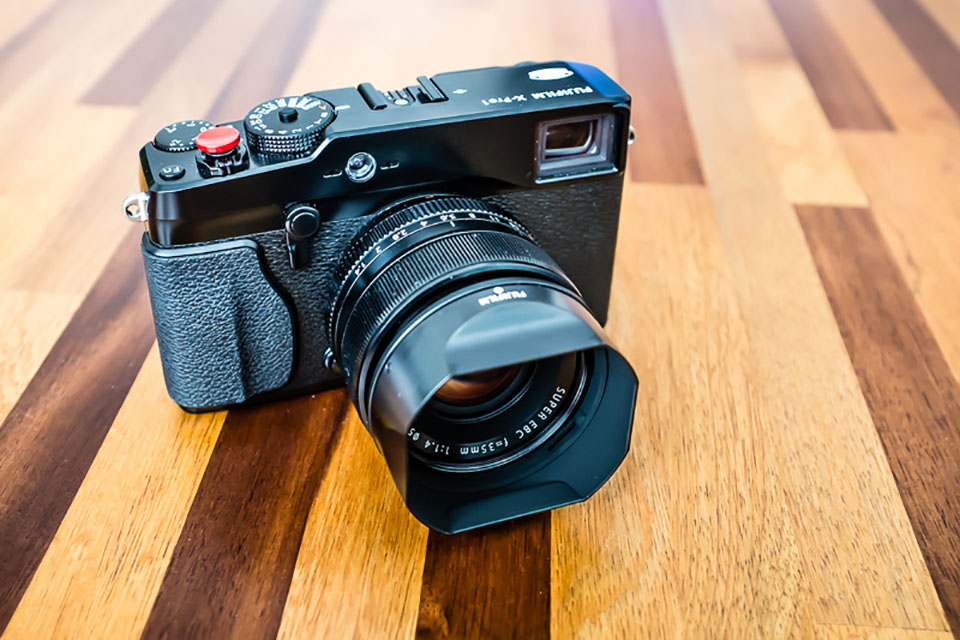
When I bought a second-hand X-Pro1 with an XF35 f/1.4 lens in 2016, I was already very familiar with Fujifilm. After all the positive stories about this poor man's Leica, I simply wanted to experience this original X-Trans camera for myself. I also bought it partly just because I wanted to own one.
It's the camera that lies in my car for just-in-case situations. As a result, it isn't used often, but it is used in a wide range of situations. The question is whether the X-Pro1 still performs after ten years. I can only compare it with my X-T3 and X100T.
Over the past year, I therefore tried to use the X-Pro1 more often than average. For example, when I went to Marrakech in Morocco again during the May holiday. Partly with this article in mind, I decided to take only my X-Pro1 with the XF35mm f/1.4.
And last week it was also allowed to prove its worth in De Broedmachine's open house in Beverwijk, which wasn't always very well lit. It's a building full of creative businesses, with a music venue and bar.
Let's start with the biggest advantage of this combination. Everything I needed during the trip to Marrakech fitted into my Peak Design Sling 5L. Besides the camera and lens, my bag contained a charger with cable, two spare batteries, a separate lens hood and some other small items.
Ideal, especially because with Transavia you can take one additional accessory free of charge alongside your hand luggage, and the dimensions of my compact bag comfortably fit within the limit.
Another advantage of this combination had to do with photographing people in Marrakech. After a photo trip with four photographer friends at the beginning of 2014, I had already asked on this site whether Marrakech really is such a paradise for photographers.
The main point was that photographing people in Marrakech wasn't always appreciated. But whether that's because people have become more tolerant of tourists after all the Covid-19 misery, or because of the type of camera, I didn't receive a single negative reaction when I pointed my X-Pro1 at someone to take a photo. Perhaps its retro appearance played a part after all.
The battery life was good too. I almost always photograph using the electronic viewfinder, and I also regularly want to look at a photo on the screen. Despite that, I never had to change the battery during the day. The battery was charged in the evening and went back into the camera fully charged in the morning.
Looking back through Lightroom, I see that I took an average of 40 photos per day, with a peak of more than 90 photos on one day. That means that with the three batteries I had with me, you can shoot almost 300 photos per day. In my view, even if it had been a photo trip, that would have been more than enough.
And then there's that much-praised image quality. I always photograph in RAW, and every photo is edited in Lightroom before it is published. When editing, I mainly use HDR presets by Piet Van den Eynde.
He is also a Fuji user, although it isn't clear to me whether his presets were specifically developed for Fuji as well. The fact is that with these presets I can get a great deal out of the photos.
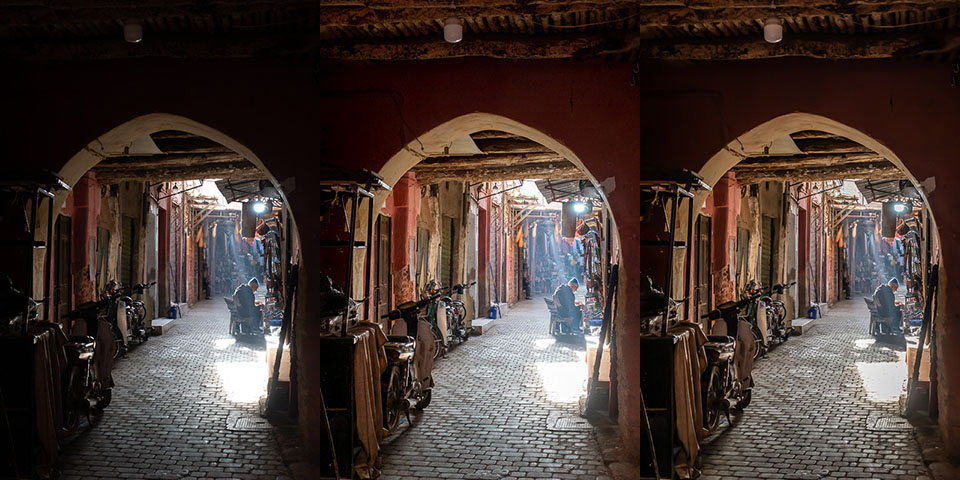
A first example is the view through the passage above, with a craftsman sitting exactly in the sunlight. The photo on the left is unedited. The middle one shows what Lightroom produces when I use the automatic settings. The last one shows what more I can get out of it with the presets mentioned earlier.
Where Lightroom mainly brightens the dark areas, I can restore more balance in the photo with the presets. Unfortunately, I can't recover enough detail in the brightest area, the shiny paving stones in the sun.
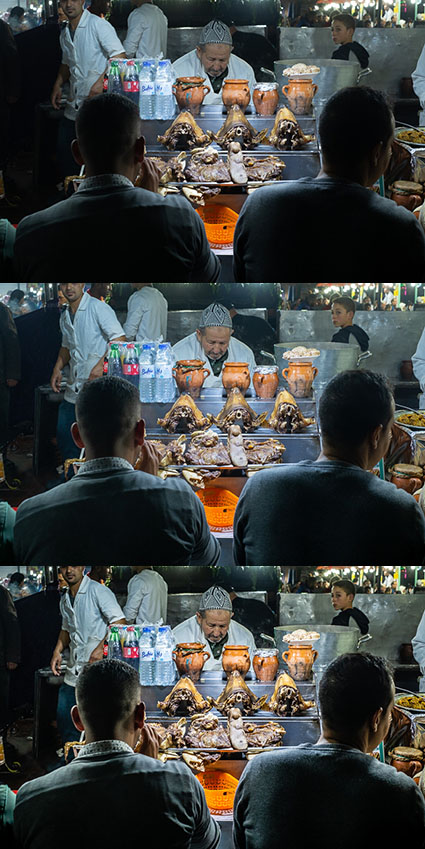
Another example is an evening photo at the famous Place Jemaa el Fna, with its food stalls. The contrasts are less pronounced, although there are bright LED lamps everywhere. Not exactly great for the atmosphere, but that's beside the point.
Here too, Lightroom mainly brightens the dark areas of the photo. By lifting the shadows and adjusting the brightness, I can still give the photo my own signature.
In that respect, the camera is just as good as what I normally produce here with my more modern cameras.
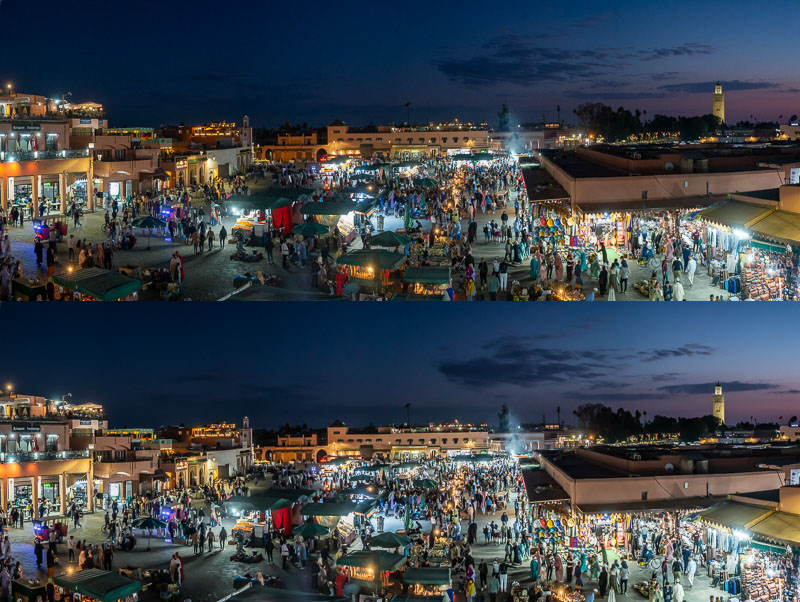
From a restaurant's roof terrace, I made a panorama of Place Jemaa el Fna early in the evening. I merge the photos in Lightroom. During this process, the photo is also edited.
I only need to do a little more to make it my own. Here too, I mainly get the result I had in mind by lifting the shadows and adding a little more brightness.
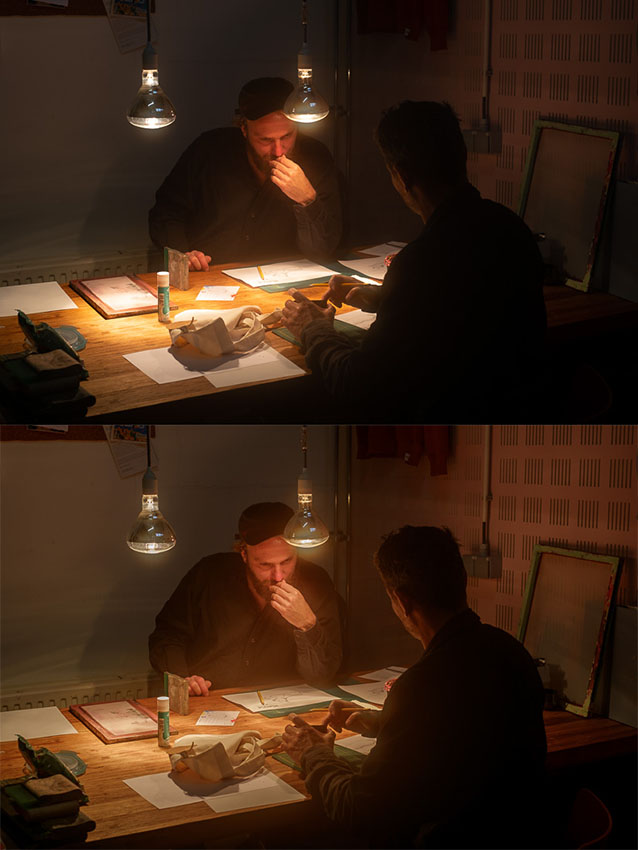
Finally, I have another photo that I took in De Broedmachine. It shows a scene with two men sitting at a desk, lit by two old-fashioned bulbs. After applying the automatic settings, I made a minimal adjustment to the highlights and didn't apply any brightness adjustment.
The colour cast from the lamps, combined with the soft contrast, gives the photo a slightly vintage look that fits the character of the X-Pro1 perfectly. For me, the photo captures the atmosphere at De Broedmachine.
The question was whether the X-Pro1 still performs. As far as image quality is concerned, my answer is an emphatic “Yes!”. As mentioned earlier, it's also useful that everything you need fits in a small bag and that the battery life is more than sufficient. But that doesn't mean I didn't encounter any shortcomings.
Enough has already been written about the autofocus speed, especially in combination with the XF35mm f/1.4 lens I used. I had taken that into account beforehand, as far as applicable. I therefore didn't experience it as a real shortcoming.
I did find the exposure compensation, and particularly the sensitivity of the dial, very annoying. I normally use a wrist strap, but for the trip to Marrakech I attached a Peak Design Slide Light.
Hanging from my right shoulder, it turned the exposure compensation dial, which meant it was regularly set to -2 stops. I didn't always notice this, so a number of photos were unintentionally taken with this setting.
While photographing at De Broedmachine, I also discovered that a maximum exposure compensation range of +2 to -2 stops isn't particularly generous.
I usually photograph in aperture priority, but when photographing performers on stage I used the camera fully manually. This was to make sure I could underexpose by more than 2 stops.
On the other hand, you could ask whether that is really a shortcoming. You don't choose a Fuji camera for no reason. With the dedicated shutter speed dial, an aperture ring on the lens and a Q button that lets you quickly change the ISO setting, you can set this camera fully manually.
Then there's the fact that this camera has no dioptre adjustment. You can replace the standard glass in the hybrid viewfinder with a dioptre glass of a particular strength. Although I wear glasses, I never did this.
Although I always photograph through the viewfinder, I haven't really been bothered by the fact that I can't see the electronic image completely sharply, in particular.
The viewfinder is sufficient for composing the image, and I rely on the selected focus point and autofocus for a sharp image. The camera has never let me down there either.
Finally, I keep the camera in an LC-X-Pro1 Leather Case. This protects the camera well, but to replace the battery and/or SD card, you have to remove the camera from the case.
This is better arranged with the second-generation Leather Case for the X100 series. It has a flap in the case that gives you access to the battery and SD card compartment.
In conclusion, I can say that the X-Pro1 still meets my needs. Despite the shortcomings described above, I can work with it perfectly well. I think the image quality is excellent, so I intend to keep using it for a long time.
If you also own this camera, I'd be interested to hear about your experiences. I look forward to reading them in the comments.
About the author
Houdt zich onder de naam Ytos Photography bezig met diverse vormen van fotografie. Geeft lezingen over fotograferen in Marokko en flitsen en organiseert regelmatig fotoreizen naar Marokko. Post af en toe op Instagram, maar is vooral actief op Facebook.
You might also like
-
 Preview: Fujifilm X-S20
by Elja Trum
-
 Fujifilm X-E5 announced
by Elja Trum
-
 Fujifilm X-T30 III announced
by Elja Trum
-
 Preview: Fujifilm X-H2s
by Elja Trum
-
 Fujifilm announces X-H2 mirrorless camera
by Elja Trum
-
 Fujifilm X-T5 announced with 40 megapixels
by Elja Trum
6 comments
-
 Pieter wrote on Tuesday 22 November 2022 at 10:21 | reply
Nikon D7000 is not a full-frame camera…
Translated from Dutch. -

 Piet van Kroonenburg
wrote on Tuesday 22 November 2022 at 18:16
| reply
Piet van Kroonenburg
wrote on Tuesday 22 November 2022 at 18:16
| reply
The Nikon D7000 is indeed a DX camera, perhaps the writer meant the D700, as that is an FX camera.
Translated from Dutch.
My Fuji X-Pro2 is admittedly a younger generation, but I am also extremely satisfied with it. My X-E2s still meets my needs every day too. -
 Ytos
wrote on Wednesday 23 November 2022 at 15:19
| reply
Ytos
wrote on Wednesday 23 November 2022 at 15:19
| reply
I checked Elja's article again and this is what it says: "The image quality delivered by the sensor would, according to Fujifilm, be better than that of the Nikon D7000 and even the Canon 5D mark II. A firm stance from Fujifilm. In any case, it would be an impressive result for an APS-C format sensor."
Translated from Dutch.
I assumed that a guru like Elja knows what he's talking about when he writes that it was one of the top cameras. I believe neither Elja nor I claim anywhere that they are also both FF cameras, but only that the X-Pro1 has an APS-c sensor. I do understand the resulting confusion, especially given the fact that the 5DmkII definitely does have an FF sensor.
Perhaps Elja can respond to this and indicate whether at the time he meant the D700 with FF sensor and this is therefore a typo, or whether he simply meant what it says. On the other hand, how important is it really. Elja's article is over 10 years old.
Nice to read that, just like me, you are still very satisfied with your Fuji camera, Piet. -
Pieter wrote on Wednesday 23 November 2022 at 18:15 | reply
‘ …gave a better image than the then-current full-frame top cameras: the Nikon D7000 and Canon 5D mkII.’
Translated from Dutch.
Ytos, here the D7000 is clearly called an FF camera, isn't it. -
Ytos
wrote on Friday 25 November 2022 at 17:11
| reply
Now that you mention it, Pieter. Then I copied that incorrectly from Elja's piece. Or I "filled in" myself that it was about FF cameras, because as I said earlier, the 5dmkII is indeed an FF camera. My mistake indeed.
Translated from Dutch.
But what else do you think of the article, Pieter? -
Pieter wrote on Friday 25 November 2022 at 19:00 | reply
Otherwise, a great piece! But maybe I’m looking at it through rose-colored glasses too…
Translated from Dutch.
A Fujifilm fan from the ‘very beginning’. First the Fujifilm S3 and then the S5.
And now the X-T1 and X-H1.
Have your say
Please note: Articles older than a week can only be commented on by signed-in visitors.Would you still like to comment? sign in or create a free account.
Become a better photographer every week
A practical photography tip in your inbox every week.
39,077 photography enthusiasts already receive the tips! More about the weekly mail. Or keep up to date via  Facebook.

Elja Trum
Photofacts; everything to do with photography!
Would you like to take better photos and keep up with what is happening in photography? Photofacts publishes articles that teach you something about photography — from a product announcement to a practical shooting tip or a look at a website. Photofacts covers photography every day and is a hobby project of Elja Trum's that got out of hand. The articles are written by a team of volunteer authors. If you would enjoy writing one or more articles for Photofacts, do get in touch.More about PhotofactsPhotofacts is made possible in part by
