

Review: Panasonic G9
Friday 22 December 2017, 11:33 by Paul Oosterlaak | 6,681 views | 1 commentThis article was translated from Dutch with the help of AI. Read the original.
Panasonic recently announced the G9 as the photography sibling of the GH5. While the GH5 is a top video camera in a stills camera body, Panasonic positions the G9 as a top stills camera.
What makes the G9 a top camera for photography, and how much video DNA does it share with the GH5? I will summarise this and more in this article.
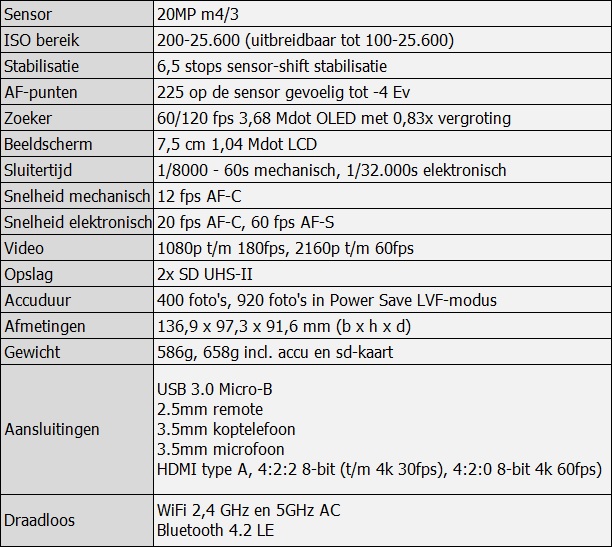
Specifications
The body
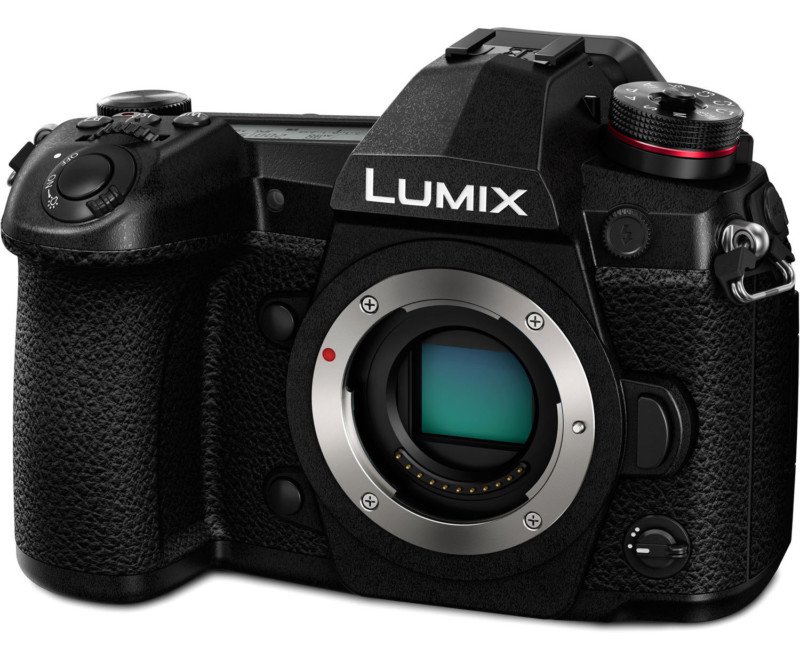
The Panasonic G80 already had a comfortable grip for people who like to hold a camera firmly. The G9 takes this a step further.
The grip is very deep and also fairly wide, so photographers with large hands can use it comfortably too. Not only is the camera quite large, comparable to a Nikon D7200 or Canon 80D, it is also very solid. The magnesium body with weather sealing gives the camera a professional body feel.
This is a camera made to be used in all conditions. The mechanical shutter should be able to make around 200,000 movements, though it may be considerably more in practice, but for fast bursts you could also use the electronic shutter, significantly extending its lifespan.
Panasonic is one of the manufacturers that thinks carefully about a camera's ease of use. Ultimately, you can work with any camera and learn to find the buttons by feel, but getting there can sometimes be difficult and take a long time with some brands.
The G9 has clear symbols or abbreviations on the buttons, so you quickly know what each button does. Naturally, you can configure the necessary buttons and dials to suit your preferences.
As an extra, Panasonic has adopted a feature from the Olympus E-M1 series: a switch that lets you switch the buttons between two settings. For example, a photo setting and a video setting.
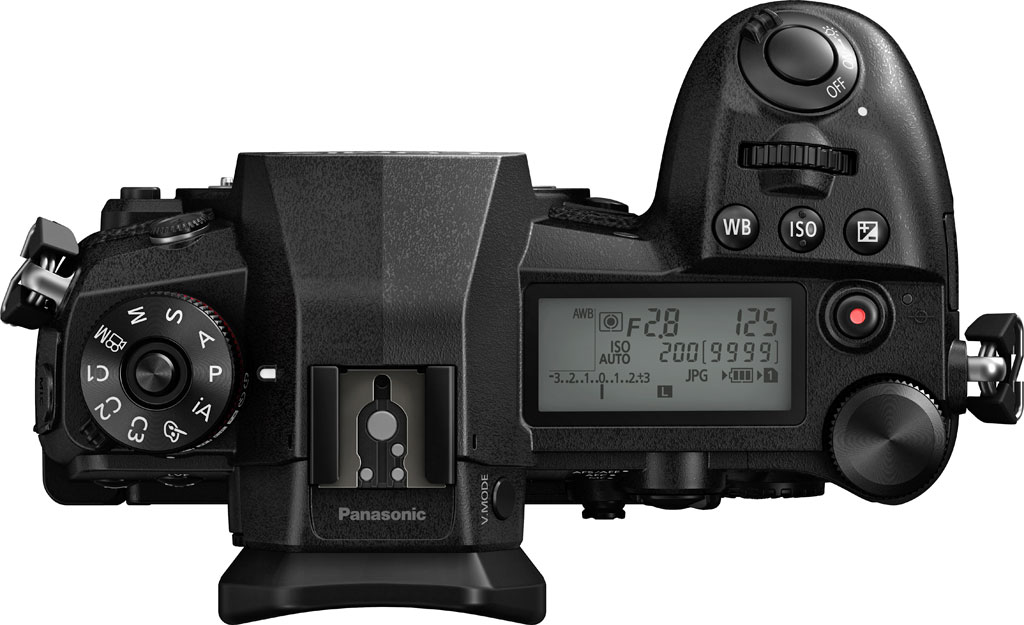
Fortunately, the body also has an LCD screen on top of the camera, so you can quickly check your settings, leaving the screen on the back switched off. Another nice addition is a joystick for moving your focus point, or navigating through menus.
The drive mode dial found on, for example, the G80 and GH5 has been combined with the mode dial, as you also see on the Nikon D7xxx series.
Anyone looking through the viewfinder will be pleasantly surprised by its huge magnification. At 0.83x, it is considerably larger than that of any other digital camera.
The huge viewfinder of the Canon 1DX II is "only" 0.76x, for example. The viewfinder is not only large, but also bright and fast. The latter is especially useful for photographing fast movement, so you do not lose sight of your subject as quickly.
The viewfinder can also be set so that there is no black-out between photos, just as with the Sony A9.
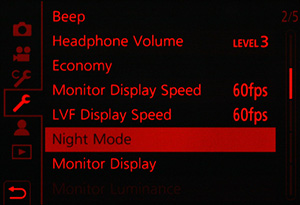
For night photography, there is also a night mode in which the viewfinder and the LCD on the back of the camera display only shades of red.
To take photos for longer on a battery, the G9 has been fitted with a larger battery than the G80 had. The battery has a capacity of 14Wh, comparable to that of the GH5, but unfortunately it has a slightly different shape. Normally, you can take around 400 shots with this battery, but in "Power Save LVF mode" this can rise to more than 900 photos.
If you shoot a lot in burst mode, you can take even more photos. If that is not enough, you can also buy a suitable battery grip, allowing you to insert an extra battery. If your batteries run out, you can also power the camera via USB while it is switched on.
Photography
The G9 is primarily a stills camera, and this is clear from the specifications. Besides the deep grip, the camera's overall size also stands out.
Panasonic has long understood that the advantage of mirrorless cameras should not necessarily be their size, but the possibilities of a camera without a mirror box, without compromising on ergonomics.
The key question, of course, is: can the G9 focus? Short answer: Yes!
Longer answer: AF-S is incredibly fast, but that is no surprise, since every mirrorless camera nowadays has "the world's fastest autofocus". Tracking a moving subject is more difficult for many mirrorless cameras.
During a test at a kart track that was not particularly well lit, even though extra lighting had been installed, the focus stayed firmly locked onto a kart speeding past.
The focus was not flawless, but that was partly down to the man behind the camera... It certainly was not the lens, as the 'PanaLeica' 200mm f/2.8 focused incredibly quickly.
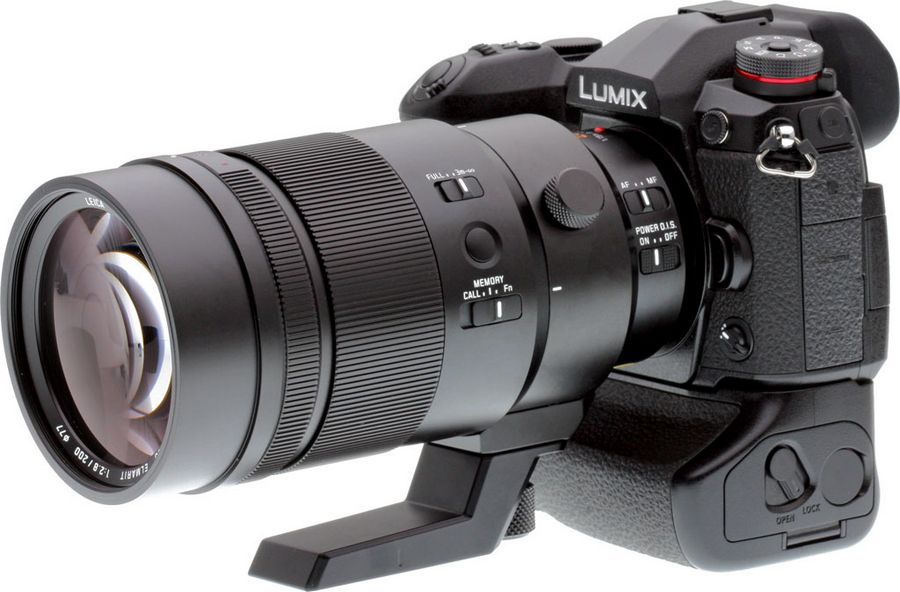
Together with the very capable focusing system, you get an extremely fast burst speed of 20 frames per second with continuous autofocus. For situations where your subject does not change position, you can increase the speed to 60fps, using the electronic shutter.
And all of this in raw. That is no small feat, and to clear the buffer quickly enough, both SD slots use a UHS-II bus.
Pentax, Olympus and several medium-format manufacturers introduced pixel shift much earlier. This shifts the sensor by half or a whole pixel several times, and the resulting images are combined in a special way.
This either produces a much higher resolution, or more detail, greater dynamic range and less noise at the same resolution. Naturally, this is not without its drawbacks. Your camera must be mounted on a stable tripod, and your subject must not move at all for the best results.
In recent years, Panasonic has been working on putting stabilisation in the camera body instead of in the lens. With the G9, they manage to achieve 6.5 stops of stabilisation with short focal lengths or longer stabilised lenses.
This is equivalent to an almost 100 times longer shutter speed! How this works out in practice remains to be seen, but it is a very welcome feature for both photography and video.
Video
The GH5 remains Panasonic's ultimate hybrid video and stills camera, but some of the GH5's excellent video features can also be found in the G9. This includes 4K video at 60 frames per second for 4K slow motion.
A fairly high bitrate of 150 Mbit/s is almost essential for high image quality per frame.
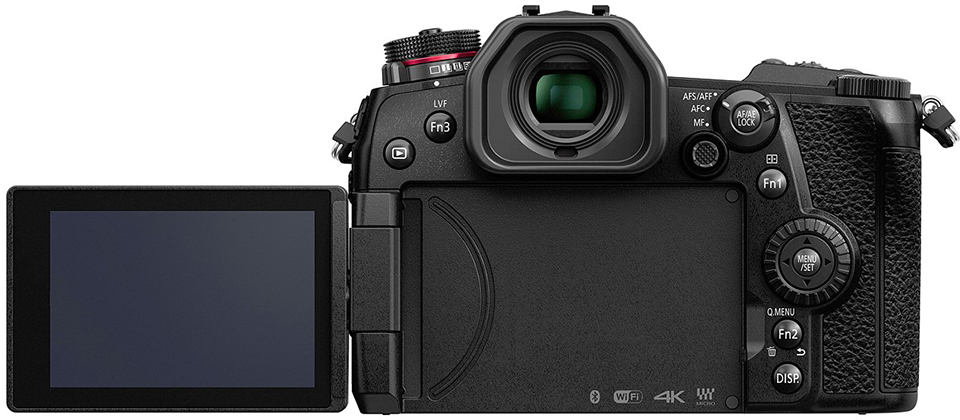
For even more slow motion, the frame rate can be set to up to 180 frames per second. As with the GH5, this can be done using VFR, Variable Frame Rate.
What the G9 has unfortunately not inherited from the GH5 is 10-bit video and the option to use V-Log. So for cinematographers who like to grade their footage afterwards, the GH5 is a better option.
The G9 does have the option to film in 6K. Given the resolution of the G9 and GH5 sensor, it is not possible to actually film in 6K. The image would need to be 6000 pixels wide for that. According to Panasonic, 6K means video with a vertical resolution equal to a genuine 6K film format.
This is possible because a Micro Four Thirds sensor has an aspect ratio of 4:3 rather than 16:9, as with the 6K image. This gives you more vertical pixels. This was very useful on the GH5 for anamorphic lenses, which could display the image correctly straight away. Unfortunately, the G9 does not have this final option.
Compared with competing stills cameras, the G9 has a considerable set of video features, so if you also like to put together the occasional video alongside your photography, the G9 is an excellent choice. Its autofocus is also considerably better than the GH5's at the moment, which many people will appreciate.
Target audience
This brings us straight to the question of who this camera is suitable for, and who it is not. In terms of price, the G9 sits between cameras such as the Sony A6500, Sony A7 II, Nikon D7500, Nikon D500, Canon 7D Mark II, Olympus E-M1 II and Fuji X-T2. And these are certainly not minor cameras, each with their own strengths.
While the Sony A7 II delivers the best still image quality, the Nikon D500 has the best autofocus, the Canon 7D Mark II has, in my opinion, the best build quality, and the Fujifilm X-T2 has beautiful lenses available, Panasonic's G9 has to prove itself in a number of areas.
Because of the smaller sensor size, very fast lenses are needed to compete in image quality.
The autofocus is very good and can compete with a number of the cameras listed above, but in my experience the D500 is still slightly more accurate. In terms of the body, I personally think the G9 is very good and perhaps even the best, but opinions on this can vary considerably.
When you look at all the features this camera has, only a small part of which I have discussed, the G9 offers the best overall package.
Conclusion
The G9 is therefore an excellent all-round camera that does not really have a weak point. So every photographer with the right budget should consider the G9.
Of course, a camera is only part of the story, and a good ecosystem around it is at least as important. As with all other cameras, lenses are often more important than the camera behind them.
Fortunately, Panasonic and Leica have thought of this too, and have since released many lenses with excellent performance. You can also use Olympus lenses on the G9 without any problems, or one of the many third-party lenses.
About the author
Paul Oosterlaak heeft een voorkeur voor landschappen, portretten en evenementen. Hij fotografeert sinds 2008 en sinds 2016 werkt hij ook in een fotozaak. Met zijn natuurkunde achtergrond houdt hij zich vaak bezig met de technische kant van fotografie, zonder daarbij de creatieve kant uit het oog te verliezen. Paul is te volgen op instagram
You might also like
-
 Panasonic announces the Lumix GH5 Mark II and Lumix GH6
by Nando Harmsen
-
 Panasonic Lumix DC-S5 announced
by Elja Trum
-
 Panasonic Lumix S1R and S1 full-frame cameras
by Michelle Peeters
-
 Panasonic Lumix GH6 announced
by Elja Trum
-
 Panasonic LUMIX S1H announced
by Michelle Peeters
-
 Panasonic announces the LUMIX S1RII
by Nando Harmsen
1 comment
-
 Theo Molenaar wrote on Tuesday 26 December 2017 at 17:50 | reply
Yes, you can also attach lenses from other brands to it. But the fast focusing is made possible by the dept from defocus technique (DFD). And that therefore does not work with lenses from other brands. That makes the camera a lot less interesting if you already have -quality- lenses from Olympus.
Translated from Dutch.
Have your say
Please note: Articles older than a week can only be commented on by signed-in visitors.Would you still like to comment? sign in or create a free account.
Become a better photographer every week
A practical photography tip in your inbox every week.
38,836 photography enthusiasts already receive the tips! More about the weekly mail. Or keep up to date via  Facebook.

Elja Trum
Photofacts; everything to do with photography!
Would you like to take better photos and keep up with what is happening in photography? Photofacts publishes articles that teach you something about photography — from a product announcement to a practical shooting tip or a look at a website. Photofacts covers photography every day and is a hobby project of Elja Trum's that got out of hand. The articles are written by a team of volunteer authors. If you would enjoy writing one or more articles for Photofacts, do get in touch.More about PhotofactsPhotofacts is made possible in part by
