

NVIDIA algorithm could speed up future photo editing
Thursday 26 April 2018, 20:40 by Michelle Peeters | 3,927 views | 1 commentThis article was translated from Dutch with the help of AI. Read the original.
Scientists at Cornell University have created an NVIDIA algorithm that can copy the artistic style from one photo to another. This lets you fix inconsistencies in your photo collection or transfer the artistic style of your best photo to a completely different photo (series).
Thanks to these scientists, this is no longer a vision of the future, and you can achieve surprisingly accurate and realistic results.
The team created an algorithm for NVIDIA, a graphics card company that extracts the stylistic characteristics of one photo and places them on a completely different image with surprising precision.
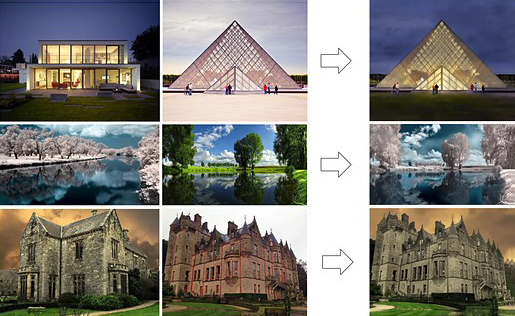
The algorithm is called FastPhotoStyle and it can transfer the colouring, drama and atmosphere of a photo, making a completely different frame look as if it was taken at the same time, even if the subjects have nothing to do with each other.
According to the developers, the aim of photorealistic image style transfer is to modify a photo so that it looks like another photo.
For faithful stylisation, the content of the photo being edited must remain the same. Only its style should resemble that of the reference photo. You should also be able to see that the edited photo was really taken with a camera.
There are already programmes that can do this too, but according to the inventors, they are slow and do not produce realistic results.
FastPhotoStyle is different, they say, because it uses smoothing after the initial whitening and Coloring Transfer step, or PhotoWCT step. This smoothing step tries to ensure that adjacent pixels have a similar appearance.
By using what they call Matting Affinity, separate parts of the image can be treated slightly differently. This is what helps the algorithm produce such realistic-looking results.
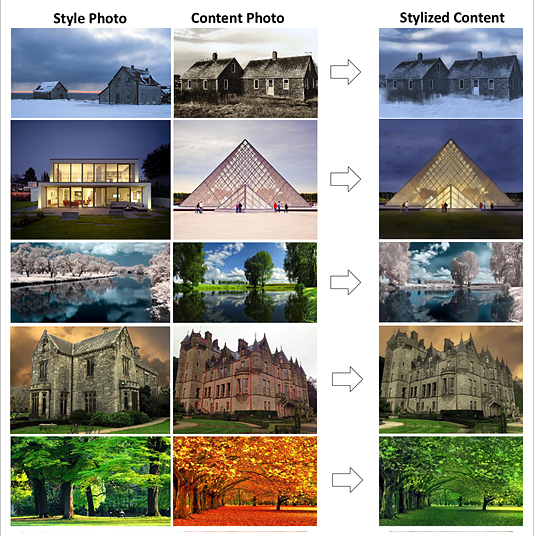
Another major difference is that this programme is reportedly up to sixty times faster than existing algorithms.
The code can be downloaded from NVIDIA's GitHub by anyone who can use it under a Creative Commons licence (BY-NC-SA 4.0), and a download of the user manual can be found on the page. You can also read the full paper.
Via: DP Review.
About the author
Michelle Peeters is fotografe en oprichter van DeuxBleus Fotografie. Michelle herkent het bijzondere in het gewone en het gewone in het bijzondere. Ze heeft zich nooit willen specialiseren en is daardoor van alle markten thuis.
You might also like
-
 The Universal Photographer
by Michelle Peeters
-
 How to find your photographic style
by Elja Trum
-
 How do you find a photography style?
by Frank Doorhof
-
 Copying and pasting in Photoshop
by Michelle Peeters
-
 Accidentally appearing in a photo with your future partner
by Elvira Smit
-
 Do you need your own style as a photographer?
by Laura van der Burgt
1 comment
-

 martinphili wrote on Friday 27 April 2018 at 08:21
| reply
You would almost wish this were a belated April Fools' joke.
Translated from Dutch.
Have your say
Please note: Articles older than a week can only be commented on by signed-in visitors.Would you still like to comment? sign in or create a free account.
Become a better photographer every week
A practical photography tip in your inbox every week.
38,886 photography enthusiasts already receive the tips! More about the weekly mail. Or keep up to date via  Facebook.

Elja Trum
Photofacts; everything to do with photography!
Would you like to take better photos and keep up with what is happening in photography? Photofacts publishes articles that teach you something about photography — from a product announcement to a practical shooting tip or a look at a website. Photofacts covers photography every day and is a hobby project of Elja Trum's that got out of hand. The articles are written by a team of volunteer authors. If you would enjoy writing one or more articles for Photofacts, do get in touch.More about PhotofactsPhotofacts is made possible in part by
