

Choose the right lens rather than the best lens
Monday 14 March 2022, 20:20 by Nando Harmsen | 8,172 views | 19 commentsThis article was translated from Dutch with the help of AI. Read the original.
During a trip to the Lofoten Islands, I got talking to a participant about equipment. This led to an insight I already knew in principle, but had actually been ignoring.
The outcome of that discussion was that you should choose a lens based on how you use it. In this article, I explain what I mean.
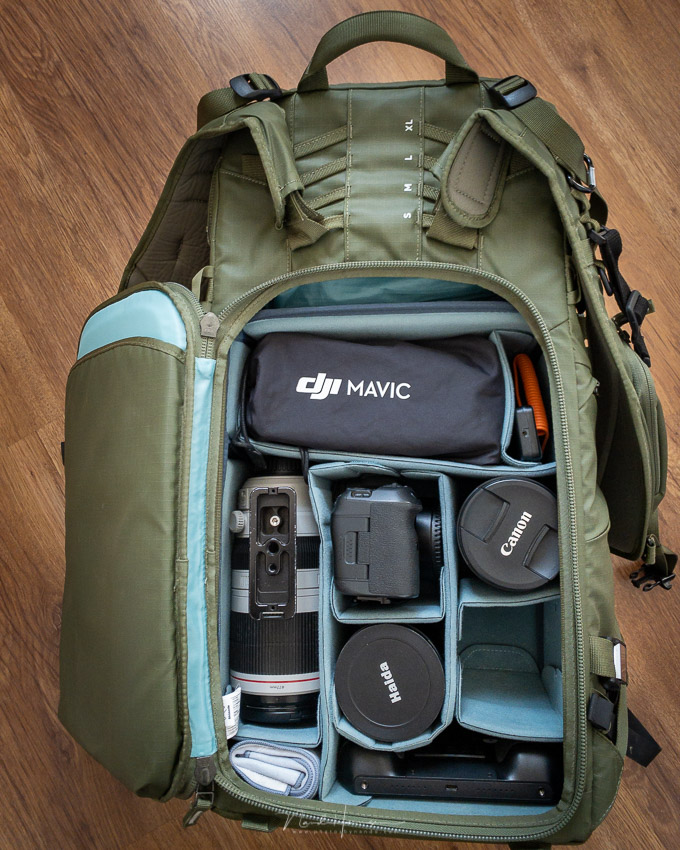
We came to this subject when I gave my opinion about the compact camera bag the participant was carrying. It contained two cameras, three lenses and a filter set. That was very different from my enormous camera bag.
The difference was not just in the size of the camera bag, but also in the weight. I was carrying no less than 10 kilograms, while the participant had perhaps 5 kilograms. I have to admit that this was partly because I also had a drone with batteries in the bag, but still.
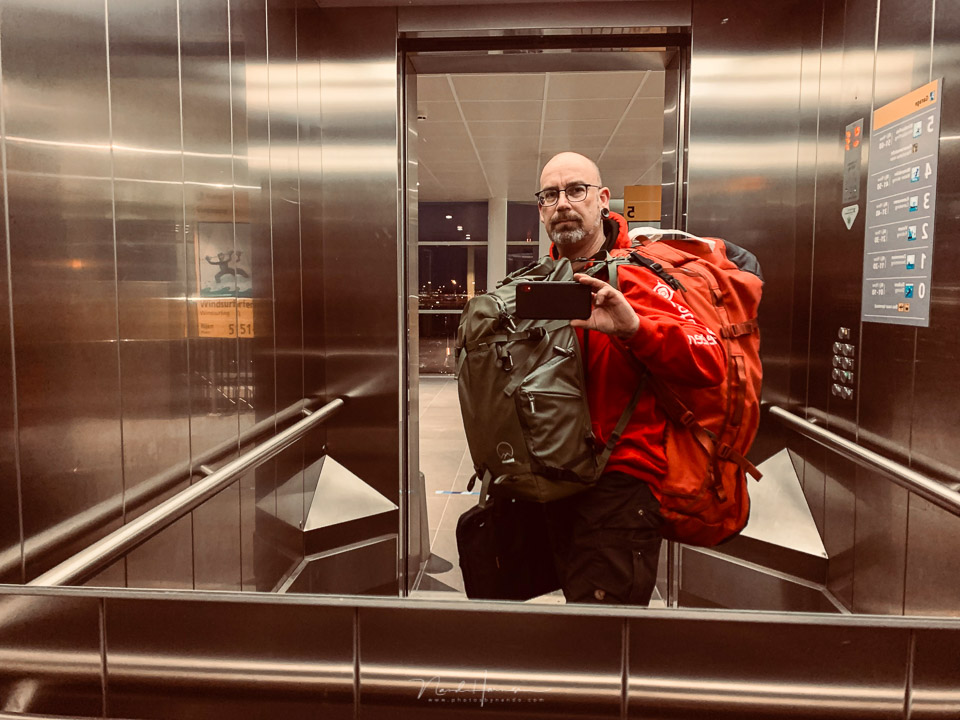
What had I brought? A Canon EOS R5, a 24-70mm and a 16-35mm lens, both at f/2.8. And a 100-400mm lens. These are large and heavy lenses, which are not always necessary for landscape photography.
When I look at landscape photography, a large depth of field is chosen in nine out of ten cases. You do not need f/2.8 for that. A lens with an aperture of f/4, or even a variable aperture between f/3.5 and f/5.6, is more than enough.
The extra stop of light that comes through the lens is also less important. You often photograph from a tripod, so the shutter speed does not matter. In short, f/2.8 is not necessary at all. So why would you, as a landscape photographer, choose a lens with a wide aperture?
An f/2.8 lens may deliver fantastic quality, but it also comes with a price tag. The quality of lenses with a smaller maximum aperture is often more than enough for us as photographers. We only see the difference in a laboratory under a microscope.
There is another advantage to the 'smaller' lenses, something I mentioned earlier: the weight. You have to carry fewer kilos, the equipment is more compact and therefore more likely to encourage you to take it with you. All advantages.
You could even take this a step further and apply it to the camera. In my view, a landscape photographer does not necessarily need a large full-frame camera.
For example, Fujifilm cameras with a 1.5x crop sensor are extremely suitable for photographing landscapes. It is easier to achieve a very large depth of field thanks to that smaller sensor.
Taken together, this gives you a smaller camera and smaller lenses, without having to compromise on quality. This can be a good reason to make a conscious choice, especially for photographers who travel a lot or spend a lot of time on the road.
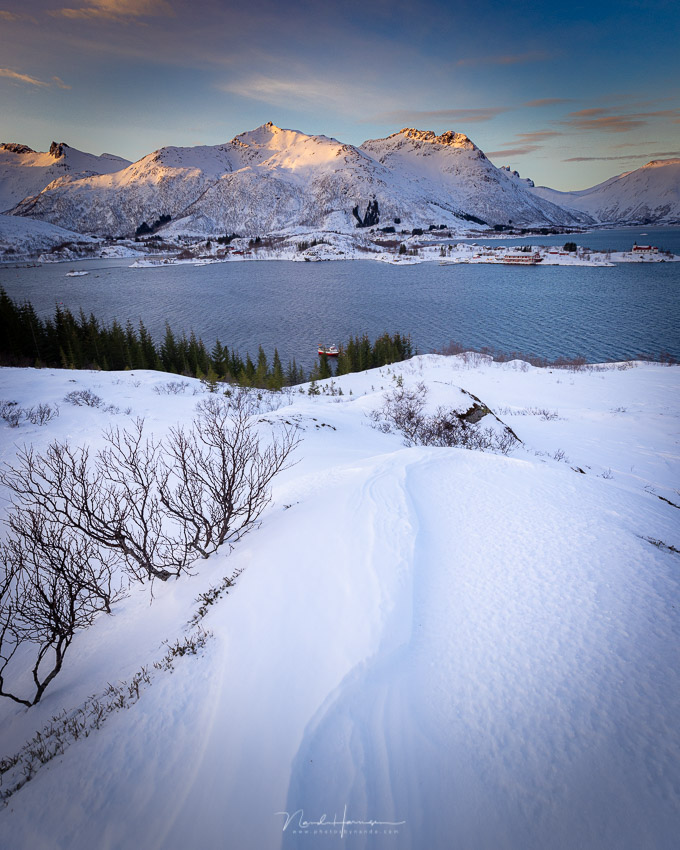
Of course, this also applies to other types of photography. Choose wisely and look beyond just the best quality. This is a trap I also seem to fall into quite often.
The conversation did at least prompt me to take a closer look at my own landscape photography equipment. Who knows, you may be able to benefit from it too.
About the author
Nando Harmsen has been photographing for more than 40 years. He specialises in wedding photography and landscape photography. Nando also gives talks, workshops, masterclasses and photo trips, and regularly reviews new and interesting equipment.
You might also like
-
 An inspiring trip to Lofoten, Norway
by Nando Harmsen
-
 A Visit to Lofoten in Winter
by Nando Harmsen
-
 I'm Going on a Trip and I'm Taking
by Nando Harmsen
-
 Tips for a photography trip. Part 1: The camera bag
by Nando Harmsen
-
 Tips for a photo trip. Part 2: the tripod
by Nando Harmsen
-
 LED versus flash: which is better?
by Elja Trum
19 comments
-

 Donald Willemsen
wrote on Monday 14 March 2022 at 22:52
| reply
Donald Willemsen
wrote on Monday 14 March 2022 at 22:52
| reply
Nando, I enjoy reading your articles and I certainly don't always agree with you. But this time I do agree with what you write in this article.
Translated from Dutch. -
 RAWshooter wrote on Tuesday 15 March 2022 at 10:35 | reply
Finally someone who walks around with a load of big stuff themselves and wonders why. It's simply macho to lug around an FF and big lenses. With virtually every photo you then see that f5.6 or f8 was needed, because otherwise you don't get sharpness in the corners, etc.
Translated from Dutch.
The truth is that you simply don't use that large glass surface then.
Take a 1.5 or 2 crop camera, screw a good “consumer lens” onto it and you take top photos. The smaller the sensor, the lighter the kit. With some fixed focal length lenses you're then heelt mobile. And then you can still work at f1.8 (or even larger) without all that fuss about blurry corners. -
 Rob Van Bever wrote on Tuesday 15 March 2022 at 10:38 | reply
Dear, I completely agree with what you write but … maybe m43 is even more interesting than 1.5 crop as travel equipment? In any case, I made the switch and am very satisfied. Equipment consists of 2 bodies, 12-100, 100-400 and 60 macro and with that I have everything …
Translated from Dutch. -
Mac wrote on Tuesday 15 March 2022 at 10:55 | reply
@RAWshooter,
Translated from Dutch.
The fact that you shoot at f5.6 or f8 does not mean that an f2.8 lens is not the best for you at that moment.
For what Nando describes you indeed do not need those lenses. But someone who photographs animals, sports, etc. often does benefit from f2.8.
And if you travel and you want to photograph more than just landscapes, you will still take the f2.8 lens with you more often, because you can also photograph indoors (and you cannot use a tripod everywhere)
And that is the point of the story, you have to choose a suitable lens, and that does not have to be the most expensive, brightest, etc., but it can be. -
 Luc Vancamp wrote on Tuesday 15 March 2022 at 11:37 | reply
Ah, I’ll keep repeating it, photography falls under the heading of art, not technology.
Translated from Dutch.
PS. I also got ‘caught’ with 3 bodies and a bunch of expensive lenses … Now I just need to learn how to see 😎 -
 BV46 wrote on Tuesday 15 March 2022 at 12:36 | reply
Spot on. You can take a little trailer with you for your stuff, but you can also bring equipment that is adapted to the situation. Just to be sure, I recognize everything in your story. When I go on holiday I want two things: 1) a relaxing holiday and 2) good photos. It means I make a sacrifice and consider relaxation for myself and my wife important. The solution is my 5Dmk4 with the 24-105mm “L” on it and nothing more. With this I might miss 5 to 10% of the photos for which I would need a different lens. So be it. After many, many years of photography and quite a few holidays, it turns out to be a compromise I can live with.
Translated from Dutch. -
 Nico van Noorloos wrote on Tuesday 15 March 2022 at 12:40 | reply
Because I have to take the strain on my back into account, when I go out I limit myself to the absolute minimum. A Sony A7 and 100-400/4.5-5.6 + a 24-70/ 2.8 lens and an Olympus Tough so I can also take photos under harsh conditions and underwater. For macro work I use a couple of extension rings. With a few other things added, it all weighs 5 kg in total. And I have to make do with that. Maybe one day I’ll buy an extra body, but those 600 grams won’t kill me.
Translated from Dutch. -
 Paul wrote on Tuesday 15 March 2022 at 13:40 | reply
Clear piece, Nando.
Translated from Dutch.
Those fast lenses are quite nice (if you can afford them) but by no means always necessary. When I was still working with film it was different, with the ISO values (DIN when I started, 17 DIN was standard, that's ISO 35!) of the films you were happy with a larger aperture.
I've been working for years now with my 3.5-5.6 16-85 as a "standard" lens, rarely needing a larger aperture, But if necessary, the 1.8 35 goes on. Besides that I do still have some extra lenses, including the big Sigma 150-600, which is also 'only' 5 to 6.3, but that too turns out to be sufficient most of the time.
An additional argument not to focus too much on absolute 'top class' and maximum sharpness is the fact that almost nobody prints their photos anymore, and certainly not in large formats. I still do that occasionally myself, and in doing so I discovered that even my ancient lenses, one of which (a Vivtar 3.8 21mm) was once severely criticized in a test, still allow beautiful A3+ prints to be made after scanning and further digital processing.
It's all very relative. -
 Patrick op reis wrote on Tuesday 15 March 2022 at 13:43 | reply
What BV46 writes is very recognizable: "The solution is my 5Dmk4 with the 24-105mm “L” on it and nothing else". 98% of my photos are travel photography and I almost always shoot those with such a setup.
Translated from Dutch. -
 RiPa-Photo
wrote on Tuesday 15 March 2022 at 20:06
| reply
RiPa-Photo
wrote on Tuesday 15 March 2022 at 20:06
| reply
'If' you can choose... then I would always go for the best lens ... because otherwise later, with another photography subject, you might need a different lens after all that is light-sensitive.
Translated from Dutch.
The finances determine.... but if possible... always go for the best quality. (That does not mean that you cannot take good photos with a consumer lens) -
 Ronny wrote on Tuesday 15 March 2022 at 22:33 | reply
Fully agree with your article,
Translated from Dutch.
but I do have a remark : in dark situations the AF will work considerably better with a fast lens, because it focuses at the widest aperture, even if you photograph with a small aperture. this was a problem I regularly struggled with before I had fast lenses. -
 Wouter J. van Duin wrote on Wednesday 16 March 2022 at 00:27
| reply
Wouter J. van Duin wrote on Wednesday 16 March 2022 at 00:27
| reply
By now I have been more than satisfied with my FujiFilm-X crop cameras for quite some time. They also have really very good lenses. And for those special cases there are even very small (manual) extremely light-sensitive lenses such as the Laowa 9 mm. Then you really no longer need a full-frame camera with very heavy lenses. You really never miss that anymore, anywhere. After all, DxO eliminates all noise and problems. A FujiFilm 18 mm 1.4 prime makes you think you are using a GFX camera. Full frame is for those who really want to lug things around.
Translated from Dutch. -
Donald Willemsen
wrote on Wednesday 16 March 2022 at 08:55
| reply
I quite often read in the comments that the weight and size of cameras and lenses play a role. Sometimes it is suggested that a crop camera is smaller and lighter than a full-frame camera. That seems like a misconception to me. If we look, for example, at the Canon EOS R5, a full-frame camera, it is not really large and certainly cannot be called heavy. The weight is mainly determined by the lenses. The material from which a lens is made especially determines its weight. Lenses from the professional segment are often made of metal (alloy) and the lenses are made of pure glass. If we look at lenses in the 'cheap' segment, plastic has generally been used there and the 'glasswork' is often also made of plastic, just as with glasses, for example. The difference in weight is therefore mainly caused by the material it is made of. In addition, with zoom lenses, the zoom range also plays a role. The larger the zoom range, the more lens groups are needed, and that also contributes to the size and weight.
Translated from Dutch.
It is therefore not the camera body that makes the difference. Full-frame or crop really makes no difference, it only affects the angle of view in combination with the chosen lens. -
liesbeth wrote on Wednesday 16 March 2022 at 10:22 | reply
Thanks for your article!
Translated from Dutch.
I’m also someone who used to lug around a ton of gear, because what if I didn’t have something with me. Since last year, for physical reasons, I’ve had to limit the weight I carry around, and that has turned out to be a good lesson. For two reasons: I now first think about what I really absolutely need to have with me. In addition, I’ve discovered the challenge of working with what I have with me at that moment. The latter certainly also helps me become more creative and yes, sometimes you can’t take the photo you had in mind, but you can take another one that may be even more successful. -
BV46 wrote on Wednesday 16 March 2022 at 11:06 | reply
@Donald Willemsen. Yes, there are undoubtedly many more cameras that qualify when it comes to saving weight and performance. Back then I had a 4/3 Panasonic Lumix DMC-GH1 with a 14-140mm. I regret getting rid of it and am still looking for its successor, the GH2, as a nice second-hand one. If you're talking about weight and performance, this one is a real winner. With the GH3 they started focusing more on video and that isn't interesting to me.
Translated from Dutch. -
Luc Vancamp wrote on Wednesday 16 March 2022 at 14:03 | reply
To Donald and everyone:
Translated from Dutch.
The glass in lenses with the same aperture is (much) smaller with a crop, so lighter.
Tip: live healthier, lose weight, then you can carry more photography gear 😃.
Kind regards
Luc -
Wouter J. van Duin wrote on Wednesday 16 March 2022 at 14:25
| reply
The difference in weight is certainly not only in the body. FujiFilm X and other smaller-sensor cameras also need lighter lenses for that smaller sensor. For my FujiFilm-X camera I have really fantastic zoom lenses and macro lenses that do not fall short of many much heavier Nikon lenses (such as I used before) but really are a lot lighter. The Chinese prime lenses that have 1.4, 1.2 or even 0.95 as their largest aperture are also small and light, so they hardly take up any space in a camera bag or jacket pocket. Because even with landscape photography, an extremely large aperture and sensitivity can come in handy, especially with extreme wide-angle lenses when something very close-up can also be brought into sharp focus. The fact that these are not automatic lenses does not detract from the quality and is not really a problem with lenses that are both very fast and extra wide.
Translated from Dutch. -
Donald Willemsen
wrote on Wednesday 16 March 2022 at 15:04
| reply
@Luc, that only applies to lenses that are specifically made for crop cameras. I use lenses that can be used on both a full-frame camera and a crop camera. You shouldn't compare apples and oranges even though they are both fruit.
Translated from Dutch. -
Paul wrote on Wednesday 16 March 2022 at 15:05 | reply
So many people, so many opinions. And misconceptions.
Translated from Dutch.
That is why Donald's remark is quite nice. Here at home we have both crop and ff bodies from Nikon. I have a D500, my daughter a D750. Almost the same size and weight, only her 24-70 2.8 Tamron weighs about 3 times as much as my 16-85 Nikon....
For standard lenses it is less, by the way, her 1.8 50 and my 1.8 35 are not much different.
But otherwise there is (especially at the moment) an incredible amount of attention being given to fast prime's, to use an English word. While we really only still need those in cases where we want little depth of field -or depth sharpness?-, or when we have to work under very difficult lighting conditions. Only people who have to be able to produce photos for their profession always and everywhere will not be able to avoid them. But amateurs like me can do perfectly well without those expensive, heavy and bulky things.
But I do cherish my long Sigma!
Have your say
Please note: Articles older than a week can only be commented on by signed-in visitors.Would you still like to comment? sign in or create a free account.
Become a better photographer every week
A practical photography tip in your inbox every week.
39,004 photography enthusiasts already receive the tips! More about the weekly mail. Or keep up to date via  Facebook.

Elja Trum
Photofacts; everything to do with photography!
Would you like to take better photos and keep up with what is happening in photography? Photofacts publishes articles that teach you something about photography — from a product announcement to a practical shooting tip or a look at a website. Photofacts covers photography every day and is a hobby project of Elja Trum's that got out of hand. The articles are written by a team of volunteer authors. If you would enjoy writing one or more articles for Photofacts, do get in touch.More about PhotofactsPhotofacts is made possible in part by
