

5 tips for creative autumn photography
Monday 9 October 2017, 19:19 by Mike Muizebelt | 14,906 views | 7 commentsThis article was translated from Dutch with the help of AI. Read the original.
Autumn is the perfect season for creating creative and surprising images. There are often more saturated colours, while the trees and fallen leaves offer beautiful colour patterns.
The sun is also no longer directly overhead so early, which means you can photograph for longer in beautiful light.
In autumn, an overcast day is more likely to be an advantage than a disadvantage. Bright, direct sunlight creates too much contrast. As a result, the beautiful autumn colours do not come into their own. An overcast day is therefore much more suitable.
Is the sun shining? Then you can also go out early in the morning or later in the afternoon to capture the autumn colours and bring more atmosphere into your photos.
Your polarising filter can reduce reflections on the damp leaves and will make the autumn colours stand out better.
Autumn photography without limits!
But what if you want to expand your autumn series with a variety of photos? Then we will photograph without rules and let ourselves be guided by the ideas that spontaneously come to mind!
Wind, backlighting, harsh contrasts or movement... this time, not the source of our frustrations, but our sources of inspiration.
We play with our focal length, the background, the light and creative blur. In this article, I will give you some ideas to get started, but remember that the possibilities are of course endless.
1. Photograph from a low angle
By choosing a low viewpoint, you avoid distractions in your background because branches, shrubs, small tree trunks and the like no longer have any influence.
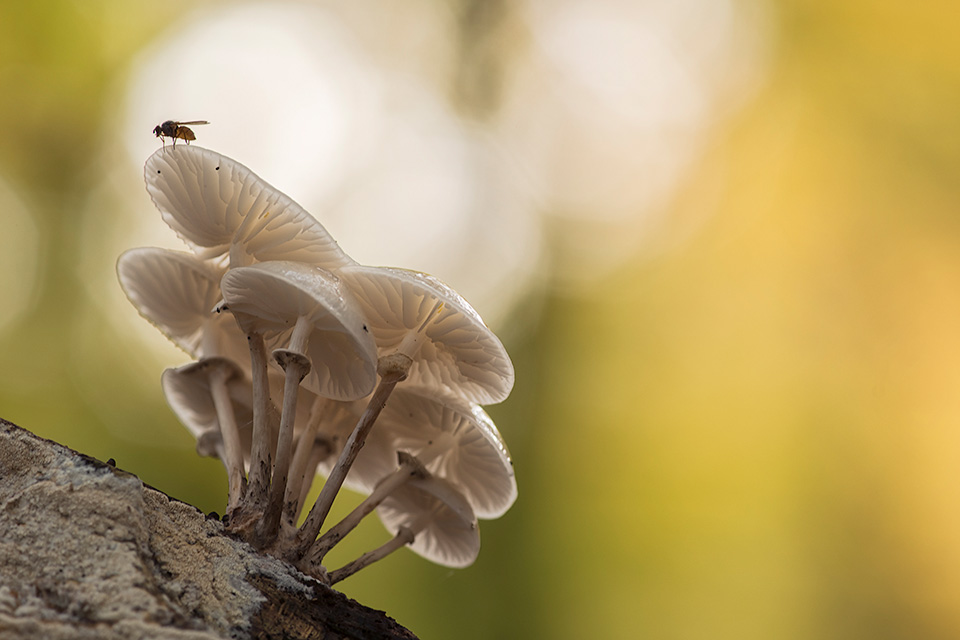
This also suddenly makes the gills of the mushrooms visible, giving the viewer a different image from the one they would normally see.
You often find mushrooms standing a little higher on fallen tree trunks, making them ideal candidates to experiment with.
2. Use slow shutter speeds
The fascinating thing about photos taken with slow shutter speeds is that you create something that we cannot see with our own eyes and brains. It gives a creative and fresh view of the things around us.
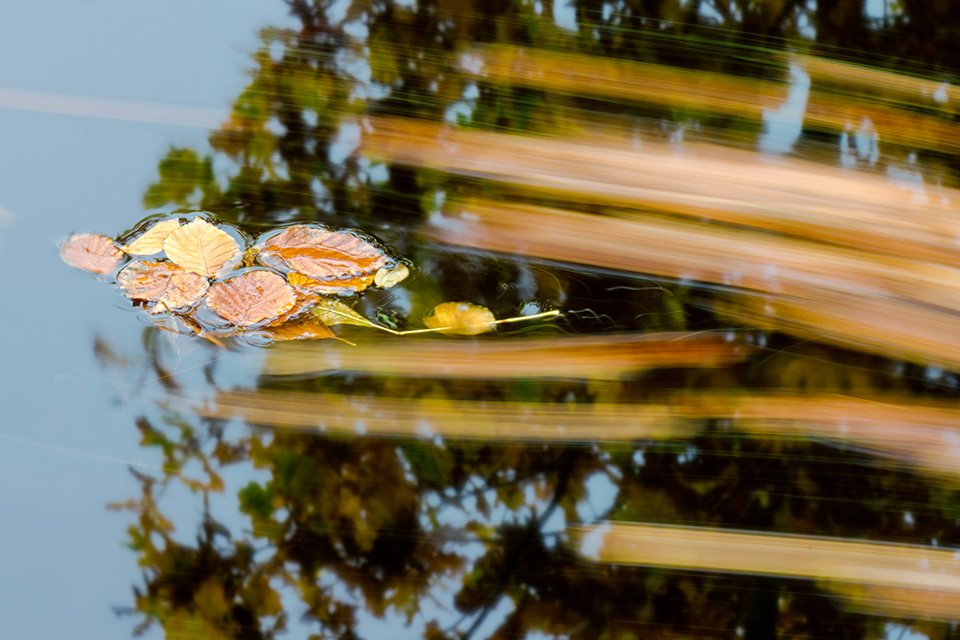
In autumn, you often see beautifully coloured leaves floating on the water. This is an ideal subject for applying this technique. Find a place with flowing water and you can quickly get started with this technique.
Experiment with different shutter speeds, with or without Neutral Density filters, to see which effect appeals to you most. On a windy day, you will often find that the wind already creates enough movement in a pool or small lake for you to work with this technique
3. Multiple exposure
Some DSLR cameras now have a double exposure function. Does your camera not have this? No problem! You can also layer two photos on top of each other using photo-editing software.
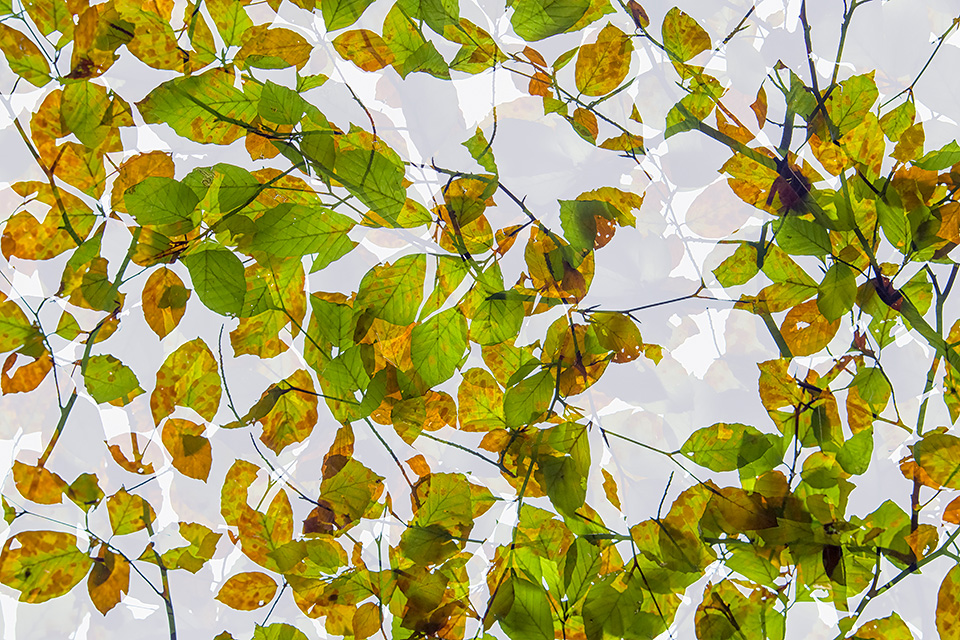
Multiple exposure is often used to create a dreamy image. You place a blurry photo over the sharp photo. It is also very effective for giving the coloured trees in autumn a soft glow!
For the photo above, I turned the camera a quarter turn for the second image, while keeping the focus and exposure the same. Where the leaves overlap, the image gets the correct exposure and you suddenly see the texture and colour come through clearly.
For a similar image, choose a branch with leaves where you can get all the leaves sharp.
4. Deliberate motion blur
When you take photos where part of the image is blurred by motion blur, you usually get dynamic images with a powerful look. The condition is that you choose a shutter speed that is slow enough to create the desired motion blur.
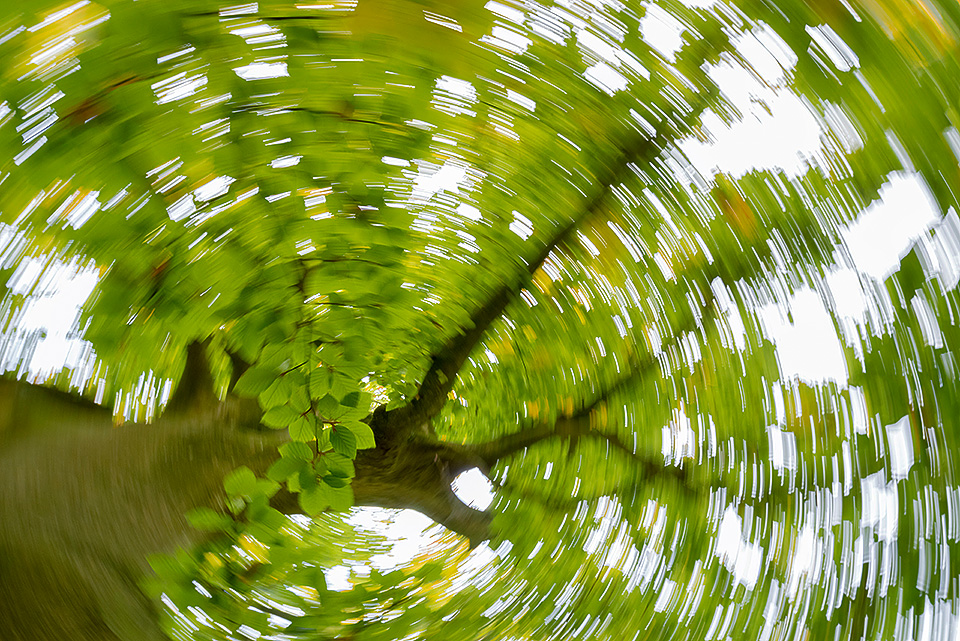
Which shutter speed should you choose? No idea. This is a typical case of trying things out and gaining experience. And of course you can gain that experience very quickly, because you can immediately see on the display after taking the photo whether you like the blur.
Normally, your subject moves and determines the shutter speed you need. In the case of this photo, the speed at which I turn my camera determines the shutter speed I need. By using a wide-angle lens, there is relatively little distortion around the pivot point and the leaves remain sharp there.
Because I turn the camera handheld, this pivot point is not in the centre of the sensor either, but it fits nicely with the principles of classical composition.
5. Use an extreme wide-angle lens
Because most wide-angle lenses have a short minimum focusing distance, you can also use them for close-up photography. The 15-30mm f/2.8 that I use in this case has a minimum focusing distance of 28 centimetres. Stopping down considerably allows you to get a little closer.
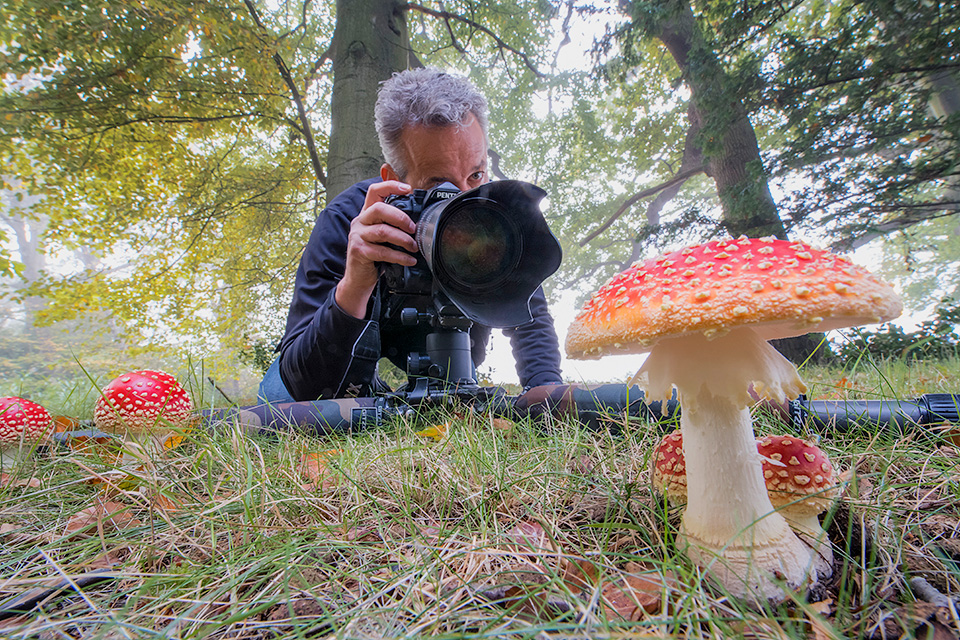
Using this extreme wide angle brings a great deal of the surroundings into your image. So make sure there are no distracting elements visible, and clear away any leaves, blades of grass and twigs in the foreground first.
In this case, I set the camera to manual focus and focus on the fly agaric. I also use a wireless shutter release to operate the camera. This allows you to make a series from which you can later select the best image.
About the author
Mike Muizebelt is een full time professioneel natuurfotograaf met een uitgesproken passie voor reisfotografie, met name op het Afrikaanse continent. Zijn 30 jaar aan ervaring als fotograaf deelt hij graag tijdens workshops, presentaties & persoonlijk reisadvies.
You might also like
-
 Creative with (Autumn) Leaves
by Laura van der Burgt
-
 12 tips for atmospheric autumn photography
by Laura van der Burgt
-
 Do you love autumn photography too?
by Laura van der Burgt
-
 5 Tips for Photographing Autumn
by Michelle Peeters
-
 Photographing beautiful autumn colours in the forest
by Laura van der Burgt
-
 Photographing autumn leaves
by Nando Harmsen
7 comments
-

 geerjanssen
wrote on Tuesday 10 October 2017 at 12:06
| reply
Clear explanation, great work and no blah blah, characteristic of a professional.
Translated from Dutch.
It is also nice that the man has a face and a site so you can see what his competence is, I always miss that here. (an opinion, but you can't look at a face and work?) -
 Mike Muizebelt
wrote on Wednesday 11 October 2017 at 18:07
| reply
Thank you Geer, nice to hear this feedback!
Translated from Dutch.
Warm regards,
Mike -
 Albert wrote on Wednesday 11 October 2017 at 19:50 | reply
nice tips, thnx
Translated from Dutch. -
 Robert wrote on Saturday 14 October 2017 at 19:24 | reply
Nicely done Geer.
Translated from Dutch.
With photo-shooting regards Robert -

-
geerjanssen
wrote on Monday 16 October 2017 at 12:00
| reply
Hi Hanneke, taking photos is enjoying yourself, And you can do that also
Translated from Dutch.
very well with your iPhone 5, in 5 years there won't be any
pop-up mirrors anymore. http://www.digifotopro.nl/content/zo-werkt-de-kleine-52mp-light-l16-camera -
Mike Muizebelt
wrote on Monday 16 October 2017 at 12:38
| reply
Hi Hanneke, thank you for your response. Geer beat me to it and I completely agree with him that first and foremost it is about enjoying creating images. Fortunately, the type of camera you use for that has no influence on it.
Translated from Dutch.
And you can also get along very well with a mobile phone. Its depth of field is unmatched and if you still want some blur.... try photographing through a hole in an autumn leaf, beautiful blurry edges are then guaranteed
Kind regards,
Mike
Have your say
Please note: Articles older than a week can only be commented on by signed-in visitors.Would you still like to comment? sign in or create a free account.
Become a better photographer every week
A practical photography tip in your inbox every week.
38,836 photography enthusiasts already receive the tips! More about the weekly mail. Or keep up to date via  Facebook.

Elja Trum
Photofacts; everything to do with photography!
Would you like to take better photos and keep up with what is happening in photography? Photofacts publishes articles that teach you something about photography — from a product announcement to a practical shooting tip or a look at a website. Photofacts covers photography every day and is a hobby project of Elja Trum's that got out of hand. The articles are written by a team of volunteer authors. If you would enjoy writing one or more articles for Photofacts, do get in touch.More about PhotofactsPhotofacts is made possible in part by
