

Don’t always choose the lowest viewpoint for your landscape photo
Monday 28 October 2024, 21:42 by Nando Harmsen | 4,203 views | 11 commentsThis article was translated from Dutch with the help of AI. Read the original.
I often see landscape photographers taking up a low viewpoint. Too often, because in many cases it is the wrong choice. During my masterclass on the Opal Coast, I made some examples of this. I’m sharing one of them.
Every year, I go to the Opal Coast in spring and autumn to teach the long-exposure masterclass. This masterclass will also take place in 2025. There is one thing I see happening every edition: photographing from an extremely low viewpoint.
The idea is simple and not even illogical. By photographing close to the ground, you can show the foreground large and in detail. It can add depth through perspective. You need an extreme wide-angle lens for it. The results can be surprising... Or they can be disappointing.
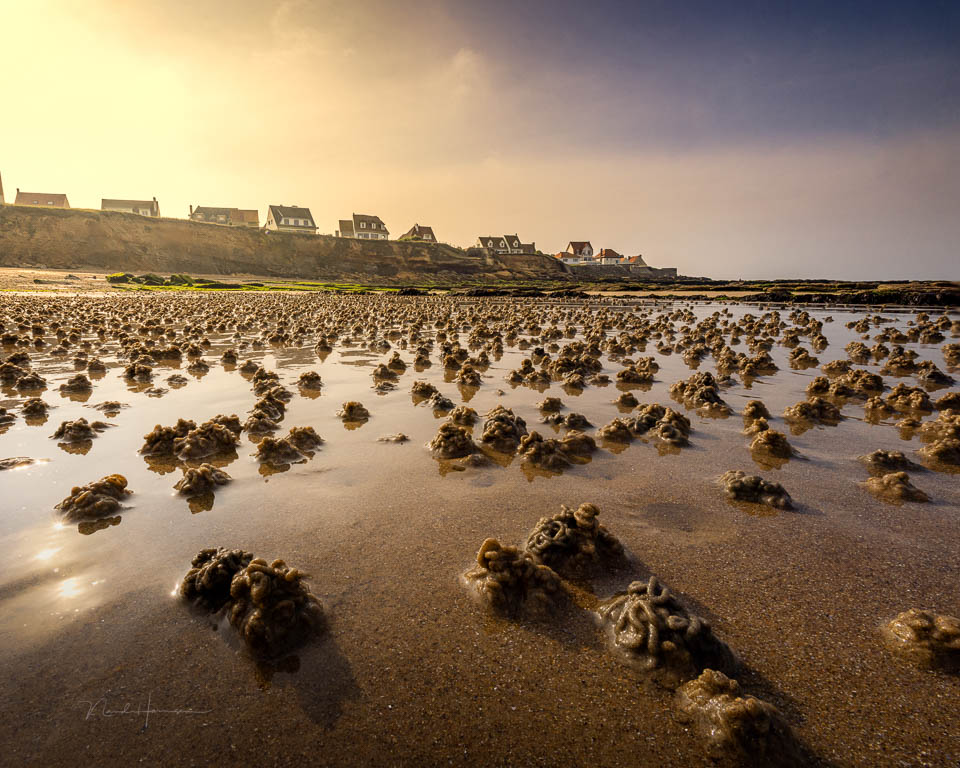
However beautiful a low viewpoint can be, it does not always work. I would even say it works less often than it does. You need something clearly recognisable in the background, or there needs to be a suitable difference in height. If you do not have that, you see nothing more than the foreground.
Especially on the beach, a higher viewpoint will often produce better results. The reason is simple: you are looking down at the landscape. This makes lines and patterns in the sand much more visible. In addition, there is less chance of placing the horizon in the middle.
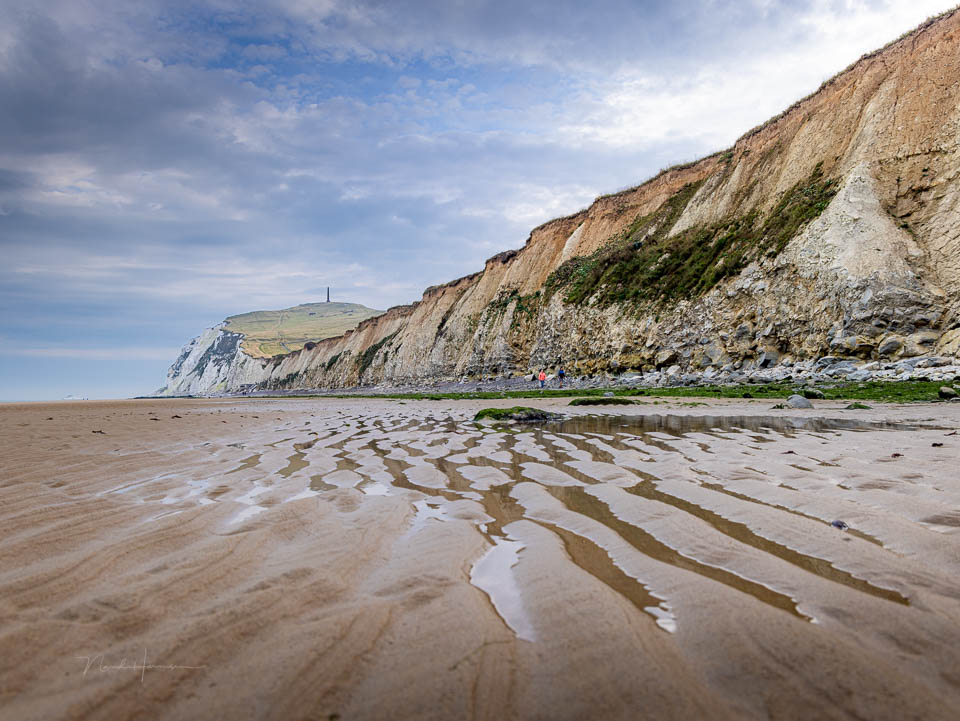
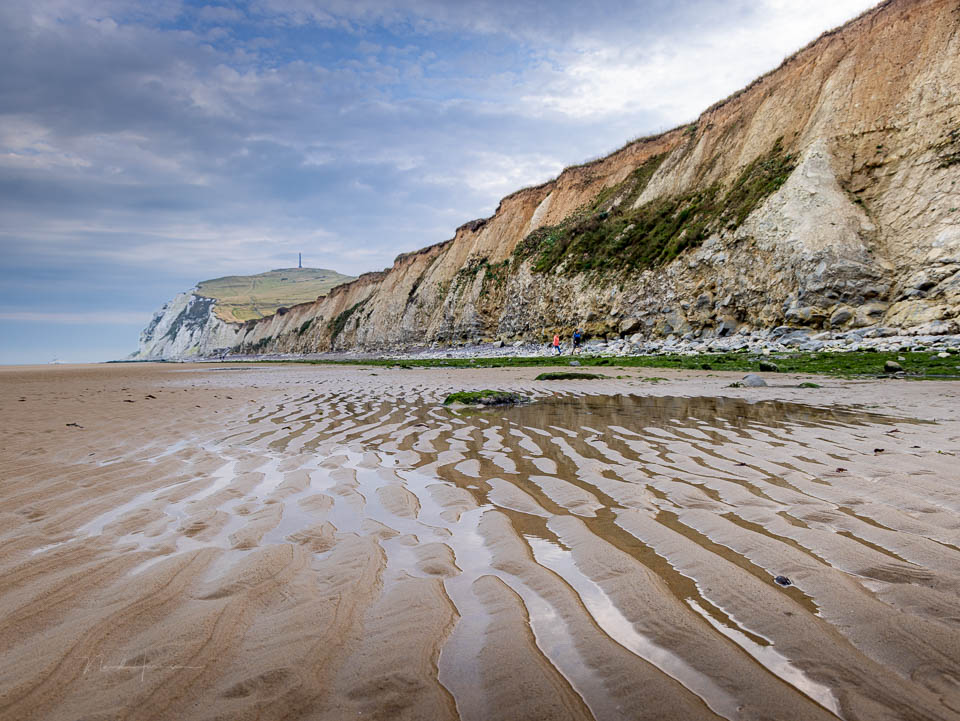
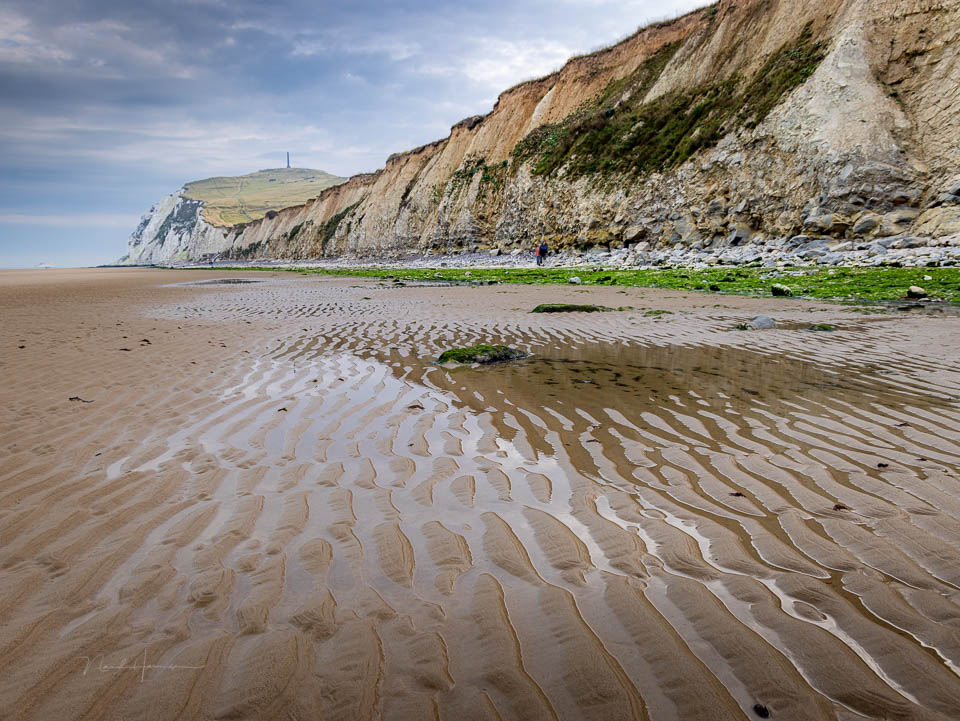
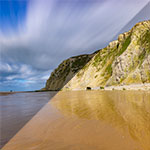
As you can see in the examples, a low viewpoint makes the ridges in the foreground appear large in the frame. The cliff in the background rises nicely above the horizon. However, the lines of all the ridges disappear because you are photographing almost parallel to the sand.
The interesting part of the sand takes up a very narrow part of the photo. As a result, you often get a lot of sky in the frame too, and there is a risk that the horizon will always be in the middle. By standing higher, you tilt the camera downwards. This does two things.
The horizon moves upwards and the sand gets more room in the photo. Lines, patterns and reflections become much more visible. This gives the photo more depth, and there is more to see.
That does not mean that a low viewpoint is wrong. There are situations where it works very well, including on a flat beach. But avoid the tendency to automatically take up a low viewpoint. Only do it if it adds something to your photo.
About the author
Nando Harmsen has been photographing for more than 40 years. He specialises in wedding photography and landscape photography. Nando also gives talks, workshops, masterclasses and photo trips, and regularly reviews new and interesting equipment.
You might also like
-
 Long Exposures on the Opal Coast
by Nando Harmsen
-
 Finding a composition at the beach
by Nando Harmsen
-
 Low, lower, lowest: finding the right viewpoint
by Erik Nevels
-
 Stormy weather is the best ingredient for landscape photography
by Nando Harmsen
-
 Trotting to (and across) the beach
by Martin van Rooij
-
 Landscape photography tip: The influence of light on a photo
by Nando Harmsen
11 comments
-
 Donald Willemsen wrote on Tuesday 29 October 2024 at 10:56 | reply
The viewpoint is often the problem for me. I discovered that again when I was doing street photography. The people appeared in the photo photographed from below. Sometimes that can produce a beautiful photo, but I don't think it's nice to have the whole series like that. How does that happen? Outside on the street I mainly use a wheelchair to get around. So you have a low viewpoint. Taking photos standing up only works if I can lean against something. Standing still without support doesn't work because I always get motion blur then. To a large extent I can compensate for that with a monopod. A tripod would be even better. But can you see me driving around in a wheelchair and also taking a tripod along?
Translated from Dutch.
I usually can't take the viewpoint I would like. When I publish photos, I sometimes get heaps of (justified) criticism thrown at me, like: wouldn't it have been better to stand a little higher, or had you had you not better taken a step to the left/right, or if you had taken this photo flat on your stomach the photo would have been much better and more of those kinds of comments. Nobody knows under what circumstances a photo was taken, but still people feel the need to give well-intentioned advice.
Sometimes I get so tired of that. My mobility is such that I can't just climb onto a rock to get the best shot or even take a step forward/backward, left/right. Having to explain again and again what my circumstances were at the time. There are plenty of places that are inaccessible to me because of my mobility to get the best shot.
And yet, yet I am able to take beautiful photos despite my limited ability to take a good viewpoint.
A photo is more than just a little higher/lower, left/right. A photo also has division of planes, colours, composition and, not to forget, atmosphere. These elements also help determine whether it is a beautiful/good photo or not.
I think the viewer looking at a photo should ask themselves: what motivated the photographer to take the photo as it is instead of 'I would have taken a step to the left/right.' -
 PixelDude wrote on Tuesday 29 October 2024 at 11:02 | reply
I guess I'd better take a giant with me on a trip then? Or would it be better to rent a helicopter? I'm not allowed to fly my drone everywhere.
Translated from Dutch.
How do you raise your viewpoint ... to what height. -
 Marcel Govaerts wrote on Tuesday 29 October 2024 at 12:14 | reply
I like the third photo best and why: there is more detail in the area between the ridges and the cliff in the background. This forms a connection between the foreground and the background. Moreover, the sky is smaller in height, from which a certain calm emanates that contrasts with the dynamics of the foreground. But, in this landscape the foreground should dominate and not the sky.
Translated from Dutch. -
 margot wrote on Tuesday 29 October 2024 at 13:34 | reply
Good article, Nando. We just need to look carefully at how the landscape can best be photographed, but a somewhat higher vantage point is usually better than being close to the ground.
Translated from Dutch. -
 richard de valk wrote on Wednesday 30 October 2024 at 12:58 | reply
A beautiful photo like this with that cliff in the background would in my opinion have more dynamism with a bit of the sea included I would like to see what causes those beautiful ripples in the sand??
Translated from Dutch. -
richard de valk wrote on Wednesday 30 October 2024 at 13:10 | reply
It's a shame that you're not allowed to fly everywhere with your drone, but you can easily raise your viewpoint by holding your arms above your head, the so-called bird's-eye perspective ?? and then you can only hope that it's a good photo, if not you could consider a camera with a tilting screen, that's what I'm considering at the moment too, because I am partially paralyzed on one side due to my cerebral infarction, much to my great annoyance, you can't do anything at all and you want so much ??????
Translated from Dutch. -
 guest wrote on Wednesday 30 October 2024 at 13:17 | reply
Dear Donald, unfortunately I suffer from that too. But if you publish a photo, tell them right away how and what, people can't smell/know what kind of problems/ailments the maker has to deal with
Translated from Dutch. -

-
 Martin Carels wrote on Wednesday 30 October 2024 at 18:37 | reply
Some people look at a photo sooooo technically that sometimes afterward they don't know what was actually in the photo!
Translated from Dutch. -
 Philippe Demeyere wrote on Thursday 31 October 2024 at 07:13 | reply
If the line in the foreground are interests to me then I leave the horizon as it is, visible or not.
Translated from Dutch. -
Philippe Demeyere wrote on Thursday 31 October 2024 at 07:22 | reply
Martin, I totally agree with you, I was a member of photo clubs for years and left them for this reason.
Translated from Dutch.
I now let my inspiration do its work and if a photo is good for me then the goal has been achieved. What the others think of it leaves me completely cold.


Have your say
Please note: Articles older than a week can only be commented on by signed-in visitors.Would you still like to comment? sign in or create a free account.
Become a better photographer every week
A practical photography tip in your inbox every week.
39,024 photography enthusiasts already receive the tips! More about the weekly mail. Or keep up to date via  Facebook.

Elja Trum
Photofacts; everything to do with photography!
Would you like to take better photos and keep up with what is happening in photography? Photofacts publishes articles that teach you something about photography — from a product announcement to a practical shooting tip or a look at a website. Photofacts covers photography every day and is a hobby project of Elja Trum's that got out of hand. The articles are written by a team of volunteer authors. If you would enjoy writing one or more articles for Photofacts, do get in touch.More about PhotofactsPhotofacts is made possible in part by
