
Low, lower, lowest: finding the right viewpoint
Saturday 17 October 2020, 20:40 by Erik Nevels | 4,097 views | 4 commentsThis article was translated from Dutch with the help of AI. Read the original.
In tutorials and talks by various photographers, I have often seen and heard it mentioned. The importance of your viewpoint.
A metre to the left or two to the right. One step forwards or four steps back. It can make a world of difference, so it is certainly worth taking the time to do it.
There is also the option of varying your height, or how low you are. Do I climb a ladder and look down on my subject like a bird? Do I make no effort and simply stay standing?
Or do I get down on my knees and choose a low perspective?
This blog is about that last choice.
The Doort
This week, choosing a nature reserve in our region was easy. We, my photography mate and I, are going to one of our favourite areas, the Doort.
This special nature reserve lies south of the centre of Echt in Midden-Limburg. Deciduous woodland and meadows alternate with each other. Together with two streams, various lakes and pools, it is a good home to a diverse range of flora and fauna.
Tree frog
The area may be best known for its tree frogs. This beautiful little green frog feels right at home here. The area is home to one of the largest populations in the Netherlands.
Over the past year, we have photographed the tree frog in the Doort several times. In warm weather and sunshine, you have the best chance of finding the animal on the bramble bushes.
How I work
Finding one is an art in itself. Do not rush and look patiently. The more often you do it, the better you get.
The tree frog is certainly not shy. If you work carefully and prevent the leaf, branch or bush it is sitting on from moving, you can get fairly close with your camera. Macro shots are then possible, but it is not easy.
The 'host bush', the bramble, regularly gets in the way. Working with a tripod is usually not possible. Placing the legs between the bushes already causes movement, and the same happens when you put a foot in the bush. So you need to be lucky for the frog to be close enough for macro shots.
Viewpoint
Photographing at the same height as the frog produces beautiful images. Its eye, or eyes, are clearly visible, as is its beautifully patterned body and, if you are lucky, its cute little feet.
That does mean you are often photographing in an uncomfortable position. Leaning forwards, bending down, getting down on your knees. A good photo takes some effort.
Lost
We carefully walk through a meadow with lots of faded plants, looking for mushrooms and perhaps a nice butterfly or another insect.
At a temperature of 15 degrees and with no sunshine, we do not expect to see any tree frogs today.
Well, there are plenty of frogs, but no green ones, until my mate suddenly stops in amazement. A tree frog is crawling in front of us on a faded lupin. Clearly lost, with no bramble bush nearby!
Without any trouble from the awkward bramble bushes, we get to work with the little creature. It lets us approach quite easily, although it regularly changes position.
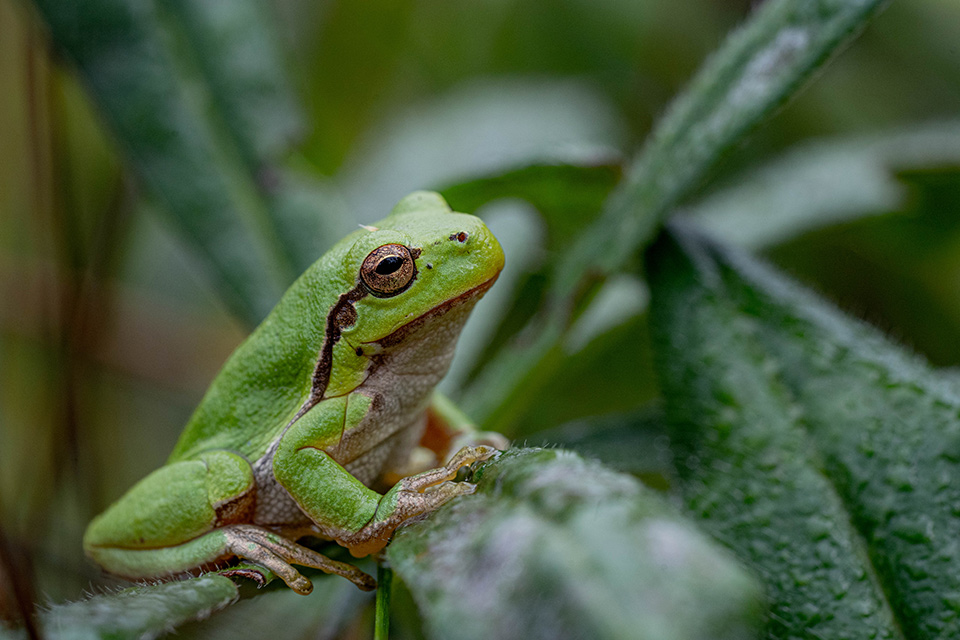
Low
Because the little frog is sitting close to the ground, I get down on my knees and bend far forwards. This means I can still work through the viewfinder and photograph it almost from the side.
I work carefully and make sure I use a sufficiently fast shutter speed. I set the aperture to f/8 because I definitely want more in focus than just the eye. I accept the resulting high ISO.
Lower
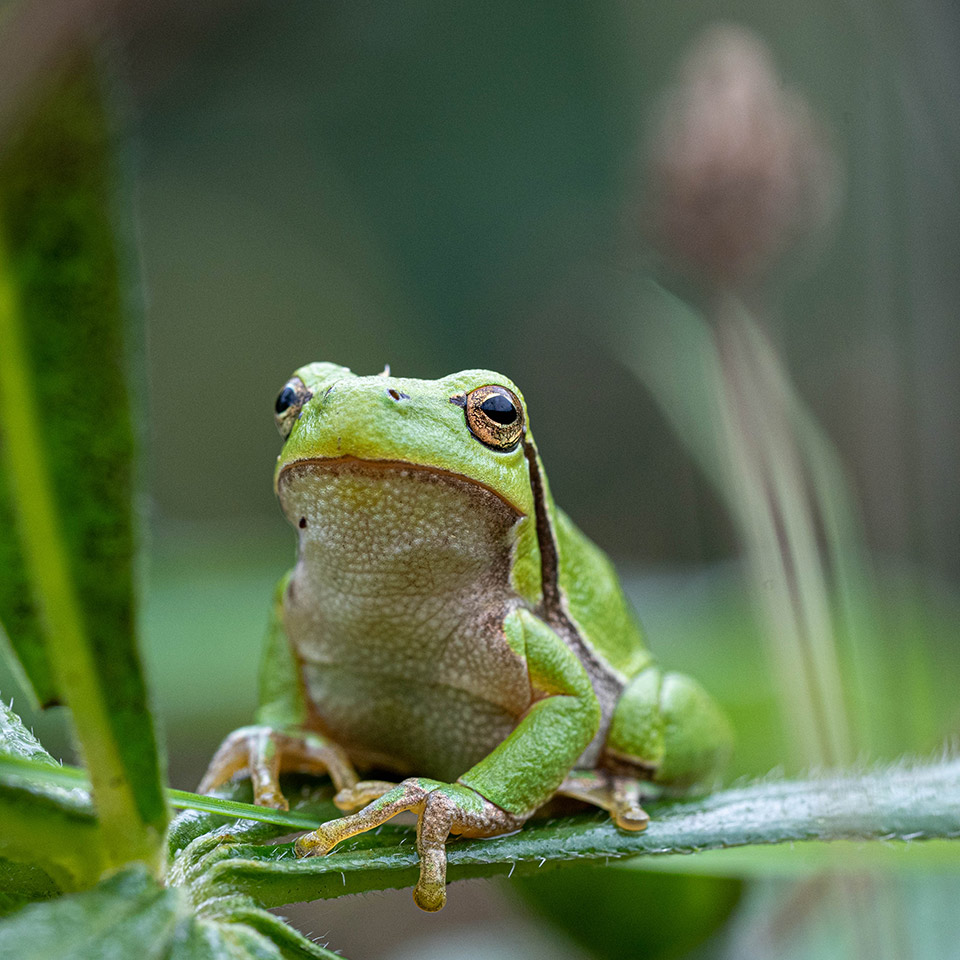
I realise that I have already taken more photos like this and start looking for something 'different'. A lower viewpoint is now quite easy because the bramble branches are not in the way.
Lying on the ground, I get the frog perfectly in frame. It has also settled nicely on a leaf and is looking straight at me. We are, so to speak, eye to eye, although I am lying down.
I just need to make sure that the seed head in the background is properly in frame and 'click'.
Lowest
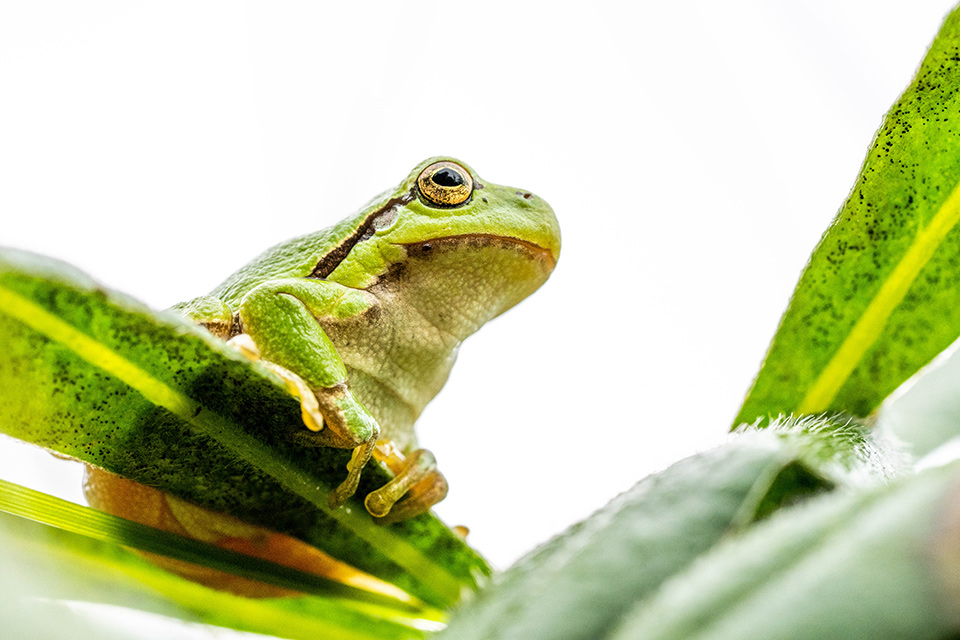
Because the animal is sitting a little above the ground, an even lower viewpoint is possible. This time, I use the flip-out screen on my camera.
Focusing is more difficult, but practice and taking several shots make perfect. Because of the backlight from the sky, the frog becomes dark, so I increase my exposure by 2 stops. High Key, as it is so nicely called.
It is actually quite funny. The frog is looking at my camera from a bird's-eye view, while I am looking at it through my screen from a frog's-eye view.
World of difference
You can see how different the three results are because of the variation in viewpoint. Decide for yourself which one appeals to you.
Or even better, make a habit of varying your viewpoint until you are, or are mostly, happy with what you see in the viewfinder or on your screen. It is worth it!
About the author
Steeds weer boeiend en op zoek naar de essentie! Dat is wat fotograferen in de natuur voor mij is. Gefocust op het landschap of het onderwerp in diens omgeving tracht ik meer dan alleen te registreren. Een continue uitdaging waarvan ik elke keer volop geniet. Meer foto's? Volg mij op Instagram en/of kijk op mijn website
You might also like
-
 The sense and nonsense of a low viewpoint in landscape photography
by Nando Harmsen
-
 Don’t always choose the lowest viewpoint for your landscape photo
by Nando Harmsen
-
 Always choose the right viewpoint for your photo, less is more
by Nando Harmsen
-
 Create calm in your photos with a low viewpoint
by Nando Harmsen
-
 Don't use a low ISO, use the right ISO setting
by Nando Harmsen
-
 Low-key is an edit, not underexposure
by Nando Harmsen
4 comments
-

 Laura van der Burgt
wrote on Sunday 18 October 2020 at 13:51
| reply
Laura van der Burgt
wrote on Sunday 18 October 2020 at 13:51
| reply
De laatste foto is echt een plaatje, mooi dat high key effect en standpunt kikkerperspectief. Ik vind het zelf een van de meest aandoenlijke beestjes die we in Nederland hebben. Helaas zien en horen we ze veel te weinig. Fijn dat je een gebied hebt waar je ze kunt spotten.
This comment was written in another language and has not been translated yet. -
 Erik wrote on Sunday 18 October 2020 at 21:55
| reply
Erik wrote on Sunday 18 October 2020 at 21:55
| reply
@Laura
This comment was written in another language and has not been translated yet.
Hallo Laura, bedankt voor je enthousiaste reactie. Het zijn inderdaad aandoenlijke beestjes. -
 Gemma wrote on Tuesday 20 October 2020 at 16:53 | reply
Wat een model die boomkikker.
This comment was written in another language and has not been translated yet.
Prachtig op drie manieren in beeld gebracht! -
Erik wrote on Tuesday 20 October 2020 at 21:19
| reply
@Gemma
This comment was written in another language and has not been translated yet.
Bedankt voor je leuke reactie Gemma!
Have your say
Please note: Articles older than a week can only be commented on by signed-in visitors.Would you still like to comment? sign in or create a free account.
Become a better photographer every week
A practical photography tip in your inbox every week.
39,079 photography enthusiasts already receive the tips! More about the weekly mail. Or keep up to date via  Facebook.

Elja Trum
Photofacts; everything to do with photography!
Would you like to take better photos and keep up with what is happening in photography? Photofacts publishes articles that teach you something about photography — from a product announcement to a practical shooting tip or a look at a website. Photofacts covers photography every day and is a hobby project of Elja Trum's that got out of hand. The articles are written by a team of volunteer authors. If you would enjoy writing one or more articles for Photofacts, do get in touch.More about PhotofactsPhotofacts is made possible in part by
