

8 tips for funeral photography
Monday 14 May 2018, 20:02 by Michelle Peeters | 17,588 views | 12 commentsThis article was translated from Dutch with the help of AI. Read the original.
Some time ago, my sister-in-law asked me if I wanted to photograph the funeral of one of her clients. It was a first, but I have since added funeral photography to my portfolio.
My sister-in-law, Wies Sanders, is a funeral director in Twente. She was looking for a photographer for the funeral of a young woman from a well-known family of lawyers.
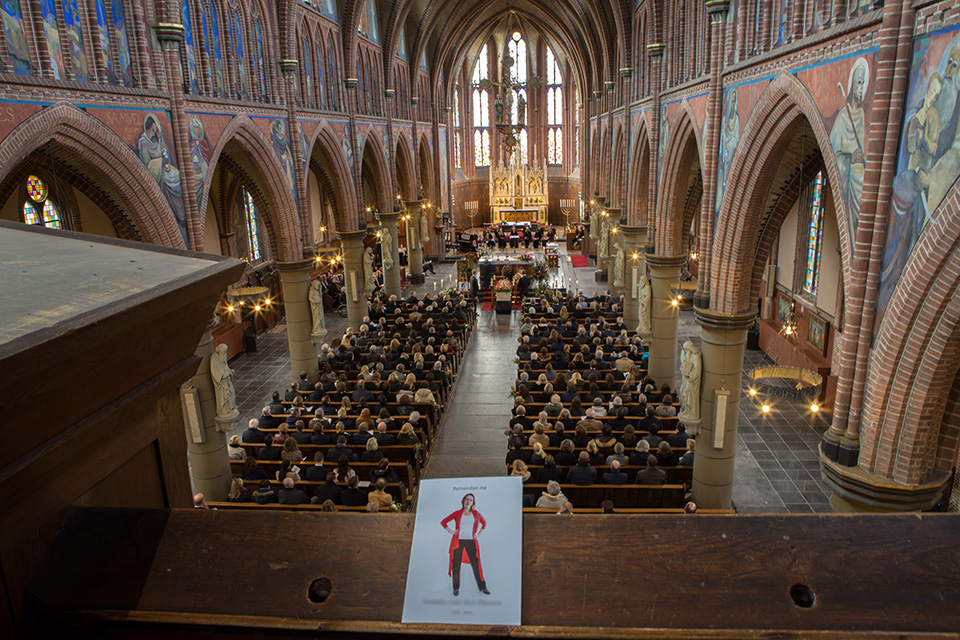
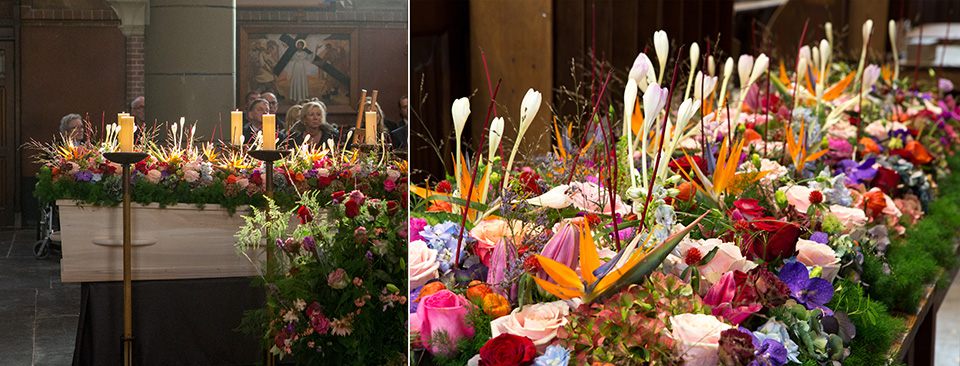
The family had not cut back on costs. The best florist had been brought in to decorate the church beautifully, and a choir had been flown in from Amsterdam. Among other pieces, they performed the Lacrimosa, the final part of Mozart's requiem.
That was really how it started. I photographed the entire funeral and then wondered whether I 'liked' it. The gratitude you receive for this work was what convinced me. People like to keep something as a reminder. The choice often comes down to photographs or film.
1. Respect and keeping a low profile
Photographing an emotional event requires a great deal of respect. You have to think very carefully, and the approach is completely different from, for example, wedding photography.
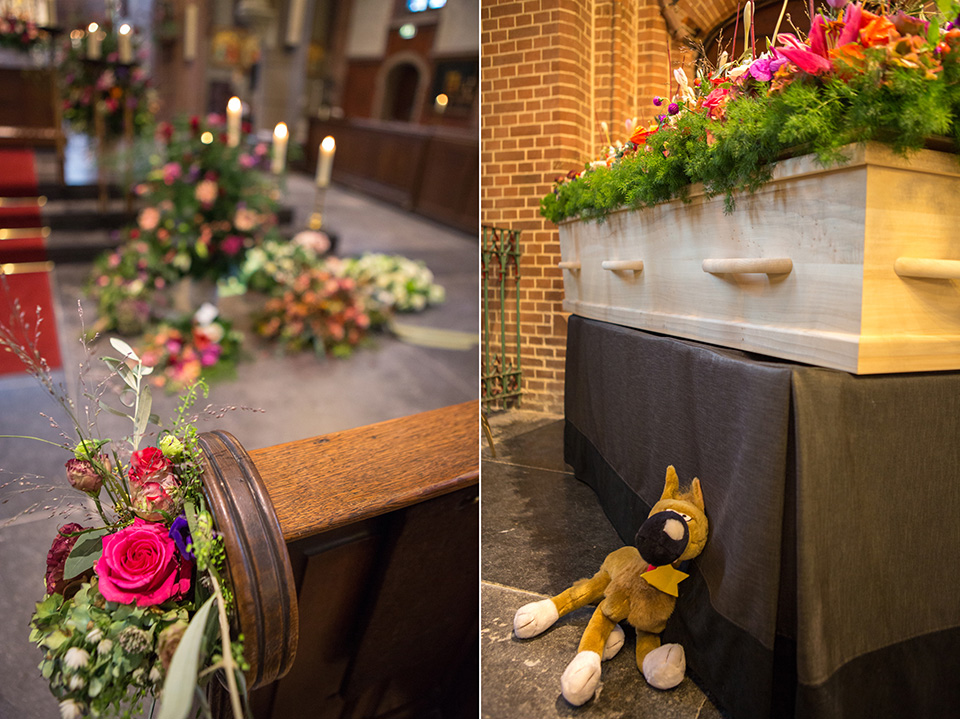
There is more to it than simply taking photographs. You can photograph things as they are. Staging is not done, and often is not possible at all. A funeral is what it is. Flash is out of the question. You will have to work with the light that is there.
You mainly photograph what you see and try to capture the atmosphere. The trick is to move around as unobtrusively as possible. Think in advance of a few places where you can stand. You can then take the photographs from there.
2. Silently
If you want to move around, it is best to do so while a piece of music or a speech is being played. People are focused on that. I received many compliments about how quietly and unobtrusively I worked, including during concerts, by the way.
Make sure you make as little noise as possible. Wear shoes with soft soles. No hard or leather soles, for example, and no high heels. The camera is always set to silent mode as well. You do not want to interrupt the silence with the camera clicking.
3. Contact
There is often contact with the next of kin beforehand. In my case, that was not possible, and I did not meet the family until the funeral centre. There was a lot of communication about the photographs afterwards.
Sometimes there is a phone call beforehand, for example about the approach or the costs. But sometimes this has already been arranged through the funeral director.
On the day of the funeral itself, very little is said to you as the photographer. You are simply working, so you do not really talk to people. Afterwards, there is often contact, and you receive compliments or comments about whether they thought the photographs were beautiful or appreciated them.
If children are involved, contact often goes through family members rather than the parents. Parents often have other things on their minds. The choices are often left to the photographer. It is usually decided beforehand whether or not photographs of the deceased should be taken.
4. Capturing emotion and atmosphere
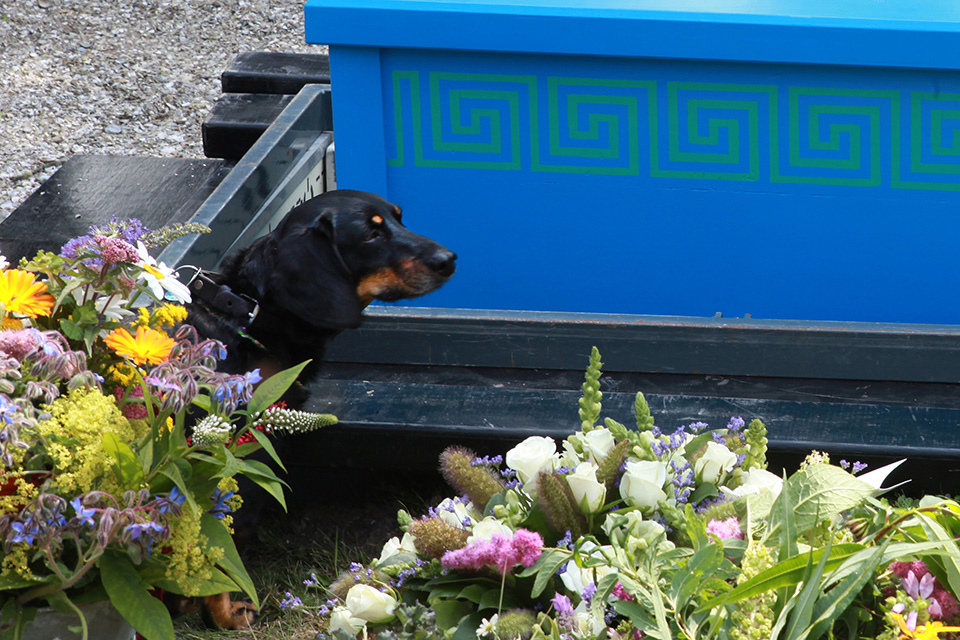
There is almost never a request to take a photograph of the loved one in the coffin, but it does happen. It is not really my preference, as the atmosphere of the funeral is what matters in the end. But you can take a few if there is a need for them.
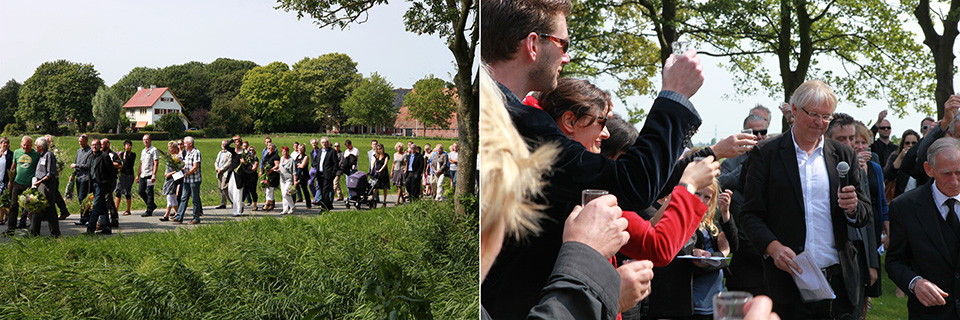
What the next of kin do during the funeral is more important to capture. Photographs that suit the deceased and show the emotion and atmosphere well. People are not waiting for photographs of themselves breaking down in tears, but they often do want to see the atmosphere photographs again.
5. In the past
In the past, funeral photography was taboo. However, death portraits of children were often made during periods of high child mortality. A photograph was often the only thing people had of a deceased child.
Some people still find it inappropriate or strange for a funeral to be photographed. But with the rise of mobile phones, funeral photography has become somewhat more popular.
In the end, a funeral is the last memory of someone. The funeral photographs are often not viewed for the first time until some time after the funeral. The photographs then bring back the atmosphere and emotions of the funeral.
Relations between funeral directors and photographers can sometimes be tense. This is because there are many photographers who work in a disruptive way.
6. Your own emotions
When you photograph the funerals of children who have died, your own emotions can sometimes surface. With older people, this is often less intense, although it can still be very upsetting. I have sometimes stood there photographing through my tears. I do not think you have to hold your emotions in.
Even if you did not know the deceased, it can still feel like a family member. I do try to control my emotions, but sometimes it cannot be avoided. Sometimes people come up to you and put a hand on your shoulder, out of understanding.
If you can find a high position, such as a staircase or a balcony in a church, near the organ, it works very well and you do not disturb anyone at all.
Especially when you use a telephoto lens, you do not have to stand right on top of people, and you can take beautiful photographs from above. Keeping enough distance is essential.
7. Wish list
The wish to have a funeral photographed always comes from the next of kin, almost never from the deceased themselves. Moroccan or Surinamese funerals are often much more exuberant and interesting to photograph.
It is difficult to get involved in those communities, as they often choose their own people. But through contacts, you can sometimes still get in.
8. A tribute
Photography at a funeral can be seen as a kind of tribute to the deceased. Especially when it results in beautiful photographs that you can keep looking at. It is also a way of acknowledging what was there. It can help you relive the moment, and you can show others what the funeral was like.
Photography can also play an important role in the grieving process. In the past, the rules around photography were much stricter, partly because of the taboo surrounding funeral photography. Taking photographs was seen as inappropriate, but that view has now changed.
With a stillborn baby, it can acknowledge that the baby existed, and it also conveys the message that the baby lives on in the hearts of the next of kin.
It either suits you or it doesn't
Funeral photography is something that has to suit you. It is a speciality that you really need to feel comfortable with. If it does not, you will not produce beautiful photographs either.
Funeral photography is not something you can simply do with the help of these 8 tips. You obviously need to be completely comfortable using your equipment to bring everything to a successful conclusion in all lighting conditions. But that is actually true of every form of professional reportage photography.
This form of reportage photography is completely different from, for example, wedding photography. You are dealing with sad rather than happy people. Completely different emotions. Think carefully about that before you start.
About the author
Michelle Peeters is fotografe en oprichter van DeuxBleus Fotografie. Michelle herkent het bijzondere in het gewone en het gewone in het bijzondere. Ze heeft zich nooit willen specialiseren en is daardoor van alle markten thuis.
You might also like
-
 Funeral photography, should you do it or not?
by Jerry van Es
-
 The inverse square law in photography.
by Frank Doorhof
-
 How do you attract the attention of potential clients?
by Huub Keulers
-
 Flash photography tip: Forget the inverse square law
by Elja Trum
-
 Why Asking for EXIF Data Is Pointless
by Nando Harmsen
-
 Dealing with deadlines: a simple step-by-step plan
by Elvira Smit
12 comments
-
 Rob de Joode wrote on Tuesday 15 May 2018 at 00:02 | reply
Dear Michelle and Photofacts editorial team,
Translated from Dutch.
Very nice and good that attention is being paid to funeral photography, but when I read:
8 tips for funeral photography, it comes across to me as though you can simply get started with it by using those 8 tips.
I am a photographer, specialising in farewell photography, and believe me, there is much more to it than is described in this article. I am missing essential things.
How to deal with poor lighting conditions, working without a flash as much as possible, your equipment must be adjusted to that. If you photographed a funeral a little while ago and are already writing an article about it now…..
Moving while someone is speaking, you should actually try to prevent that, it is often very quiet then. In my opinion, that is not the right moment to move.
There is often contact with the bereaved as well. I can name a whole range of things that the photographer has to take into account, which are not mentioned in the article, but which are very important in order to be able to create a valuable memory.
But once again, I think it is very nice that this form of photography is being written about, but many essential things are not mentioned.
And it comes across to me as though if you take these 8 tips into account, it will all turn out fine. From experience I can say: so no!
I am going to stop my account now, because I could tell you a lot more about it.
But in my opinion, with this special form of photography, this article falls seriously short, but it also does a disservice to the work of many good farewell photographers! A farewell photographer must ensure a valuable memory, otherwise the grief is actually made worse, by creating a beautiful memory you hope that it can be comforting. Farewell photography / funeral photography is a specialism.
Kind regards,
Farewell photographer Rob de Joode
www.kiekfoto.nl/uitvaartfotografie
www.kiekfoto.nl/afscheidsfotografie -

 Michelle Peeters wrote on Tuesday 15 May 2018 at 00:11
| reply
@Rob: you are absolutely right that you can't just do funeral photography with the help of these 8 tips. It is indeed a speciality that either suits you or it doesn't. It turned out to suit me and I intuitively did many things right. Moreover, my sister-in-law briefed me and prepared me quite well. And besides that, of course you need to have enough experience in photography to bring this to a successful conclusion under all (lighting) conditions, but that also applies to other genres, such as wedding photography.
Translated from Dutch. -
Rob de Joode wrote on Tuesday 15 May 2018 at 00:29 | reply
@Michelle, thank you for your response, I immediately believe that funeral photography will suit you well and that with your experience you will bring it to a successful conclusion. But there are things you describe that I and other colleagues experience differently. Very good that your sister-in-law gave you quite a good briefing and prepared you. I don't quite know how to put it. Let's just say that I find the article, based on a single experience, too light for this specialisation. (That is how I put it politely.)
Translated from Dutch. -
Michelle Peeters wrote on Tuesday 15 May 2018 at 10:14
| reply
@Rob: it's not about no experience at all, but that's perhaps how it came across in this article. Actually, funeral photography and everything that comes with it can't be covered in a single article either. Besides photographic skills (which are actually self-evident), you need to have a lot of other, especially social, skills and empathy. Besides being able to sense the atmosphere well (knowing when you need to be invisible or quiet). And knowing how to deal with your own emotions. A profession in its own right, which certainly won't suit every photographer!
Translated from Dutch. -
 Marijke wrote on Tuesday 15 May 2018 at 11:24 | reply
Just 3 weeks ago my husband passed away. Our children and I also had the cremation photographed through the funeral director. It has become a beautiful, precious document of a funeral full of love with a laugh and a tear.
Translated from Dutch. -
 Irene wrote on Tuesday 15 May 2018 at 14:14 | reply
Nice to read and nice advice and responses. I would personally like to add that it can also be a valuable look back. As a bereaved person, you are occupied with your grief and only later do you realize and see what happened around you. But you have that as a bride too. You simply can't see everything around you. And then those 'oh yes' moments are also so beautiful
Translated from Dutch. -
 Henk wrote on Tuesday 15 May 2018 at 15:06 | reply
All respect for your valuable additions, Rob, but I read the article as a "starting point for", intended more to get photographers who want to start doing this thinking. If this was Michelle's intention, it works perfectly fine for me. For someone who really wants to specialise in funeral photography, a workshop or course would perhaps be the obvious choice.
Translated from Dutch. -
 guest wrote on Tuesday 15 May 2018 at 16:49 | reply
@Henk, what you describe is also often the problem with text, one person reads it differently than another. But this article will have a follow-up. And as for Michelle, I've been a fan of her articles for a long time.
Translated from Dutch.
Regards Rob. -
 Dwars wrote on Tuesday 15 May 2018 at 18:43 | reply
First of all, what beautiful photos, Michelle, but here we go again. It’s also never possible to write an article anymore without criticism. You call your column 8 tips and not the manual to something.
Translated from Dutch.
I haven’t called myself a photographer for years. There are so many people who presume to claim that title for themselves with great bravado. Even if you have attended photography school 10 times or have 40 years of experience, some modesty is still appropriate when lecturing someone else. How often I read that people act like know-it-alls in a ruthless way, especially on social media. In my opinion, it’s the people, the clients, who can give you that title, not you alone.
Nowadays everyone calls themselves a photographer since the rise of SLRs and later smartphones, right? And everyone craves attention, admiration and respect. I’m sorry, but I may have misunderstood it @Rob, but you come across as if you alone know how it should be done. You certainly don’t lack self-confidence and that can work out well for you in many cases. I read on your website: “Photographer is not only my profession, I am one too!” The first part of this sentence may be completely true, but the second part is something I (despite having already won some international awards myself) wouldn’t dare put on my website. But perhaps I’m doing it wrong and am too modest. You undoubtedly take beautiful photos and as far as funeral photography is concerned, I would therefore have liked to see some more additional tips in your argument under the heading “constructive criticism”. -
 Jan L. Paal wrote on Tuesday 15 May 2018 at 20:38 | reply
Dear Michelle, I think it’s a very successful article with very beautiful photos. And as @Dwars already mentioned: it’s not a manual for funeral photography, but just a few useful tips. For some 'professionals' perhaps all obvious things, but quite useful for others.
Translated from Dutch. -
guest wrote on Tuesday 15 May 2018 at 21:52 | reply
@Dwars, I definitely don't want to come across as someone who thinks they know it all, on the contrary, I wanted to indicate that funeral photography is a difficult branch of photography, partly because of the circumstances and the bereaved, for whom you have to do the work. And besides that, I regularly have contact with other funeral photographers and we discuss things a lot. There is a lot of contact among us. And about my website, you have to read that in context. (And maybe I should think about that sometime, thank you.)
Translated from Dutch.
But back to funeral photography, through Michelle I got the chance to go into more depth about funeral photography on Photofacts and I'm taking that chance. Because I would like funeral photography to become more 'normal'. Many people don't know it exists. So more additional tips under the heading 'constructive criticism' will be coming. And then also really the things you run into.
I have respect for Michelle, and by the way I follow everything here on Photofacts. And the photos are also beautiful, there is nothing wrong with them. It would be too easy to remain silent now. I said A, so now B as well.
Kind regards, Rob -
 ikke wrote on Wednesday 16 May 2018 at 08:58
| reply
@ Michelle, I think it’s really great to read what you’ve done from your own experience. In this case too. At my mother’s funeral, we also had photos taken and they were just crap, wrong lighting (she knew the location) and not retouched, and an amount that scares you. I think it’s super that you give people who want to photograph tips and motivate them to just try. Big thumbs up for you!
Translated from Dutch.
Have your say
Please note: Articles older than a week can only be commented on by signed-in visitors.Would you still like to comment? sign in or create a free account.
Become a better photographer every week
A practical photography tip in your inbox every week.
38,886 photography enthusiasts already receive the tips! More about the weekly mail. Or keep up to date via  Facebook.

Elja Trum
Photofacts; everything to do with photography!
Would you like to take better photos and keep up with what is happening in photography? Photofacts publishes articles that teach you something about photography — from a product announcement to a practical shooting tip or a look at a website. Photofacts covers photography every day and is a hobby project of Elja Trum's that got out of hand. The articles are written by a team of volunteer authors. If you would enjoy writing one or more articles for Photofacts, do get in touch.More about PhotofactsPhotofacts is made possible in part by
