

Getting started with stock photography
Saturday 7 December 2019, 20:10 by Tromp Willem van Urk | 6,983 views | 4 commentsThis article was translated from Dutch with the help of AI. Read the original.
After a number of articles about different aspects of stock photography, here is finally an explanation of how to actually get started.
Broadly speaking, this blog consists of two parts. A list of the most interesting stock agencies, followed by a description of what you need to do to start offering stock photos.
Shutterstock
Shutterstock is by far the largest stock agency. Its database currently contains more than 300 million stock photos. That is an enormous number. But despite that, or perhaps precisely because of the large database, Shutterstock is visited by a great many buyers.

Shutterstock sells more than 300,000 images every day. For most photographers, earnings are therefore by far the highest here. If you want to start selling stock photos, you cannot ignore Shutterstock! I am personally signed up with more than 10 stock agencies, but Shutterstock alone accounts for more than 40 per cent of my turnover!
Sign up with Shutterstock
iStock
iStock is the oldest active stock agency. As part of Getty Images, it has a large market share, especially in America. The number of sales at iStock is lower than at Shutterstock, but the average price per photo is higher.

As a result, it is one of the better-earning agencies after Shutterstock. iStock sales are still growing as well.
Sign up with iStock
Adobe Stock (formerly Fotolia)
Adobe is of course known for managing and processing photos with Lightroom and Photoshop. A few years ago, it also started focusing on selling photos. Fotolia was acquired for this purpose in 2014. The name was then changed to Adobe Stock.

Together with iStock, this agency is one of the better-selling agencies after Shutterstock. This may have something to do with its integration into other Adobe products. You can offer photos directly from Lightroom, and buy photos from Photoshop and use them immediately.
Sign up with Adobe Stock
Dreamstime
Dreamstime is one of the older stock agencies. It originally operated mainly on the European market, but sales are now worldwide, as they are at every stock agency. The price per photo sold usually varies from around 30 US cents to a few dollars.

However, after more than two sales per photo, these payments keep increasing. There is no admission review and the process of submitting photos is well organised. That makes Dreamstime an ideal agency for starting to sell stock photos.
Sign up with Dreamstime
Depositphotos
Depositphotos is one of the newer and emerging stock agencies. The agency is making good progress. The website looks attractive and accessible.

It is therefore a pleasant agency to start with in stock photography. Earnings are not yet the highest here, but who knows what we can expect from this agency in the future!?
Sign up with Depositphotos
More stock agencies
There are hundreds of stock agencies worldwide. I have given a short list of a number of the largest agencies that I am personally signed up with. If you want to know more in general, take a look at Microstock group.
For even more specific information about the agencies mentioned here, you could visit my personal website.
Signing up with a stock agency
Every (amateur) photographer can sign up with a stock agency to start selling photos there. You can find links to the most interesting agencies elsewhere on this page. For registration, you will of course need to fill in some personal details.
Most agencies then have a number of additional admission requirements. Usually, filling in a questionnaire is enough. Some agencies first require you to submit a number of photos for assessment. They will then look at the quality and commercial value of your photos.
If these are good enough, you are accepted and can start submitting your photos. Admission requirements have become much more lenient in recent years. It would therefore have to go very wrong for you not to be accepted.
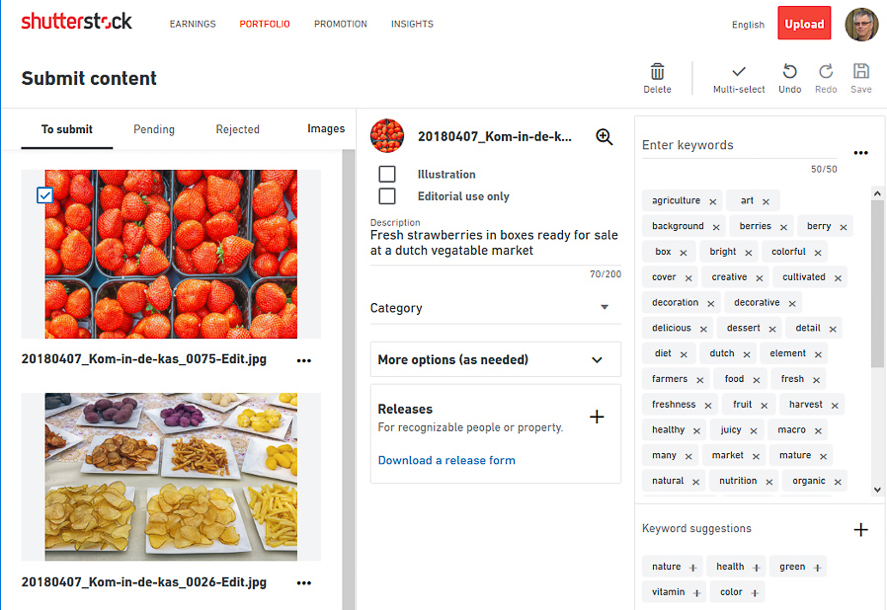
Submitting a stock photo
Once you have registered with a stock agency, you can start submitting your photos. Your workflow is roughly as follows:
- Select suitable photos that you want to offer as stock photos. I have already written quite a bit about which photos are and are not suitable in earlier articles on this blog;
- Add a title and keywords to your photos. You can do this from programmes such as Photoshop and Lightroom. There are also specific programmes available for stock photography. Titles and keywords are always in English!
- Do this beforehand. That means doing the work once per photo. You can also add keywords after uploading your photos to a stock agency, but then you have to do it separately for each agency!
- Upload the photos in jpg format to a stock agency. You can do this with ftp, but most agencies also have a web form for this;
- If necessary, classify the photos by category on the stock agency's website;
- Wait for the review process. Some photos may be rejected;
- If possible, resubmit rejected photos after correcting the identified shortcomings;
- The photo is ready for sale. You do not need to do anything else;
- Wait for the upcoming sales;
- Request a payout as soon as your balance exceeds the minimum payout amount; At some stock agencies, this is done automatically.
Finally, the information about the workflow given above is of course very brief. A separate blog post could be written about each step. But who knows, perhaps that is something for another time!?
About the author
Tromp Willem van Urk is een enthousiaste hobbyfotograaf die een aantal jaren geleden met stockfotografie is begonnen. Op zijn website Kruwt.nl Stockfotografie kun je daarover lezen en blogt Tromp Willem regelmatig over zijn eigen ervaringen.
You might also like
-
 Stock photography, still interesting?
by Tromp Willem van Urk
-
 Make money with stock photography (video)
by Elja Trum
-
 7 ways to make money as a photographer in 2021
by Elja Trum
-
 The Perfect Picture: the Final (season 5)
by Elja Trum
-
 Het Perfecte Plaatje: the final in Oman
by Elja Trum
-
 Het Perfecte Plaatje: the semi-final in Iceland
by Elja Trum
4 comments
-
 Mars wrote on Wednesday 11 December 2019 at 20:12 | reply
Are there stock agencies that require you to use only their services? So that you are not allowed to offer the same photo to another stock agency? (perhaps this used to be the case)
Translated from Dutch.
Greetings from Mars -

 Tromp Willem van Urk
wrote on Wednesday 11 December 2019 at 22:34
| reply
No, all international stock agencies allow you to offer your photos through multiple agencies.
Translated from Dutch.
With a number of agencies (including iStock and Dreamstime), you can indicate yourself whether you want to be exclusive there. You then get a higher commission.
I have never done that myself. A slightly higher return for a photo doesn't outweigh the even higher return from being signed up with more agencies.
Unless you know for sure that you always want to stay with one agency. Then that is an option, of course. -
 Irene Damminga wrote on Tuesday 17 December 2019 at 11:25
| reply
Since Nationale Beeldbank was taken over by Hollandse Hoogte in 2018, you can only offer new photos there. For me, that's a reason not to upload anything there. See point 7 https://www.nationalebeeldbank.nl/docs/richtlijnen-fotografen-nbb.pdf
Translated from Dutch. -
Tromp Willem van Urk
wrote on Tuesday 17 December 2019 at 20:37
| reply
Absolutely right Irene. They have the requirement there that if you offer photos through them, you are not allowed to sell photos anywhere else anymore. So even if they are different photos.
Translated from Dutch.
Since then I have also stopped selling my photos there.
Have your say
Please note: Articles older than a week can only be commented on by signed-in visitors.Would you still like to comment? sign in or create a free account.
Become a better photographer every week
A practical photography tip in your inbox every week.
39,024 photography enthusiasts already receive the tips! More about the weekly mail. Or keep up to date via  Facebook.

Elja Trum
Photofacts; everything to do with photography!
Would you like to take better photos and keep up with what is happening in photography? Photofacts publishes articles that teach you something about photography — from a product announcement to a practical shooting tip or a look at a website. Photofacts covers photography every day and is a hobby project of Elja Trum's that got out of hand. The articles are written by a team of volunteer authors. If you would enjoy writing one or more articles for Photofacts, do get in touch.More about PhotofactsPhotofacts is made possible in part by
