

Stock photography, still interesting?
Saturday 30 November 2019, 15:51 by Tromp Willem van Urk | 5,282 views | 8 commentsThis article was translated from Dutch with the help of AI. Read the original.
It's been a while since I wrote a few articles about stock photography. So here's a follow-up at last. Is stock photography still interesting, and is it something for you?

The bad news
To start with the bad news, the margins in stock photography are under pressure. The average price you currently get for a sold stock photo is lower than it was, say, five years ago. The number of stock photo providers has also increased considerably. So the pool has become much thinner.
A few years ago, I used to do calculations about my earnings from stock photos. At the time, I was running at 4 to 1, for example. For every four photos I put online, I earned an average of one dollar a month. I could then 'calculate' how much I could earn with how many extra photos.
That time has passed, though. I still regularly submit new photos, but extra income in proportion to what it was back then is no longer possible.
A thief of your own purse?
At the beginning of this year, Wilmar Dik wrote an interesting article on this blog: Stock photography for photographers, a thief of your own purse.
In short: the stock photography business model is not profitable for photographers. Too much work for too little income. Especially when the margins are also getting smaller.
Is Wilmar right? It depends on how you approach the question, but as he puts it, I agree with him. If you are a commercial photographer who has to make a living from your photos, and a photographer who also wants to see your work translated into income within a reasonable time, then the article in question suits you perfectly.
The good news, but with a different perspective
But it is important which perspective you use when drawing the conclusions mentioned above. Does the effort you put in always have to be commercially worthwhile straight away?
A (hobby) photographer also simply enjoys working with their photos. You experience the time spent on it as ordinary hobby enjoyment.
And then stock photography gives you some great moments. It is always a surprise to see one of your own photos again. On a website, in a magazine, or wherever. These are always small moments of satisfaction.
Use your time as well as possible, be selective!
With stock photography, too, you can keep an eye on where you do or do not spend extra time. A good example is the beautiful sunset that every photographer has a few of. Your fingers itch to turn it into a nice stock photo.
But my advice is not to spend your time on those photos!
There are already thousands of photos of sunsets available from stock agencies. And there are undoubtedly some gems among them. There is every chance that your photo will get lost among them. Spend your time on photos that have a better chance of selling.
Budapest
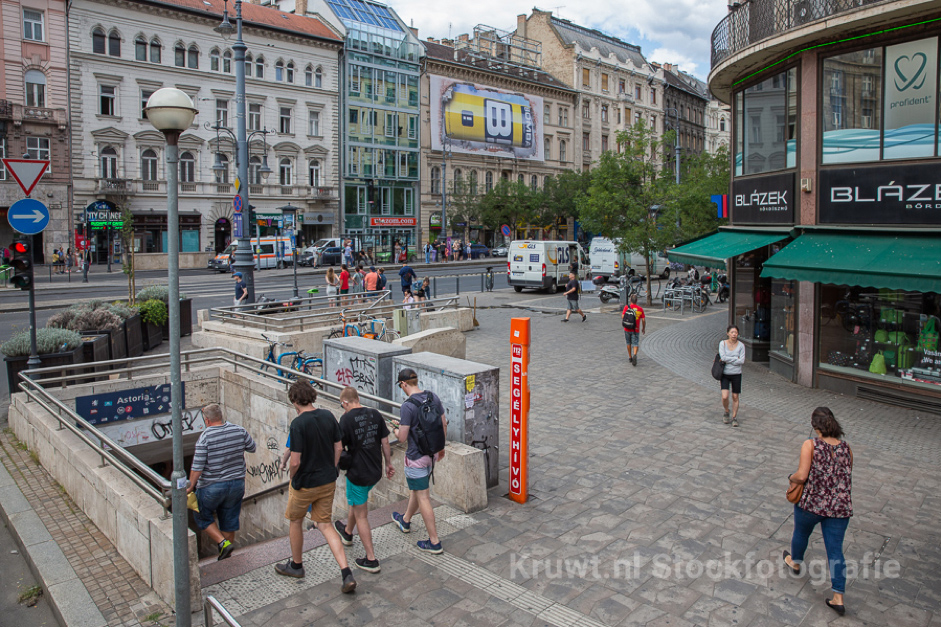
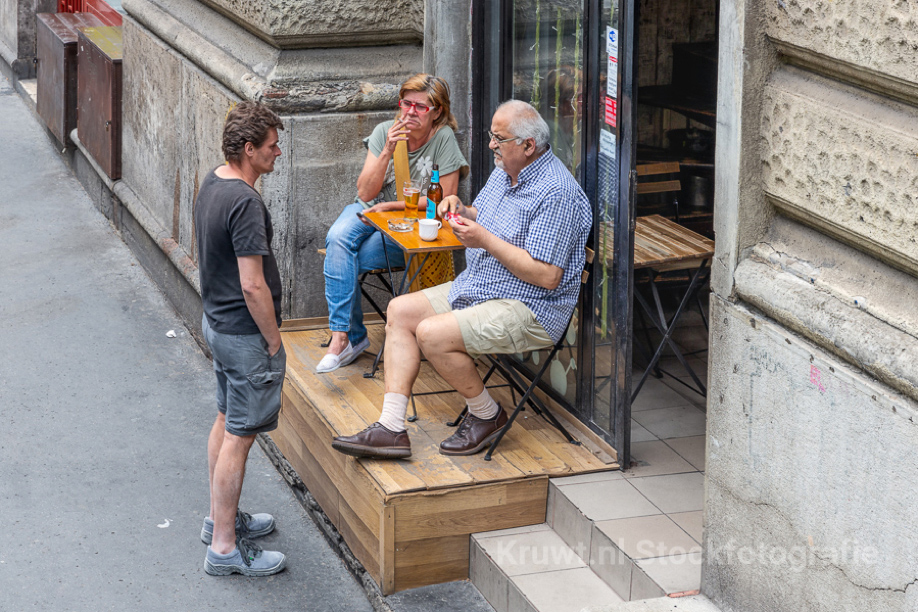
As a stock photographer, you need to pay more attention to the photos you would not normally take. In this blog, I have included three photos as an illustration, all taken during a week in Budapest this summer.
The first photo, of the Budapest skyline at night, looks the most spectacular.
But there is every chance that this photo will not make it as a stock photo. This is the standard beautiful picture of Budapest. Of course I take that too, but if you start looking, you will find that this photo already has many predecessors as a stock photo!
The other two photos show the 'ordinary' street scene of Budapest. These are more unique photos. And it could easily be that these are picked up and start selling. Especially if you add the right thematic keywords.
Experience also shows that once a photo starts selling, it often keeps going for a while.
Always surprising
Another aspect of stock photography that I enjoy: it always turns out differently from what you expect. In the previous paragraph, I made a prediction about the number of sales of my Budapest photos, but it could easily turn out differently!
Top sellers often appear from unexpected angles. That also means stock photography remains surprising and exciting.
Conclusion, interesting or not?
Unfortunately, I cannot answer that question for you. In this article, I have given you a few considerations for either not starting, or starting with it. It is up to you to decide what you are going to do.
Are you a (commercial) photographer who wants to see stock photography as a profitable business model, and do you want to earn back the time you put into it (quickly)? Then I have just one piece of advice for you: don't start! Save yourself the effort and frustration. Use your photographic talent in another way!
But if you enjoy working with your photos in a different way, why not? It can give you a lot of satisfaction, and any income is a nice bonus. As time goes by, you will notice that it starts to become quite a nice little amount after all.
If you decide to start, good luck, but above all, enjoy taking lots of photos!
In two previous articles, I wrote about Stock photography, is it for you? and Stock photography, which photos are suitable?. In my next article, I will explain what you need to do next. Which stock agencies are there, how do you sign up, and how does submitting photos work?
About the author
Tromp Willem van Urk is een enthousiaste hobbyfotograaf die een aantal jaren geleden met stockfotografie is begonnen. Op zijn website Kruwt.nl Stockfotografie kun je daarover lezen en blogt Tromp Willem regelmatig over zijn eigen ervaringen.
You might also like
-
 Make money with stock photography (video)
by Elja Trum
-
 Getting started with stock photography
by Tromp Willem van Urk
-
 7 ways to make money as a photographer in 2021
by Elja Trum
-
 Planning a landscape photo down to the last detail, or not?
by Nando Harmsen
-
 Plug-in: Translating keywords, titles and captions in Lightroom
by Dick Holtman
-
 Adobe updates Lightroom (Classic) with new AI masks
by Elja Trum
8 comments
-
 Rob Ijsselstein wrote on Tuesday 3 December 2019 at 11:35 | reply
Nice little story.
Translated from Dutch. -
Rob IJsselstein wrote on Tuesday 3 December 2019 at 11:39 | reply
Nice story. I've been uploading photos to Shutterstock for 2 years now. And I've sold more than 50. The biggest stumbling block is the minimum payout amount. At this rate, it will take 4 years before I can receive my first payout. That is quite a long time, and then another 4 years after that.
Translated from Dutch. -
 Bas wrote on Tuesday 3 December 2019 at 12:27 | reply
The photos accompanying the article clearly show people. How does that work with rights?
Translated from Dutch. -
 Henk wrote on Tuesday 3 December 2019 at 17:12 | reply
Like Bas, I am also curious about the rights in such a situation.
Translated from Dutch. -

 Tromp Willem van Urk
wrote on Tuesday 3 December 2019 at 19:23
| reply
Hi Rob,
Translated from Dutch.
It takes a long time for sales of stock photos to get going. It's like a slow diesel train. It starts very slowly but if you steadily offer new photos, and your sales start picking up a bit, then it keeps rolling faster and faster. And it usually keeps up the momentum.
But 50 photos in 2 years is really very little! How many photos do you have online, and do you also regularly offer new photos? Or is something going wrong with your keywords? Because no matter how beautiful your photo is, if it can't be found you won't sell anything.
Difficult to give an opinion in general terms like this. But after a number of years it should be possible to have a payout every month!
Send me a personal email with some more specific information. Who knows, maybe I can give you some more targeted tips ! -
Tromp Willem van Urk
wrote on Tuesday 3 December 2019 at 19:24
| reply
Hello Bas and Henk,
Translated from Dutch.
A very valid question! There are a number of strict rules when offering stock photos. For example, there may not be any recognizable people in the image. It is also forbidden to offer photos of intellectual property. The latter can include trademarks and logos. If you do want to offer these photos, you have to erase logos and a model release is required for people.
These are often not available, however. The same goes for the photos shown in this article. But then there is the possibility of offering these photos as so-called editoral stock photos.
An editoral photo may be sold because it has news value for a particular place or event. Using this photo for commercial purposes such as advertisements is prohibited, however. But you often see this kind of photos again in newspapers, magazines, etc.
Despite the ‘limited’ use, these kinds of photos often still sell very well. I have editoral photos in my portfolio that belong to my absolute top sellers ! -
Rob Ijsselstein wrote on Wednesday 4 December 2019 at 13:40 | reply
I only use English keywords. Does it help to use Dutch keywords as well?
Translated from Dutch. -
Tromp Willem van Urk
wrote on Thursday 5 December 2019 at 08:10
| reply
No, keywords on stock sites are in English!
Translated from Dutch.
Some stock agencies offer automatic translation options, but I don't use them. Some words then get translated in a very mangled way.
So always your keywords (and title) directly in English.
Have your say
Please note: Articles older than a week can only be commented on by signed-in visitors.Would you still like to comment? sign in or create a free account.
Become a better photographer every week
A practical photography tip in your inbox every week.
39,024 photography enthusiasts already receive the tips! More about the weekly mail. Or keep up to date via  Facebook.

Elja Trum
Photofacts; everything to do with photography!
Would you like to take better photos and keep up with what is happening in photography? Photofacts publishes articles that teach you something about photography — from a product announcement to a practical shooting tip or a look at a website. Photofacts covers photography every day and is a hobby project of Elja Trum's that got out of hand. The articles are written by a team of volunteer authors. If you would enjoy writing one or more articles for Photofacts, do get in touch.More about PhotofactsPhotofacts is made possible in part by
