

What is focal length?
Wednesday 12 December 2018, 21:13 by Michelle Peeters | 17,044 views | 20 commentsThis article was translated from Dutch with the help of AI. Read the original.
When you are a beginner photographer, it can sometimes be difficult to keep track of all the buttons and functions on a complex camera. The term focal length was not included in the article '25 photography terms you need to know'. So here is a brief explanation.
The three photos in the compilation below clearly show what happens when you want to keep a subject, in this case the violinist on a beautiful square in Budapest, the same size in the frame each time while using different focal lengths.
As you zoom in, which means the focal length becomes longer, you have to move further away from your subject to keep it the same size in the frame.
With a wide-angle lens, with a short focal length, you have to photograph your subject from a very short distance to capture it filling the frame, or in this case at the same size.
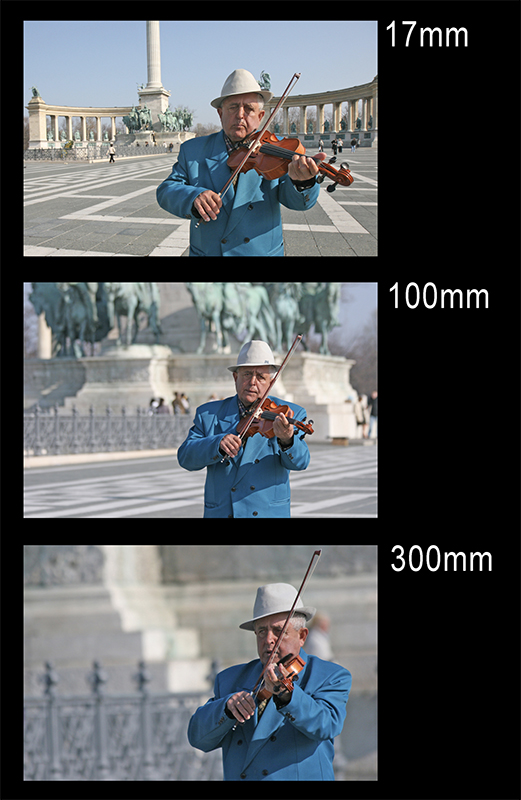
The focal length relates to the lens of your camera, and it should also be marked on the lens. Technically speaking, it is the distance in millimetres between the optical centre of your lens and the point where parallel light rays are focused into a single point.
The optical centre depends on many factors, including focusing distance and lens design
The focal length of your lens determines how much can be seen in your photos and how large the subject appears in the frame. A kit lens often has a focal length of 18-55 mm, so these are the minimum and maximum focal lengths of your lens.
The lower the number, the more of the surroundings you will see in your image, and the smaller everything will appear.
This is also called wide angle. There are even shorter focal lengths, such as 12mm, which are then called super wide angle. Wide-angle lenses can cause distortion in your image, especially when you use them at a short distance from your subject. They are therefore less suitable for portraits, or headshots.
To make a portrait taken with a wide-angle lens fill the frame, you have to stand very close to the person being photographed. The result is distortion! An alternative is cropping, but that comes at the expense of the quality of your image.
With a long focal length, you see less of the surroundings in your photo. The image is therefore more zoomed in. With a high number, also called a long focal length, you are talking about a telephoto lens.
Focal lengths of at least 85, 100, 200 and 400 mm are often used for this.
Because a telephoto lens appears to bring the background closer, the compressing, or compression effect of a long focal length that makes the foreground and background appear closer together, the resulting background blur will also be increased in the photo.
Want to learn more about the basics of photography?
At Photofacts Academy, our online learning environment for photographers, we have a complete photography basics course. You can follow this course for two weeks with a free trial membership.
About the author
Michelle Peeters is fotografe en oprichter van DeuxBleus Fotografie. Michelle herkent het bijzondere in het gewone en het gewone in het bijzondere. Ze heeft zich nooit willen specialiseren en is daardoor van alle markten thuis.
You might also like
-
 Effect of focal length in portraits
by Nando Harmsen
-
 Composition tip: Choose the right focal length
by Elja Trum
-
 5 Beginner Tips for Better Photos
by Nando Harmsen
-
 Converting focal length to full-frame is pointless
by Nando Harmsen
-
 10 Tips for Beginner Photographers
by Elja Trum
-
 Let your focal length ranges overlap
by Nando Harmsen
20 comments
-

 Paul Oosterlaak wrote on Friday 9 February 2018 at 11:19
| reply
"The focal length has to do with the lens of your camera, and if all is well, it is also written on it. Technically speaking, this is the distance in millimeters between your camera sensor and the center of your lens. "
Translated from Dutch.
No, really not. It is the distance between the optical center of the lens and the point at which parallel light rays are bundled into 1 point. The optical center depends on many factors, including focusing distance and lens design.
"The focal length of your lens determines how much can be seen in your photos and how large the subject appears in the frame."
The focal length of your lens together with the size of your sensor.
"This is also called wide-angle. There are even shorter focal lengths, for example 12mm, which is then called super-wide-book."
Obviously, the boundaries between super-telephoto, telephoto, standard, wide-angle, super-wide-angle and ultra-wide-angle are vague. But it is more convenient to talk in terms of angles of view or possibly, as is usually done, in terms of full-frame equivalent focal lengths. So wider than 35mm is wide-angle, wider than 24mm is super-wide-angle and wider than 16mm is ultra-wide-angle, for example (these are not absolute values).
"Wide-angle lenses can cause distortion in your image, especially if you use them to photograph your subject from a short distance."
Every lens causes distortion, because this depends on your perspective. The distortion is only more clearly visible in certain situations.
"So they are not suitable for portraits."
With this, you are doing many portrait photographers a disservice. I know photographers who shoot portraits with fish-eye lenses. Extreme perspective distortion and deformation are deliberately used then. You would be better off saying that if you want less distortion in your portrait, you are better off working with longer focal lengths. -
 Michelle Peeters wrote on Friday 9 February 2018 at 11:42
| reply
@Paul: thanks for your addition! A fisheye lens isn't exactly a typical portrait lens, is it? I was always taught that for a beautiful and undistorted portrait you should use a focal length of at least 100mm (wide-angle equivalent). Otherwise you get hugely enlarged noses (everything that sticks out gets hugely enlarged). So probably fine for caricature shots!
Translated from Dutch. -
Paul Oosterlaak wrote on Friday 9 February 2018 at 12:11
| reply
Portraits: so many people, so many preferences, so many lenses...
Translated from Dutch.
A tight head-and-shoulders portrait is indeed often shot at 100+ mm, but a full-body portrait is more often shot at 50mm or wider. If I have the space, I shoot almost everything at 135mm, but sometimes I don't have the space and/or you want more context with the portrait and I use 50mm (or even wider). So it's not that clear-cut, so add more nuance when you talk about this.
The gist of this article is of course that it shouldn't be too long, but adding a little nuance here and there would also make it more complete and more accurate. -
Michelle Peeters wrote on Friday 9 February 2018 at 12:17
| reply
Agreed Paul, thanks again for your addition! Perhaps an idea to expand this article a bit with your input and possibly other input to make it complete.
Translated from Dutch.
These are things you really have to deal with a lot in practice and that you have to keep thinking about.
What would actually be interesting is to find out when you start seeing distortion, or when it starts to become noticeable. I know many photographers who photograph babies or very small children from a very short distance. And they claim not to be able to see any distortion! The issue they have, of course, is also the lack of space (having to work in small mobile studios). Do you perhaps have anything to say about this? -
 100
wrote on Saturday 10 February 2018 at 12:10
| reply
"The focal length has to do with the lens of your camera, it should also be written on it if all is well. Technically speaking, this is the distance in millimetres between your camera sensor and the centre of your lens. "
Translated from Dutch.
‘No, really not. It is the distance between the optical centre of the lens and the point at which parallel light rays are bundled into 1 point.’
Actually, neither statement is correct for the lenses people use on their cameras, because those are not “thin lenses” but “thick lenses” or lens systems, and different definitions apply to those which are interesting to optical engineers, but will not interest the average photographer.
I think the three example photos are much more important than the optical theory because you can clearly see the effects of the different lenses there. The most striking difference is the difference in compression. The “longer” the focal length, the closer the foreground and background come together.
With the focus on the violinist’s head, you can see that the violin becomes proportionally smaller and the fence in the background becomes increasingly larger. An additional effect is the greater background blur, which increases the separation between subject and background.
Portraits:
You can shoot a portrait with virtually any lens, but it is not for nothing that 85mm lenses are considered portrait lenses. Little distortion and relatively simple optics mean that “fast” (f/1.8) and reasonably affordable (a few hundred euros) go together, making them interesting for people who take portraits and want something more than an 18-55 kit lens. -
-
-
Michelle Peeters wrote on Sunday 11 February 2018 at 10:04
| reply
@100: beautiful, yes! I've always wanted to do something like that myself, but I never got around to it.. And I don't have a 1000mm lens!
Translated from Dutch. -
 martinphili wrote on Sunday 11 February 2018 at 10:13
| reply
The distortion in portraits (large nose and so on) has mainly to do with the distance between photographer and subject. That is perspective. In that light, I therefore completely agree with the statement that every lens is suitable for portraits.
Translated from Dutch. -
Michelle Peeters wrote on Sunday 11 February 2018 at 11:22
| reply
@martinphili: yes, you have a point there! I should actually have mentioned in my article that (to get the violinist the same size in the frame each time) I had to keep moving farther away with a longer focal length.
Translated from Dutch.
To get a portrait taken with a wide-angle lens to fill the frame, you have to stand at a very short distance from the person being portrayed in that case. Result: distortion!
An alternative is cropping, but that comes at the expense of the quality of your image. -
100
wrote on Sunday 11 February 2018 at 12:57
| reply
@martinphili
Translated from Dutch.
“Distortion in portraits (a big nose and so on) has mainly to do with the distance between the photographer and the subject. That is perspective.”
Yes and no.
You can only get a “big nose” if the lens has negative compression (stretching), and that applies to lenses with a focal length shorter than a standard lens. If we divide lenses up simply, you only get stretching with wide-angle lenses (<35mm) and compression only with telephoto lenses (>70mm). Between 35 and 70mm (the boundaries are arbitrary, but it is about the order of magnitude) you get an image comparable to what we see with our eyes.
So if you photograph with a standard lens (let's say 50mm), you will see that photographing from far away or up close has little or no effect on the proportions of a face. The best example is most macro lenses, with which you photograph at very short distances and yet have little trouble with stretching. -
martinphili wrote on Sunday 11 February 2018 at 14:56
| reply
I spent a long time taking portraits with a 50mm lens and you notice there too that you can get too close. You even have that perspective distortion with your eyes, things that are close look bigger.
Translated from Dutch.
You are absolutely right that a wide-angle lens distorts. It definitely does. I had to think about that macro lens for a moment, but couldn't the lack of stretching/distortion also be because the subject is just so small? -
Paul Oosterlaak wrote on Sunday 11 February 2018 at 15:52
| reply
@100: focal length for a thick lens or lens system is indeed not as straightforward as with a thin (ideal) lens (without spherical aberration), but assuming an optical center (wherever that may be) is accurate enough.
Translated from Dutch.
As for that 50mm. That is simply an arbitrary value that was once easy and cheap to produce. It has nothing to do with distortion. And as martinphili already says, you can just as well get distortion with it. Many a head-and-shoulders portrait taken with a 50mm shows visible distortion.
As I said earlier, you always have distortion. If you take a photo of railway tracks with an 800mm lens, you don't see parallel lines either. -
100
wrote on Sunday 11 February 2018 at 18:02
| reply
Displaying a 3D subject on a 2D sensor is by definition a form of distortion of reality, but there are many forms of distortion. In this case I think we are talking about a specific form; compression. This form has two faces, positive compression (compression) and negative compression (stretching). Wide angle shows stretching, telephoto shows compression. So there must be a zero point somewhere where one form changes into the other.
Translated from Dutch.
That transition point is around 50mm (I mentioned the range >35mm and <70mm to avoid discussion about the exact point). It is about the principle that wide angle gives a fundamentally different distortion than telephoto and that in between you have a range where neither form of distortion is significant. That is the range of the standard lens.
It is precisely with what are often called portrait lenses (focal length between 85 and 135mm for 35mm) that there is (slight) compression and many people experience that as aesthetically pleasing. The distance between, for example, the tip of the nose and the face is shown as smaller than it actually is.
As for macro lenses; many of these lenses have a focal length between 50 and 105mm, but the stated focal length is actually only correct if you photograph subjects that are farther away. At 1:1, the actual focal length is often 30% or more shorter than the stated value, so you are in the range of “standard lenses”.
There are also wide-angle macro lenses, the Venus Laowa 15mm f/4 for example, and with that you also see the specific wide-angle distortion caused by stretching (example below).
https://www.flickr.com/photos/petapixel/18903354809/in/dateposted/ -
Paul Oosterlaak wrote on Sunday 11 February 2018 at 18:20
| reply
Compression depends on distances and not on focal length: https://flic.kr/p/BctdW1
Translated from Dutch.
As far as macro lenses are concerned: a macro lens actually effectively renders the image of a longer focal length, which is why the maximum aperture also decreases (you can also see this neatly on Nikon cameras). What you mean is focus breathing -
100
wrote on Tuesday 13 February 2018 at 01:17
| reply
@Paul
Translated from Dutch.
Indeed, if you keep the distance the same and crop a photo taken with a 21mm lens enough, you get the same image as with a 200mm lens, provided your subject is not too far away, otherwise you will have too few pixels left.
But do you also have an example where a nose looks much bigger than it actually is when using a 200mm lens, as with a close-up taken with a 16mm lens?
Probably not because the minimum focusing distance of a 200mm lens is simply too great, my 70-200 has a minimum focusing distance of 1.2 metres, my 16-35 has a minimum focusing distance of 0.28 metres, in short, focal length affects the distance at which you can take photos and therefore also the possible forms of distortion.
The core of the article was, in my opinion, the use of lenses with different focal lengths and the difference that arises when you keep your *subject* the same size in the frame. If the distortion then progresses from stretching to compression as in the example photos, there is somewhere a (focal) point at which neither of the two is present. -
 Rob Bot wrote on Wednesday 14 February 2018 at 12:03 | reply
Michelle thanks for your explanation. Great responses everyone! But reading the article again, it was mainly intended for the beginner (hobby) photographer! In other words, the responses are at a completely different level! And was that really the intention. Perhaps these could be better included in a topic for advanced photographers!! I'm afraid that a lot of beginner hobby photographers won't understand a thing after reading all the responses and will give up!
Translated from Dutch. -
 Liesbeth Dersjant wrote on Wednesday 14 February 2018 at 21:24 | reply
I was quite happy with Michelle's clear explanation. Of course Paul will be right, but that does make it quite a bit more complicated if you don't know that much about it. For now, I'll save his additions for later. I hope there will also continue to be room for simple explanations. Thank you, Michelle.
Translated from Dutch. -
Michelle Peeters wrote on Wednesday 14 February 2018 at 21:49
| reply
@Rob and Liesbeth: the article has already been supplemented with a number of tips from comments!
Translated from Dutch. -
Paul Oosterlaak wrote on Wednesday 14 February 2018 at 22:26
| reply
It’s simple for now, but also correct. So a win-win situation. Thanks Michelle!
Translated from Dutch.
Have your say
Please note: Articles older than a week can only be commented on by signed-in visitors.Would you still like to comment? sign in or create a free account.
Become a better photographer every week
A practical photography tip in your inbox every week.
38,884 photography enthusiasts already receive the tips! More about the weekly mail. Or keep up to date via  Facebook.

Elja Trum
Photofacts; everything to do with photography!
Would you like to take better photos and keep up with what is happening in photography? Photofacts publishes articles that teach you something about photography — from a product announcement to a practical shooting tip or a look at a website. Photofacts covers photography every day and is a hobby project of Elja Trum's that got out of hand. The articles are written by a team of volunteer authors. If you would enjoy writing one or more articles for Photofacts, do get in touch.More about PhotofactsPhotofacts is made possible in part by
