

Effect of focal length in portraits
Sunday 11 May 2025, 18:36 by Nando Harmsen | 4,214 views | 5 commentsThis article was translated from Dutch with the help of AI. Read the original.
You often hear that a longer focal length is very suitable for portrait photography. It gives good perspective in the proportions of the face. But it also has a major effect on how the background appears in the image.
You are not going to use a wide-angle lens for portraits. Although you can achieve special effects and exciting compositions, it is a no-go for a proper portrait. The most noticeable feature is the nose, which becomes far too large in relation to the rest of the face.
From a focal length of 50mm onwards, you will hardly have this problem. Unless you get too close, of course, which I have done in this example. But for a normal portrait, anything from 50mm is perfect. If you use a smaller sensor format, convert it so that you have the same angle of view.
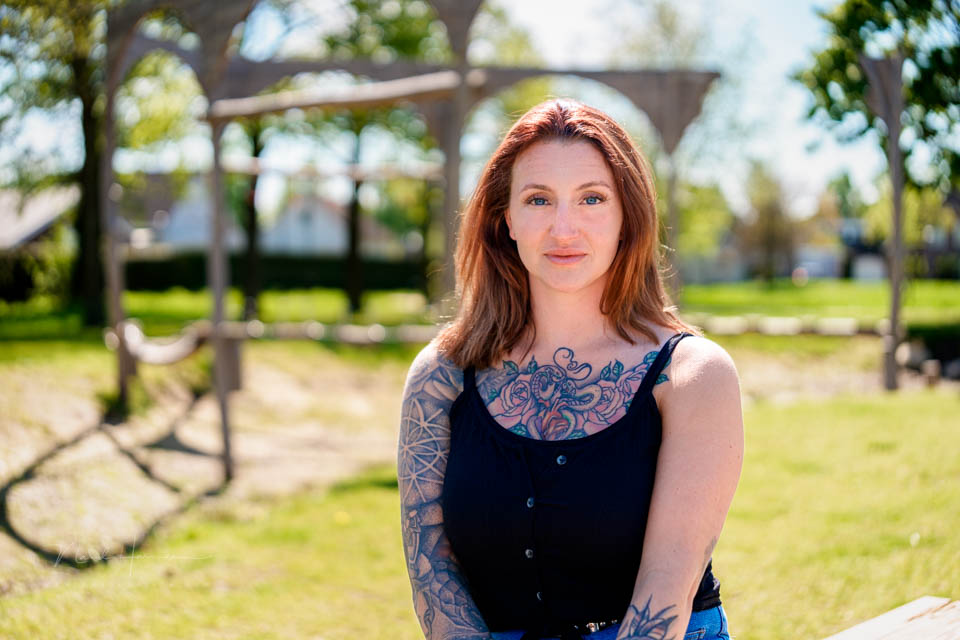
Besides the proportions of the face, focal length has a major effect on the background. As the focal length gets longer, the angle of view becomes smaller. Everything appears larger in the image. It is not just the model who appears larger, the background is enlarged too.
Because your model appears larger in the image, you may want to compensate for this. By taking more distance, you can make your model the same size again. However, the background remains enlarged by the same amount, even if you move further away from your model.
With a longer focal length, you get less of the background in the image, and the blur also becomes greater. This makes it easier to separate your model from the background. The smaller angle of view also gives you the chance to be selective when it comes to the background.
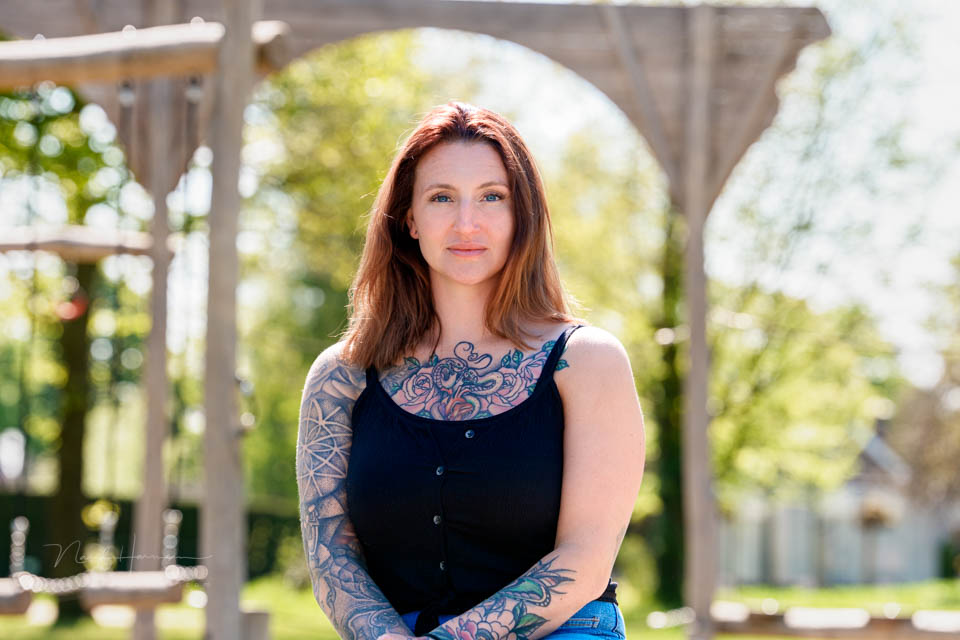
You can take perfect portrait photos with 50mm. You can take perfect portrait photos with 100mm or even 150mm. One is not automatically wrong, and the other is not automatically right. Every angle of view gives a different look. Choose the one you think best suits your portrait.
Keep this rule of thumb in mind. The larger the angle of view, the greater the role of the surroundings in your photo. The smaller the angle of view, the more attention is focused on your model. Choose the optimum balance for your photo by making a conscious choice of focal length.
About the author
Nando Harmsen has been photographing for more than 40 years. He specialises in wedding photography and landscape photography. Nando also gives talks, workshops, masterclasses and photo trips, and regularly reviews new and interesting equipment.
You might also like
-
 Choose the right perspective
by Nando Harmsen
-
 Landscape photography tip: Choose the right perspective
by Nando Harmsen
-
 Removing shadows from faces with AI
by Elja Trum
-
 Street photography theme: face masks and the big bad wolf
by Jan Poldervaart
-
 Light the space, not the face
by Elja Trum
5 comments
-
 Mac wrote on Tuesday 13 May 2025 at 08:04 | reply
Golden rule for portrait photos has always been an 85-135mm lens.
Translated from Dutch.
the 85mm and 135mm are not seen that much anymore nowadays (replaced by zoom lenses). But in the analog era every photographer had either an 85mm or a 135mm in their bag for portraits. -
 Donald Willemsen wrote on Tuesday 13 May 2025 at 14:25 | reply
That's right Mac, in the analog era I always used a 135mm for portraits on a full frame. Now with a crop sensor I often use 85mm to get approximately the same angle of view.
Translated from Dutch. -
Fotospullen@onsmail.nl wrote on Tuesday 13 May 2025 at 16:01 | reply
...... and all of this, of course, entirely aside from the question of what a portrait is... a head shot.... something a bit broader.... or much broader indeed.....
Translated from Dutch.
But, as far as I'm concerned, in principle actually in all cases the person concerned should be depicted with respect. And therefore e.g. no strange perspectives etc -
Jacques wrote on Tuesday 13 May 2025 at 22:08 | reply
Why don't I read anything here about the difference between crop and full-frame cameras. Pretty relevant in this case.
Translated from Dutch. -


Have your say
Please note: Articles older than a week can only be commented on by signed-in visitors.Would you still like to comment? sign in or create a free account.
Become a better photographer every week
A practical photography tip in your inbox every week.
39,023 photography enthusiasts already receive the tips! More about the weekly mail. Or keep up to date via  Facebook.

Elja Trum
Photofacts; everything to do with photography!
Would you like to take better photos and keep up with what is happening in photography? Photofacts publishes articles that teach you something about photography — from a product announcement to a practical shooting tip or a look at a website. Photofacts covers photography every day and is a hobby project of Elja Trum's that got out of hand. The articles are written by a team of volunteer authors. If you would enjoy writing one or more articles for Photofacts, do get in touch.More about PhotofactsPhotofacts is made possible in part by
