

Review: The Great Landscape Photography Book by Scott Kelby
Friday 14 June 2019, 20:10 by Michelle Peeters | 6,976 views | 0 commentsThis article was translated from Dutch with the help of AI. Read the original.
We received a copy of Scott Kelby's latest book from publisher Van Duuren Media: 'The Great Landscape Photography Book'.
Have you ever dreamed of taking such incredible landscape photos that your friends and family say, 'Hang on, did you really take that photo yourself?' Then you're in luck.
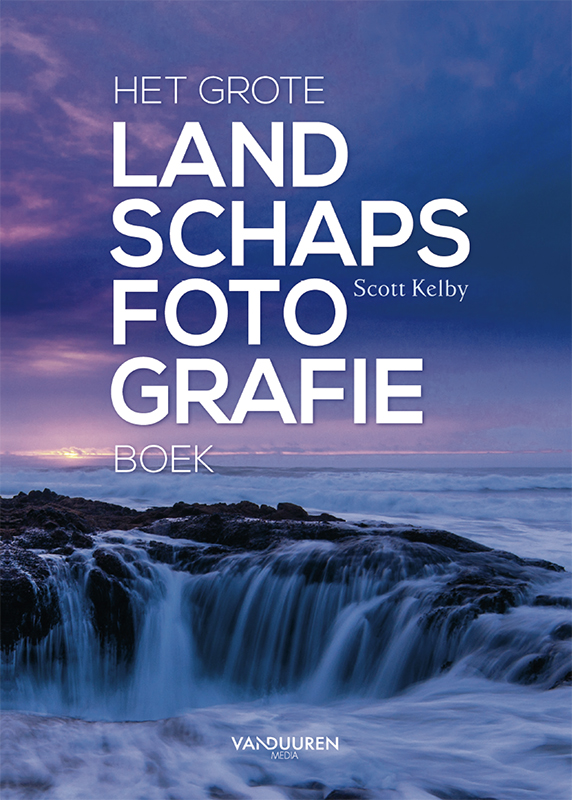
In this book, professional photographer and award-winning author Scott Kelby teaches you how to take and edit such breathtaking landscape photos.
Scott reveals all his secrets and tried-and-tested techniques as he covers everything. From essential equipment and camera settings to the techniques you need to take impressive landscape photos.
From stunning landscapes at sunrise to capturing fast-flowing streams and waterfalls, and from photographing the night sky or the Milky Way to creating sweeping panoramas. Scott shows you all of it.
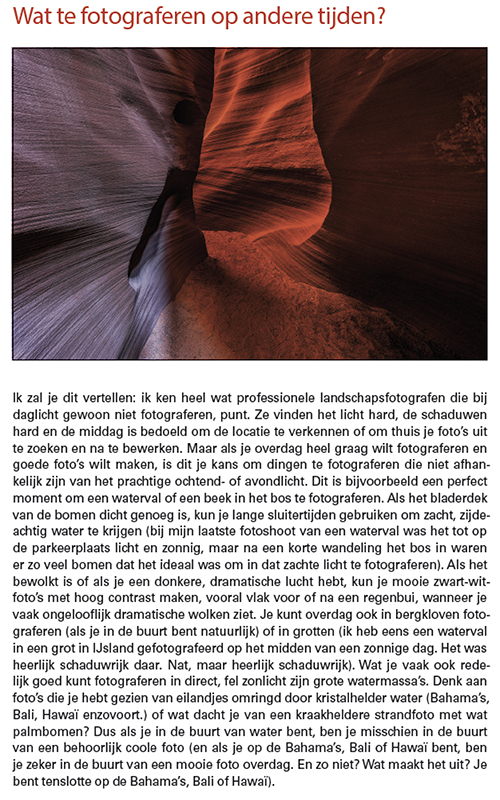
Alongside many other subjects, Scott covers the following:
- the secrets to getting super-sharp, crisp images, without having to buy a new lens;
- the right camera settings for landscape photography and why, and which ones you should avoid;
- where to focus your camera to get razor-sharp photos from foreground to background;
- how to create beautiful high-dynamic-range photos, impressive panoramas and even HDR panoramas, and how to process them professionally;
- how to take compelling long-exposure landscape photos;
- which equipment you really need, which items you are better off leaving at home, which accessories work best and lots of great tips that will not only help you take better photos, but also make the whole process of taking photos more enjoyable.
You will find it all in The Great Landscape Photography Book, from planning to post-processing, where you turn your photos from ordinary into fantastic. Best of all, there is just one subject per page, so you immediately find all the information you need.
Contents
Chapter 1: Essential equipment
Chapter 2: Camera settings and lenses
Chapter 3: Before you start shooting
Chapter 4: Composition
Chapter 5: HDR and panoramas
Chapter 6: Long exposures
Chapter 7: Starry skies and the Milky Way
Chapter 8: Post-processing
Chapter 9: More tips
Chapter 10: Landscape recipes
What did I think of it?
I have to say that I read the book in one go and in a very short time. It is more complete than complete, and I could not find anything that was missing.
As usual with Kelby, the introduction with the acknowledgements is quite extensive, but you can easily skip this.
The content of the book is completely interesting. Even the introductions to each new chapter, where you sometimes wonder where they are going, are well worth reading. Somehow, they get you fully in the mood for the relevant landscape photography subject.
I thought I already knew quite a lot about landscape photography, but I still learnt a great deal from this book. The tips he gives are almost never obvious. There is always another eye-opener.
For example, he explains clearly why an aperture of f/11 gives the sharpest result. Sharper even than f/22 or f/32, which is probably due to lens aberrations and diffraction.
It was also new to me that shooting in RAW gives you smoother transitions in the sky with less banding, visible lines between shades of colour.
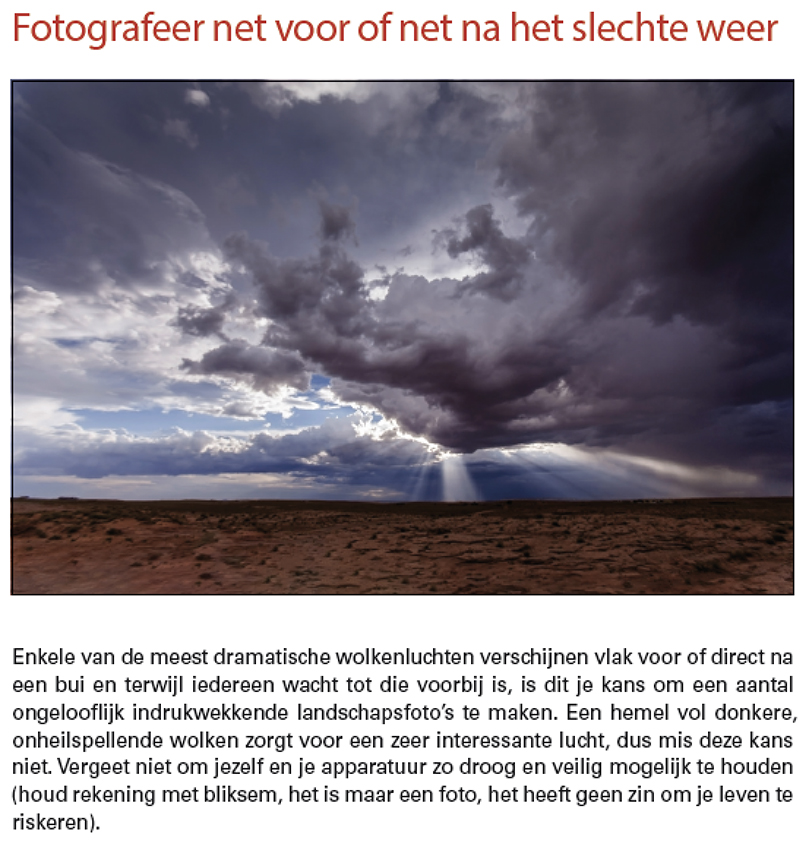
I knew it intuitively, just like evaluative metering, which works well for landscape photography, setting the white balance to 'cloudy' and using the 'one shot' focusing method. But it is very useful to see these intuitive assumptions confirmed in this book.
He explained when you can use an extreme wide-angle lens, namely when you have something very close as your foreground, such as a rock or a piece of driftwood, and how you can achieve great results with it.
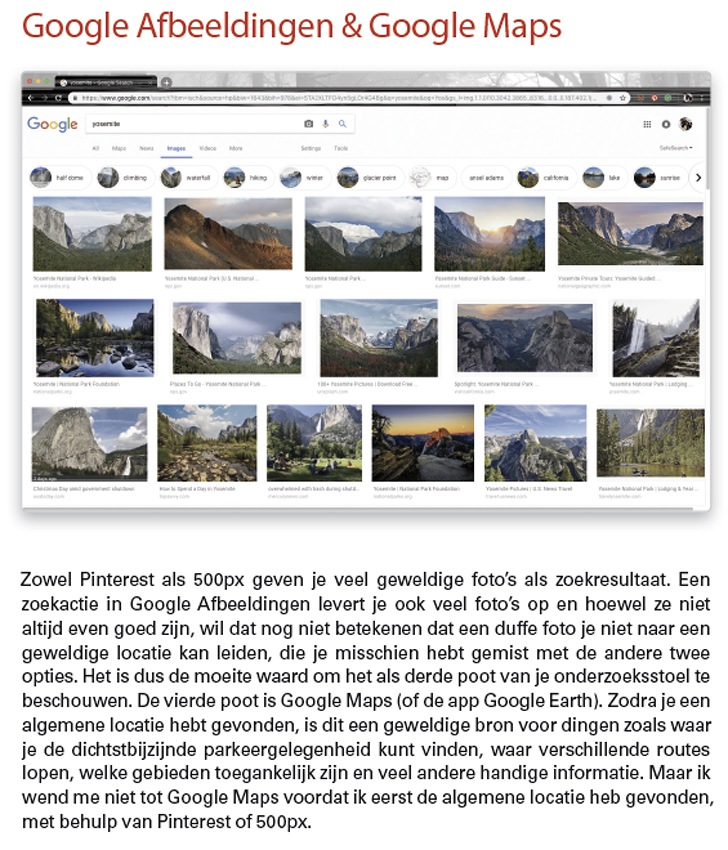
You can find beautiful locations through Pinterest, 500px and Google Maps. A dull photo you find there can still lead you to a great photo location.
You can still take photos in bright sunlight. It just depends on the subject. Large bodies of water are perfect for this. Think of islands surrounded by water or waterfalls.
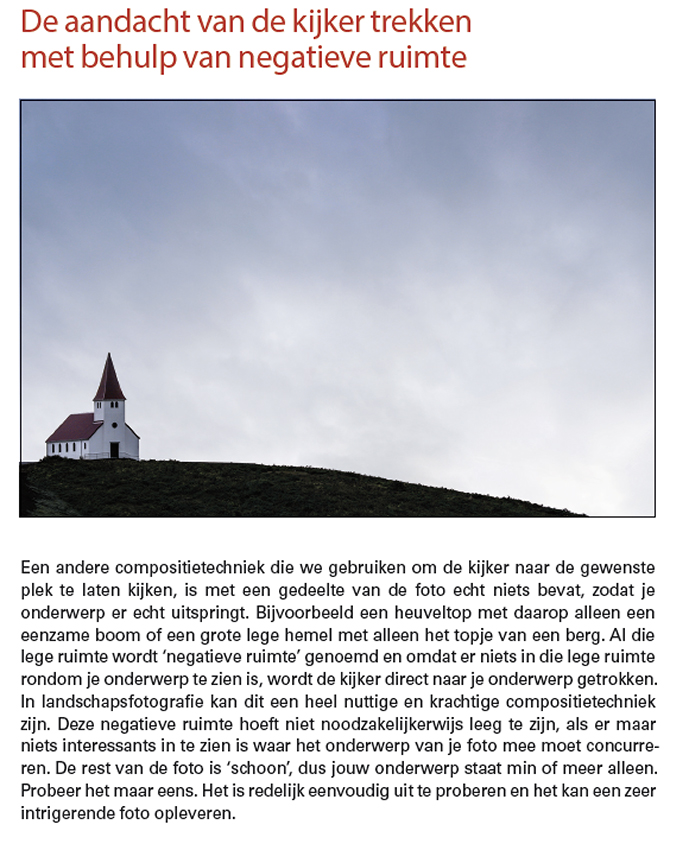
What I also found very interesting was his explanation of where to place the horizon line and how to lead the viewer's eye. For example, towards light. And how you can also do this with negative space, meaning a section of the photo that contains absolutely nothing. This makes your subject really stand out.
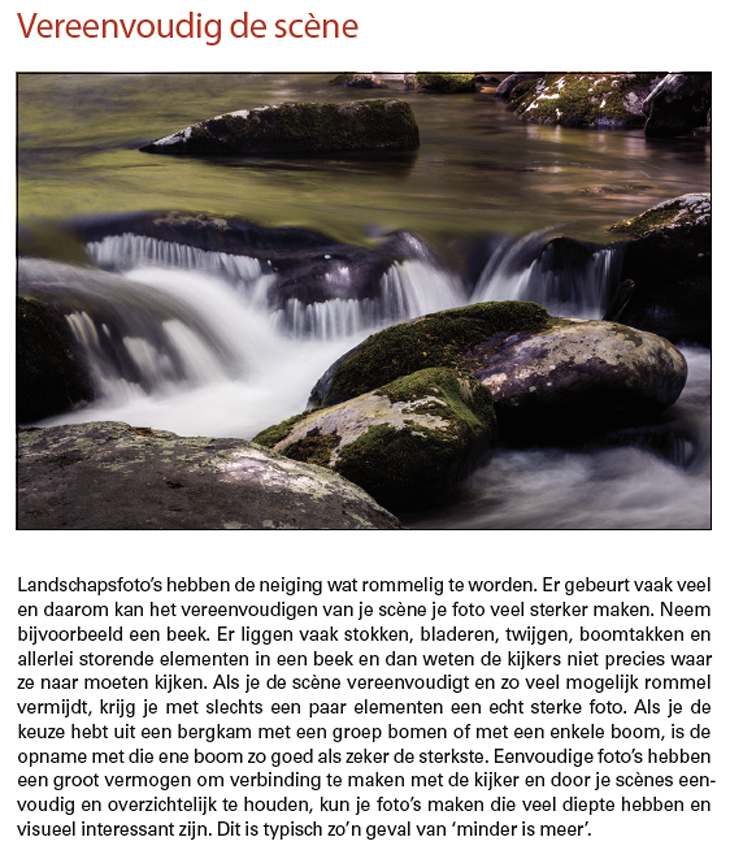
In landscape photography, you need a clear and well-defined subject. If it looks cluttered, you need to simplify the scene. Panoramas make large things look large, an eye-opener, and ensure that they retain their scale.
Everything you need for a good panoramic photo, including camera settings, equipment and things to look out for, is explained in detail. He also gives you plenty of ideas and inspiration to try something different.
The chapter on photographing the Milky Way attracted my attention the most, because this is quite technically challenging. I had already studied this in some depth in the past, yet reading this chapter gave me a lot of extra knowledge.
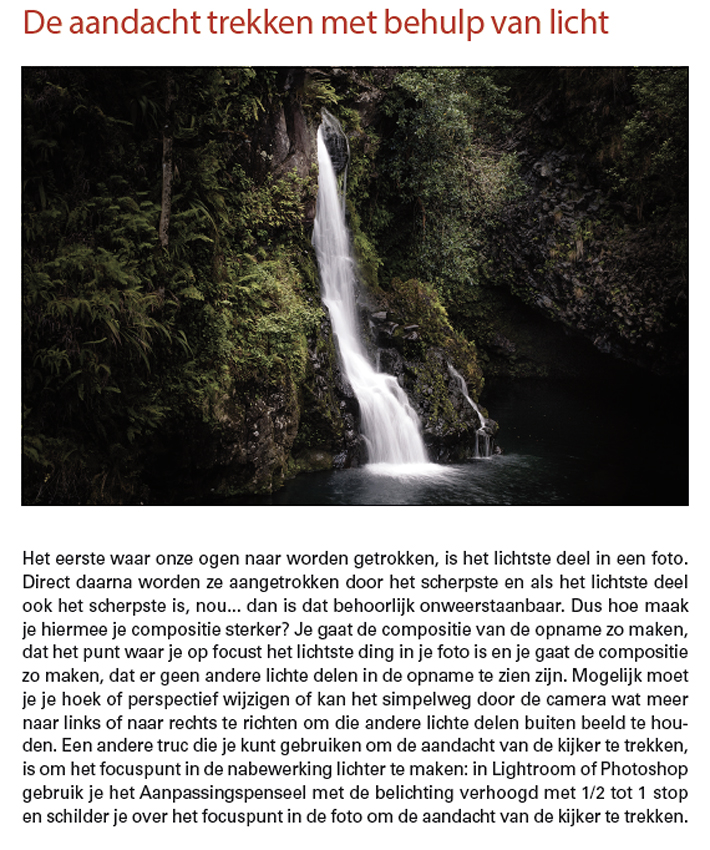
I did not yet know that the Milky Way is only visible for a few months each year in the northern hemisphere, namely from April to July. During this period, the Milky Way appears as a horizontal band across the southern sky.
With the PhotoPills app, you can see where the Milky Way appears in the sky. The app uses augmented reality. An image is placed on your camera screen, exactly where the Milky Way appears in the sky at that location. This allows you to explore your location during the day and plan where you will stand to create a beautiful foreground for your photo.
The ideal camera settings are explained in detail, as is the reason why: f/2.8, 15 seconds, ISO 1600-3200. An extreme wide-angle lens, 24mm on a full-frame camera is the minimum, works best.
Three different focusing methods are explained, including Focus Peaking, a camera setting that marks parts of the photo with high-contrast edges.
In many places in the book, links, URLs, are provided to videos that you can watch online. In these videos, he explains in detail, for example, how best to edit a Milky Way photo.
The final chapter consists of landscape recipes with a short and concise step-by-step plan for achieving a particular result. Some of the subjects he examines include composition with leading lines, mirror-like reflections, strong foreground elements, dramatic skies, mountain peaks and waterfalls.
I am particularly enthusiastic about the book. It gives you exactly the information you need, as well as plenty of inspiration and ideas for taking photos in beautiful locations around the world. Definitely something to take with you on holiday!
Special price and how to order
The book will be published on 27 June 2019. Until then, the pre-order price is 29.99 euros instead of 34.99.
» Order: The Great Landscape Photography Book by Scott Kelby
About the author
Michelle Peeters is fotografe en oprichter van DeuxBleus Fotografie. Michelle herkent het bijzondere in het gewone en het gewone in het bijzondere. Ze heeft zich nooit willen specialiseren en is daardoor van alle markten thuis.
You might also like
-
 Review: Portrait Photography with Natural Light by Scott Kelby
by Michelle Peeters
-
 Review: Photographing with the iPhone by Scott Kelby
by Elja Trum
-
 20 photography books you should read!
by Michelle Peeters
-
 Review: Photo book 'Voor altijd Rotterdam'
by Erik van Rosmalen

0 comments
Be the first to share what you think!
Have your say
Please note: Articles older than a week can only be commented on by signed-in visitors.Would you still like to comment? sign in or create a free account.
Become a better photographer every week
A practical photography tip in your inbox every week.
38,982 photography enthusiasts already receive the tips! More about the weekly mail. Or keep up to date via  Facebook.

Elja Trum
Photofacts; everything to do with photography!
Would you like to take better photos and keep up with what is happening in photography? Photofacts publishes articles that teach you something about photography — from a product announcement to a practical shooting tip or a look at a website. Photofacts covers photography every day and is a hobby project of Elja Trum's that got out of hand. The articles are written by a team of volunteer authors. If you would enjoy writing one or more articles for Photofacts, do get in touch.More about PhotofactsPhotofacts is made possible in part by
