

The Plan
Tuesday 15 September 2026, 14:41 by Michiel Heijmans | 739 views | 0 commentsThis article was translated from Dutch with the help of AI. Read the original.
In part one of this column, I discovered that much of his street archive is interchangeable, and that with the eyes he has now, he hardly makes anything anymore. In this second part: how he returns to the streets, but with the patience he learned in the studio. And an assignment for you.
I ended part one with a question: what does suit a street photographer who no longer wants to rely on quantity? I have been experimenting with that over the past few months. What follows is not a recipe. It is what I do now, and why.
It starts with a word that goes against everything I have ever learned about street photography: plan.
Street photography thrives on chance. That remains true. You cannot direct what happens at a crossroads, and you should not want to. But chance and planning do not exclude each other.
In the studio, I learned that you can invite chance. You set up the light, choose the background, start a conversation, and then wait for something to happen that you could not have thought of yourself. The preparation makes the moment possible. I take that idea outside with me.
In practical terms, that means two things.
First: I no longer work with individual images, but in series. I call this conceptual street photography. In the past, every photo was an island. A hit here, a nice photo there, all equally good and all separate from one another.
That is exactly why the archive feels so interchangeable. Now I decide in advance what a series will be about. Not in grand terms, just a small limitation. I am looking for stillness. People waiting. The last quarter of an hour before a shopping street closes.
One staircase in Nijmegen and everyone who comes down it. The subject matters less than the fact that there is only one. A series forces you to look beyond the first good photo, because one good photo is not a series.
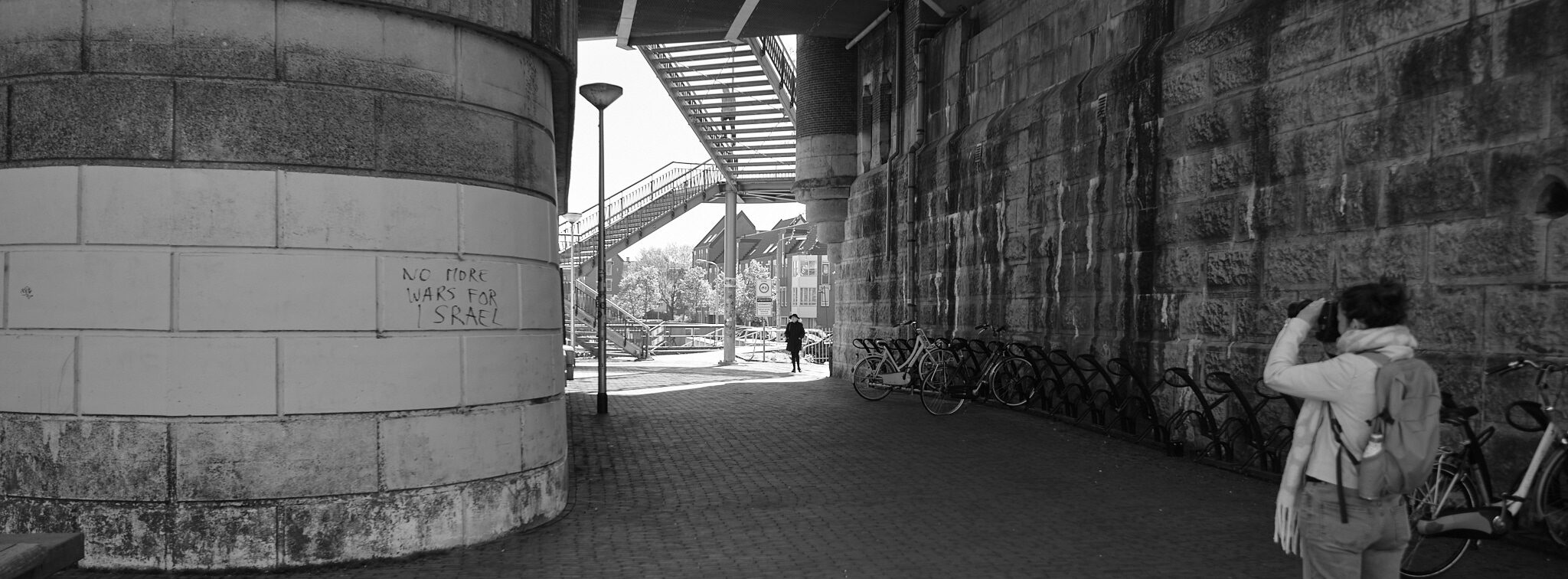
Fotowolk Nijmegen, that one staircase and waiting for someone to come down © Michiel Heijmans
Second: one place, and returning until it is right. That is the biggest change for me. I no longer walk all over the city looking for whatever there is to find. I choose a corner, a street, a square, and stay there. An hour, sometimes longer.
And the following week I go back. Different light, different people, the same place. In the studio, you do not go home after ten minutes because the portrait is not right yet. You stay, you wait, you let it come. Why did I never do that on the street?
I tried this in London, during a few free hours between two workshop days. One underpass near Barbican, harsh morning sunlight, strips of light on the ground. In the past, I would have stood there for three minutes, taken two photos of the first passer-by in the light, and moved on.
Now I stayed. Twenty minutes, still somewhat restless, outside my comfort zone. I saw how the light shifted, I saw which people walked slowly and which walked quickly, I saw that there was a moment when the strips fell exactly at eye level.
When that moment came, I knew exactly what I wanted. I took seven photos. One of them is good. Taken deliberately, with attention to light and timing. This photo was a choice.
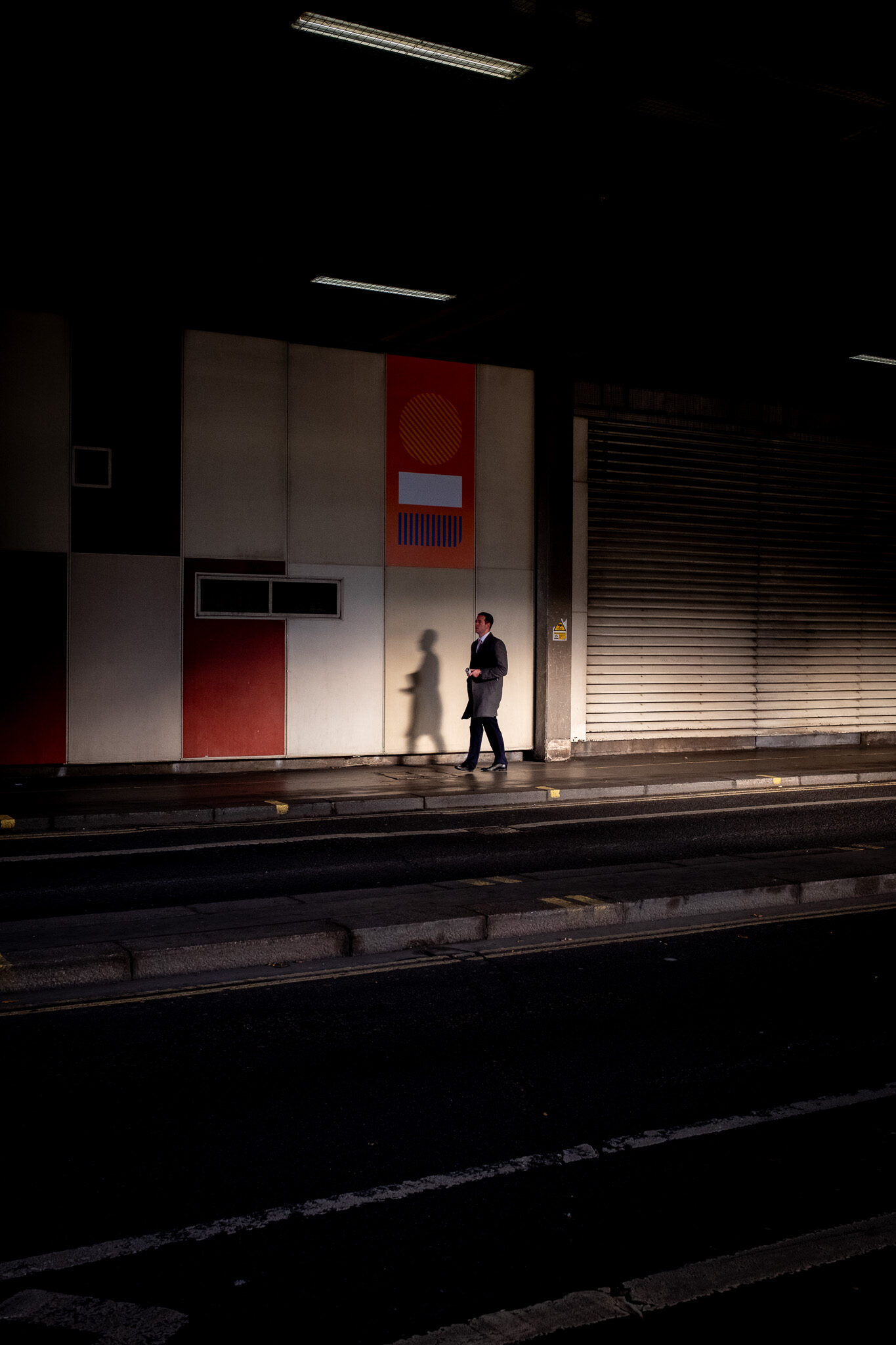
London Barbican - f/4, 1/250s, 1250 ISO @ 23mm © Michiel Heijmans
That is what I take from the studio: waiting, and a form of direction. Not directing the people, but directing myself. Where am I standing, what do I see, what am I waiting for?
What I deliberately do not take with me is control over everything. That is the trap when you come from portrait photography. You want to control the light, the pose, the expression. That does not work on the street, and it should not.
As soon as you start directing everything, you are no longer making a street photo, but a portrait with a street as its setting. Chance must remain in charge. I only prepare the place where chance is allowed to happen.
And then the hardest part. Choosing.
Making fewer photos is one thing. Showing fewer is something else, and that is where it really hurts. For years, I lived to the rhythm of the feed. Take a good photo and share it that same evening. Reactions, likes, confirmation that you are still taking part.
That rhythm is the opposite of what I am trying now. A series is only a series when it is finished, and that takes weeks or months. So I leave images aside. I look at them again after a week, and once more after a month.
Most of them are rejected. Not because they are bad, but because they are not new. I ask myself one question: have I made this before? If the answer is yes, it goes. That hurts. It is also exactly the point.
I am not going to pretend that I have it all figured out now. I have a few series in progress, and none of them is finished yet. Some days I come home with nothing and still think I have lost my touch.
Imposter syndrome? Who knows. But for the first time in years, I feel that I am making something, instead of collecting something. That difference is bigger than I thought.
The assignment, for me as well.
An assignment, because a column about patience that is only about me is worth nothing. Honestly, I am not that patient yet.
Choose one place. It does not have to be a beautiful place, just somewhere you can get to easily. A corner in your own village, a bus stop, the entrance to a supermarket.
Go there once a week for the next four weeks, for at least half an hour, preferably at different times. Do not walk around. Stay put. Only take a photo when you are sure you have not made it before. Do not put anything online until the four weeks are over. Then choose three images that together tell something they do not tell separately.
If you get three images out of it, you will have made relatively more than I have stored on that hard drive in most years. Let me know how it went. I am curious whether you notice what I noticed too: that making fewer photos does not feel like less once you know what you are waiting for.
About the author
Michiel is professioneel straatfotograaf en geeft workshops en lezingen over straatfotografie. Hij schrijft columns voor Focus Magazine en is erg actief op Instagram. Daar vind je dagelijks inspiratie en tips voor je eigen straatfotografie!
You might also like
-
 Street Photography with a Plan
by Michiel Heijmans
-
 Increase Your Chances of Taking Successful Street Photos
by Huub Keulers
-
 Making Plans, Telling Stories
by Michiel Heijmans
-
 The Hunger
by Michiel Heijmans
-
 Planning a landscape photo down to the last detail, or not?
by Nando Harmsen
-
 From the street to the treehouse
by Michiel Heijmans
0 comments
Be the first to share what you think!
Have your say
Please note: Articles older than a week can only be commented on by signed-in visitors.Would you still like to comment? sign in or create a free account.
Become a better photographer every week
A practical photography tip in your inbox every week.
39,083 photography enthusiasts already receive the tips! More about the weekly mail. Or keep up to date via  Facebook.

Elja Trum
Photofacts; everything to do with photography!
Would you like to take better photos and keep up with what is happening in photography? Photofacts publishes articles that teach you something about photography — from a product announcement to a practical shooting tip or a look at a website. Photofacts covers photography every day and is a hobby project of Elja Trum's that got out of hand. The articles are written by a team of volunteer authors. If you would enjoy writing one or more articles for Photofacts, do get in touch.More about PhotofactsPhotofacts is made possible in part by
