
Photographing dogs in the studio
Monday 28 October 2019, 11:22 by An Smedts | 10,518 views | 9 commentsThis article was translated from Dutch with the help of AI. Read the original.
Photographing dogs in the studio... A fun challenge, but of course the dog has no idea what the point of such a photoshoot is. And he certainly cannot imagine that his owner is planning to hang a large print of him in the living room afterwards!
For many dogs, a studio shoot is a special experience. A good approach and knowledge of the dog certainly help you achieve a successful shoot. Below are 9 tips for bringing out the best in a dog in the studio.
Know who you have in front of you
Ask the owner about the dog's character beforehand. Is the dog afraid of strangers or a friend to everyone? Does it react quickly to strange sounds or is it unflappable? Has the dog had a traumatic past or a truly luxurious life?
Make sure you know the breed and its specific characteristics, and always let the dog take the initiative in making contact with you. This way, the dog will not see you as a threat and you can start the shoot with confidence!
Relax and take it easy
A relaxed atmosphere during the shoot is very important. Dog owners are sometimes very tense before the shoot, as they have no idea whether the dog will listen or cooperate. If you notice this, it is important to first create a calm atmosphere and clearly explain how the shoot will go, so the owner can trust you and fully cooperate.
If everyone is relaxed and enjoying themselves, the shoot becomes a fun experience with the best results! Also discuss beforehand that the shoot should not become a family outing, and limit the presence of other people to a minimum. This allows the dog to concentrate fully on its owner, and means you as a photographer will not miss a single lovely look!
Make a concrete plan
When you arrive, the dog can be let loose in the studio to have a look around and sniff. Observe carefully how the dog behaves and fire a flash once while it is exploring, without expecting anything else from it. If the dog reacts anxiously to the flash, allow plenty of time to get it used to it before starting the real work.
No reaction to the flash? Time for the next step! It is useful to have the dog sit on a bench, so it is immediately in the right position for the light. I like to start by taking a headshot. While doing this, you can find out how obedient the dog is and whether it responds well to your voice.
Based on this, you can develop a more concrete plan for your shoot. Does the dog not react at all to your silly sounds? Then work with the owner, a treat or a toy to attract its attention. Be flexible and always be prepared to adjust your plans according to the model in front of you!
Lenses/equipment/settings
The 24-70 mm and 85 mm are my favourite lenses for the studio. You can use them to take the nicest portraits, but also to go a little wider in your images. Do you have a dog in front of you that likes to do its own thing? Then it can help to replace your prime lens with a zoom lens, so you miss fewer opportunities.
I like to shoot tethered and connect the laptop to a large screen. This means the owners can immediately see the result of your work, and you can easily communicate what you would still like to adjust. This way, the owners are more involved, can actively help out and, afterwards, you have your gallery ready straight away!
If you want the entire dog to be sharp, use an aperture around f8, and keep the ISO as low as possible in the studio. To freeze movement, such as dogs catching a treat, you need fast flashes. I use broncolor siros flashes, which can effortlessly capture every movement with perfect sharpness.
A large softbox is a real asset for creating beautiful soft light. Striplights can help separate the dog from the background, and an extra flash with a reflector and grid aimed at the background gives your image more depth and immediately creates a subtle vignette around the dog.
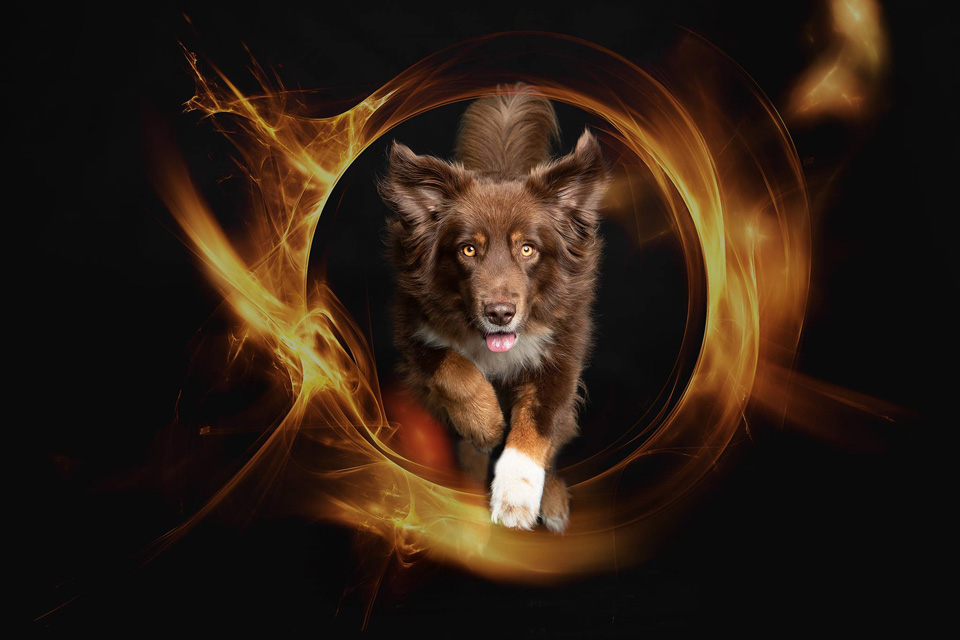
Black dogs
If you are photographing a black dog or a black background, you can use striplights placed diagonally behind the dog to separate it nicely from the background. This also gives your image more dimension.
A black sheet of plexiglass can also create a very attractive artistic effect through its reflection. First, however, make a good assessment of whether this is feasible with the dog, as the smooth surface can be very frightening for some dogs.
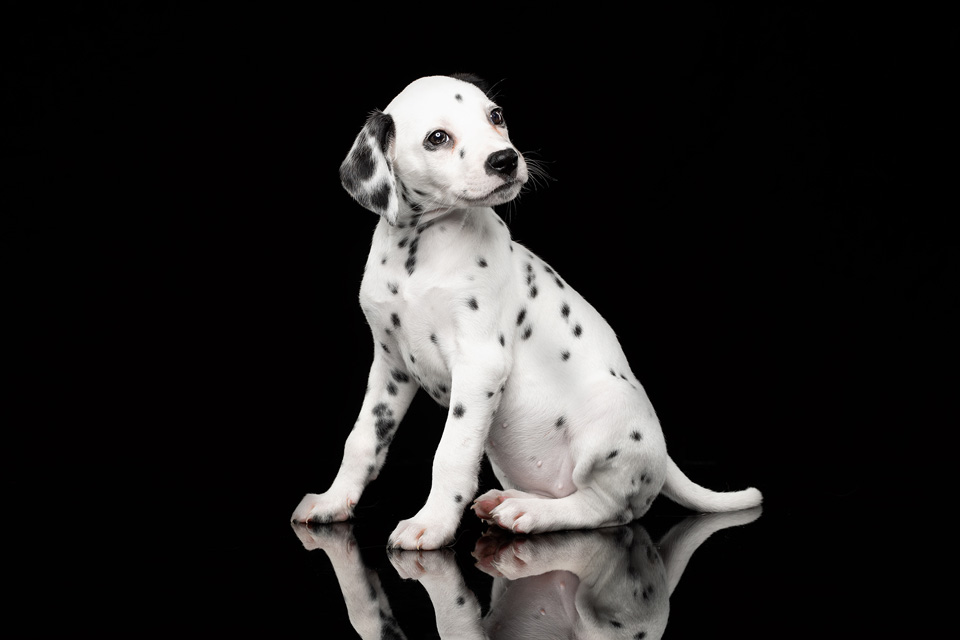
Colours and accessories
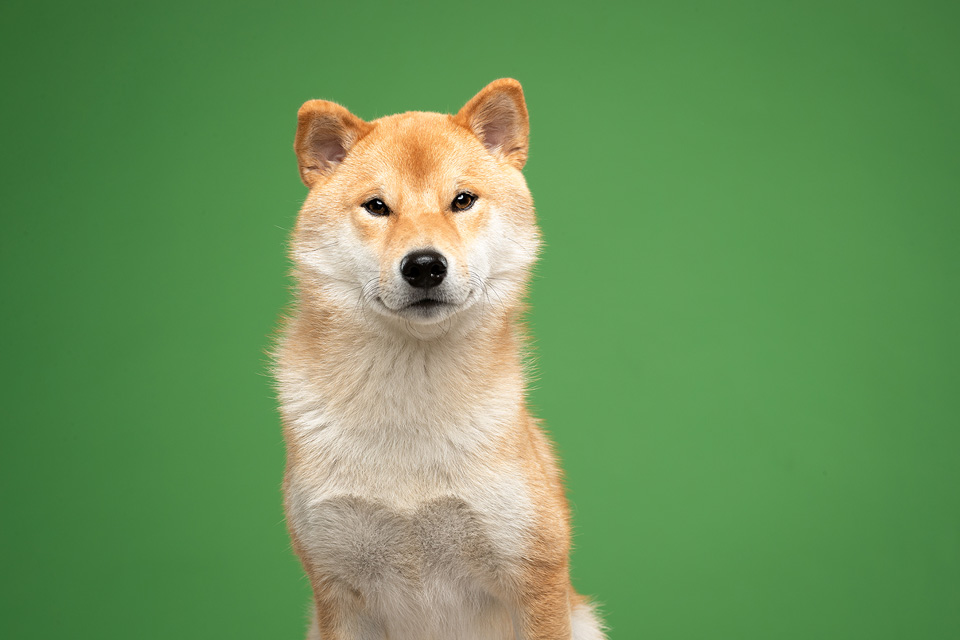
The great thing about photographing dogs in the studio is that you get dogs of all sizes, types, colours and characters! This makes the possibilities endless and the work very interesting! With different paper background colours, you can find a suitable colour for every dog. The disadvantage of paper is that it does not last forever, but you can also use this to your advantage.
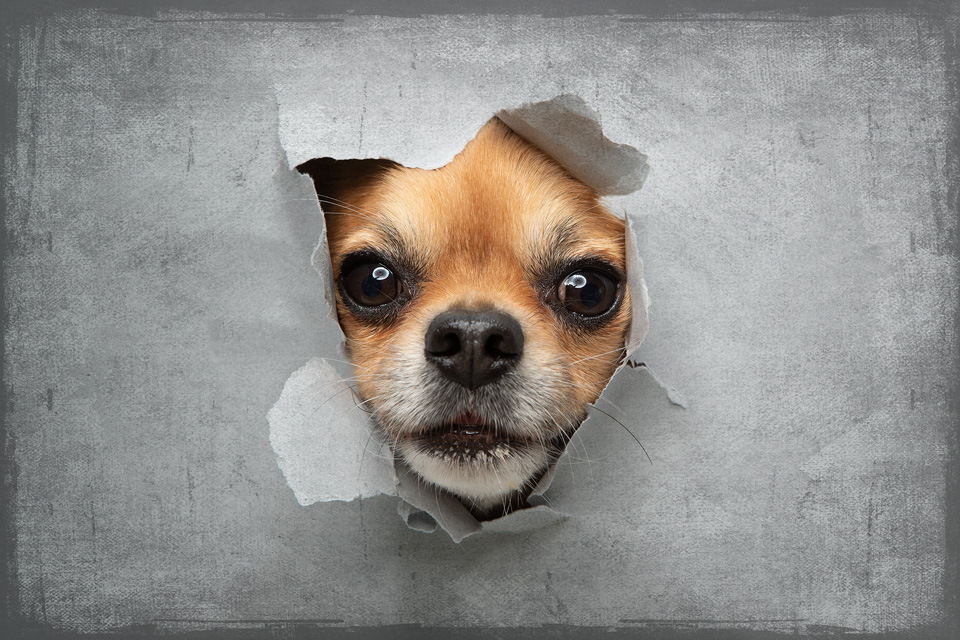
An enthusiastic dog has made a hole in your paper? Move away from the classic portrait and go for a fun head-through-the-paper photo! Success guaranteed, and lots of fun during the shoot while trying to get the dog to do it. With a treat on the right side, the dog will undoubtedly have a go at some point!
With small breeds, there are many possibilities for working with accessories. A bow, a flower wreath, a suitcase, hammock or fun chair? It does not have to be complicated or difficult, and it quickly adds some variety to your shoot.
Litters
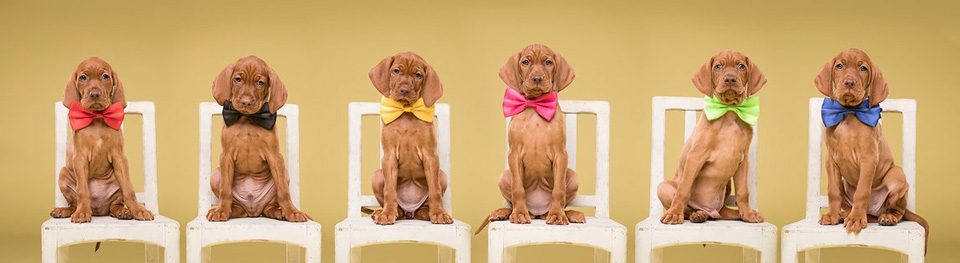
Breeders often want a photo of all the puppies together as a memento of their litter. In this case, Photoshop can be a useful tool. Photographing 10 puppies at once is a real challenge and can quickly cost you a lot of time. Photograph them separately and bring them together in Photoshop afterwards.
Do you have a litter where all the dogs look very similar? Ask the breeder beforehand to make an A4 sheet for each dog with its name on it. This is very useful for avoiding putting the same dogs twice in your group photo afterwards!
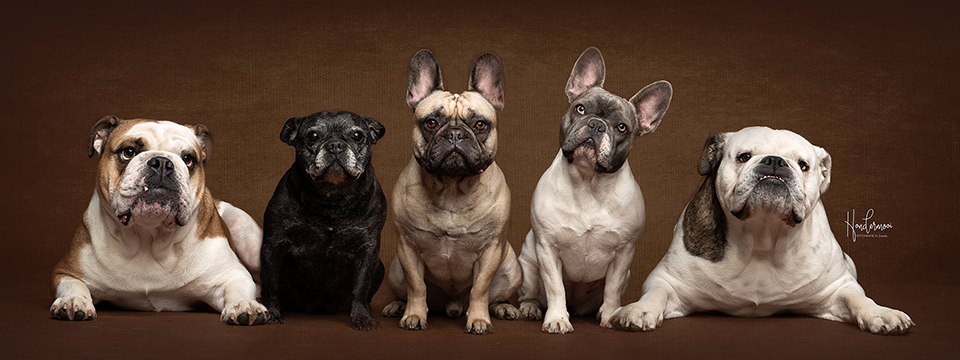
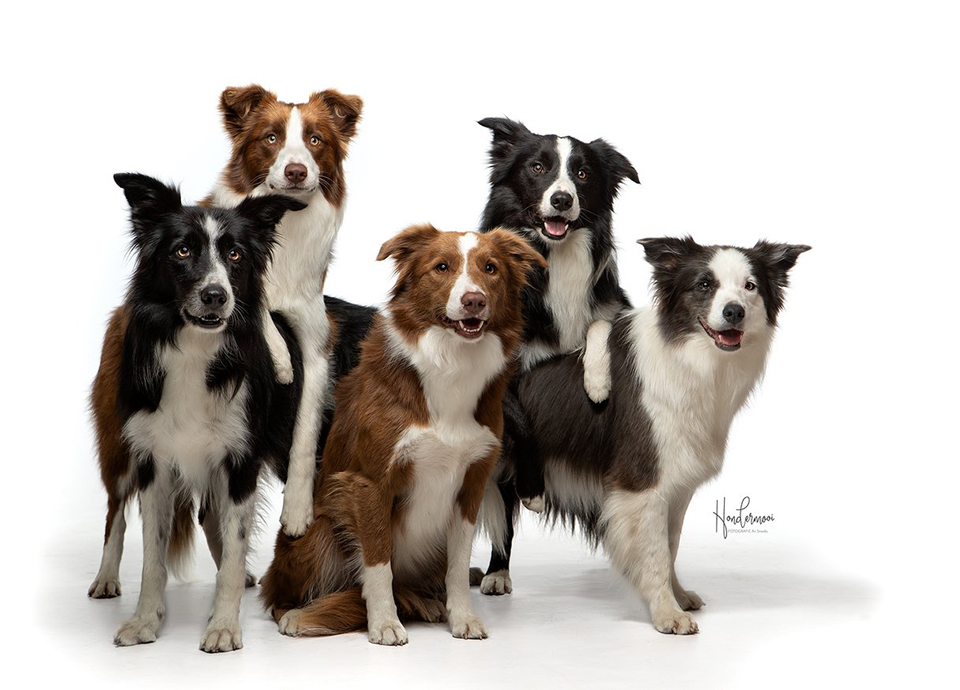
Multiple dogs
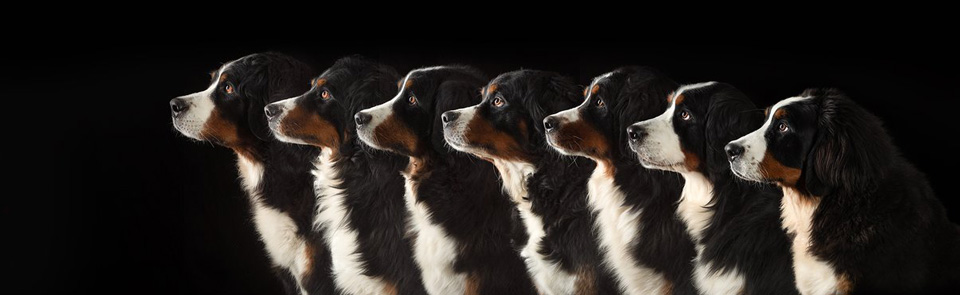
Owners often have several dogs that each have a place in their hearts, but that cannot always pose together easily. Photoshop can be a useful solution here too. Try taking an angled profile photo of each dog separately and combine them afterwards.
A striking effect and a group photo to please the owner, without them having to pose together. With some practice and experience, you can do this with a whole bunch of dogs!
Finally
Patience, calm and a big heart for dogs are the keys to success. Make it a challenge to “read” every dog and bring out the best in it that way. A hole in your paper, the occasional accident, a wet tongue in your face and lots of hair to clean up afterwards?
Ah well, embrace it with love and turn a blind eye now and then. What could be better than dog owners going home immensely proud because their beloved four-legged friend cooperated so well and will have a place of honour on the wall in their home!
About the author
An Smedts is hondenfotografe en gespecialiseerd in het fotograferen van huisdieren in de studio. Kleurrijke portretten met een speelse touch zijn haar handelsmerk. Elke maand maakt ze voor WOEF magazine een kleurrijke cover en ook voor workshops studiofotografie kun je in haar studio in Pellenberg (België) bij haar terecht.
You might also like
-
 5 Tips for Photographing Dogs
by Elja Trum
-
 Recreating a Room in Your Studio
by Elja Trum
-
 Editing a Dog Photo in Lightroom Classic
by Nando Harmsen
-
 5 Tips for Variety in the (Home) Studio
by Elja Trum
-
 Studio portraits with two flashes
by Elja Trum
-
 Using your garden as a portrait studio
by Elja Trum
9 comments
-
 Mia Wouters wrote on Monday 28 October 2019 at 22:13 | reply
Wat een mooi artikel Ann, ik heb er heel wat van opgestoken en kom nu met een nog geruster hart naar de shoot in november. pootje van loeka en imit.
This comment was written in another language and has not been translated yet. -

-
 Christiaan wrote on Tuesday 29 October 2019 at 10:25 | reply
Leuk artikel en mooie foto's, als Berner persoon vind ik de Berner foto erg mooi. Ben er zelf ook mee bezig als de tijd het toe laat, vooralsnog met eigen hond en die van mijn moeder.
This comment was written in another language and has not been translated yet.
Wat ik zelf merk is dat mijn honden maar een paar minuten geduld hebben om mee te werken. Ook als ze beloond worden. Hoe lang ben je gemiddeld met een hond bezig tijdens een studio shoot?
Onlangs een achtergrondsysteem gekocht met een zwart vinyl achtergrond. Achteraf denk ik dat papier beter was geweest, want ondanks het strijken van het doek blijf je vouwen zien.
Voor low key is er prima mee te werken, maar als je met een flitser en een gel de achtergrond een kleur wil geven is het resultaat (nog) niet je van het. Maar we blijven oefenen. -
 Robert Vogels wrote on Tuesday 29 October 2019 at 13:02 | reply
Leuk artikel An. Misschien nog een tip, denk om een lichtje in de donkere honden ogen. Anders worden het van die zwarte gaten in hun snoet.
This comment was written in another language and has not been translated yet.
Fotoschietgroeten Robert -
An Smedts wrote on Tuesday 29 October 2019 at 13:26 | reply
Dag Christiaan, met honden moet je inderdaad zo snel en efficiënt mogelijk werken, pupjes en oudere honden zijn snel moe en ook honden die in goede conditie zijn hebben het na een uurtje doorgaans wel gehad. Als je de hond in een soort "trainingsmodus" krijgt dan krijg je er meestal wat meer van gedaan op langere tijd.
This comment was written in another language and has not been translated yet.
Probeer eens een zwarte molton doek, met voldoende afstand tot de achtergrond zal deze pikzwart ogen en zal je niks van plooien zien. -
-
Robert Vogels wrote on Tuesday 29 October 2019 at 15:18 | reply
Is in jouw foto's prima An. Ik ' schoot' een keer een zwarte hond...en daar heb ik toen van geleerd.
This comment was written in another language and has not been translated yet.
Groet Robert -
 Lilian Verhappen wrote on Friday 1 November 2019 at 11:34 | reply
Wat een mooie foto's.
This comment was written in another language and has not been translated yet. -
Have your say
Please note: Articles older than a week can only be commented on by signed-in visitors.Would you still like to comment? sign in or create a free account.
Become a better photographer every week
A practical photography tip in your inbox every week.
39,013 photography enthusiasts already receive the tips! More about the weekly mail. Or keep up to date via  Facebook.

Elja Trum
Photofacts; everything to do with photography!
Would you like to take better photos and keep up with what is happening in photography? Photofacts publishes articles that teach you something about photography — from a product announcement to a practical shooting tip or a look at a website. Photofacts covers photography every day and is a hobby project of Elja Trum's that got out of hand. The articles are written by a team of volunteer authors. If you would enjoy writing one or more articles for Photofacts, do get in touch.More about PhotofactsPhotofacts is made possible in part by
