

Create creative stories with your macro lens
Wednesday 12 December 2018, 14:50 by Michelle Peeters | 31,192 views | 10 commentsThis article was translated from Dutch with the help of AI. Read the original.
Most people know macro photos as extreme close-ups of insects and flowers, showing every detail. Lovely pictures! But macro photography is much broader than just taking beautiful photos of insects and flowers.
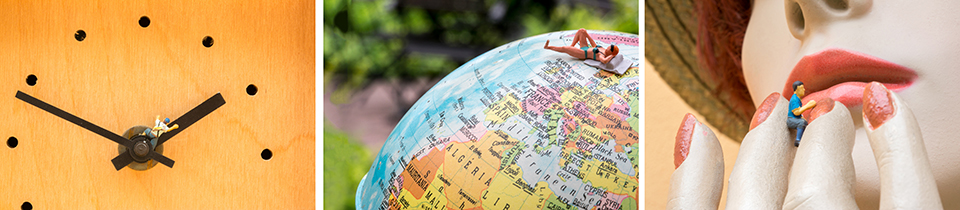
Everyday objects
To learn to 'see' potential subjects, you mainly need to train your creativity. Put your camera down for a moment and search online for photos that appeal to you.
And try looking at your surroundings differently. You only notice how obvious the objects around you seem once you start paying attention. You no longer even 'see' many objects, let alone consider them interesting photographic subjects.
Try experimenting with backlighting, silhouettes and abstract crops, so you definitely don't come home with 'ordinary' macro photos.
Pay attention to the background. An out-of-focus background quickly becomes a blur. A blur of one single colour is beautiful. But one with different colours and spots soon becomes distracting.
You probably hold a glass in your hands several times a day. But take a good look at that glass. See how the reflection and colour change as you move it. Look at all the everyday objects around you in your home, at the office, in the garden or as subjects in this way.
The trick is to want to see the possibilities and then photograph them in a way that amazes your audience.
Miniature figures
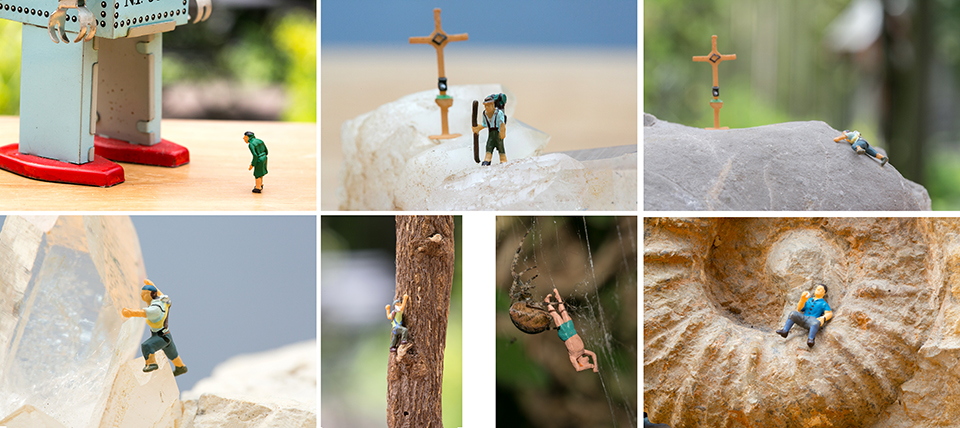
Using miniature figures is a fun way to create creative stories. The advantage of using them is that they don't move, so there is no hassle with shutter speeds. It also teaches you to look more creatively.
You can find subjects literally everywhere around you: from a Lego piece to a spoon, and from a ping-pong ball to the underside of a mushroom. The results are often spectacular and surprising.
Miniature landscapes
You can make it your speciality: miniature landscapes in your own garden. You can turn stones, grass and flowers in your back garden, studio or living room into a dramatic fantasy landscape. Sometimes it is impossible to distinguish them from the real thing.
But you can also create a fantasy landscape that you would not easily find in real life. There are countless possibilities for applying the 'reverse perspective effect', making something small appear very large, see further on in this article.
Aliens
Woodlice, bumblebees, flies and other insects often look very different in close-up than they do from an everyday perspective. Make dramatic use of this effect and photograph the little creatures as full-blown aliens.
Turn blades of grass and flowers into imaginative coloured trees, and stones into mountain ranges. Make snow-covered peaks with a cloud of icing sugar.
Making up a plot
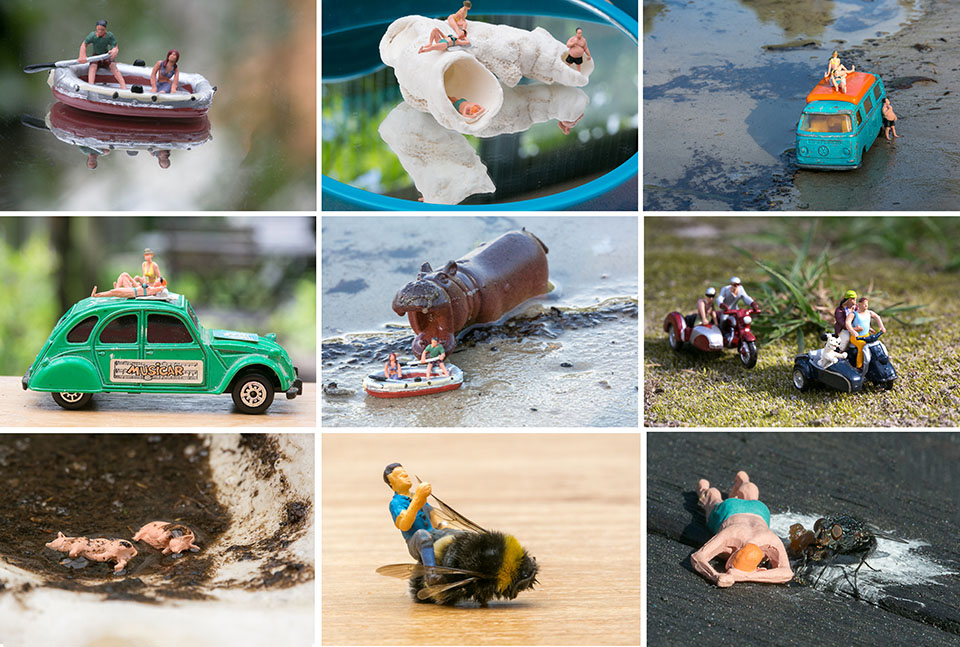
You can even tell entire visual stories with these miniature figures in your miniature landscapes, with or without insects or other living creatures. This creates a very strong surreal effect.
Unsuspecting paddlers being attacked by a hippopotamus, a fly seeing a tasty snack in a sleeping bather, a man trying to tame a bumblebee, a traveller getting caught in an enormous spider's web and then being encased by a huge cross spider.
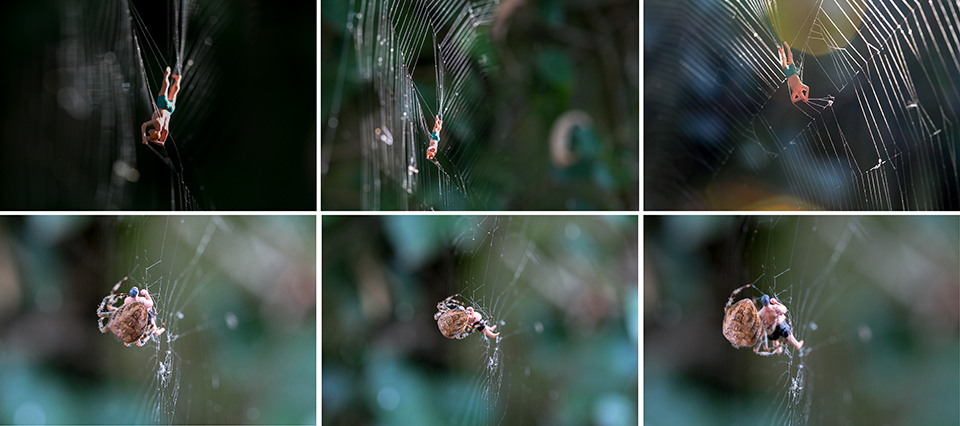
It is great fun to do, and just coming up with the plot for your photo is a joy. It is even more interesting to then work out your idea properly. You will have to solve quite a few problems with light, focus, composition and angle of view.
Tips for getting the technical side right follow below. The only limitation is your own creativity and perseverance. The result is always a unique photo that has never been made before!
Insanely shallow depth of field
Macro photography remains difficult, of course: the depth of field is often insanely shallow, sometimes only a few millimetres. That means working very carefully and using long shutter speeds to get sharp photos. Patience, planning and time are needed. There is no room for snapshots!
Always take a clothes peg with you when you go out to take macro photos. If a flower moves too much in the wind, you can secure the stem to another twig that you push into the ground.
Tripod
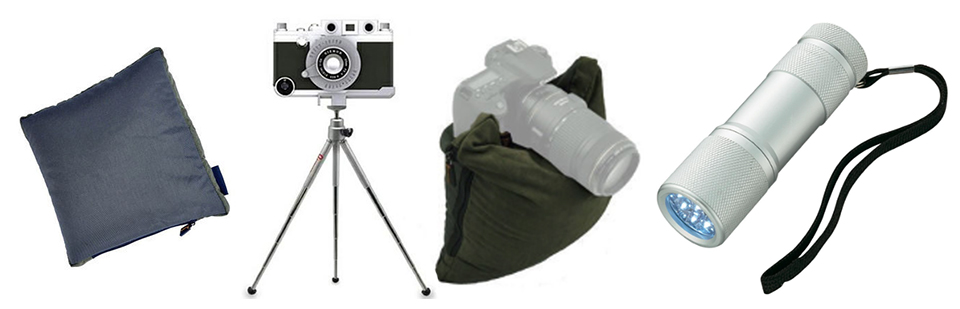
Because you are photographing tiny things from very close up, every millimetre you move forwards or backwards can put your subject out of focus. Your camera therefore has to remain completely still. In addition, the longer shutter speeds are always longer than expected.
For example, if you want the whole head of the fly to be sharp, you need to choose a smaller aperture. The result: motion blur. A tripod is therefore essential.
A beanbag is also a good alternative! Switch off stabilisation when using a tripod, otherwise you may still get blurred photos.
Extra light
Light is essential in macro photography. If there is too little light, use a torch, one with an LED works best. Or buy a daylight torch. This light is almost identical to daylight and is useful as an extra light source.
Experiment with the angle and strength of your light source. Light from the side, grazing light, shows the structure of your subject beautifully.
Reverse perspective
By playing with perspective, you can make small things appear very large, while showing large things as small. If you can focus reasonably close to a subject with your standard or wide-angle lens, you can already use this technique effectively in your photos.
Think of a close-up of a butterfly on a stone, with a tiny walker passing by in the background. Make sure your main subject is interesting enough!
You don't necessarily need a macro lens
If a macro lens is beyond your budget, you can also start with your kit or telephoto lens. These often have a very short minimum focusing distance nowadays, so they are reasonably suitable for close-ups.
Extension tubes
You can make subjects appear even larger in the frame by buying a set of extension tubes, hollow rings without glass that you place between your lens and camera. This increases the distance between your lens and the camera sensor, making the minimum focusing distance shorter.
So, with extension tubes, your camera sensor remains physically the same distance from your subject, but the subject appears much larger in the frame!
Where to buy the miniatures
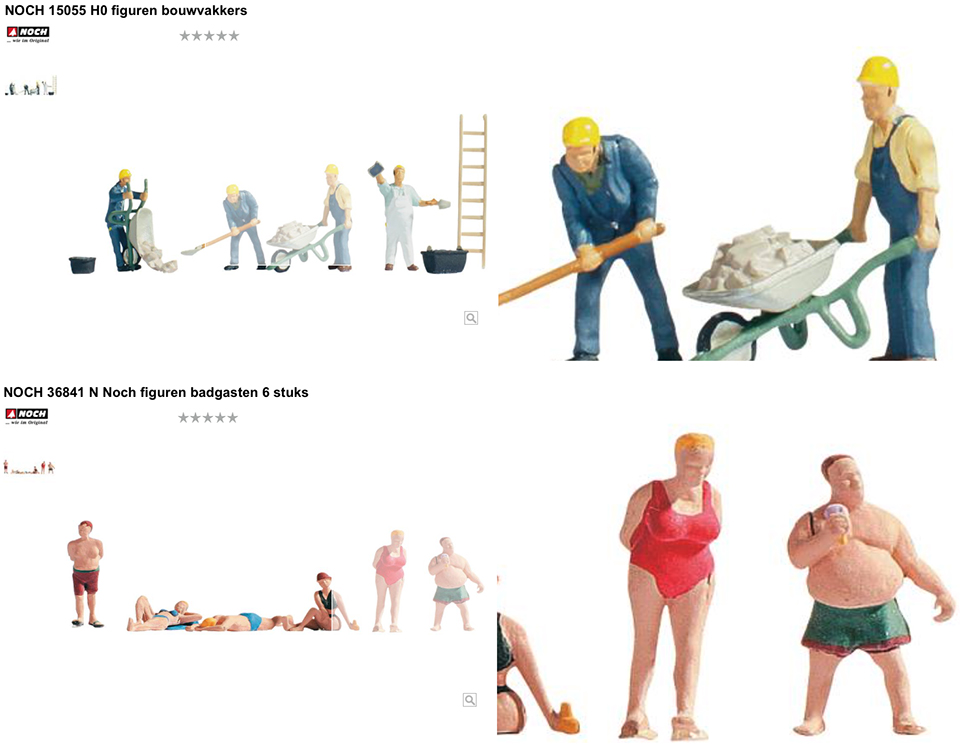
At Conrad you can buy all kinds of miniatures. Bathers, travellers, older passers-by, mountaineers, construction workers, you name it.
Slinkachu
The London street artist Slinkachu is a good source of inspiration. In 2006, he started his miniature spectacle Little People. Using his tiny figures, at a scale of 1:87, Slinkachu creates highly humorous dioramas.
The figures usually come from model railway kits. The project is about both placing the scenes and photographing them.
Miniature worlds that make your mouth water
Food photographers Pierre Javelle and Akiko Ida also use various tasty treats as scenery and miniature figures to create beautiful photos for the MINIMIAM series.
Through their lens and impressive imagination, Pierre and Akiko take you into landscapes of doughnuts, cakes, fruit, vegetables and even blobs of meringue mixture, along with the very happy miniature inhabitants, models at a scale of 1:87 bought from hobby shops.
The love car
Here is a fun video by Hernandez Dreamphography about how the 'Love Car' came about.
Macro photography course
Would you like to learn more about macro photography? Then you could take the macro photography course at Photofacts Academy, taught by Johannes Klapwijk.
You can follow this and other courses for two weeks with a free trial membership.
About the author
Michelle Peeters is fotografe en oprichter van DeuxBleus Fotografie. Michelle herkent het bijzondere in het gewone en het gewone in het bijzondere. Ze heeft zich nooit willen specialiseren en is daardoor van alle markten thuis.
You might also like
-
 How Much Macro Should You Choose?
by Nando Harmsen
-
 The Antique Steinheil München Macro-Quinar 100mm f/2.8
by Nando Harmsen
-
 Northrup on macro photography
by Michelle Peeters
-
 7 Tips for Macro Photography
by Mike Muizebelt
-
 Choose the right perspective
by Nando Harmsen
10 comments
-

 Guido Bellens wrote on Tuesday 28 March 2017 at 08:50
| reply
Wow, that video with the Fiat 500 is fantastic. This shows once again that there are practically no limitations, except your own imagination.
Translated from Dutch. -
 Michelle Peeters wrote on Tuesday 28 March 2017 at 11:38
| reply
You also have to be a little handy for that, right! But it is indeed fun to see what is all possible!
Translated from Dutch. -
 Mariël van den Bos wrote on Tuesday 28 March 2017 at 23:51 | reply
what a nice article!!
Translated from Dutch. -
 Huub wrote on Wednesday 29 March 2017 at 09:41 | reply
you can put all your creativity into this. Great fun to do.
Translated from Dutch. -
 Ole wrote on Wednesday 29 March 2017 at 16:07 | reply
Interesting to hear/read that people see this as a specific branch of photography where you can unleash all your creativity. Surely you can do that with anything over which you yourself have final say... Or do you see that differently?
Translated from Dutch. -
 Martine wrote on Wednesday 29 March 2017 at 17:18 | reply
I'm also working on photographing toy cars in the real world as my final project for module 3 basic photography. Quite a difficult subject because of getting the scale right. Getting the paving right isn't simple either. It requires a lot of inspiration (e.g. black sandpaper as asphalt). Still pretty cool to do.
Translated from Dutch. -
Michelle Peeters wrote on Wednesday 29 March 2017 at 20:04
| reply
@Martine: getting the exposure right, that really is the big challenge! Once you've figured that out, you're really well on your way. Good luck!
Translated from Dutch. -
 Andrea wrote on Wednesday 29 March 2017 at 20:50 | reply
What a super nice article.
Translated from Dutch.
I'm a fan of macro photography, but also of Slinkachu.
For the photography course, I also had to make a photo à la Slinkachu. It took a lot of time, but not as much as the photo of the Fiat.
Pretty cool that all of that is possible. -
Michelle Peeters wrote on Thursday 30 March 2017 at 14:27
| reply
@Andrea: I am quite curious about your Slinkachu photo. Quite a challenge. Did it turn out well?
Translated from Dutch. -
 DirkT wrote on Friday 31 March 2017 at 11:26 | reply
Very fun and informative article!
Translated from Dutch.
Have your say
Please note: Articles older than a week can only be commented on by signed-in visitors.Would you still like to comment? sign in or create a free account.
Become a better photographer every week
A practical photography tip in your inbox every week.
38,764 photography enthusiasts already receive the tips! More about the weekly mail. Or keep up to date via  Facebook.

Elja Trum
Photofacts; everything to do with photography!
Would you like to take better photos and keep up with what is happening in photography? Photofacts publishes articles that teach you something about photography — from a product announcement to a practical shooting tip or a look at a website. Photofacts covers photography every day and is a hobby project of Elja Trum's that got out of hand. The articles are written by a team of volunteer authors. If you would enjoy writing one or more articles for Photofacts, do get in touch.More about PhotofactsPhotofacts is made possible in part by
