

A fan of mushrooms and creepy-crawlies
Saturday 31 October 2020, 16:32 by Erik Nevels | 4,623 views | 4 commentsThis article was translated from Dutch with the help of AI. Read the original.
Autumn offers plenty of opportunities to enjoy using your camera in nature. Forests with beautiful autumn colours, misty landscapes, the last dragonflies, spiders in their webs covered in dewdrops. Plenty to choose from.
I am also a fan of mushrooms. Over the past few weeks, my mate and I have gone looking for them. And it turns out we are not the only fans. Insects can regularly be found on them. The icing on the cake for us!
The Munnichsbos and the Ravenvennen
We put our luck to the test in two beautiful nature reserves in central and northern Limburg, the Munnichsbos and the Ravenvennen respectively.
The Munnichsbos lies south of Sint Odiliënberg. The Vlootbeek meanders beautifully through it. It is an untouched forest where trees that have fallen, including several mighty beech trees, are not cleared away. It is only logical that woodpeckers, as well as many other animals, thrive here.
The Ravenvennen is a nature reserve north of Venlo, near Arcen, Velden and Lomm. Parabolic dunes, coniferous forests, heathland and pools characterise the area. The pools are an excellent habitat for all kinds of amphibians, such as the moor frog.
Mushrooms
Now that the weather has been rather damp in recent weeks, mushrooms are increasingly springing from the ground or from (dead) wood. Three weeks ago, we still had to search hard. Today, in the Munnichsbos, we soon stop to entrust the first mushrooms to our memory cards.
Modern architecture
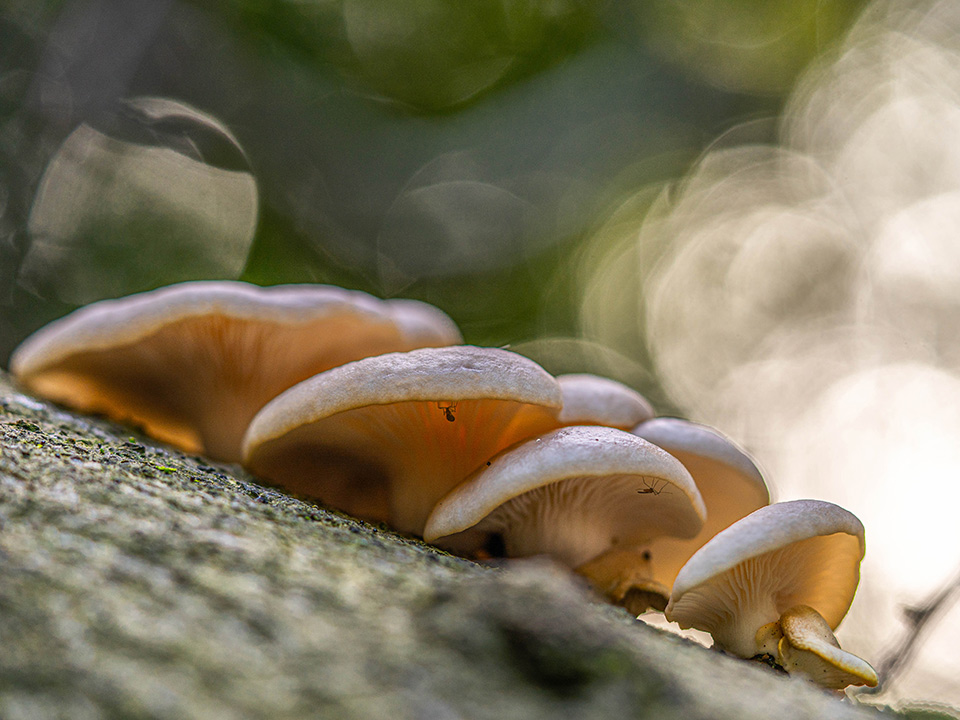
Groups of mushrooms are often found at the foot of (almost) dead trees or, as in the photo below, on a dead fallen trunk. They often remind me of modern buildings. As if an architect had gone wild with shapes, arrangement and colours.
First I look for a viewpoint from which the group looks good in the frame against an equally beautiful background. I work from a tripod and choose a low viewpoint, both to see the gills beneath the caps and because of the bokeh that becomes visible this way.
The bokeh here is caused by the light falling through the high canopy of the trees. By choosing an aperture of f/3.2, the bokeh bubbles become beautifully large and round. I focus on a point just behind the front of the middle mushrooms.
The fronts still need to be sharp, though. I check this by zooming in through the viewfinder or on your screen.
Because there is quite strong backlighting, the mushrooms almost become a silhouette in the viewfinder. Even so, I do not overexpose to prevent the white bokeh bubbles from becoming completely blown out.
I expect to be able to make the mushrooms visible in post-processing. I keep the ISO at 160 and the shutter speed becomes 1/100 second. The timer beeps and 'click'!
Ladybird
When I discover a giant bracket fungus with beautiful semicircular, fan-shaped caps at the foot of a large beech tree, I first take some photos of the whole fungus.
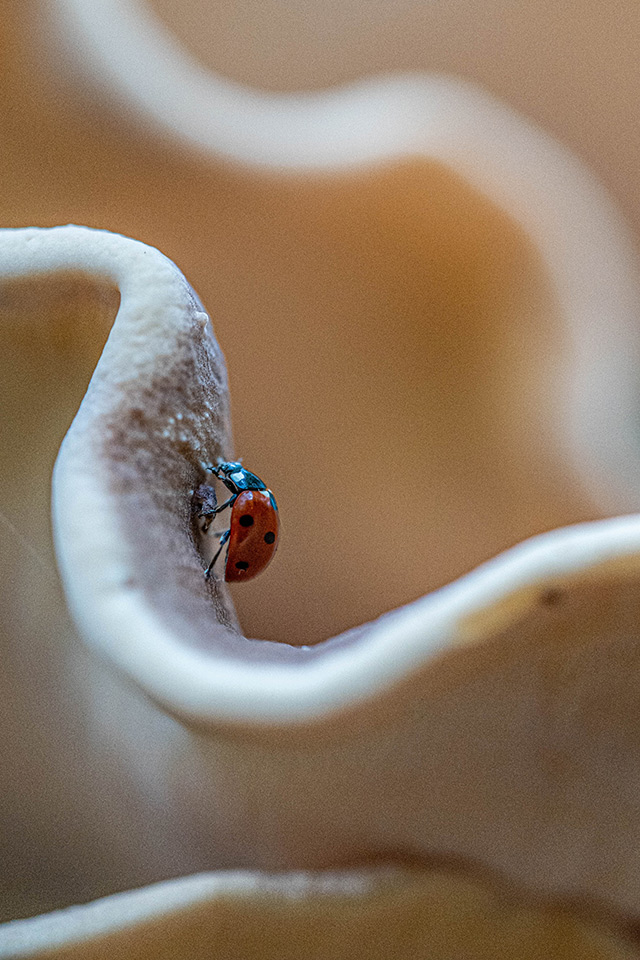
A good record shot, but I want to do something else with those beautiful shapes and move closer. Then I see a ladybird 'hurrying' across one of the caps.
How do I approach this? Because the little creature keeps changing position, I photograph it handheld. Autofocus on, spot metering, a sufficiently fast shutter speed to prevent motion blur and a wide aperture to let in as much light as possible.
And, not to forget, the image stabilisation switch set to 'on'. Despite the wide aperture, the ISO has to go up considerably.
My patience is put to the test. The creature seems determined not to walk where I would like it to. As soon as it does, I take several shots.
I am not happy with most of the photos, mainly because the animal's head is still out of focus, as I am inclined to 'stop down' my aperture. But the photo below rewards my patience after all.
Dump fly
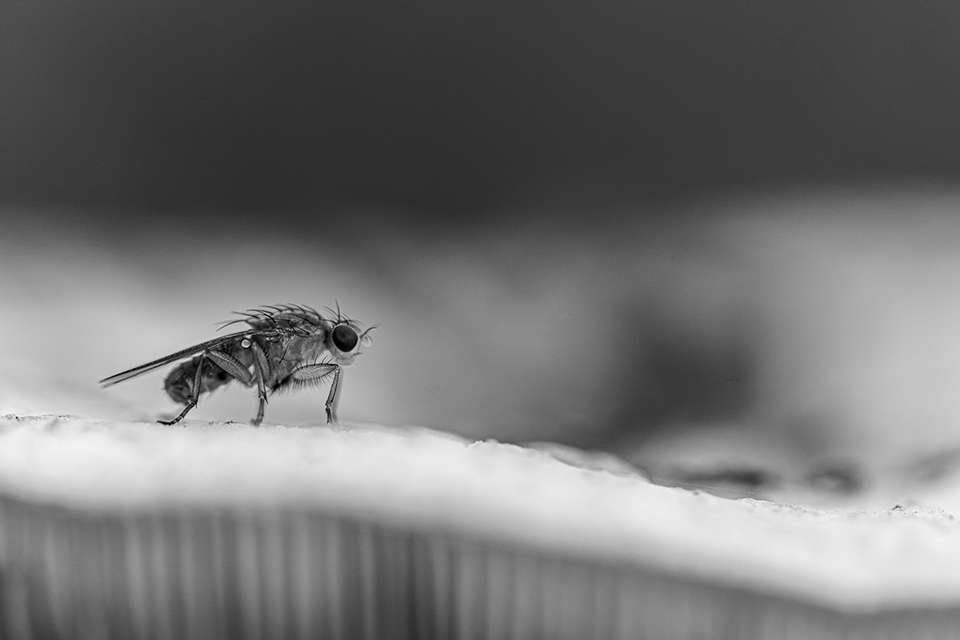
A week later, in the Ravenvennen area, I once again discover an insect on a mushroom. Unlike last week's ladybird, this fly is sitting still. It is a Suillia, which belongs to the dump fly family and can regularly be found on mushrooms in autumn.
Because this one stays very still and there is hardly any wind, I take the risk and set up the camera on my tripod. I compose the shot so that I have it exactly side-on in the frame.
I choose a wide aperture so that only the creature is sharp. Low ISO and therefore a slow shutter speed. I am lucky. The fly remains stoically in place. I can even take the time to zoom in on the image on my flip-out screen. Is the eye sharp?
When I view the shots large on my monitor at home, I enjoy the details of this special little fly. Beautiful in colour, but surprisingly attractive in black and white.
About the author
Steeds weer boeiend en op zoek naar de essentie! Dat is wat fotograferen in de natuur voor mij is. Gefocust op het landschap of het onderwerp in diens omgeving tracht ik meer dan alleen te registreren. Een continue uitdaging waarvan ik elke keer volop geniet. Meer foto's? Volg mij op Instagram en/of kijk op mijn website
You might also like
-
 12 tips for atmospheric autumn photography
by Laura van der Burgt
-
 10 tips for photographing mushrooms
by Nando Harmsen
-
 Autumn is coming again. Five ideas for photographing
by Nando Harmsen
-
Ideas for Photographing Mushrooms
by Nando Harmsen
-
 Photographing beautiful autumn colours in the forest
by Laura van der Burgt
-
 Creative with (Autumn) Leaves
by Laura van der Burgt
4 comments
-
 Robert wrote on Tuesday 3 November 2020 at 10:15 | reply
Niccce Erik. And what patience.
Translated from Dutch.
Robert -
 Jaap wrote on Tuesday 3 November 2020 at 11:49 | reply
I would have liked to see the color photo as well
Translated from Dutch. -

 Erik wrote on Tuesday 3 November 2020 at 17:26
| reply
Erik wrote on Tuesday 3 November 2020 at 17:26
| reply
@Robert.
Translated from Dutch.
Thank you Robert. It indeed often requires a lot of patience. But the times when it pays off do give a great feeling. -
Erik wrote on Tuesday 3 November 2020 at 17:36
| reply
@Jaap.
Translated from Dutch.
I understand that you want to see the colour photo Jaap (and perhaps more readers). That's why I had already thought of including it as a thumbnail photo in this blog. You can see this mini photo on the Photofacts / blog homepage. I'll also put it on my Instagram (erik.natuurfotografie), then you can view it a bit larger on your PC.
Have your say
Please note: Articles older than a week can only be commented on by signed-in visitors.Would you still like to comment? sign in or create a free account.
Become a better photographer every week
A practical photography tip in your inbox every week.
39,078 photography enthusiasts already receive the tips! More about the weekly mail. Or keep up to date via  Facebook.

Elja Trum
Photofacts; everything to do with photography!
Would you like to take better photos and keep up with what is happening in photography? Photofacts publishes articles that teach you something about photography — from a product announcement to a practical shooting tip or a look at a website. Photofacts covers photography every day and is a hobby project of Elja Trum's that got out of hand. The articles are written by a team of volunteer authors. If you would enjoy writing one or more articles for Photofacts, do get in touch.More about PhotofactsPhotofacts is made possible in part by
