

How do you photograph tree frogs?
Monday 28 August 2023, 22:11 by Erik Nevels | 4,481 views | 6 commentsThis article was translated from Dutch with the help of AI. Read the original.
They are cute little creatures, those tree frogs. They are also difficult to find. Once you have found them, that does not immediately mean you will get a good photo. This blog is about how you can achieve that.
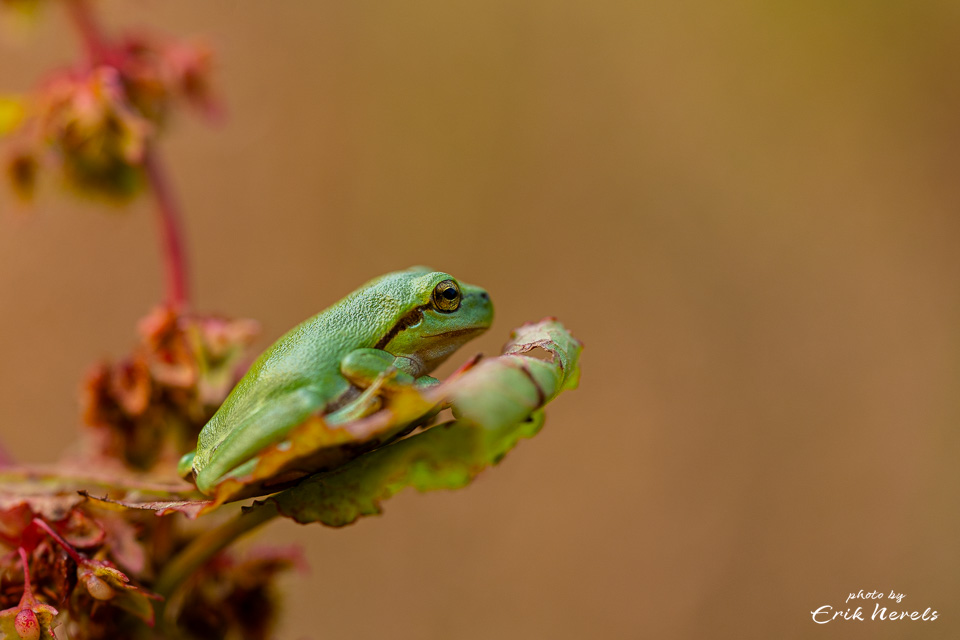
Species and distribution.
The European tree frog, with the Latin name Hyla Arborea, occurs across a large part of Europe. In our country, it is the only species found here. Looking at the distribution map, you can find tree frogs (roughly) in the south and east of the Netherlands and in some places along the west coast.
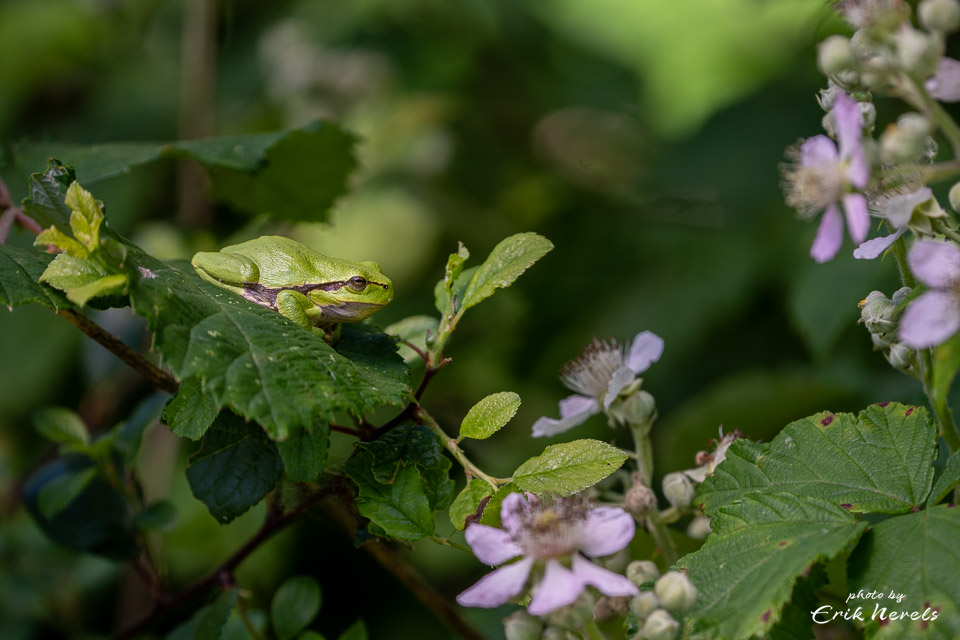
The little creature likes places where it can sit in the sunshine, especially on blackberry bushes. A damp environment near water is also important. Tree frogs grow to 4 to 5 cm, have smooth skin and are green.
Their feet are also striking, with adhesive discs on their toes. Their prey consists of insects.
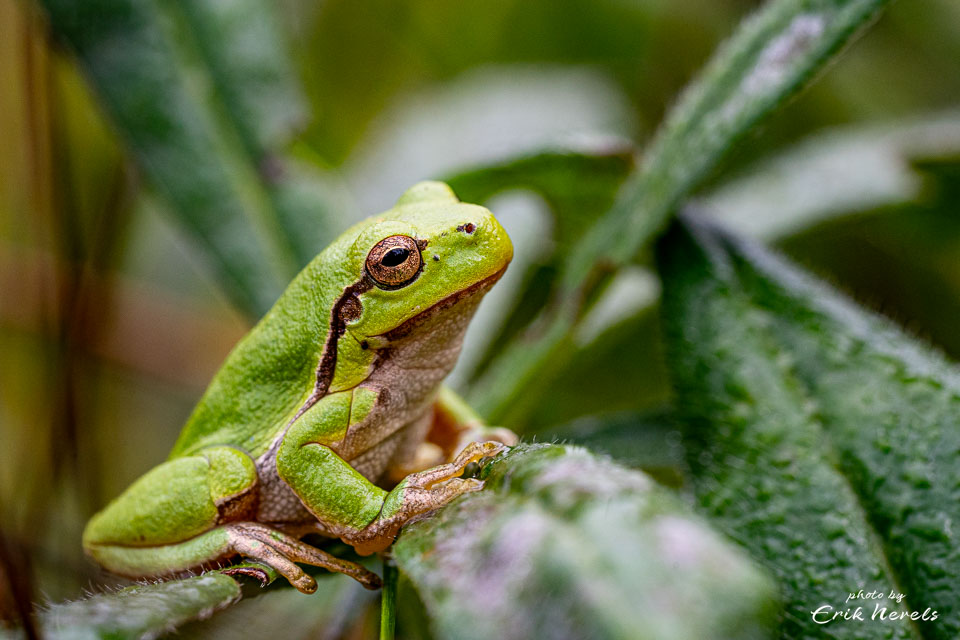
Looking for tree frogs.
If you know an area where tree frogs occur (take a look at waarnming.nl, for example), a sunny day gives you the best chance of success. Walking along the bushes, you will not spot them straight away.
Because they are small (especially the young ones), and sit on the green leaves of blackberry bushes with their green camouflage, it is easy to walk straight past them. Walk slowly and search carefully. If you have seen one, there are usually several nearby.
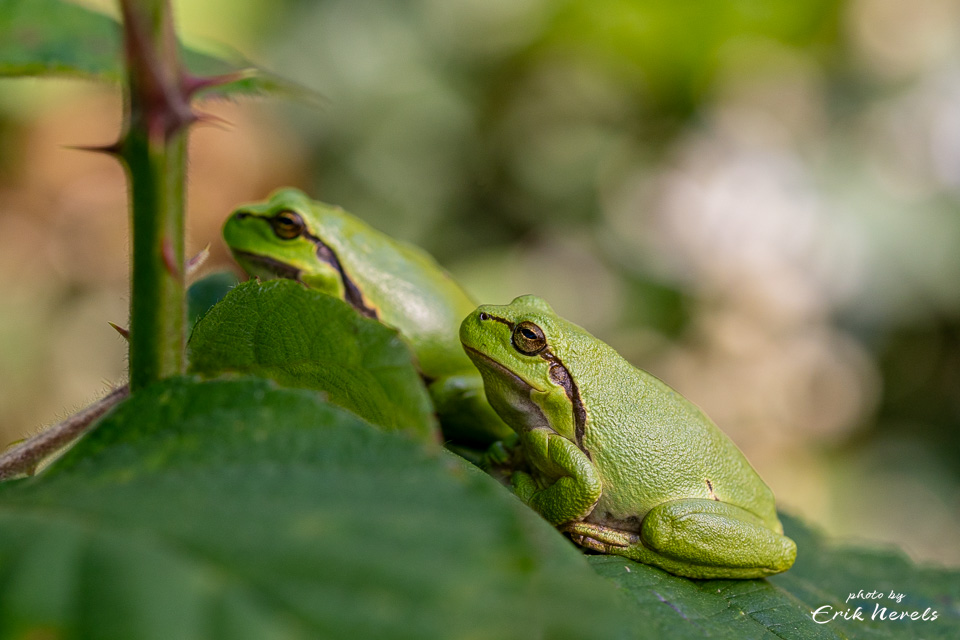
Endangered species.
The tree frog is an endangered species, so it is especially important that you do not disturb it. If you want to photograph one, make sure you do not move the bush it is sitting on.
So be careful not to step on branches or touch them with your arms or camera. As long as you do not do that, they will usually stay exactly where they are. Picking them up is definitely not done!
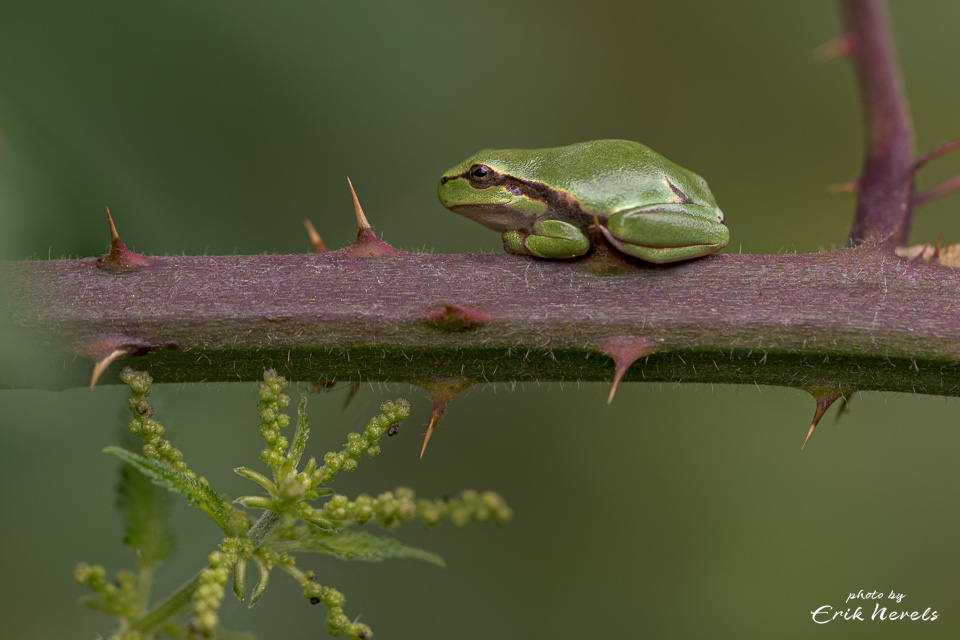
Sun worshippers.
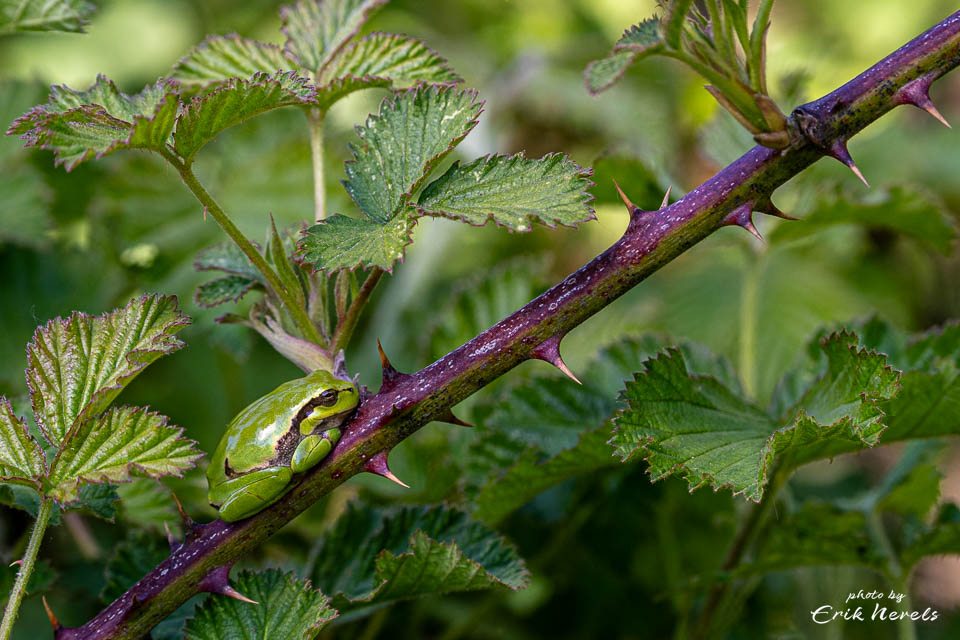
Tree frogs are true sun worshippers. They only emerge during the morning and look for a spot in full sunlight. They usually sit on a blackberry leaf, and sometimes on a branch surrounded by sharp thorns.
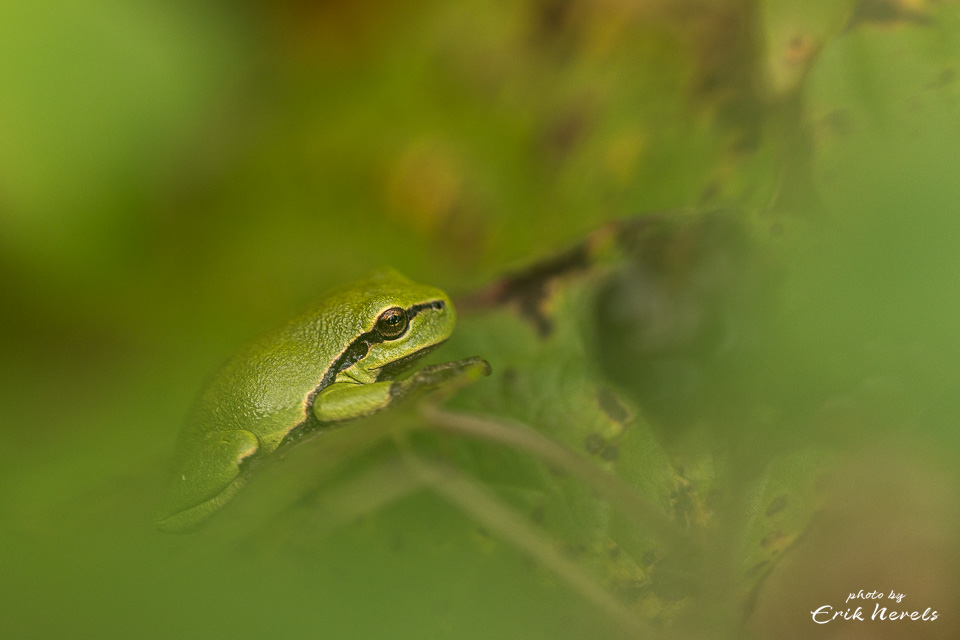
With their legs folded underneath their bodies, it is a question of whether they are sitting in a good position for an expressive photo. With their backs to you or too far away is much more common than, for example, climbing on a branch with their cute feet clearly visible.
So it is a matter of patience, careful searching and, of course, luck to come across an unusual pose.
Choosing a lens
You can actually photograph a tree frog with any lens or focal length. However, because they are so small, you need a macro lens or extension tubes to make them appear larger in the frame.
The immediate disadvantage is that you then have to get close, with the risk of disturbing them. If you have a telephoto lens, you can start with that. This allows you to keep more distance from the animal and photograph it in its surroundings. You can then switch to the macro lens afterwards.
Avoid overexposure
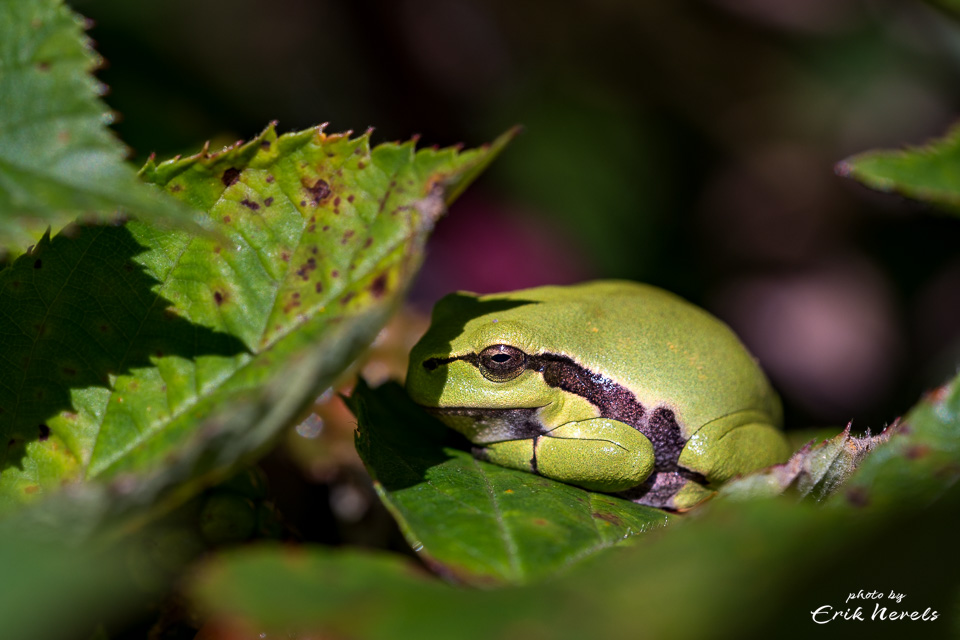
With tree frogs in bright sunlight, you need to watch out for overexposure. Their smooth, damp skin easily reflects the bright sunlight, quickly resulting in blown-out white patches even when the frog is otherwise perfectly exposed.
Without aids, however, this is difficult to prevent. You can wait for the sun to disappear for a moment, or make sure you put the frog in the shade. A small diffuser screen works best. It still lets some light through, but takes the edge off the harshest light.
A polarising filter can also help. This filters out the harsh light, provided that your viewing direction is (reasonably) perpendicular to the direction of the sun's rays.
Underexposing or spot metering.
Another way to partly prevent overexposure of the frog's skin is to underexpose heavily, especially if your light metering is set to cover a large part of the frame.
You can also use spot metering to base the exposure solely on the frog itself and minimise white patches. In both cases, the frog's surroundings will become darker, but this can partly be corrected in post-processing by lifting the shadows.
Handheld or tripod?
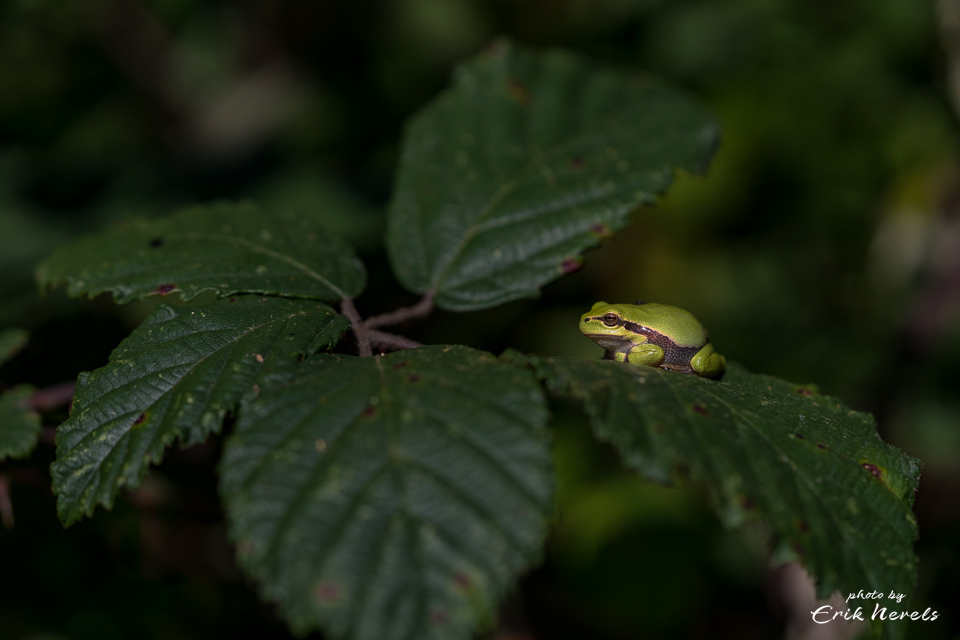
Working from a tripod is certainly fine if you have enough room for it. This sometimes works with a large telephoto lens. With a macro lens, rarely, because you then have to put at least one of the legs into the bushes, which is disastrous.
The movement this causes in the bush will usually disturb the frog and make it disappear. That is something you want to avoid.
In short, photographing them works best handheld. Stabilisation should be switched on and you need a sufficiently fast shutter speed. Depending on the desired depth of field, choose the aperture and the distance to the subject.
That leaves the ISO. Increase it if necessary.
About the author
Steeds weer boeiend en op zoek naar de essentie! Dat is wat fotograferen in de natuur voor mij is. Gefocust op het landschap of het onderwerp in diens omgeving tracht ik meer dan alleen te registreren. Een continue uitdaging waarvan ik elke keer volop geniet. Meer foto's? Volg mij op Instagram en/of kijk op mijn website
You might also like
-
 Ways to Photograph a Tree
by Nando Harmsen
-
 A tree fully in the frame? Or not?
by Nando Harmsen
-
 Photograph Through a Foreground for Atmospheric Macro Photos
by Nando Harmsen
-
 The sense and nonsense of a low viewpoint in landscape photography
by Nando Harmsen
-
 Nature photography tip: A forest is not a collection of trees
by Rob Dijkstra

6 comments
-
 Mariën Paul wrote on Tuesday 29 August 2023 at 16:09 | reply
Rarely have I seen such powerful images of the tree frog. Very beautiful to look at. Heartfelt congratulations
Translated from Dutch. -
 Francisco wrote on Wednesday 30 August 2023 at 08:54 | reply
Very beautiful shots. I wasn't able to capture them this well on my last vacation. I'll do something with the tips.
Translated from Dutch. -

 Erik wrote on Wednesday 30 August 2023 at 10:48
| reply
Erik wrote on Wednesday 30 August 2023 at 10:48
| reply
Thank you Francisco. Good luck!
Translated from Dutch. -
 Hans Stijntjes wrote on Wednesday 30 August 2023 at 09:39 | reply
Nice and informative story. Photographing tree frogs is my favorite, I have more than 100 of them. In my area there are many at a certain location. The shrubs are well maintained and provided with proper fencing in the spring. After about 2 months, there is nothing left of that fencing: everything is destroyed for the perfect shot. Are nature photographers also nature lovers?
Translated from Dutch. -
Erik wrote on Wednesday 30 August 2023 at 10:50
| reply
Thanks for your nice response. The answer to your question is obvious. Fortunately, all the nature photographers I know are also nature lovers and treat it with respect.
Translated from Dutch. -
Erik wrote on Wednesday 30 August 2023 at 10:47
| reply
Thank you Mariën Paul!
Translated from Dutch.
Have your say
Please note: Articles older than a week can only be commented on by signed-in visitors.Would you still like to comment? sign in or create a free account.
Become a better photographer every week
A practical photography tip in your inbox every week.
39,079 photography enthusiasts already receive the tips! More about the weekly mail. Or keep up to date via  Facebook.

Elja Trum
Photofacts; everything to do with photography!
Would you like to take better photos and keep up with what is happening in photography? Photofacts publishes articles that teach you something about photography — from a product announcement to a practical shooting tip or a look at a website. Photofacts covers photography every day and is a hobby project of Elja Trum's that got out of hand. The articles are written by a team of volunteer authors. If you would enjoy writing one or more articles for Photofacts, do get in touch.More about PhotofactsPhotofacts is made possible in part by
