

To stack or not to stack
Wednesday 29 December 2021, 20:02 by Erik Nevels | 5,114 views | 0 commentsThis article was translated from Dutch with the help of AI. Read the original.
The title for this blog came to me by analogy with William Shakespeare's line 'to be or not to be' from Hamlet. To stack or not to stack? The analogy here is purely about the English wording used to ask yourself a question of choice.
When it comes to my photography, the choice of whether or not to stack a photo depends on the key question: “Do I want the subject, or even the whole photo, to be sharp from front to back, or not?”
Focus stacking and depth of field
In my previous blog, sharpness, where do you place it and how deep, I explained, using a number of practical situations and photos, which choices of settings you can make.
One choice I did not cover was focus stacking. It is a way of increasing the depth of field in your photo. To do this, you take a series of photos focused at different points.
You then combine them in a computer programme such as Photoshop, stacking them into one photo in which all the sharpness from the series is brought together.
In practice
Until recently, I was not very experienced with focus stacking. I did not use it because I enjoyed, and still enjoy, the challenge of playing with a limited depth of field to make a striking photo, as I also show in my previous blog.
Sometimes, however, I noticed a little lack of sharpness once I got home and looked at the photos on my computer. A landscape that is just not quite sharp in the foreground or background, or a macro subject that deserves a little more sharpness without making the background too sharp.
Over the past few weeks, I have been experimenting with focus stacking more often, and it turns out to be precise work.
Landscape
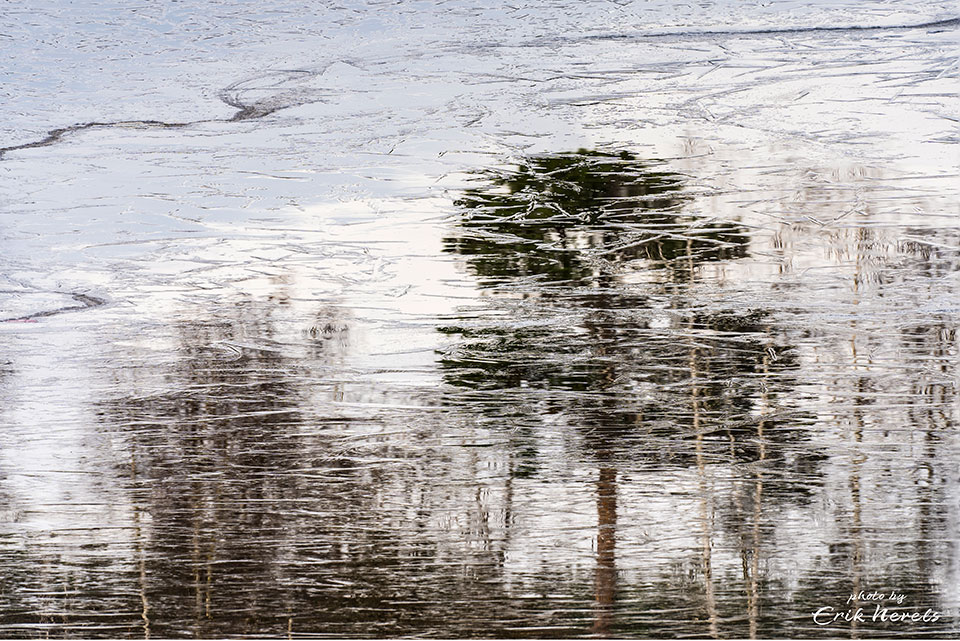
Hooray, it froze to five degrees below zero last night. I walk with my mate through one of our local patches, the Beegderheide. The pools are frozen and the thin layer of ice shows a maze of lines.
My attention is drawn to a long, large meandering crack and to the reflection of the trees and sky on the other side of the pool.
For the composition I want, I zoom in quite a lot to 209mm, and I remember from a similar attempt the previous week that I cannot get the ice sharp from front to back in a single exposure. I decide on a stack of three photos.
Camera on a tripod and focusing at f/11 on the foreground, the middle and finally the large crack in the top left. The stacked and 180-degree rotated result that appears on my computer later satisfies me. The maze is sharp and the reflection is beautiful.
Mushroom
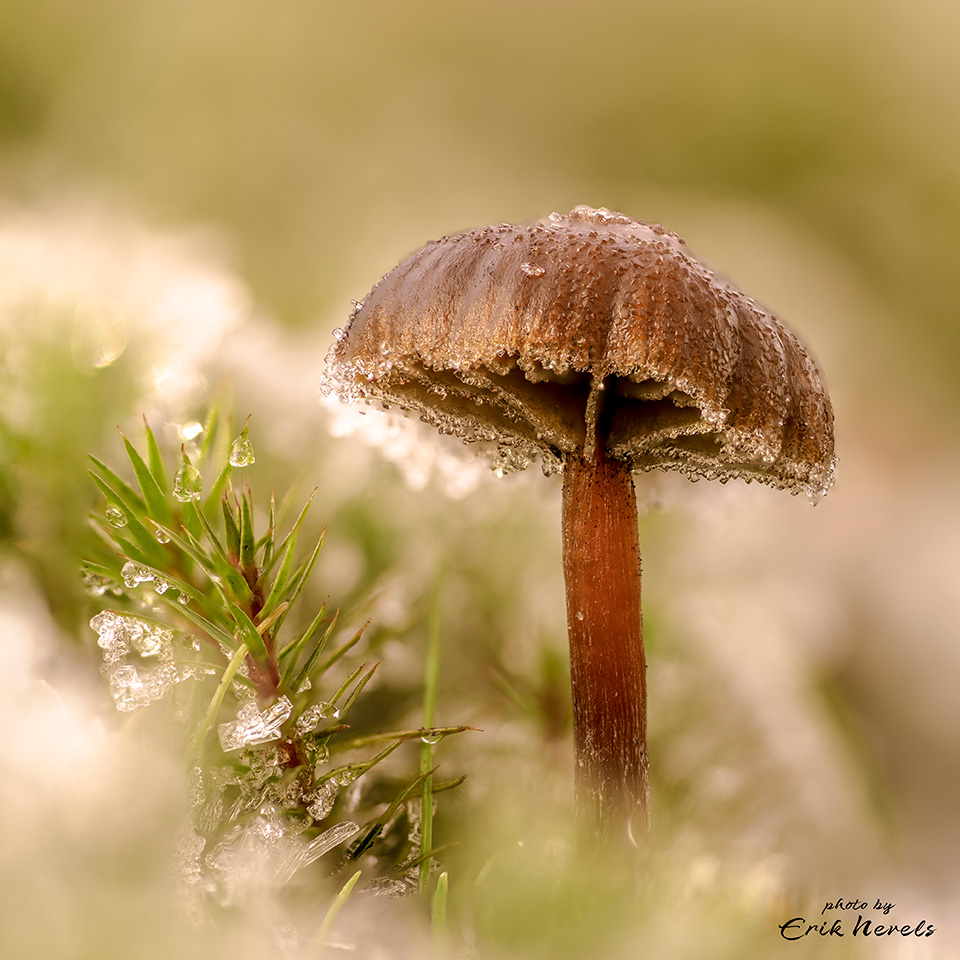
While the sun does its best to melt the frost from the mushrooms, I discover a lovely mushroom with strikingly large gaps between the gills underneath the cap. It deserves a photo quickly, before the frost disappears completely.
To get the gills completely sharp, I have no choice here but to use a photo stack. I also want to keep the busy foreground and background fairly blurred.
To achieve that, I choose an aperture of f/3.2 and realise that a good stack will require a lot of photos. First, I set up the camera properly on the tripod, decide on the composition and focus manually on the front of the cap.
Because I want to know afterwards where my stack series begins, I first take a photo with my finger in front of the lens. Then I start the series. For each following photo, I manually set the focus a little further back by turning the focus ring a fraction to the left.
I continue until I have the stem sharply in view. To be sure of getting the frost underneath completely sharp as well, I take a few extra photos with the focus even further back. I finish with a finger in front of the lens again.
In the end, the count reaches 22 photos, which I load into Photoshop as layers at home. When the programme eventually combines them into one layer, the image I had in mind appears. A sharp mushroom with a blurred background.
Ice miniatures
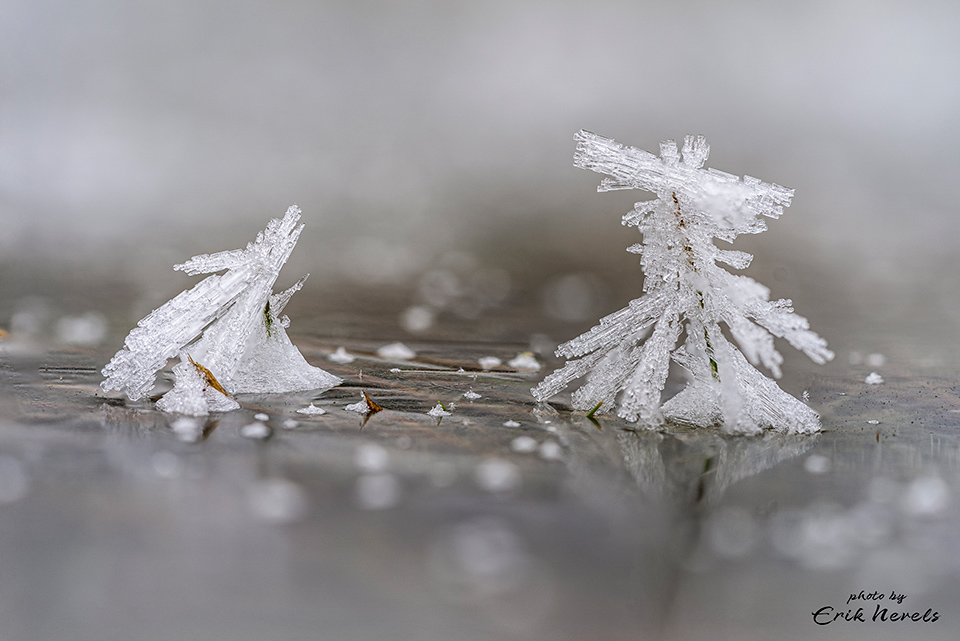
It can be even smaller. These miniatures of ice crystals make me kneel on two-day-old ice. It turns out to be sturdy enough, and I place my camera with macro lens on the ice. The miniatures are too high in the frame and I consider: 'Remove the L-bracket or put a stick under the lens'.
I cannot find a stick nearby, but a paper tissue turns out to be enough to raise the lens slightly. I focus on the frosted blades of grass, which, in my view, deserve to be completely sharp.
In this case too, even the smallest aperture of f/22 is not enough. So, just as with the mushroom, I work with a focus stack, but this time with an aperture of f/4.0.
This means I can make do with fewer photos and take a series of twelve. The background remains nicely blurred, and the little figures start to shine once stacked into one photo.
Precision work
You have to put some effort into focus stacking. It is precise work, and it is easy to make a mistake. Take steps that are too large when focusing, or have the focus of your first photo already too far back, and you will miss a bit of sharpness.
Just look at the last photo, or perhaps you have already noticed it. The figure on the right is not completely sharp at the front.
Especially considering the 'amount of work' in the field and behind the computer, the question remains whether focus stacking is worth the effort.
That is a personal choice, because what image do you want to make? I know that I do not want to go down the route of record shots, which the mushroom photo is leaning towards, for example. Still, when it freezes again, I will certainly return to the blades of grass on the ice.
About the author
Steeds weer boeiend en op zoek naar de essentie! Dat is wat fotograferen in de natuur voor mij is. Gefocust op het landschap of het onderwerp in diens omgeving tracht ik meer dan alleen te registreren. Een continue uitdaging waarvan ik elke keer volop geniet. Meer foto's? Volg mij op Instagram en/of kijk op mijn website
You might also like
-
 How does focus stacking work?
by Michelle Peeters
-
kopie.jpg "How reading fewer blogs and watching fewer YouTube videos improved my photography") How reading fewer blogs and watching fewer YouTube videos improved my photography
How reading fewer blogs and watching fewer YouTube videos improved my photographyby Frédéric Paulussen
-
 Which is better? Stacking or noise reduction?
by Nando Harmsen
-
 Not enough depth of field in your landscape? Use focus stacking.
by Nando Harmsen
-
 Focus stacking: experimenting is learning
by Juliette Gribnau
-
 Plug-in: Translating keywords, titles and captions in Lightroom
by Dick Holtman
0 comments
Be the first to share what you think!
Have your say
Please note: Articles older than a week can only be commented on by signed-in visitors.Would you still like to comment? sign in or create a free account.
Become a better photographer every week
A practical photography tip in your inbox every week.
38,981 photography enthusiasts already receive the tips! More about the weekly mail. Or keep up to date via  Facebook.

Elja Trum
Photofacts; everything to do with photography!
Would you like to take better photos and keep up with what is happening in photography? Photofacts publishes articles that teach you something about photography — from a product announcement to a practical shooting tip or a look at a website. Photofacts covers photography every day and is a hobby project of Elja Trum's that got out of hand. The articles are written by a team of volunteer authors. If you would enjoy writing one or more articles for Photofacts, do get in touch.More about PhotofactsPhotofacts is made possible in part by
