

(Almost) All Your Photos Will Disappear
Saturday 20 July 2024, 14:28 by Elvira Smit | 3,599 views | 7 commentsThis article was translated from Dutch with the help of AI. Read the original.
My grandmother has a shoebox containing her old photos. It is a manageable stack, and lovely to look through. But what will happen to our images? We take too many, keep everything and lose track. A recipe for misery.
Until the end of the 1990s, I had my film developed at Hema. I made a scrapbook with some of the photos. The remaining images are in a box within easy reach.
But then.
The digital revolution
At the start of 2000, I got a digital camera. One with just a few pixels. What followed was five years of digital photography that disappeared into the great unknown. Probably because of a crashed computer.
Anyway, from 2006 onwards I had images again, folders full of them. Those folders grow larger every year: it is not just the file size, the number of photos is also increasing. Ask me to find a specific photo and I will be occupied for hours. I have too many images, images without context.
Just like you, I reckon.
Most of your photos are probably on your laptop and phone. Perhaps you used to share your images on Hyves, then on Facebook, and now on Instagram. And soon on another platform. Maybe you even have a website to avoid all those platform moves, like I do.
Your images live digitally. If you print 1% of all your images, that is an enormous amount. You only look at most of the photos you take at the time itself.
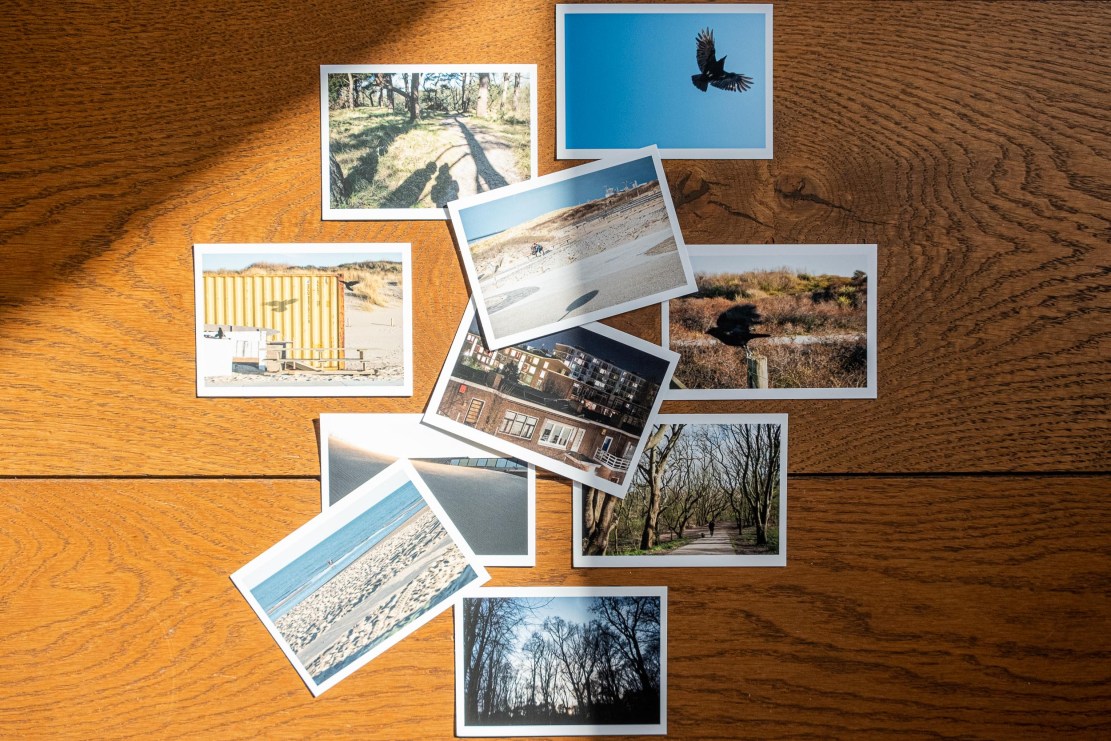
Search task
Try finding a photo from your 2013 holiday showing you with a travel companion. How long do you think it will take you? That says something about the state of your archive.
And if we cannot even make sense of our own mess of images, what are we leaving future generations with? All our images are full of context that only exists in our brains. Who is in the photo, and when and where the image was taken.
What you can do
There are, of course, ways to reduce the chance of being forgotten. Make something that looks valuable. Something that future generations would feel bad about throwing away.
Make a beautiful printed book, scrapbook or frame a photo. Write on the back what it is, where it is and, above all, who is in it.
Or simply come to terms with the fact that everything is temporary, and that your images only have real value to you. Some of them, anyway. Even then, the same applies: make something of them.
Scroll through your archive, pick out the gems and learn about your own photographic preferences at the same time if you play this game.
What remains of my images
I have no illusions about it: I think all my images will disappear. I would even say that the photos in my grandmother's shoebox have a greater chance of surviving than my entire digital archive, which grows by around 10,000 photos every year...
About the author
Ik heb een eigen fotografieblog, Kronkeling. Daar schrijf ik om de week twee artikelen. Over hoe je je blik kunt scherpen, je creativiteit kunt aanwakkeren, en over fotografen die mij inspireren. Geen technische zaken, wél over hoe je leert kijken. En dat blijkt nog een hele klus. Een mooi startpunt zijn de Kronkeltips, die vind je hier.
You might also like
-
 All your photos will disappear (yes, really)
by Elvira Smit
-
 The pros and cons of a backup camera
by Nando Harmsen
-
 To stack or not to stack
by Erik Nevels
-
 Photo archive on an M.2 SSD drive
by Elja Trum
-
 What happens to our photos when we're no longer here?
by Nando Harmsen
-
 Which is better? Stacking or noise reduction?
by Nando Harmsen
7 comments
-
 Paul van Aken wrote on Tuesday 23 July 2024 at 23:03 | reply
Recognizable story. I myself have (almost) always kept my photos by year, even back in the analog days. All the negatives in albums by date. When I went digital I continued doing that, if I had few photos in a year 1 folder, otherwise by month, or by vacation.
Translated from Dutch.
Your example is therefore a piece of cake for me, turn on the PC, go to the drive with photos (an entire drive indeed) and then to the requested year.
Works fine for me, I have stored all my negatives and slides in the same way (scanned), so I can find everything from 1962 to 2024 again in no time. -
 Stefanie wrote on Wednesday 24 July 2024 at 10:19 | reply
I also have everything organized by year and description, and the individual in-between photos with the description 'miscellaneous'. In those, it sometimes takes a bit of searching, but never too long. I already made photo books of holidays and family celebrations, and have now also started making books of my other photo projects. For me, it's also much more fun to look back at them again
Translated from Dutch. -

 Elvira Smit
wrote on Wednesday 24 July 2024 at 10:43
| reply
Elvira Smit
wrote on Wednesday 24 July 2024 at 10:43
| reply
@Paul van Aken: Wow, that must feel great, to really have an overview of your photo archive. It shows how important it is to start with a clear system. After that, it's simply a matter of continuing to follow your own system. Amazing that you can go all the way back to 1962!\n\n@Stefanie: how great that you make photo books! The printed form of a photo (loose or in a book) still makes the biggest impression on me. And looking through a photo book together is simply more fun than sitting together behind a screen
Translated from Dutch.
-
 Erika Blok wrote on Wednesday 24 July 2024 at 10:40 | reply
Our photos are also stored by year and by holiday on an external hard drive. Then once again on another external hard drive that is kept in the shed. In the event of a fire, the chance that you will lose everything is then small.
Translated from Dutch.
My husband makes AV presentations from our holiday photos, which are also stored by year and by location on the external hard drives.
Wonderful to look back again on a winter evening and enjoy all the beautiful things we have seen.
Sometimes also with family or friends and acquaintances who also really enjoy watching this.
If you want more information about AV presentations, take a look at the NVBG (Dutch association for image and sound) website -
 spaander
wrote on Wednesday 24 July 2024 at 11:17
| reply
spaander
wrote on Wednesday 24 July 2024 at 11:17
| reply
I have divided my photo archive into (year) folders and subdivided those into month folders. The month folders may also contain folders for specific occasions. This way, photos can be found relatively quickly. In addition, I rename all my photos with the date and sequence number. So I can already tell from the photo's filename when it was taken. Edited photos also get a letter so they are recognizable too.
Translated from Dutch. -
 Gerda Roelofs Barreveld wrote on Wednesday 24 July 2024 at 15:52 | reply
I have my photos in Lightroom. In it, I can tag people and therefore also find them again. Add tags and search by date.
Translated from Dutch. -
Elvira Smit
wrote on Thursday 25 July 2024 at 14:52
| reply
@Erika Blok: nice, projection evenings. Good tip!
Translated from Dutch.
@spaander: sounds like a watertight system. I also use the year-month-special occasions, but not the extra letter for an edited photo. Nice to read.
@Gerda Roelofs Barreveld: Yes, that is of course also pretty smart: have Lightroom help search for specific people
Have your say
Please note: Articles older than a week can only be commented on by signed-in visitors.Would you still like to comment? sign in or create a free account.
Become a better photographer every week
A practical photography tip in your inbox every week.
39,024 photography enthusiasts already receive the tips! More about the weekly mail. Or keep up to date via  Facebook.

Elja Trum
Photofacts; everything to do with photography!
Would you like to take better photos and keep up with what is happening in photography? Photofacts publishes articles that teach you something about photography — from a product announcement to a practical shooting tip or a look at a website. Photofacts covers photography every day and is a hobby project of Elja Trum's that got out of hand. The articles are written by a team of volunteer authors. If you would enjoy writing one or more articles for Photofacts, do get in touch.More about PhotofactsPhotofacts is made possible in part by
