

Photographing a common blue butterfly at 't Ham
Sunday 4 October 2020, 16:32 by Erik Nevels | 4,196 views | 5 commentsThis article was translated from Dutch with the help of AI. Read the original.
Over the past few weeks, the change in the weather has really made itself felt. Temperatures dropped sharply and it even rained again!
And with that change come different plans for our photography day. Mushrooms are high on our list. Or are we being too optimistic about our plan for today?
We? That's my photography mate and me, both keen nature photographers. Every week, we head out together for half a day, or longer, to a nature reserve in our region, Central Limburg. In my blogs for Photofacts.nl, I'll report on our photography adventures.
't Ham
Today I'm going to 't Ham with my mate, a beautiful and varied nature reserve near Horst, Limburg. Just like last week, our plan is to look for mushrooms. We hope to find some now that it has rained over the past few days.
As soon as we start walking, we see another photographer, Piet, at work. The goldfinches are flying back and forth, making a lively subject for his camera. My mate knows Piet, who knows the area very well.
When we ask whether there are already any mushrooms, the answer is a lukewarm 'yes'. He has already seen parasol mushrooms and is willing to walk with us to the meadow where they are growing.
On the way, he tells us about 'his' area, while continuing to observe and occasionally clicking his camera. Our cameras are still in our backpacks, since we are here for the mushrooms.
Plan changed
We soon arrive in the intended meadow. 'If we keep walking along this edge, we'll probably see another small copper,' our guide tells us. 'It's still early and they don't want to fly yet. And they're only here because they are less bothered by the wind here.'
After about 100 metres, we get lucky. 'There's one!' At first I can't see it, no matter how hard I look. But then my eyes stop searching too, and I have the little butterfly in my sights. It turns out not to be a small copper, but a common blue butterfly.
It's wonderful how small and delicate it is, blending into its surroundings. We abandon our original plan and I focus on the little creature, partly because neither of us is particularly enthusiastic about parasol mushrooms among the grass.
Backlight or front light
First, I make sure to memorise the stem the butterfly is sitting on by scanning the surroundings and remembering anchor points. It wouldn't be the first time that I unpack my gear and can no longer find the subject.
I attach my camera to my tripod and get to work. The only question is whether to work facing the rather bright sun or with the sunlight behind me. I decide on backlighting and an aperture of f/6.3 or f/7.1, because I want both the head and the wings to be sharp in the image.
Incidentally, this is the first time I've worked with a tripod with a tilting centre column. And it turns out to be much more user-friendly for this kind of macro work than a standard one. I can position my camera accurately where I want it surprisingly quickly.
Windbreak
Because the wind is making things difficult, I decide to use my reflector to keep the butterfly out of the wind a little. It helps, but it also has an 'additional' effect. The screen does what it is meant to do, reflect light.
This puts the butterfly nicely in the light. To prevent motion blur caused by the gusty wind, I increase the ISO to 1,000, giving me a shutter speed of 1/8,000s.
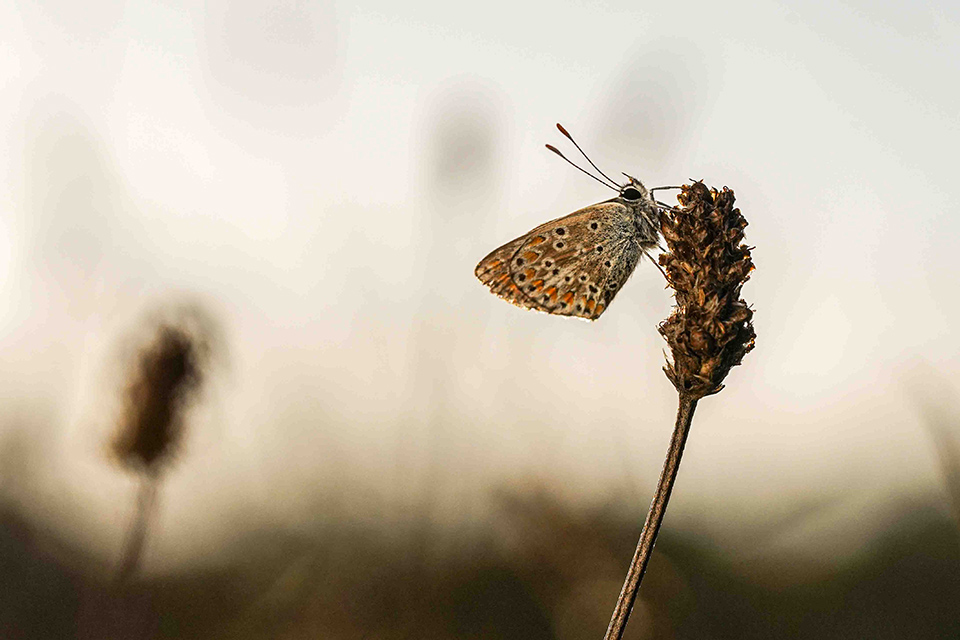
Front light, with a diffusion screen
I make room for my mate, who also wants to photograph the butterfly, which is still posing patiently. On Piet's advice, I have a go at photographing a young parasol mushroom, but it doesn't come close to the butterfly, so I go looking for another small copper.
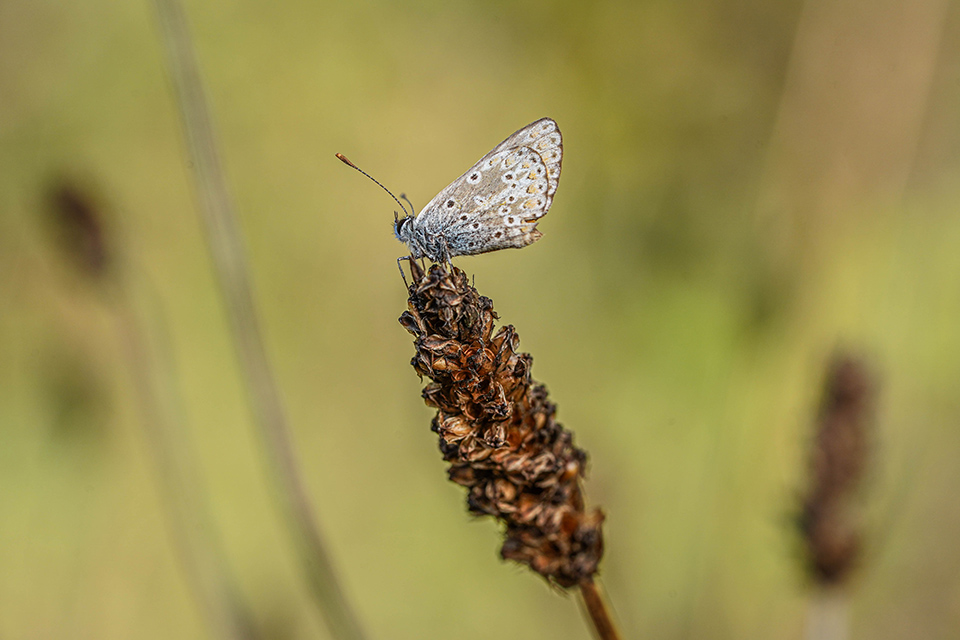
I find one in the shelter of the border, as practice makes perfect! This one is sitting beautifully too, and I decide to photograph it with front light this time.
I carefully position my tripod and manage to get the camera back into the right position quickly. Less of a close-up, with more of the surroundings. The butterfly is now in bright light, so I use a diffusion screen to soften the strong sunlight.
The wind is helping too, as it is less strong, so I lower the ISO to 400. By 'sliding' the camera around, I try to get an interesting background in the image.
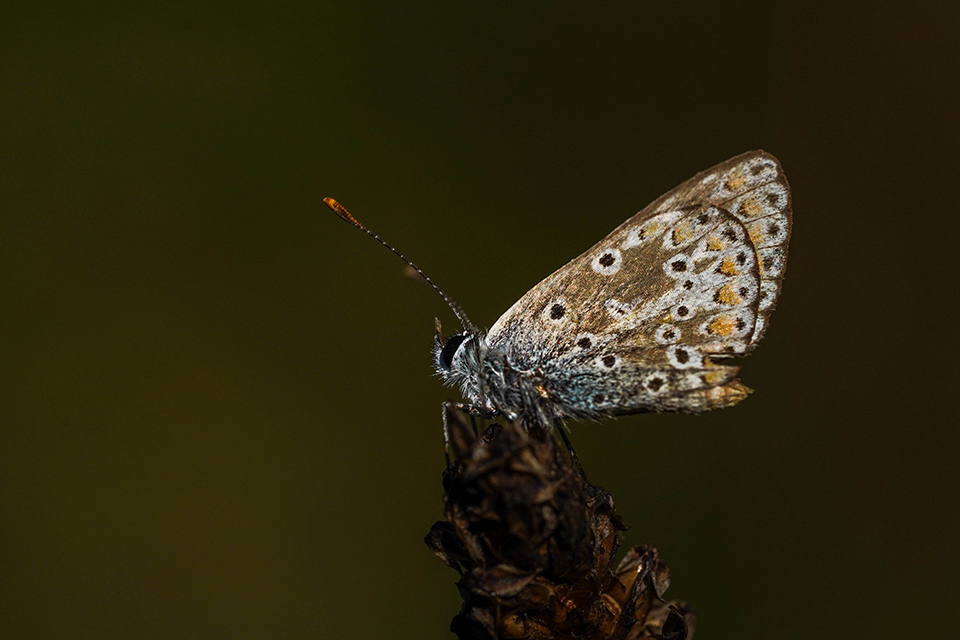
Underexposing by 2 stops
My mate suggests that I try underexposing heavily, which will make the background dark. I think to myself that it's a good idea to consider doing that more often. With the control dial set to -2 stops, I can immediately see the result in my viewfinder.
About the author
Steeds weer boeiend en op zoek naar de essentie! Dat is wat fotograferen in de natuur voor mij is. Gefocust op het landschap of het onderwerp in diens omgeving tracht ik meer dan alleen te registreren. Een continue uitdaging waarvan ik elke keer volop geniet. Meer foto's? Volg mij op Instagram en/of kijk op mijn website
You might also like
-
 Photographing butterflies with morning dew
by Erik Nevels
-
 Capturing the Blue Hour with Your Phone
by Elja Trum
-
 Try photographing in bad weather
by Elvira Smit
-
 Stormy weather is the best ingredient for landscape photography
by Nando Harmsen
-
 Bird photography? Don't forget the common species.
by Nando Harmsen
-
 Street photography tip: Go out when it rains
by Michiel Heijmans
5 comments
-
 JG wrote on Tuesday 6 October 2020 at 12:34 | reply
Very good explanation of how camera settings work, read many books. This is the first time that a result is generated with text and explanation.
Translated from Dutch. -
 Bertus wrote on Tuesday 6 October 2020 at 12:52 | reply
Fire butterfly?
Translated from Dutch.
You mean Icarus blue? -
 Marc wrote on Tuesday 6 October 2020 at 16:40 | reply
Bertus you're right, I was a bit startled too.
Translated from Dutch. -

 Erik wrote on Friday 9 October 2020 at 11:29
| reply
Erik wrote on Friday 9 October 2020 at 11:29
| reply
@JG
Translated from Dutch.
Thank you JG for your positive response! I hope it inspires you with your photography. -
Erik wrote on Friday 9 October 2020 at 11:31
| reply
@Bertus and @Marc
Translated from Dutch.
Thank you for your attentiveness. It is indeed a common blue in the photos.
Have your say
Please note: Articles older than a week can only be commented on by signed-in visitors.Would you still like to comment? sign in or create a free account.
Become a better photographer every week
A practical photography tip in your inbox every week.
39,079 photography enthusiasts already receive the tips! More about the weekly mail. Or keep up to date via  Facebook.

Elja Trum
Photofacts; everything to do with photography!
Would you like to take better photos and keep up with what is happening in photography? Photofacts publishes articles that teach you something about photography — from a product announcement to a practical shooting tip or a look at a website. Photofacts covers photography every day and is a hobby project of Elja Trum's that got out of hand. The articles are written by a team of volunteer authors. If you would enjoy writing one or more articles for Photofacts, do get in touch.More about PhotofactsPhotofacts is made possible in part by
