

Photographing butterflies with morning dew
Sunday 2 May 2021, 13:31 by Erik Nevels | 6,185 views | 6 commentsThis article was translated from Dutch with the help of AI. Read the original.
Today, as forecast, the weather conditions are on our side. Almost no wind, sunshine and dew. My friend and I have arranged to meet in the 't Ham nature reserve near Horst in North Limburg.
We are looking for the orange-tip, a beautiful day-flying butterfly that can mainly be seen from April to June when the weather is warm enough.
Everything ready
At half past seven I park my car at 't Ham, collect my gear and walk into the area. My friend arrived earlier and points me towards 'the second field' by phone.
She has also already found two orange-tips. So I am walking towards a well-prepared setup.
Cuckoo flowers
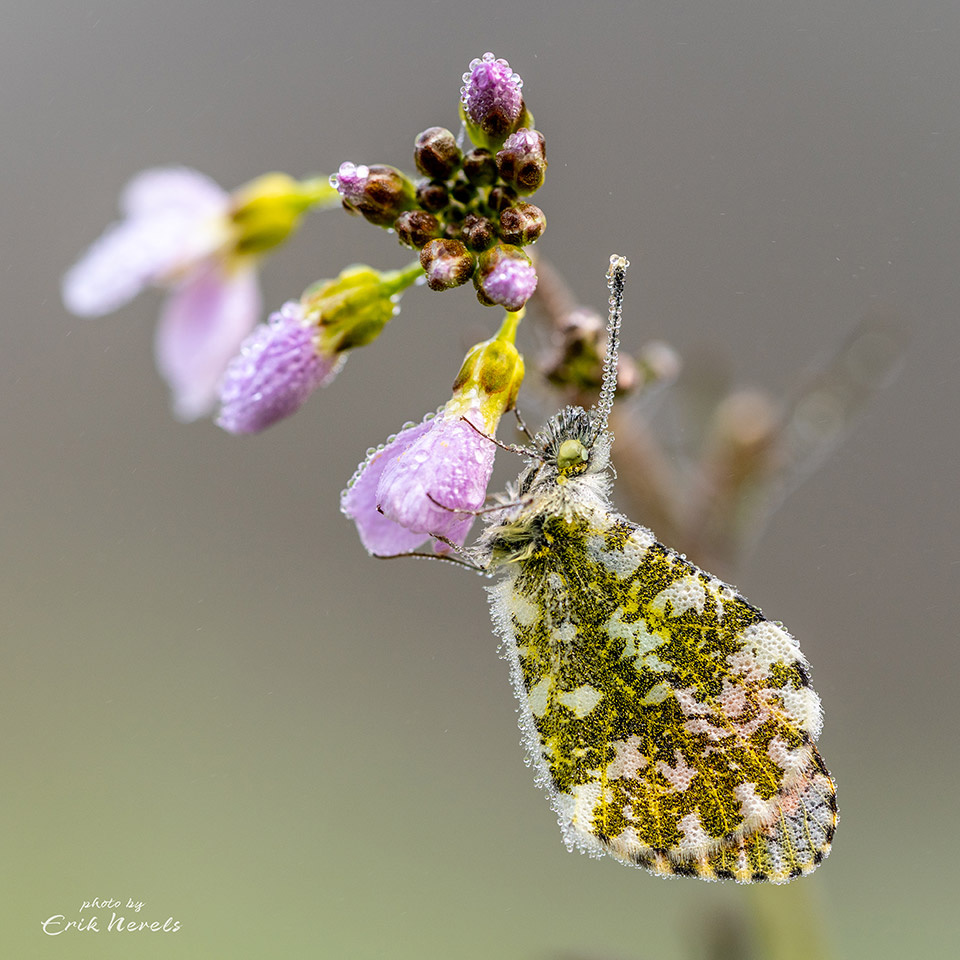
10 minutes later I am at the 'second field' and she points out a male hanging from a cuckoo flower, completely covered in dew drops.
The fact that the butterfly is hanging from this particular flower is not a coincidence. The cuckoo flower is one of its host plants, plants that it lives on and where the female lays her eggs. Knowing how this butterfly lives helps you find it.
Dew
The morning dew means that the butterflies cannot fly yet. Their entire bodies are covered in tiny drops, making their wings far too heavy. They first have to dry before the butterfly can take to the air. That gives us the chance and the peace to settle down and take our time.
Initially still
Because there is hardly any wind at first, I can manage with shutter speeds of around 1/320 sec and keep my ISO relatively low. To prevent camera movement, I use the 5-second timer.
After an hour of photographing, it starts to get a little windy and the flower with the butterfly moves from time to time. I now take several photos with almost the same settings until I see that the flower is still at the moment I press the shutter. And if in doubt, I take two more photos.
A cable release would make things much easier. Then I would only press the shutter when the flower is not moving. I really should buy that accessory.
Aperture
The third choice in the exposure triangle concerns the aperture. And this is particularly critical in macro photography. At the maximum aperture of f/2.8 and at a short distance from the subject, the depth of field is so shallow that it is already quite an art just to get the eyes sharply in focus.
If I also want the antennae and folded wings to be sharp, I choose a smaller aperture and also take several shots with different aperture values.
As well as choosing the aperture, I make sure that I point the lens at right angles to the butterfly. That is quite a challenge when you consider that the butterfly occasionally shifts position.
I therefore regularly check whether my camera position is still correct by looking from above and from the side at a distance. My tripod with a tilting centre column is very useful for this.
Focusing
I focus manually, on the eyes. I zoom in on the eyes in the viewfinder or on the screen so that I can focus accurately.
By moving the focus point to the wing and antennae with the joystick, I can check whether they are sharp too.
If they are not, but I want them to be, I first check whether my lens is still at right angles to my subject. If not, I correct this. If it is, I choose a smaller aperture for more depth of field.
Position
Today I start with backlighting. The sun is still relatively low. To prevent the butterfly from becoming a silhouette, I do not choose to overexpose, but use fill light with the help of my reflector.
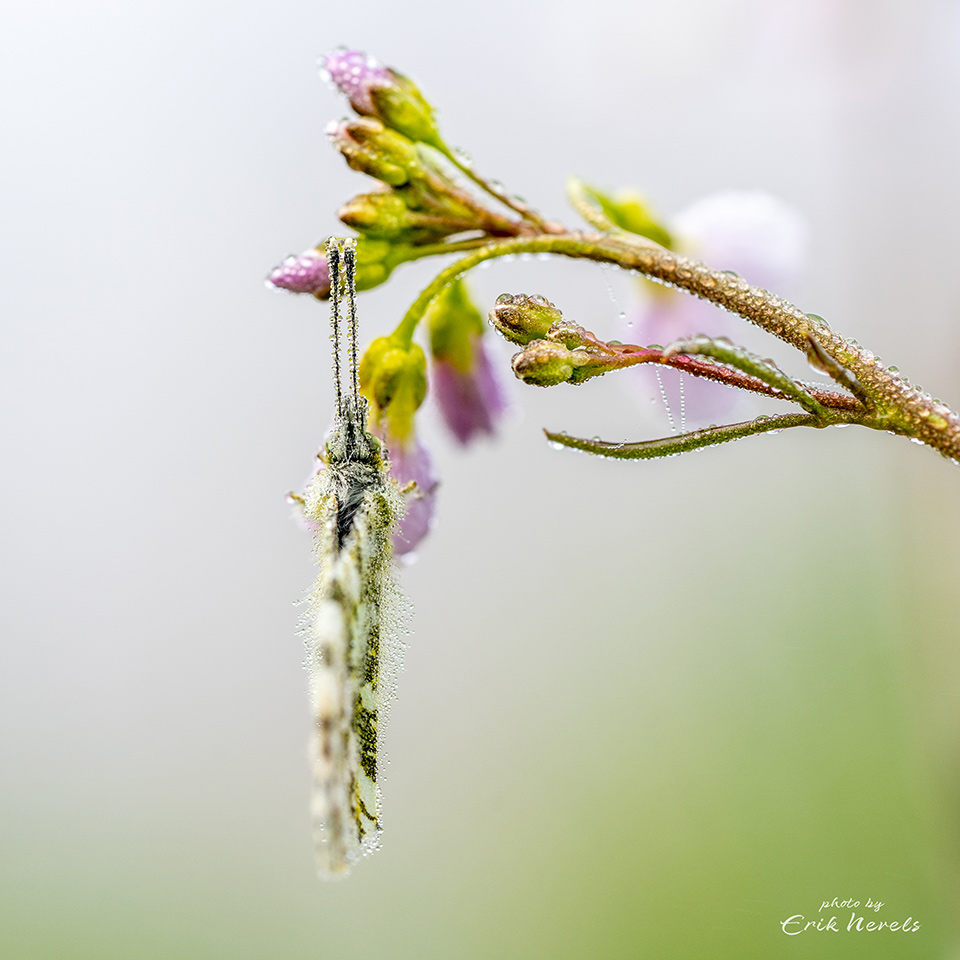
Half an hour later, I decide to photograph the butterfly straight from the front rather than from the side.
Flash
An hour after starting, my friend and I change position, or rather, change butterflies. There is still enough dew to continue at a leisurely pace.
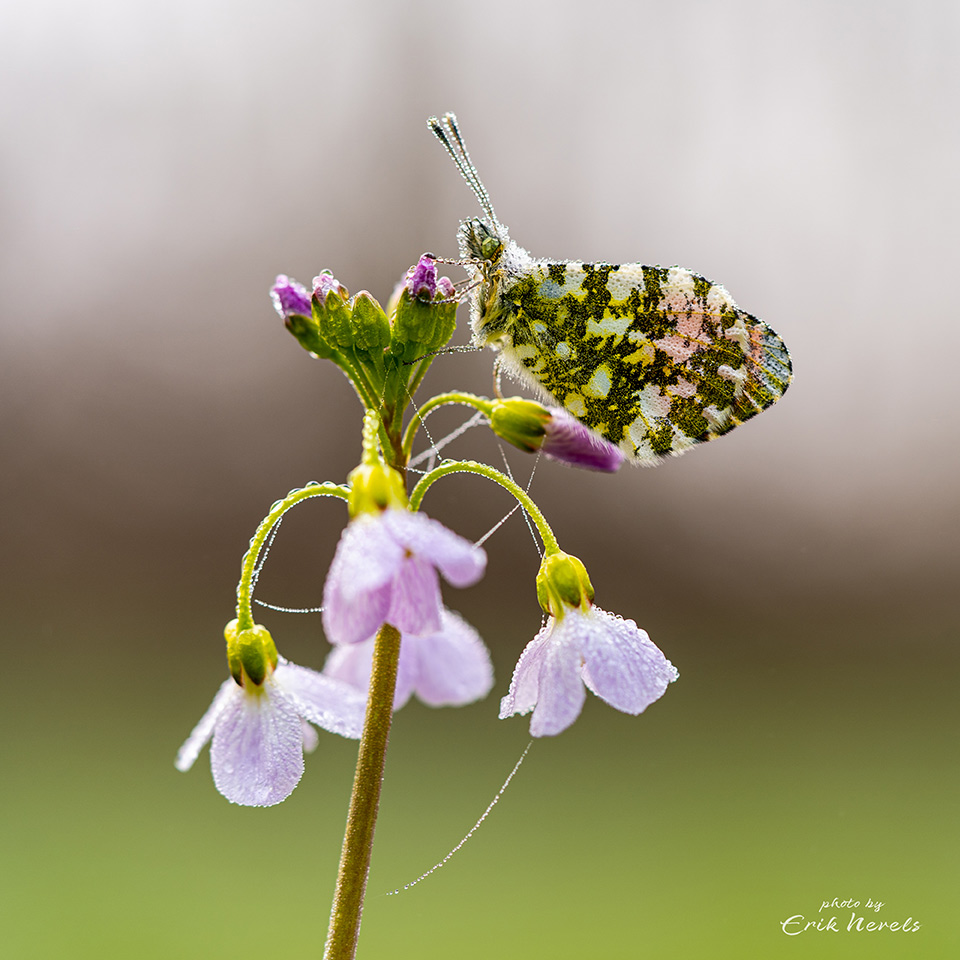
To give the backlighting an extra boost, I decide to use flash with remote control. I place the flash behind the butterfly but out of frame and control it using the trigger mounted on the camera. I happily experiment, and the next 45 minutes fly by.
Field 3
It is already past 9 when I move to the third field. The area guide, who has appeared in the meantime, discovers even more dewy orange-tips. I have plenty to choose from, but not for much longer.
The dew drops continue to dry and at around half past nine the first wings open or shift, revealing the male's orange tip.
.jpg "20210420 t Ham untitled shot 7308765(1)")
About the author
Steeds weer boeiend en op zoek naar de essentie! Dat is wat fotograferen in de natuur voor mij is. Gefocust op het landschap of het onderwerp in diens omgeving tracht ik meer dan alleen te registreren. Een continue uitdaging waarvan ik elke keer volop geniet. Meer foto's? Volg mij op Instagram en/of kijk op mijn website
You might also like
-
 7 Tips for Macro Photography
by Mike Muizebelt
-
 Where do you find your inspiration?
by Nando Harmsen
-
 If you can't think of anything to photograph, try these ideas
by Nando Harmsen
-
 Review: Canon RF 100mm f/2.8L IS macro lens
by Nando Harmsen
-
 Who inspires you, and why?
by Elvira Smit
-
 Mushrooms without a macro lens, plus a few extra tips
by Nando Harmsen
6 comments
-
 Wim wrote on Tuesday 4 May 2021 at 12:57 | reply
Hi, I know how to find "'t Ham', but how do I find "field 1-2-3"?
Translated from Dutch. -

 Erik wrote on Tuesday 4 May 2021 at 15:31
| reply
Erik wrote on Tuesday 4 May 2021 at 15:31
| reply
@Wim. Here are the coordinates of field 1: 51.435613556817, 6.06093515289034. From there, head NE for 2 and 3. Don't forget your boots. It's wet there. Good luck!
Translated from Dutch. -
Wim wrote on Friday 7 May 2021 at 07:29 | reply
Good morning, the fields where I was standing were heavily fenced off with barbed wire!? Is that correct?
Translated from Dutch. -
Wim wrote on Saturday 8 May 2021 at 13:04 | reply
Hi, could you please respond to my question in my previous comment?
Translated from Dutch.
I am planning to make a new attempt in t Ham in the short term -
Erik wrote on Saturday 8 May 2021 at 21:40
| reply
@Wim. That's definitely correct. The coordinates are correct. The Hamweg has a side path southwest of field 1. Follow that path up to the wooden gate on the right. Go through the gate and walk back towards field 1. That's how you get there.
Translated from Dutch. -
Willem wrote on Sunday 9 May 2021 at 13:01
| reply
Hi Erik,
Translated from Dutch.
Found little meadows, cuckoo flowers. I unfortunately only saw the butterflyz when they started fluttering after warming up!
Next time I need to search/look better while they are still "cold".
Thanks for your good tip!
(Keep me in mind for locations👍👍
Have your say
Please note: Articles older than a week can only be commented on by signed-in visitors.Would you still like to comment? sign in or create a free account.
Become a better photographer every week
A practical photography tip in your inbox every week.
39,078 photography enthusiasts already receive the tips! More about the weekly mail. Or keep up to date via  Facebook.

Elja Trum
Photofacts; everything to do with photography!
Would you like to take better photos and keep up with what is happening in photography? Photofacts publishes articles that teach you something about photography — from a product announcement to a practical shooting tip or a look at a website. Photofacts covers photography every day and is a hobby project of Elja Trum's that got out of hand. The articles are written by a team of volunteer authors. If you would enjoy writing one or more articles for Photofacts, do get in touch.More about PhotofactsPhotofacts is made possible in part by
