
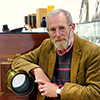
Misonne, a Belgian photographer, 1870-1943
Friday 31 January 2020, 20:02 by Leen Koper | 7,683 views | 6 commentsThis article was translated from Dutch with the help of AI. Read the original.
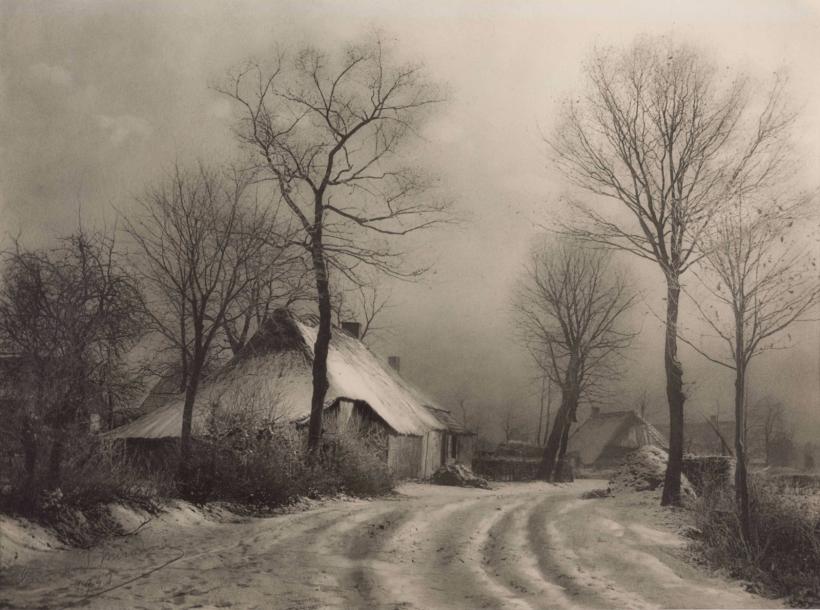
In the early 1980s, I bought a book about Belgian photographer Léonard Misonne at De Slegte, a cheap bookshop in Rotterdam, for just 24.50 guilders, around 11 euros today.
I did not know him at the time, but was immediately struck by the truly sublime images in it. The same book now sells for around 70 euros at auctions, so it was certainly not a bad purchase.
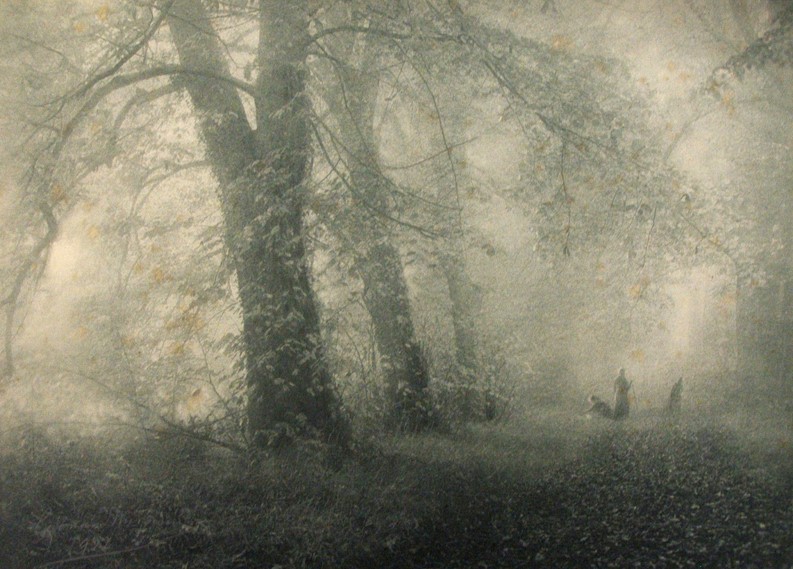
Léonard Misonne
Who was this Léonard Misonne? Born in Gilly (Charleroi) 150 years ago this year, the son of a lawyer and the youngest of seven children. Neither his father nor his mother was short of money. This shaped his life. He was able to study, attended the grammar school in Charleroi and graduated with distinction as a mining engineer in 1895.
He never worked as one, preferring to play the piano, paint and, above all, take photographs. He visited France, where in Paris he particularly admired the work of Corot and Doré, as well as England, Germany, the Netherlands, Italy and Switzerland.
As an enthusiastic cyclist, he even won races, he mainly explored the area between the Sambre and the Meuse, where he knew every corner.
Pictorialism
In photographic terms, he belonged to the school of the pictorialists, a style he would never abandon and in which he reached great heights. What is pictorialism? Wikipedia says: “Pictorialism was one of the earliest movements in photography, somewhat related to Impressionism.
The movement reached its peak between 1890 and 1910, but then fell into decline, particularly under the influence of modernism.” It says here that it fell into decline, but that is not quite true. Many of the better photographers, particularly in landscape photography, such as Joe Cornish, are embracing it again, albeit in a more modern form.
Since buying this book, I too, although at a much lower level, have been a great admirer of this pictorialist style.
The finest subject leaves me cold if it does not have the right lighting I am looking for. I cannot emphasise enough the value I place on the elements of light and mood.
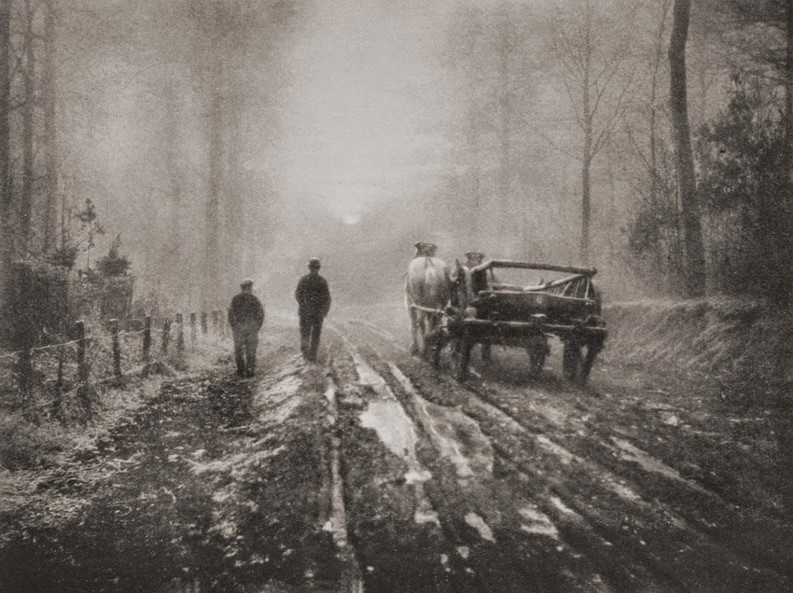
Light is everything
This statement is characteristic of his work throughout his life, whether he was photographing landscapes in his surroundings or, from 1939 onwards, countless images of the cities of Antwerp and Ghent, the Belgian coast and the area around Amsterdam, where he stayed for health reasons.
The subject itself is nothing, light is everything! Early in the morning, he would regularly seek out some picturesque spot to capture the struggle between sunlight and the morning mist with his camera.
Many of his images were taken in the wooded surroundings of his own home, with gardeners or one of his eight children serving solely to bring life to the landscape.
Adding skies without Photoshop
What characterised his work? First of all, adding skies. For contemporary photographers, this is usually a simple task using Photoshop or a similar programme, but around a hundred years ago things were very different.
Sometimes an attentive viewer can spot it, but usually he made sure you could not find out at all. He was that skilled a craftsman.
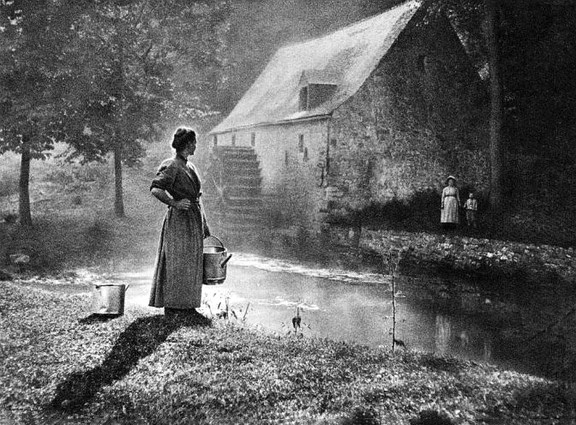
Soft focus
Secondly, his use of soft focus effects. Not the soft focus we artificially add to the entire image with an NIK filter or something similar. Nor the effects created with real filters, such as Carl Zeiss Softars. No, when enlarging, he applied the soft focus effects only locally.
He preferred a sharp photograph with only certain areas softened, such as hair in backlighting. Success does not lie in the price of the lens. You can soften when enlarging, but you do not have to.
You need to have a method that allows you to give an overly sharp image a trace of softness. This softening must be adapted to the image the artist has in mind.
Flou-Net
For this purpose, he designed a device called a “Flou-Net”, which allowed you to influence the sharpness while enlarging, and he even had it patented in a few countries. However, he published about it in various magazines but never used it himself.
Portrait photographers did use it, though, and they achieved some success with it. It softened the skin and removed small imperfections, which meant that they could save quite a bit of retouching.
As far as retouching was concerned, today's Photoshop would have been ideal for him. He wrote: An intervention is permitted when it is necessary. It must not be an end in itself, but a means. We do use such a means, albeit with some restraint, but in such a way that the intervention is invisible.
Do not retouch too much
Of course, he could hardly have imagined that today this has also become a stylistic device. You cannot determine in percentages how far you can go with retouching. Why would it be better to stop at 5%, 10% or 20%?
What I mean is that I consider retouching acceptable as long as the image does not lose its photographic character.
To those who claimed that their bad photographs were closer to the truth because they had not been retouched, he replied: Photography gives an exact representation of reality, but it does not show what cannot be represented.
What is the right value?
All values can be adjusted, the choice of film, developer, exposure time and so on. So what is the “right” value? Perhaps something to think about when using Photoshop today.
Around 1920, the tide began to turn. Before then, Misonne had been the “king” of landscape photography, but now people began to embrace the new photography. They no longer believed in creating images that formed a work of art, as if you were looking at a painting.
People began to appreciate the cool, stark representation of rather banal subjects such as matchboxes, a knife and a fork. The New Objectivity entered art photography. Misonne, however, remained faithful to his way of depicting things and entered into discussions with representatives of the new style.
New Objectivity
In 1935 he wrote: In this age of the machine, we should photograph that machine, but no, in this age we should photograph “back to nature”. Misonne remained a landscape photographer throughout his life.
He continued to capture the tones of the light, the mist, the rain and the clouds in his enthusiasm for the thousands of differences in brightness they created. “Everything is immersed in light. The darkness that makes the image heavy is brought to life by the filter of light.
He often used people in the landscape. In one article, he even went so far as to divide the role of people in the image according to distances of 4 to 5 metres, 10 metres and 15 metres for those in the distance. He advised against photographing people while they were moving, to avoid incorrect poses.
Keep in mind that he photographed on glass plates, which meant it took quite a while to make the next exposure. Moreover, he felt it was easy to retouch people in the distance away for a moment if they were distracting. (In this respect, he seems very much like a “photoshopper avant la lettre”.)
Misonne acquired a great reputation in the world of photography through his work. His work was shown at many exhibitions, and he published his theories in quite a few magazines about what a landscape photograph should be and how to achieve it.
As M. Henry Craebeex, an engineer at Gevaert, said in a commemorative broadcast for Radio Brussels two years after his death, in 1945:
Misonne earned his place among the classics of photography. People felt that he had struck a previously unknown tone. His name spread from our country far beyond its borders, and it was not long before he had earned the title of 'king of landscape photography'.
About the author
Leen Koper woont en had tot voor kort een fotostudio in Zierikzee. Na ruim 40 jaar als fotograaf gewerkt te hebben, houdt hij zich nu voornamelijk bezig met landschapsfotografie. Als beroepsfotograaf heeft hij in de loop der jaren vele internationale prijzen gewonnen en gaf les en ook regelmatig seminars in Engeland, België, Frankrijk, Duitsland en Oostenrijk.
You might also like
-
 Review: Photo book 'Voor altijd Rotterdam'
by Erik van Rosmalen
-
 Review: 'Photoshop Masters' by Rob de Winter
by Huub Keulers
-
 20 photography books you should read!
by Michelle Peeters
-
 Documentary review: Step into the World of Lars van de Goor
by Michelle Peeters
-
 Photographing with Canon's cheap primes
by Nando Harmsen
6 comments
-
 Harry wrote on Friday 31 January 2020 at 21:59 | reply
Thanks Leen.
Translated from Dutch.
the only correct name is Herman Craeybeckx. -

 Leen Koper wrote on Friday 31 January 2020 at 23:04
| reply
You are 100% right. My memory wasn't as good as I thought after all.
Translated from Dutch. -
 marwil Horst ter wrote on Saturday 1 February 2020 at 12:42 | reply
Well put Leen, read it with interest.
Translated from Dutch. -
 Peter van Dinther wrote on Tuesday 4 February 2020 at 13:59 | reply
Beautiful. There are quite a lot of photos by him on Pinterest. Nice article, I enjoyed reading it
Translated from Dutch. -
Leen Koper wrote on Tuesday 4 February 2020 at 14:46
| reply
I could write much more about this brilliant photographer, but well, it also needs to remain readable for people with a shorter attention span.
Translated from Dutch.
-
 Gerda Kooger Pel wrote on Tuesday 4 February 2020 at 21:30 | reply
Very impressive Photographer Leonard Misonne , who how should I say that ....... ; paints with his Camera !!! What a discovery for me ! Have been painting and sculpting myself for a very long time but this surpasses a lot for me .
Translated from Dutch.
Great that you bring this Artist to our attention !
I will certainly delve into this Photographer !
Thank you Mr. Leen Koper .........
Have your say
Please note: Articles older than a week can only be commented on by signed-in visitors.Would you still like to comment? sign in or create a free account.
Become a better photographer every week
A practical photography tip in your inbox every week.
39,021 photography enthusiasts already receive the tips! More about the weekly mail. Or keep up to date via  Facebook.

Elja Trum
Photofacts; everything to do with photography!
Would you like to take better photos and keep up with what is happening in photography? Photofacts publishes articles that teach you something about photography — from a product announcement to a practical shooting tip or a look at a website. Photofacts covers photography every day and is a hobby project of Elja Trum's that got out of hand. The articles are written by a team of volunteer authors. If you would enjoy writing one or more articles for Photofacts, do get in touch.More about PhotofactsPhotofacts is made possible in part by
