

Preview: Canon EOS 77D, 800D and M6
Friday 17 February 2017, 20:02 by Michelle Peeters | 14,018 views | 7 commentsThis article was translated from Dutch with the help of AI. Read the original.
On 15 February, Canon introduced its three new members of the EOS family at the A'DAM Tower: the EOS M6, EOS 77D and EOS 800D. The new EF-S 18-55mm f/4-5.6 IS STM kit lens was also announced, the smallest lens in its class!
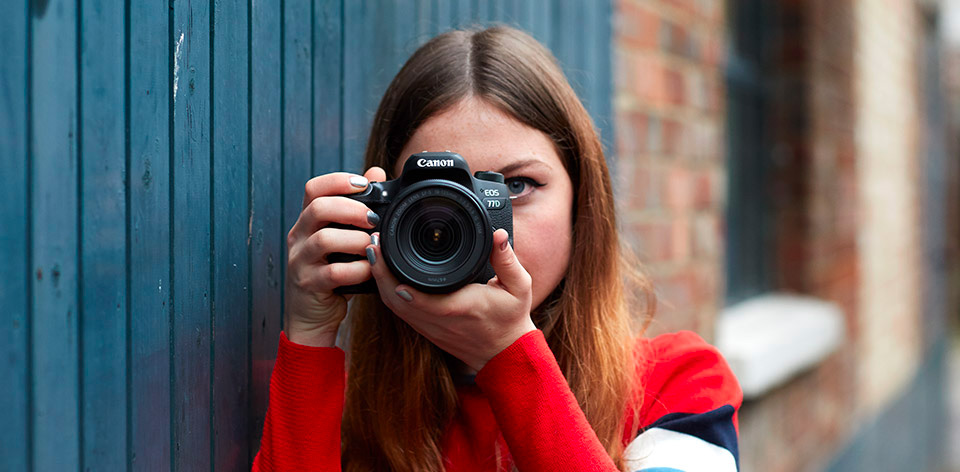
In the heart of Amsterdam, we had the chance to work with the cameras for a while. Bruno Winnen (Marketing Director Benelux) and Jip Barth (technical specialist at Canon Netherlands) gave presentations about Canon's marketing strategy for 2017 and the specifications of the new products.
Is the camera market saturated?
You probably hear it time and time again: “the camera market is completely saturated”. Compact cameras in particular are falling out of favour because of 'cannibalisation' by the new smartphones.
Well, according to Canon, that is not quite true! Because despite the fact that the camera market is indeed shrinking by 17%, the Japanese camera manufacturer continues to invest in a DSLR for every possible user.
With the new EOS 77D, which sits below the 80D mid-ranger, Canon is once again opening up a new subcategory.
Letting the smartphone play a role
Because 'people who take photographs occasionally' remain the largest target group, and smartphone users are included in that group, Canon wants to move towards a complete solution for users (Multiple Entry Doors), making the switch from a smartphone to a system camera easier.
The new M6 camera, as well as the new DSLRs, therefore all have wifi, NFC and Bluetooth built in, so you can use your smartphone to communicate with your camera.
Another new subcategory?
If you look at Canon's entire DSLR range, you could become quite confused by the arrival of the 77D and the brand-new 800D in relation to the older 80D, 760D and 750D cameras.
In this article, our first impression of these new cameras.
Canon EOS 77D and 800D
The EOS 77D and EOS 800D are largely identical in terms of specifications. Both cameras have a 24.2-megapixel APS-C sensor with Dual Pixel autofocus and a Digic 7 image processor. Both cameras have 45 autofocus points.
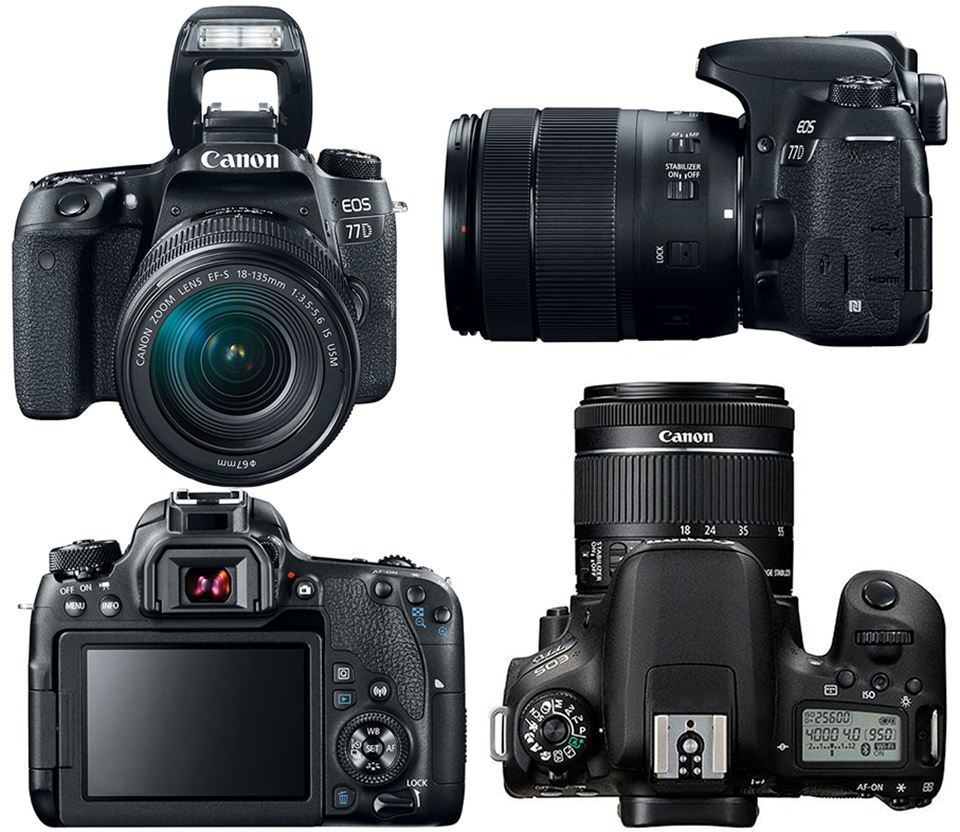
The sensor has a sensitivity range of 100 to 25,600 ISO, and you can shoot at 6 photos per second, dropping to 4.5 frames per second when using live view. Both cameras have built-in wifi and Bluetooth, as well as a 3-inch screen.
You can film at full HD resolution with a frame rate of up to 60 frames per second. Unfortunately, you still cannot record in the razor-sharp 4K format.
The EOS 77D body has a recommended retail price of 920 euros without a kit lens, while the cheaper EOS 800D sells for 870 euros. The more expensive EOS 77D has a built-in interval mode, bulb modes, more options for custom settings, an LCD on top of the camera and an eye sensor by the viewfinder that switches off the 3-inch screen on the back of the camera.
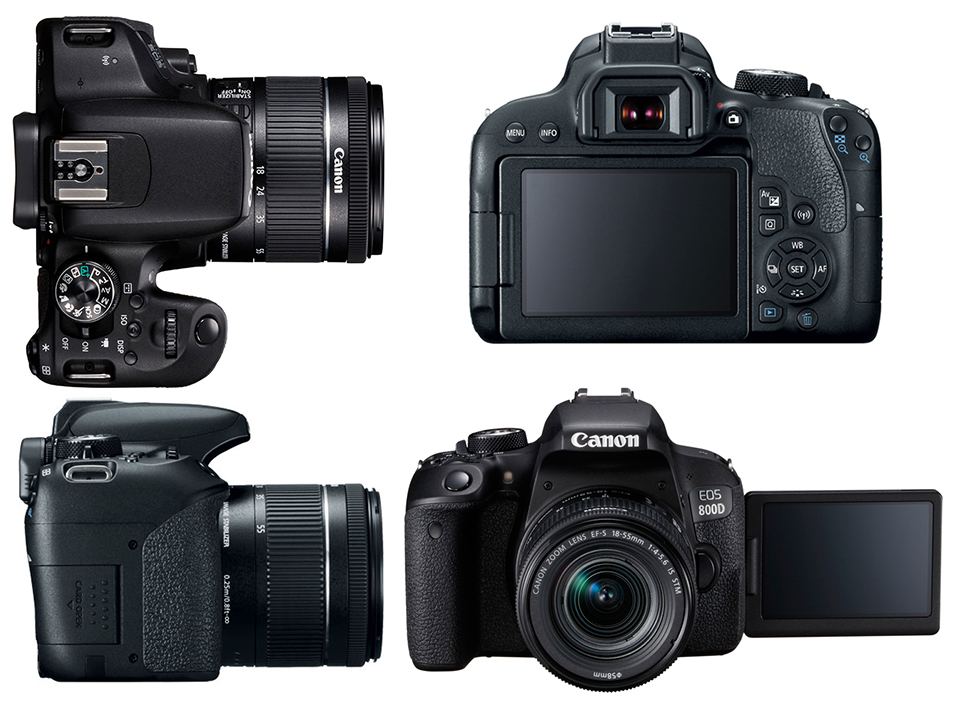
The EOS 800D lacks these features and also has one fewer dial. Both cameras are positioned below the EOS 80D, which was released last year.
But what should you choose?
What I wonder is whether Canon's huge expansion of its range will not cause a great deal of confusion. With the 80D, 77D, 800D and 760D all offering cameras that are fairly close together, you need to know exactly what you want from your kit to make an informed choice.
Canon 77D is the '80D light'
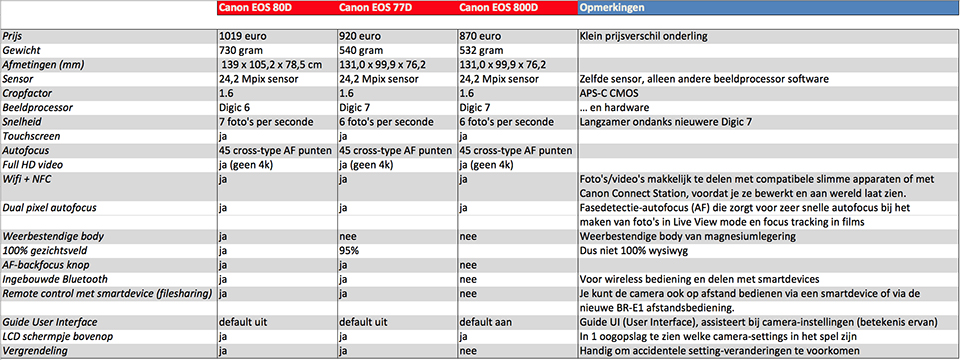
As you can see in the table above, the 77D is essentially the '80D light'. The camera is almost identical to the 80D inside, but comes in a smaller, non-weather-sealed body. The material used for this body does not feel particularly robust, and it does not look that way either. It feels rather plastic-like, unlike the magnesium alloy used for the 80D body.
But Canon has proved itself in terms of durability, so I am not too worried about that. It could perhaps look a little better.
It is around one hundred euros cheaper, considerably lighter and smaller too. That can be a major advantage if you have problems carrying heavy loads or large volumes! But if you need a very fast camera with a weather-sealed body because you do a lot of outdoor photography, the 80D is still the better option. You will simply have to accept the extra weight and volume.
Very small differences between the 77D and 800D
The differences between the 77D and 800D are even smaller! The main distinction is that they allow you, as a photographer, to explore your creativity and photographic limits in completely different ways. It depends on where you are in the learning process.
The EOS 77D gives you full control, allowing you to make the camera completely your own. With two control dials, you can adjust settings such as aperture and shutter speed, and the top LCD screen shows you every setting. The camera is suitable for both experienced and beginner photographers. You can choose the guided mode or use many manual settings. In short, it is for photographers who want to develop their skills.
The EOS 800D has an instructional interface, allowing less experienced photographers to learn about the effect of the camera settings while taking pictures. This increases their knowledge of photography and helps them develop their skills. This camera is therefore actually intended as an entry-level model for beginner photographers, but it has the same capabilities as the 77D.
If you look at the price difference between the 77D and 800D, you will see that it is minimal, just 50 euros. It therefore seems a little unclear why Canon chose to release both cameras with such a minimal distinction. It seems to me that almost every photographer would choose the 77D over the 800D for just 50 euros extra.
Even if it were only because of the handy rear control dial instead of the buttons on the 800D. And of course because of the useful top LCD screen, which shows your settings at a glance. In the end, the standard built-in Bluetooth, the eye sensor by the viewfinder, the built-in interval mode, the bulb modes and the lock switch make this camera worth the modest extra cost.
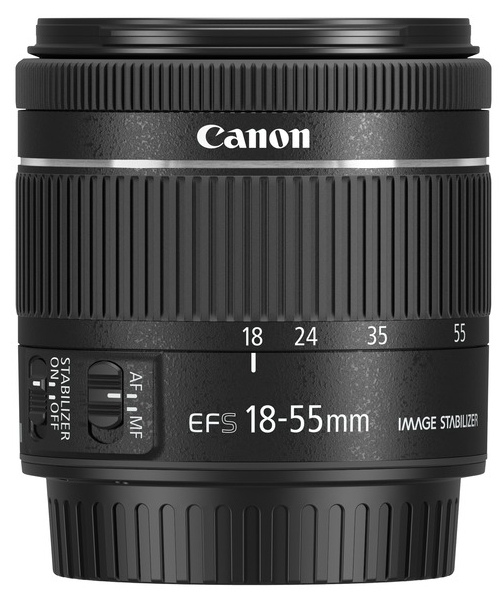
Canon EF-S 18-55mm f/4-5.6 IS STM
Alongside the two DSLRs, Canon says it is bringing the smallest non-retractable DSLR kit lens on the market: the EF-S 18-55mm f/4-5.6 IS STM. The lens is 61.8 mm long and weighs just 215 grams. It is an all-round lens with a 4-stop Image Stabilizer for shake-free shots in low light or at maximum zoom.
An aperture consisting of 7 blades creates attractive background blur in portraits, while Servo AF with whisper-quiet STM autofocus is perfect for razor-sharp video scenes without distracting sounds. This lens delivers the fastest live view autofocus when used with the 77D and 80D!
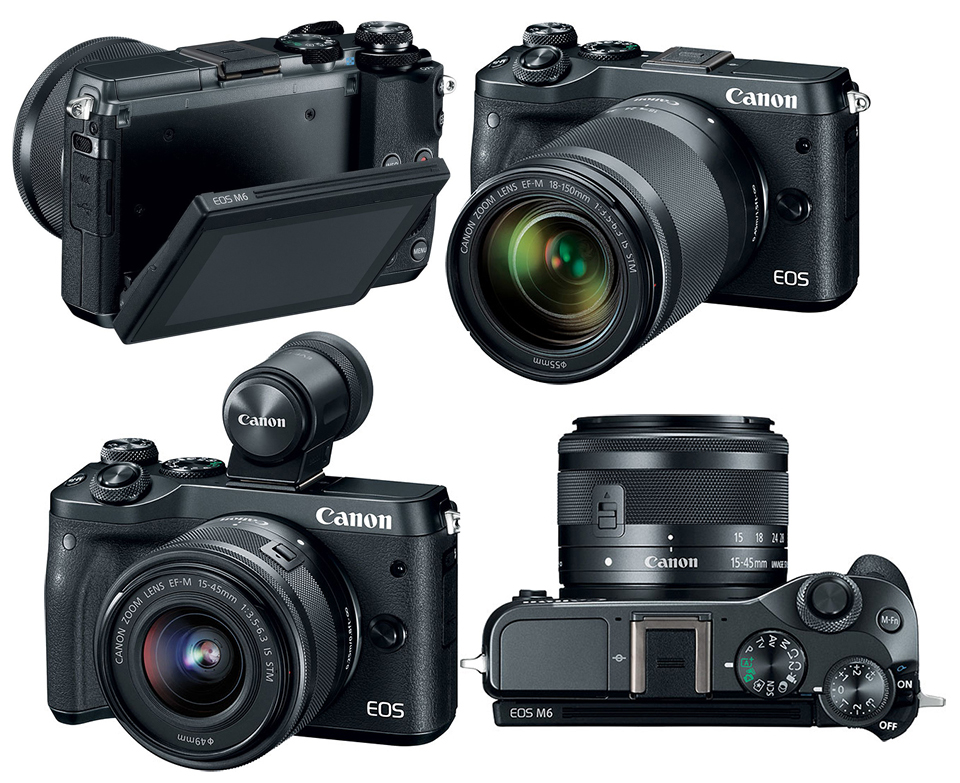
Canon EOS M6
Alongside the two DSLRs, Canon has announced the EOS M6. This mirrorless system camera, which uses EF-M lenses, has a 24.2-megapixel APS-C sensor. There are 49 autofocus points, and you can shoot at 7 frames per second, or 9 frames per second if focus is locked on the first frame.
The M6 does not have a built-in viewfinder, but you can use an optional electronic viewfinder. This separately available EVF-DC2 viewfinder has 2.36 million dots and cannot be tilted upwards. The viewfinder costs 280 euros.
The Canon M6 also has a 3-inch screen, wifi, NFC and Bluetooth, and can record at 1080p resolution at up to 60 frames per second. Unfortunately, here too you still cannot record in the razor-sharp 4K format.
In terms of specifications, the M6 is largely identical to the previously released M5, but it is cheaper. The M6 therefore lacks the M5's built-in EVF and fully tilting selfie screen. The M6 will cost 820 euros as a body only.
About the author
Michelle Peeters is fotografe en oprichter van DeuxBleus Fotografie. Michelle herkent het bijzondere in het gewone en het gewone in het bijzondere. Ze heeft zich nooit willen specialiseren en is daardoor van alle markten thuis.
You might also like
-
 Canon 77D, 800D and M6 announced
by Michelle Peeters
-
 Review: Photographing with a Canon 77D
by Michelle Peeters
-
 Canon introduces macro lens with built-in ring light
by Michelle Peeters
-
 Canon introduces mirrorless crop cameras: the EOS R7 and EOS R10
by Nando Harmsen
-
 Review: Canon EOS R7
by Nando Harmsen
-
 Canon EOS 850D: fast mid-range DSLR with 4K video
by Michelle Peeters
7 comments
-
 Wim Hendriks wrote on Tuesday 21 February 2017 at 11:26 | reply
so waiting for the 4K....to be continued..
Translated from Dutch. -

 Michelle Peeters wrote on Tuesday 21 February 2017 at 11:51
| reply
Indeed, that shouldn't take too much longer, I think!
Translated from Dutch. -
 Willy van Dreumel wrote on Tuesday 21 February 2017 at 12:10
| reply
Naah... In my eyes, Canon is showing once again that they don't really know which direction they want to go in. I think the differences between the 77D and the 800D in particular are simply too small to justify two different products. Maybe, just maybe, something will still come of that M5 / M6 series, but in that too they have made strange choices in my opinion. And by that I mainly mean the separate EVF and the screen on the M5 that folds down 180 degrees. They could have thought that through a bit better. Glad I switched to Fuji's X-T2 last week!
Translated from Dutch.
-
Michelle Peeters wrote on Tuesday 21 February 2017 at 12:14
| reply
I agree with you! I am and will remain a huge Canon fan but I won't be investing in a new camera again anytime soon. They are robust devices that continue to serve you well for a long time! Only the weight (I have a Canon EOS 5d Mark III) of course remains a problem, hence why they keep looking for lighter bodies and lenses time and time again. That Fuji X-t2 also comes out very well in the tests indeed!
Translated from Dutch. -
 Leo Noordhuizen wrote on Tuesday 21 February 2017 at 14:51 | reply
It will happen slowly, depending on how quickly lenses become available, but ultimately I think the 'system cameras' will replace the extremely heavy SLRs.
Translated from Dutch. -
Michelle Peeters wrote on Tuesday 21 February 2017 at 14:55
| reply
I think so too Leo, but don't forget the smartphones either..
Translated from Dutch. -
 Huub Sanders wrote on Tuesday 21 February 2017 at 15:49 | reply
Nice to run into you here, Leo.
Translated from Dutch.
Have your say
Please note: Articles older than a week can only be commented on by signed-in visitors.Would you still like to comment? sign in or create a free account.
Become a better photographer every week
A practical photography tip in your inbox every week.
38,764 photography enthusiasts already receive the tips! More about the weekly mail. Or keep up to date via  Facebook.

Elja Trum
Photofacts; everything to do with photography!
Would you like to take better photos and keep up with what is happening in photography? Photofacts publishes articles that teach you something about photography — from a product announcement to a practical shooting tip or a look at a website. Photofacts covers photography every day and is a hobby project of Elja Trum's that got out of hand. The articles are written by a team of volunteer authors. If you would enjoy writing one or more articles for Photofacts, do get in touch.More about PhotofactsPhotofacts is made possible in part by
