

Review: Canon EOS R7
Friday 9 September 2022, 13:31 by Nando Harmsen | 10,345 views | 4 commentsThis article was translated from Dutch with the help of AI. Read the original.
In May 2022, Canon announced two new mirrorless cameras. These were the EOS R10 and the EOS R7. Canon Netherlands lent me the EOS R7 for a holiday in the German Eifel, where I put the camera through its paces. You can read what I think of the camera in this review.
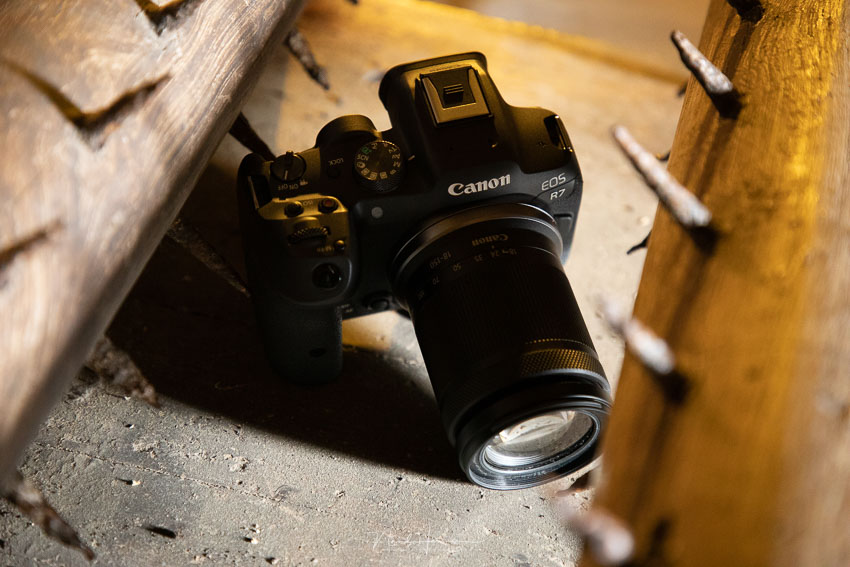
With the Canon EOS R and EOS RP, Canon entered the world of full frame mirrorless cameras. These were cautious steps on the way to the EOS R5 and EOS R6, and of course the EOS R3.
These cameras set the bar high with excellent IBIS and fantastic autofocus.
The Canon EOS R10 and EOS R7 are not so much successors, but a next step to bring the mirrorless system to APS-C cameras as well.
You know, cameras with a smaller sensor. Canon already had these in its range, the excellent EOS M cameras including the EOS M50 II. With the EOS R10 and EOS R7, however, you get the RF mount and all the lenses available for it.
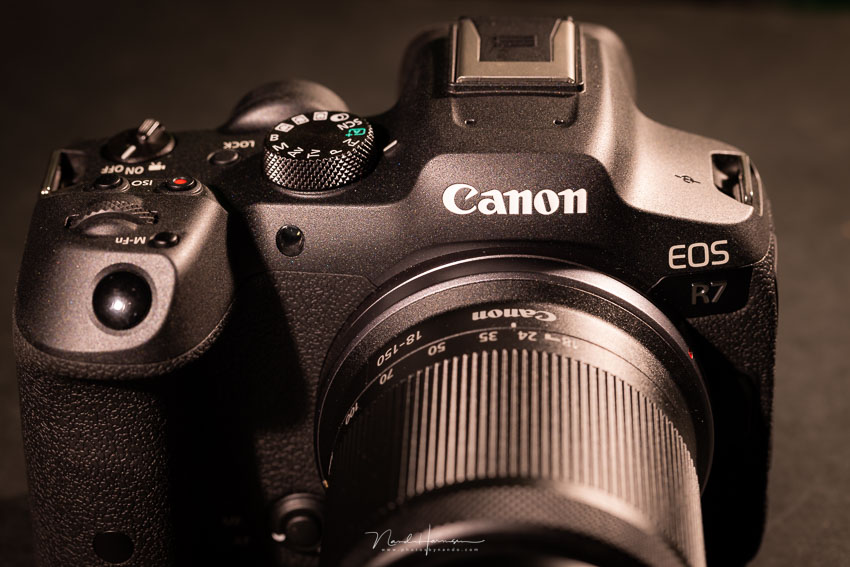
The most important specifications
First, I want to list the specifications. Not all of them, just what I think are the most important ones.
- 32.5-megapixel APS-C (1.6x) Canon CMOS sensor
- ISO 100-32,000, expandable to ISO 51,200
- Continuous shooting up to 15 fps with the mechanical shutter and 30 fps with the electronic shutter
- Dual Pixel CMOS AF II with 651 AF areas using 100% of the image
- 5,915 manually selectable AF points, covering 90% x 100% of the image
- AF tracking for people (eye, face and body), animals (eye, head and body for dogs, cats, birds and many more animals), cars and motorbikes in all AF modes
- AF sensitivity down to -5 EV
- In-body stabilisation in 5 directions, up to a maximum of 7 stops
- Shutter guaranteed up to 200,000 actuations
- Weather sealing
- Dual UHS-II SD slot
- WiFi and Bluetooth connection
- 4K 60 fps with 7K oversampling, 1080p up to 120 fps, YCbCr4:2:0 8-bit or YCbCr4:2:2 10-bit when HDR PQ or CLog3 is selected
The RF mount accepts all lenses with an RF mount, and, via the adapter, EF, TS-E, MP-E and EF-S lenses. Lenses from the EOS-M system will not fit.
The Canon EOS R7 in detail
I was lent the Canon EOS R7 for a while for a review, together with the new RF-S 18-150mm F3.5-6.3 IS STM zoom lens. I took it with me on holiday to the German Eifel. Use in a realistic situation, so to speak.
But not before I had taken a good look at this new APS-C camera.
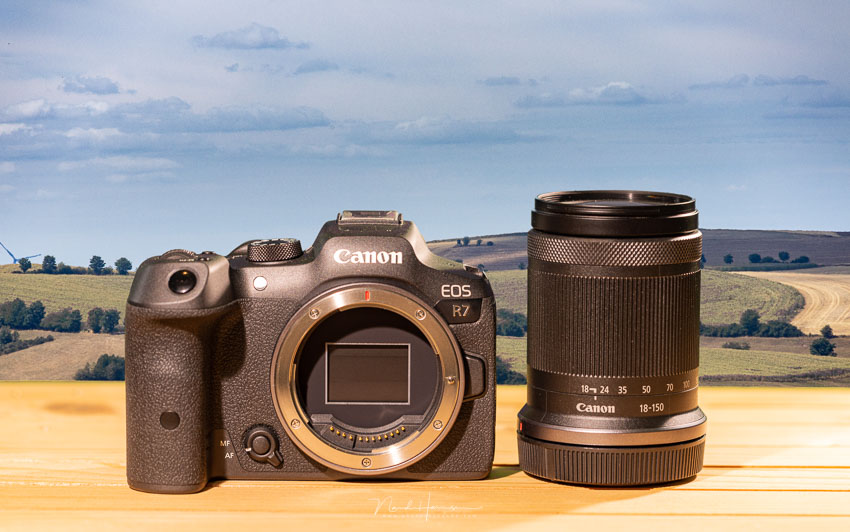
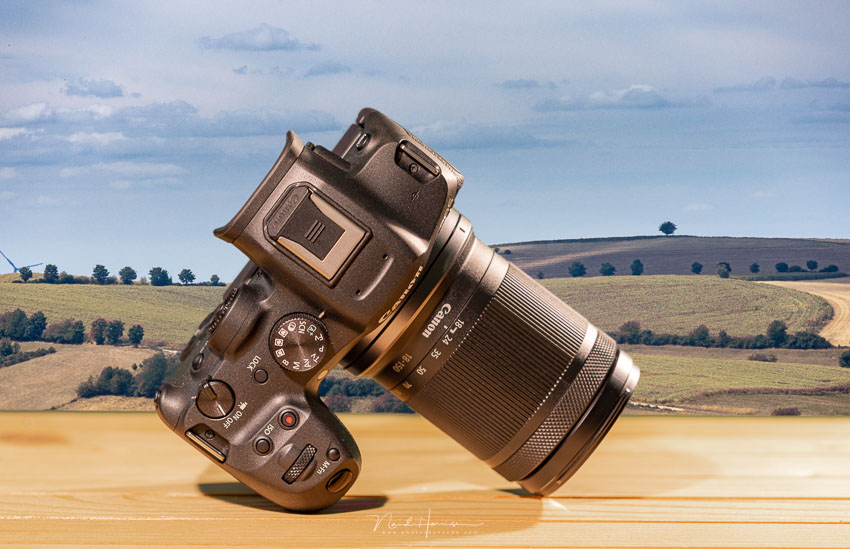
The EOS R7 is a very compact camera, smaller than the EOS R5 and EOS R6. However, the camera does have a similar grip, so the body sits comfortably in your hand.
The body measures 132.0 x 90.4 x 91.7 mm and weighs 612 grams with card and battery. You can see the difference compared with the full frame EOS R5, and the R6 too, when you see them side by side.
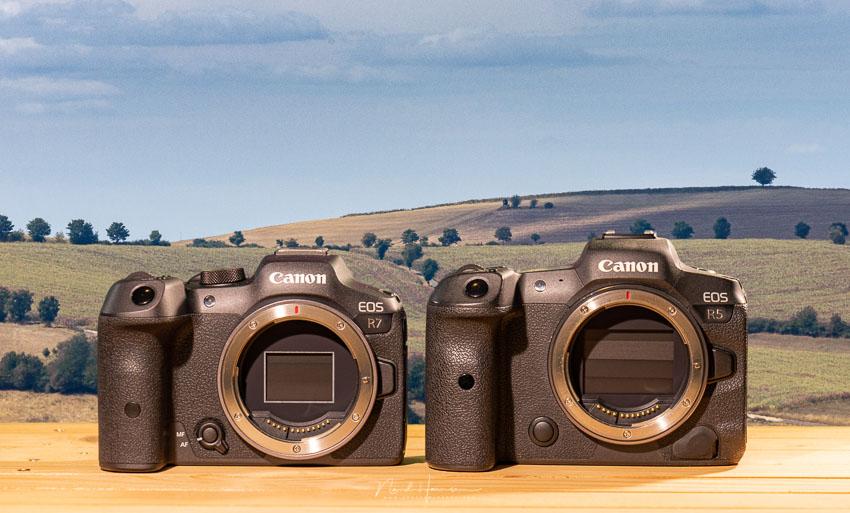
There are a few changes compared with the full frame R models. The power switch has been moved and allows you to switch between camera and video.
The control wheel by your thumb is integrated with the joystick, and there is an AF/MF switch on the front of the camera.
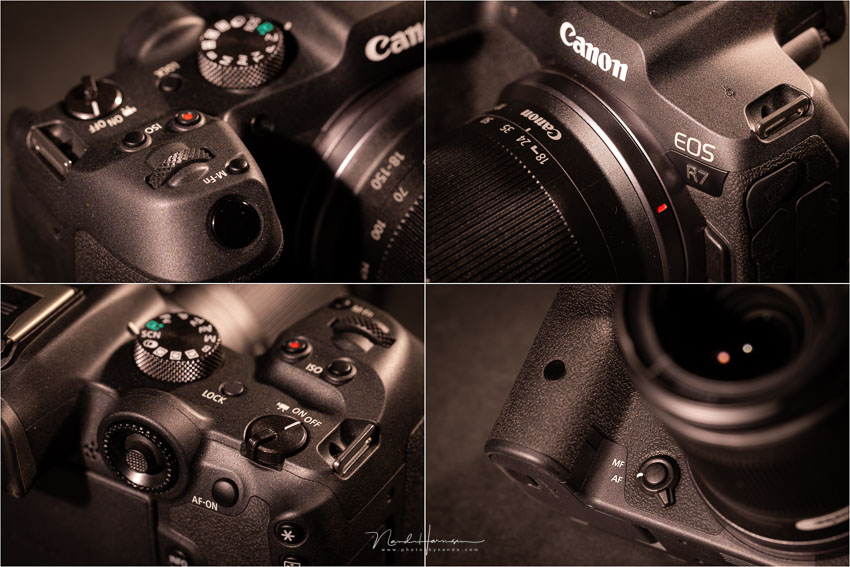
There is no screen on top of the camera. You find the PASM dial, an ISO button, the video recording button and the M-Fn button, which gives access to a selection of five programmable functions.
Next to the power switch there is also a LOCK button to lock certain buttons and control dials.
The LCD screen is fully articulating and has 1.62 million pixels. It is of course a touchscreen for operating the camera, autofocus and the menu. The electronic viewfinder is an OLED screen with 2.36 million pixels and a maximum refresh rate of 120 fps.
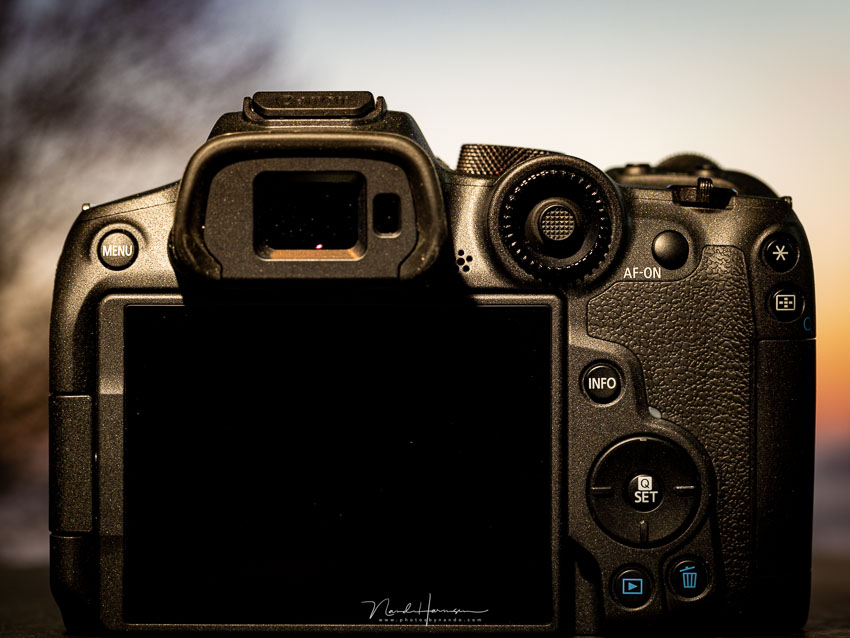
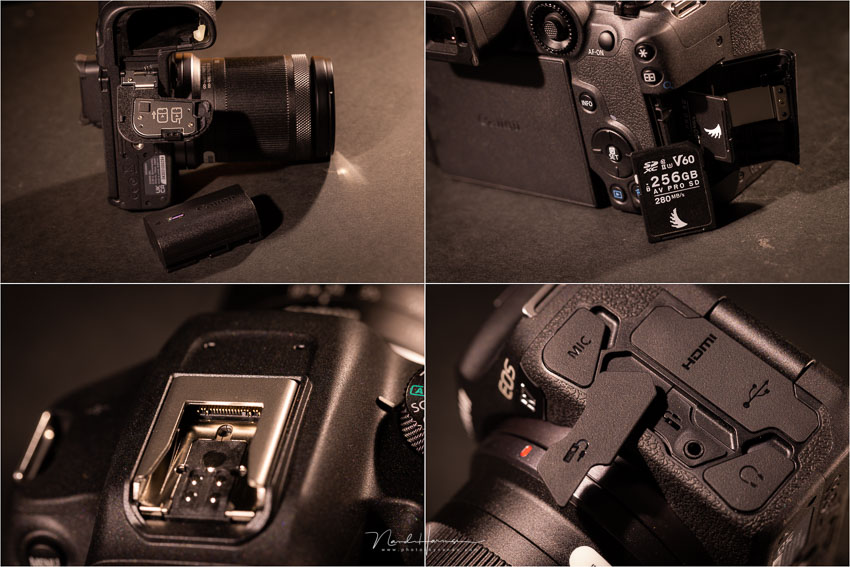
The EOS R7's connections include USB-C, a remote control connection, micro-HDMI, and both headphone and microphone connections. You have two UHS-II SD card slots for storing your images. The EOS R7 also has the multi-function hot shoe.
The menu and the options
The menu controls of the Canon EOS R7 hold no real surprises. They are the same as on all other EOS models and can be operated entirely using buttons and the touchscreen.
There is a wide range of options for personalising buttons, control dials, the custom buttons C1 through C3, and a My Menu with several tabs.
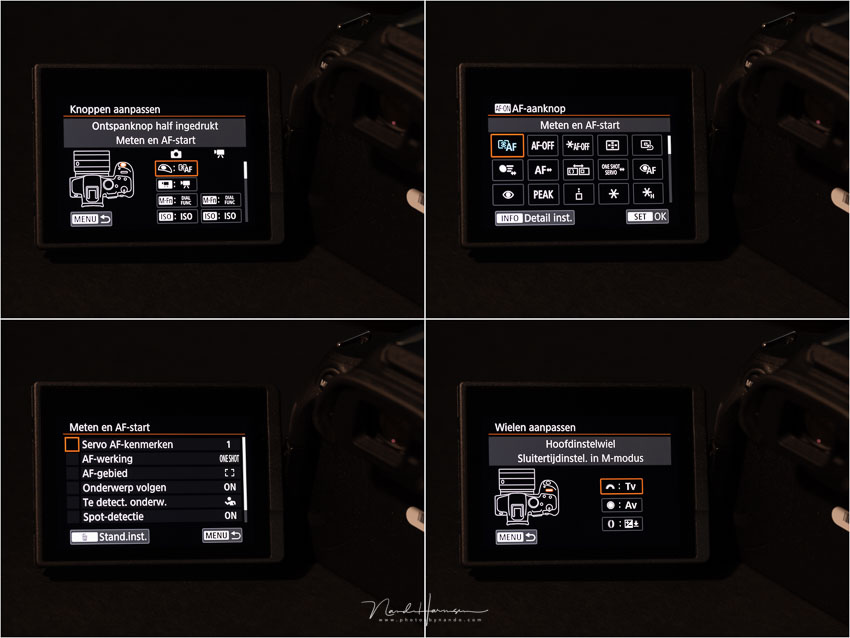
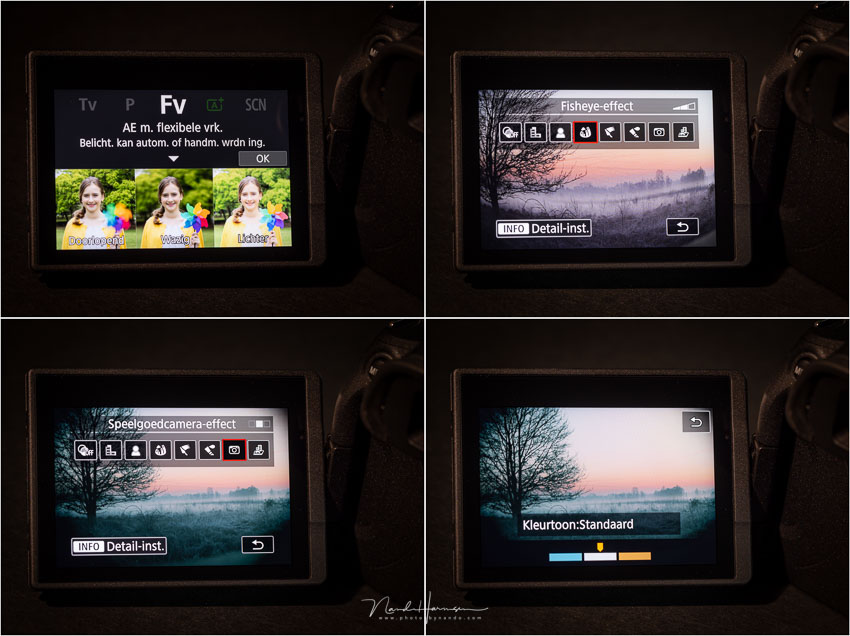
The camera does seem to be aimed at hobbyists, since you can use the same visual system as I saw on the EOS M50 cameras. There are creative settings such as fish-eye effect, miniature effect and various other filters, aimed at JPEG photographers.
Using the camera
I did not test the video features of the EOS R7, even though the specifications are very interesting for videographers. 4K 60 fps from 7K oversampling and the absence of a 30-minute recording limit are very appealing. You also have C-log3 and YCbCr4:2:2 10-bit available.
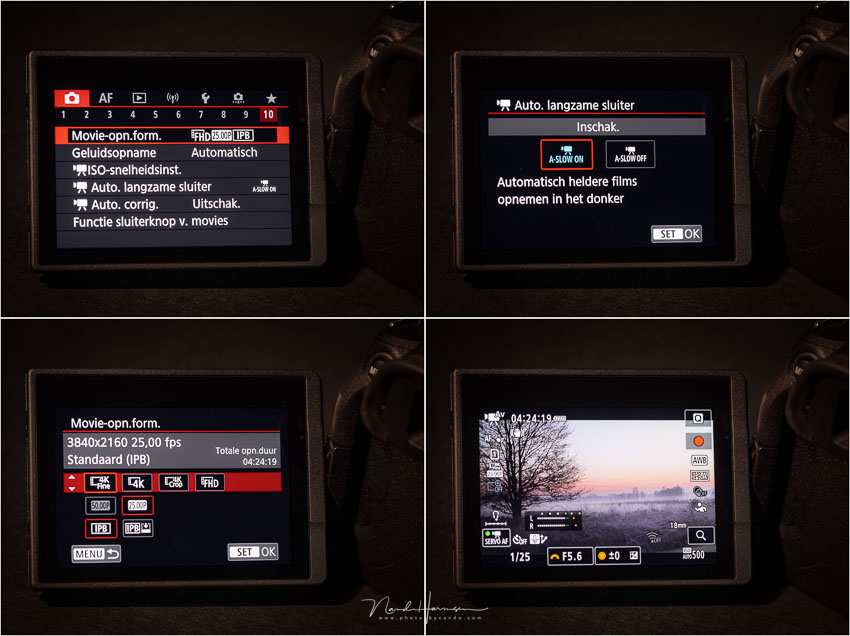
For this review, however, I am only looking at the camera's options and use for photography. The autofocus and speed, combined with the resolution, make the EOS R7 very interesting for action photography.
The APS-C sensor also gives you a narrower angle of view, making the focal length of your lens appear 1.6x longer.
The new combination of the control wheel and joystick takes quite a lot of getting used to, especially because of the muscle memory built up over years of using the control wheel separately from the joystick. I kept moving my thumb to the wrong place when I wanted to use the control wheel.
Despite this, it is useful because both controls are in one place. You just have to get used to it. I do miss the dial that is now where the power switch is, which I normally programme for ISO. I now have to press a button first to change it.
The position of the power switch is more comfortable than what you see on the full frame EOS mirrorless models. The extra position for video is especially better than the double operation required with the full frame models.
The EOS R7 has an automatic horizon level. This means that a wonky horizon is corrected automatically. Although I was sceptical, it works remarkably well and is certainly an advantage.
Another option, which I did not really use because there was no need, is pre-shooting. This allows the camera to start saving images when you half-press the shutter button.
When you eventually press the shutter button, a series of photos from half a second before you pressed the shutter button is saved.
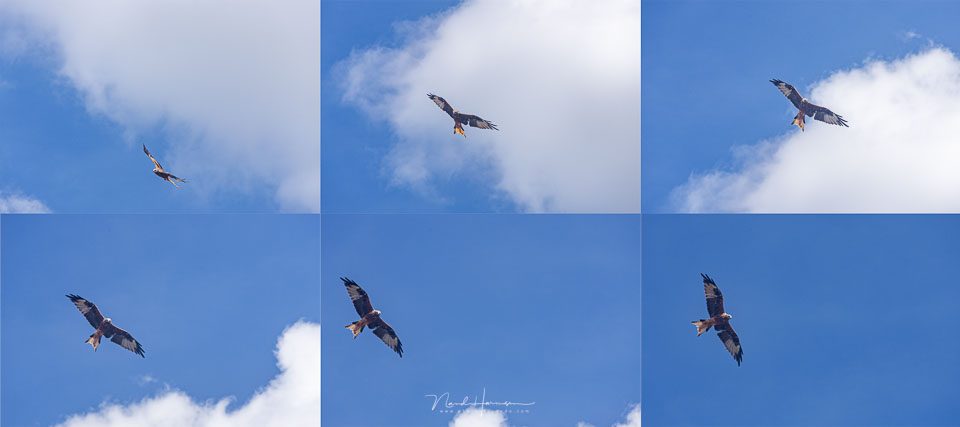
At 30 frames per second, as many as 15 photos are saved before you fully press the shutter button. This means you are almost never too late to capture the action. Incidentally, the EOS R7 is faster than the full frame models, which do not go faster than 20 frames per second.
The results
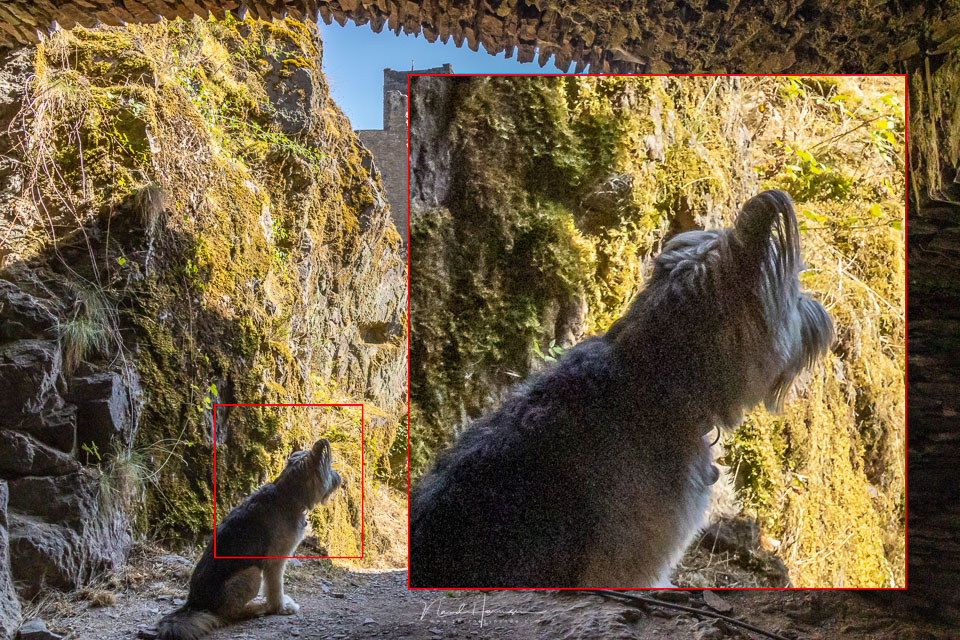
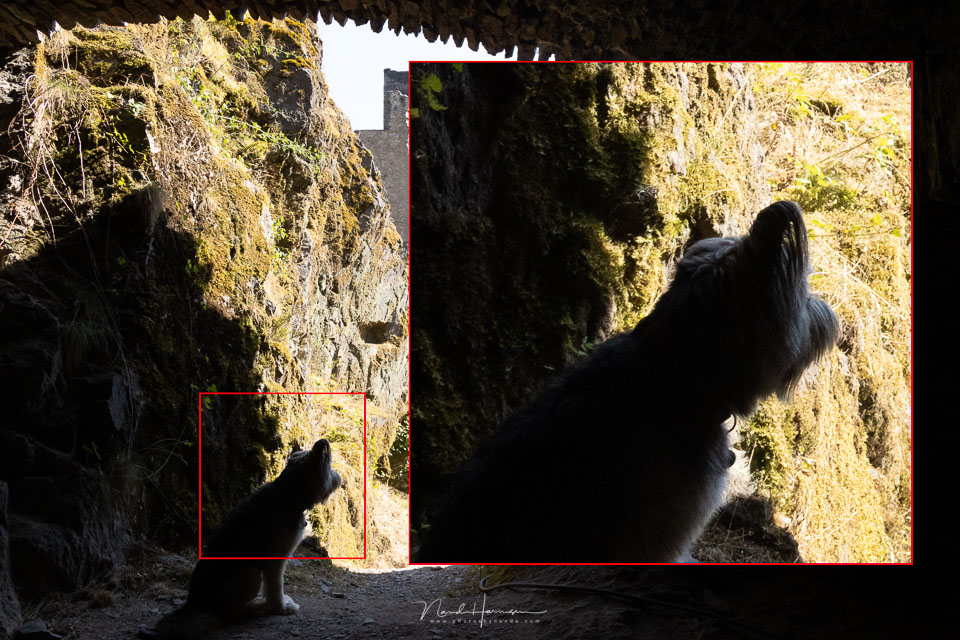
The dynamic range of the EOS R7 is smaller than that of its full frame siblings, mainly because of the smaller sensor combined with the high resolution. That does not mean it is poor. You can take perfectly good photos at ISO values up to 3,200, as long as your exposure is correct.
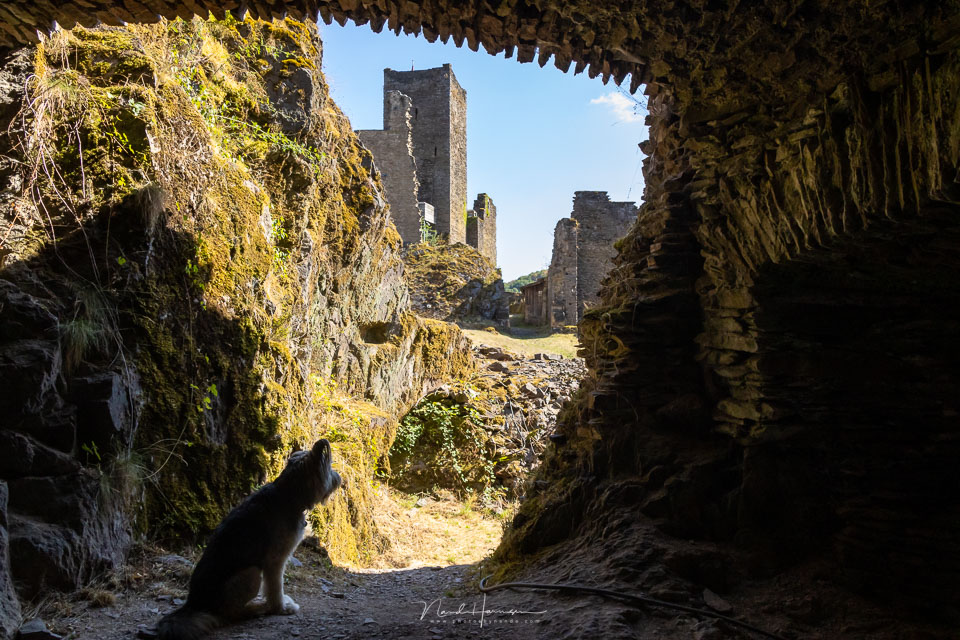
When you brighten dark areas, you can see that you cannot go much further than 3 stops before the noise becomes distracting. At higher ISO values, you are penalised more quickly, a normal consequence that occurs with every camera.
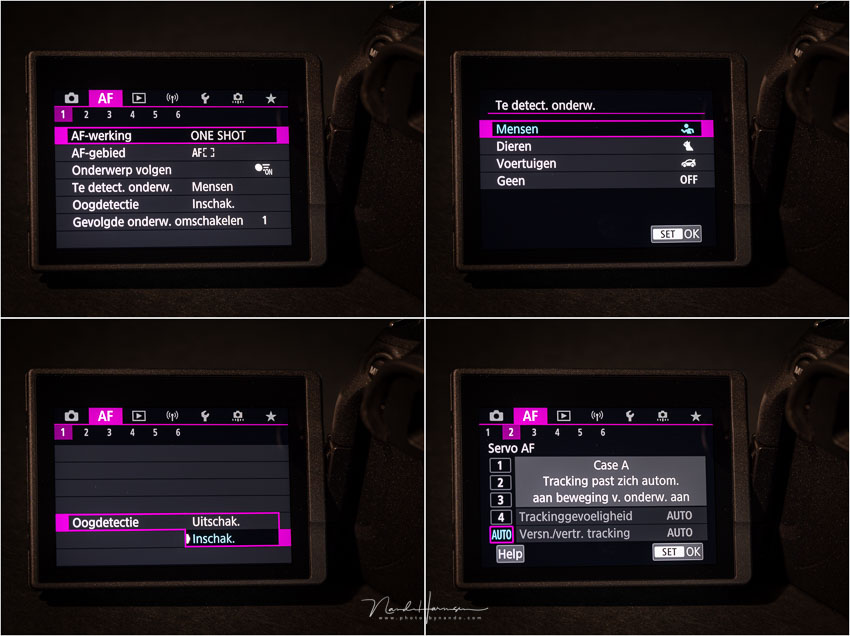
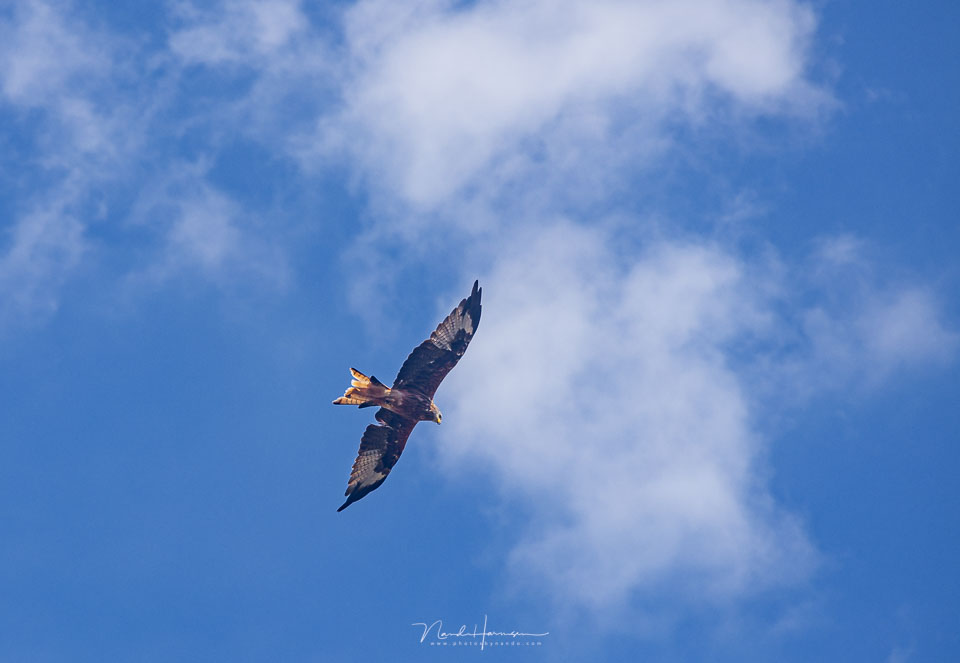
The camera is fast and the autofocus is accurate. The crop factor is an advantage when a long focal length is important. During this review, I only photographed with the RF-S 18-150mm, since it is offered as a kit. I expect most people will use the camera in that way too.
The RF-S 18-150mm is of course not the best lens you can get. It is compact, made of plastic, has a wide zoom range and is not very fast. You can compensate for the latter with ISO, of course. The image quality is sufficient for normal use.
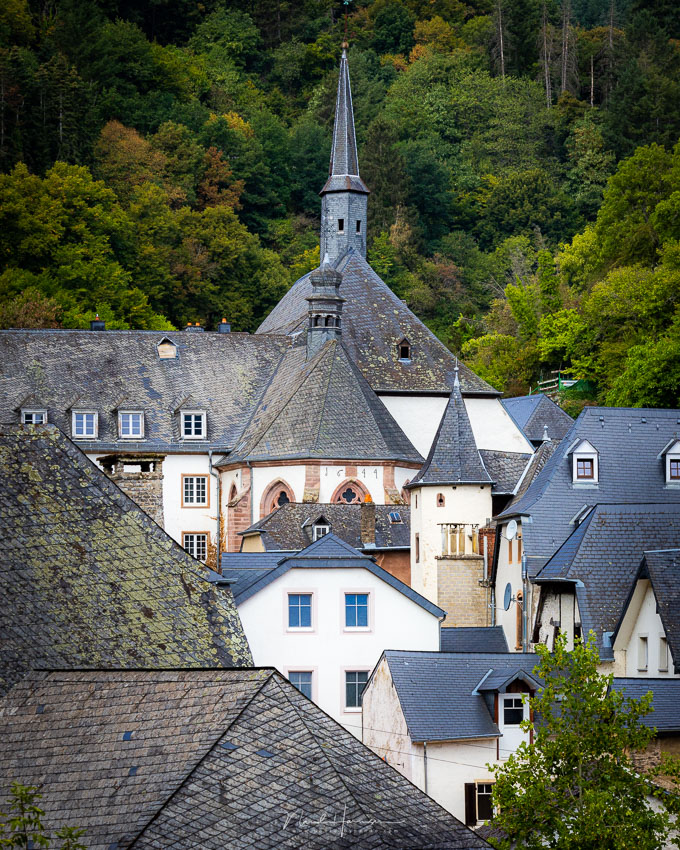
The full performance of the EOS R7 will only come into its own when an L lens is mounted, or one of the excellent affordable primes that Canon offers.
Conclusion
The Canon EOS R7 left me with mixed feelings. It is a very nice camera with excellent performance. Its video capabilities in particular are professional, which should not be underestimated.
For photography, you quickly get the impression that this is the mirrorless version of the famous EOS 7D Mark II. An action camera with an APS-C sensor that is perfect for photography with longer focal lengths. Yet the camera also seems very much aimed at hobbyists. The creative settings in particular, aimed at JPEG photographers, reinforce that feeling.
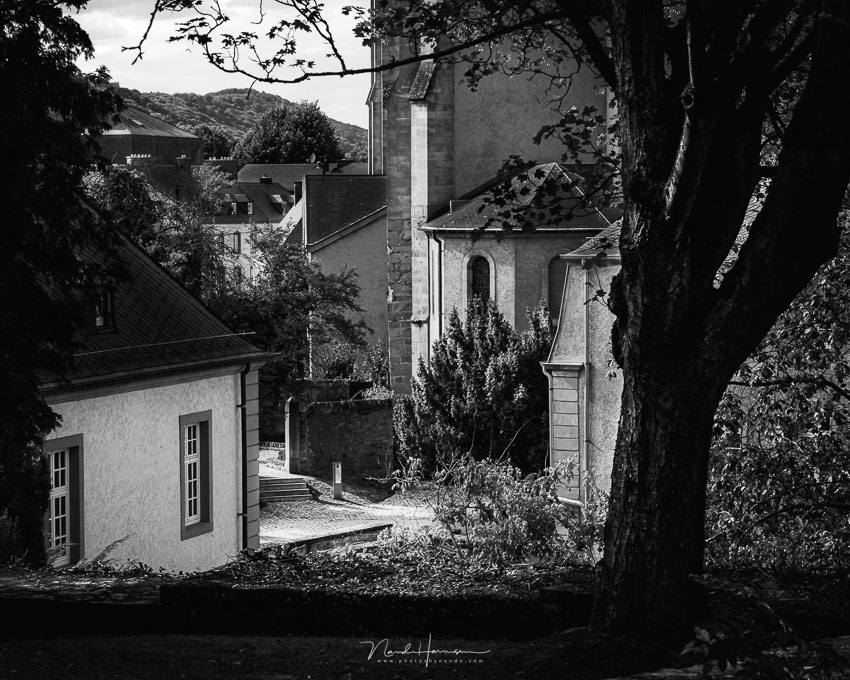
Although the EOS R7 will perform excellently with an RF100-500L lens, an RF70-200L lens or any other RF L lens, I think it is better suited to the standard RF lenses.
Think of the RF100-400 that I reviewed recently, or the RF primes that I used in the French Tarn.
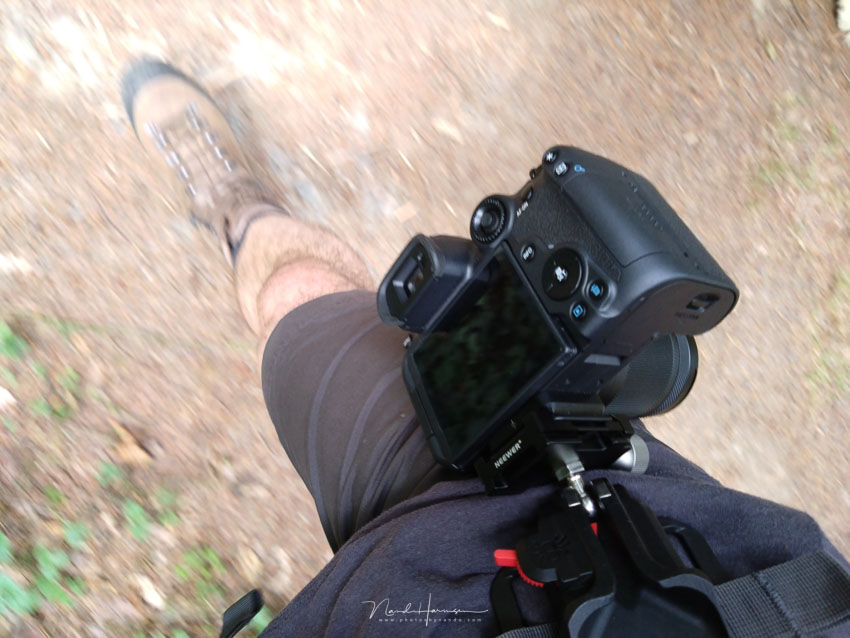
In this respect, the Canon EOS R7, at a recommended retail price of 1519 euros, or 1919 euros with the RF-S 18-150mm, is a camera that falls somewhat between two stools. The price is too high for the creative JPEG photographer, while the photographer willing to spend this amount is unlikely to be interested in those creative features.
What I like
- Excellent resolution
- Fits comfortably in the hand despite its light weight and small size
- Combination of control wheel and joystick works well, but takes some getting used to
- Better position for the power switch, which also includes switching to video
- Fantastic AF and AF tracking
- IBIS
- Fantastic video options
- Dual card slot
- Crop factor is ideal when long focal lengths are desired
- Good dynamic range
- Auto level option
- Pre-shooting available, up to half a second before fully pressing the shutter button
- Dedicated AF/MF switch on the camera body
What I like less
- Control wheel and joystick combination takes a lot of getting used to
- You have to be careful not to accidentally switch the camera to video mode when turning it on
- Shutter is louder than expected
- Falls between a consumer camera and a semi-professional camera
- Micro-HDMI connection
- Creative settings may not make sense for this camera's target audience
- The camera regularly froze and required the battery to be removed before it would work again
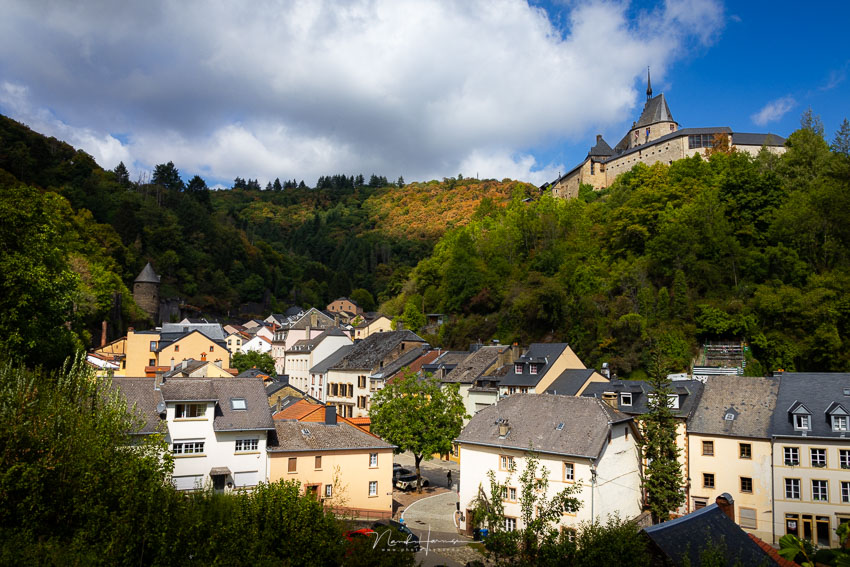
The camera regularly froze, with nothing working, not even the power switch. I could not find out why this happened. It was necessary to remove the battery for a few seconds to get the camera working again.
After returning from the holiday, I looked for a reason why the camera froze. It turns out that this can happen when you press the play button immediately after taking the photo to review it.
Canon is working on solving this problem, and it will not be long before a firmware update fixes it. In any case, it is something to bear in mind until then, because you could miss great moments because of it.
Who is this camera for?
This brings us to the question of who this camera is suitable for. As I said, I find that difficult to say. It is a fantastic second camera for someone who already has a mirrorless camera, or as a B-roll camera when filming.
The serious amateur photographer will also get a lot of enjoyment from the EOS R7, and the options are good enough to compete, partly, with Canon's full frame models. In some cases, the options are even more extensive.
In some respects, the EOS R7 is a fully-fledged replacement for the EOS 7D Mark II. The camera is incredibly fast, the autofocus is fantastic and the crop factor gives you that extra magnification.
On the other hand, the EOS R7 also seems aimed at the amateur who simply wants to take beautiful photos. The creative functions point in that direction too.
Do you find the EOS R7 too expensive? Then you can always consider the Canon EOS R10. This camera's specifications are not as extensive as those of the EOS R7, but for anyone who does not need them, the EOS R10 can be a good alternative.
Would you still prefer full frame? Then the EOS RP is worth considering. It is cheaper, but you do miss modern features and options such as IBIS and the excellent autofocus capabilities.
About the author
Nando Harmsen has been photographing for more than 40 years. He specialises in wedding photography and landscape photography. Nando also gives talks, workshops, masterclasses and photo trips, and regularly reviews new and interesting equipment.
You might also like
-
 Review: Canon EOS R10 mirrorless camera
by Nando Harmsen
-
 Canon introduces mirrorless crop cameras: the EOS R7 and EOS R10
by Nando Harmsen
-
 Review of the fantastic Canon EOS R6 Mark II
by Nando Harmsen
-
 Review: Canon EOS R3
by Nando Harmsen
-
 Review: Sony A1 mirrorless camera
by Nando Harmsen
-
 Review: Canon EOS R6
by Nando Harmsen
4 comments
-

 Donald Willemsen
wrote on Saturday 17 September 2022 at 13:11
| reply
Donald Willemsen
wrote on Saturday 17 September 2022 at 13:11
| reply
Nando, it strikes me that your review is less complimentary than many others. Your review is partly based on your own needs and experiences with other models from the same brand. There is nothing wrong with that in itself, but of course that does make it less objective. Not that the other reviews are more objective, because other interests often play a role as well. For example, a glowing review in a magazine can then result in a well-paid advertising campaign from Canon. What your review tells me is that it is not all sunshine and roses with the camera discussed. That is of course a good thing. It does make it more difficult to consider whether or not to purchase it.
Translated from Dutch. -
 Nando
wrote on Sunday 18 September 2022 at 16:55
| reply
Nando
wrote on Sunday 18 September 2022 at 16:55
| reply
@Donald Willemsen:
Translated from Dutch.
Why is my review less objective, while at the same time you mention vested interests in other reviews?
My review is based on my experiences as a photographer, and is not a promo for the camera. It is as objective as it can be. You wouldn't want me to make it seem better than it is, just to simplify your decision.
My advice, list your wishes and requirements, on paper. And see how many of those wishes and requirements the camera meets. Be objective in that too, and don't set unreasonable wishes and requirements.
As long as you don't think that the camera takes better photos than your older camera. At most, you can use the newer technologies to your advantage, if you really need them. -
Donald Willemsen
wrote on Friday 23 September 2022 at 01:07
| reply
@Nando, I would like to answer your question. Your review is less objective because you compare it with another Canon that you are used to using. You don't have an interest like magazines do. In that sense, you are objective. That's what I mean.
Translated from Dutch.
However, I found it striking that many reviews sing hosannas about the R7, while you don't on a few points, because you mention a couple of things that bother you when using the R7, precisely because you are used to using a different camera. I appreciate that. Points for me to pay attention to as well.
So I find the difference in reviews striking. Don't see that as a negative point, but rather as a positive one.
I think you didn't understand me correctly, and perhaps I didn't explain it well either. I am well aware that it is not easy to write a good review. Everyone chooses their own approach. In any case, I learned something from your review again, and that's only a good thing. -
 peterheins
wrote on Saturday 29 October 2022 at 20:11
| reply
peterheins
wrote on Saturday 29 October 2022 at 20:11
| reply
Great review. Nothing wrong with assessing the camera from your own point of view. It's fine to be critical, not every new camera has to be hallelujah. I had the Canon RP myself but went "back " to the D series again. Why? I find the R series too compact, too light. I prefer having more weight on my tripod. And for the D series I can buy professional L lenses relatively cheaply. I now have the Canon 6D mark II and the 6D because I also occasionally shoot a wedding and in combination with all L lenses I don't have to charge top dollar and I don't compromise on quality. That's how everyone makes their own choices.
Translated from Dutch.
Have your say
Please note: Articles older than a week can only be commented on by signed-in visitors.Would you still like to comment? sign in or create a free account.
Become a better photographer every week
A practical photography tip in your inbox every week.
39,077 photography enthusiasts already receive the tips! More about the weekly mail. Or keep up to date via  Facebook.

Elja Trum
Photofacts; everything to do with photography!
Would you like to take better photos and keep up with what is happening in photography? Photofacts publishes articles that teach you something about photography — from a product announcement to a practical shooting tip or a look at a website. Photofacts covers photography every day and is a hobby project of Elja Trum's that got out of hand. The articles are written by a team of volunteer authors. If you would enjoy writing one or more articles for Photofacts, do get in touch.More about PhotofactsPhotofacts is made possible in part by
