

Review: Fujifilm GFX 100S II medium format camera
Friday 27 September 2024, 15:51 by Elja Trum | 4,038 views | 5 commentsThis article was translated from Dutch with the help of AI. Read the original.
In May this year, Fujifilm announced the GFX 100S II. It is the most affordable digital medium format camera there is. The camera has a huge 102-megapixel sensor in a relatively compact body. We put it through its paces.
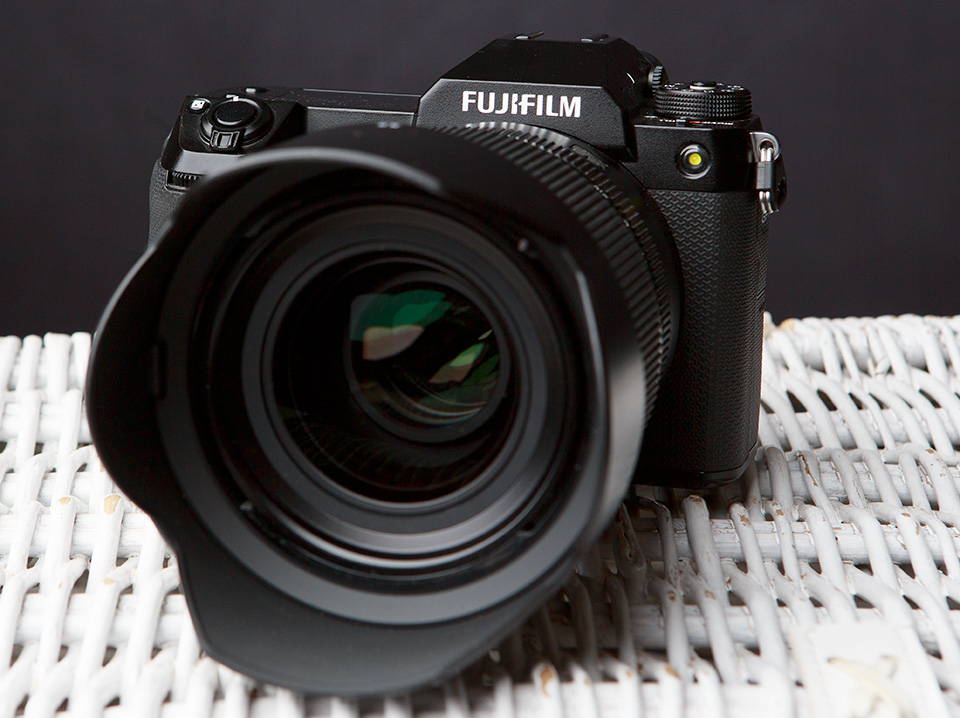
Fujifilm GFX 100S II specifications
- 101-megapixel medium format sensor (44 x 33 mm)
- 7 frames per second
- Sensitivity: 80 - 12,800 ISO (expandable to 40 - 102,400 ISO)
- Tilting 3.2-inch screen (2.3 million pixels)
- Electronic viewfinder (0.84x magnification, 5.76 million pixels)
- In-body image stabilisation up to 8 stops
- 2x SD card slots
- G mount (for GF lenses)
- 0.79x crop factor
- 4K video at 30 fps
- Weight: 883 grams
- Dimensions: 150 x 104 x 87mm
In practice
The Fujifilm GFX 100S II is a comfortable size. It is just a fraction larger than, for example, a Canon EOS R5 and weighs about the same.
The controls work fine, although I prefer the retro controls of, for example, a Fujifilm X-T5. You operate the GFX 100S II as you are used to with many brands, using the dials for the desired settings. If you want, you can also set the aperture on the lens.
You can also press the dials, by the way, and assign another function to them. I set them so that they locked the current value, for example the ISO. This means you cannot accidentally change the ISO.
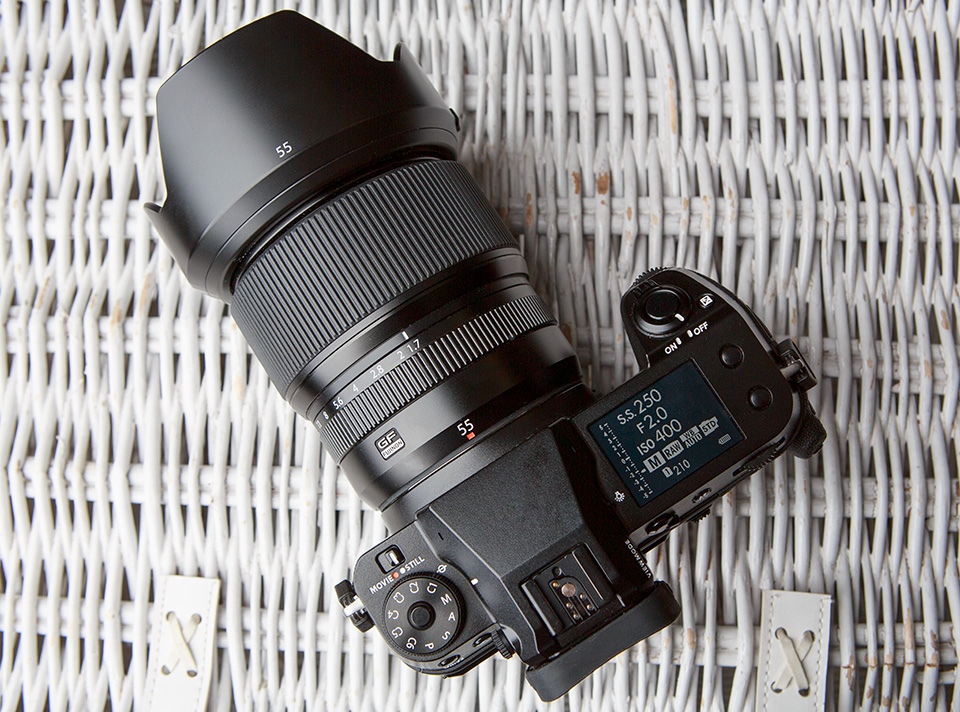
A physical PASM dial lets you set the shooting mode. This dial also has six customisable presets. You can also lock the dial with a push button to prevent it from being turned accidentally.
On the right-hand side is a 1.8-inch e-Ink screen. You can see the camera's current settings on it, even when the camera is switched off. Convenient and easy to read. You can display information in three different ways: detailed information, virtual dials and a live histogram.
Photos are taken in a 4:3 format instead of the usual 3:2 format of 35mm cameras. This may take some getting used to, but personally I like these proportions. They make portrait photos a little less narrow and landscape photos a little taller.

If you want, you can also simply set the camera to a 3:2 image format. You will then lose some pixels. Part of the sensor will not be used.
The autofocus works well and quickly, even in low light. I mainly shoot portraits, and eye detection is very useful to work with. The Fujifilm also has various alternative subject detection options.
Dynamic range
The sensor's dynamic range is very large. In photos with a lot of contrast, a large difference between dark and light areas, this gives you the option to capture both the dark and light areas properly in a photo.
The sensor can also capture images in 16-bit, with 14-bit as an option.
When editing your photo, this gives you plenty of options for lightening dark areas and darkening light areas. Very useful in practice.
The 102 megapixels are also great when editing. You have so much detail to work with. For example, you can perfectly remove imperfections from the skin.

Compared with the Fujifilm GFX 100 II
The GFX 100 II was released last year, so to speak the big brother of the 100S II. This bigger brother has the same sensor, but more video options and a larger buffer. The GFX 100 II also has a CF Express Type B slot, which is particularly important for video.
The viewfinder on the GFX 100 II is also larger and has almost twice as many pixels, 5.76 million dots versus 9.44 million dots.
If video is very important to you, the extra cost of the GFX 100 II may certainly be worthwhile. If it is the photos you care about, there does not really seem to be a good reason to pay an extra 3,000 euros for the GFX 100 II over the GFX 100S II.
The GFX 100 II may also be the better choice for action because of its larger buffer. However, I expect action photographers would choose a different type of camera anyway.
Compared with the Fujifilm GFX 100S
When you compare it with the predecessor of the GFX 100S II, there are certainly some interesting updates. The sensor has been updated, for example, and its sensitivity has been lowered to 80 ISO.
A lot has also stayed the same. The cameras are almost identical on the outside. The only noticeable difference here is the updated covering on the grip. All the buttons and their positions are unchanged.
The viewfinder has had a significant resolution boost. From 3.69 million dots to 5.76 million dots.
The GFX 100S II can now also take 7 frames per second, whereas its predecessor could manage a maximum of 5 frames per second. The image stabilisation and autofocus have also been improved.
The new model is also slightly lighter, the battery lasts longer and the image stabilisation is better. Another noteworthy point: the price is even lower than that of the previous model.
If you already have a GFX 100S, upgrading to the GFX 100S II is probably not really worth it. Even so, these are solid upgrades compared with the previous model.
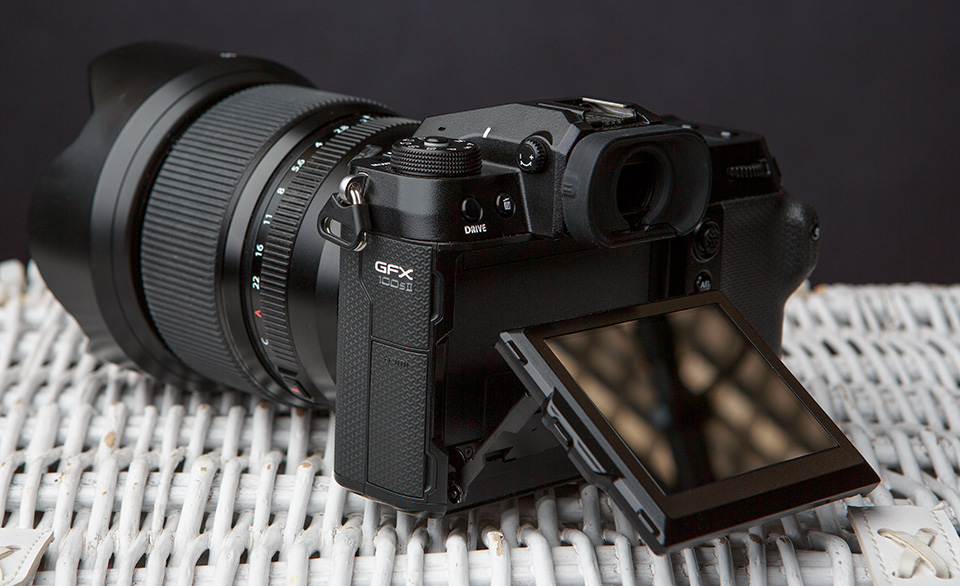
Medium format becomes affordable
Fujifilm has been working for years to make medium format more affordable with its GFX cameras. Especially as other full-frame cameras now seem to be getting more expensive almost all the time.
Suppose you order a Canon EOS R5 mark II, then you will already be paying 4,799 euros. The Nikon Z8 costs a comparable 4,599 euros.
At 5,499 euros, a medium format Fujfilm GFX 100S II is therefore 'only' 700 euros more expensive. And the GF lenses are also no more expensive for medium format than comparable high-end RF lenses. That does not make them cheap, of course, as most lenses cost somewhere between two and three thousand euros.
Disadvantages of the GXF 100S II
I am enthusiastic about the Fujifilm GFX 100S II, but of course, like every camera, it also has some disadvantages.
Slow response
The GFX 100S II has a certain sluggishness while shooting. Even at a fast shutter speed, such as 1/2000s, it takes a moment to take the photo.
With many other brands, and also with other Fujfilm cameras, you can hear what your shutter speed is when you press the shutter button. With the GFX 100S II, taking a photo at 1/4000s takes just as long as taking a photo at 1/100s.
You hear and feel no difference. This means you need to pay extra attention to the shutter speed being used. You could easily end up using a shutter speed that is too slow and therefore take blurry photos.
You can also notice this sluggishness while shooting. When you take a photo, it takes about half a second before you can take the next one. Even at high shutter speeds.
In practice, with the way I photograph portraits, I did not experience any problems with it at all. But perhaps you work differently, in which case I can imagine that it could be annoying.
Of course, you should also switch on high-speed mode. You can then take up to seven frames per second. So it is certainly not the case that the camera would be unusable for someone who wants to capture some fast action occasionally.
Demanding on your computer
The 100-megapixel files are large. If you choose 'lossless compressed', the photos are about 120 megabytes each. You need large, fast SD cards, a fast card reader and plenty of space on your computer.
A fast, recent computer is also recommended so that you can load and edit the files quickly. My computer, now about a year and a half old, can edit the files quickly and without any problems, but if you have an older system, you may need to upgrade.
Moderate menu system
As far as I am concerned, Canon is the champion when it comes to the menus on its cameras. You especially notice that when you work with a menu system like Fujifilm's. It involves more searching, and I regularly have to Google something first before I can even find a specific setting.
Fujifilm also has a habit of greying out menu options or changing them based on other camera settings. However, it does not indicate anywhere which setting is causing the problem. That can be frustrating.
At one point, the flash stopped working for me. It would no longer fire. The flash menu only showed 'off', with no way to change anything. It eventually turned out that the flash options were no longer available because I had set the camera to the electronic shutter.
Unprotected sensor
There is a huge sensor in the GFX 100S II. It is quite nice to see it when you remove the lens from your camera. Less so when you are photographing in nature or in a dusty building. The sensor is very vulnerable this way,
It would have been nice if the mechanical shutter covered the sensor when the camera was switched off. That would reduce the chance of getting dust on your sensor somewhat.

Conclusion
There is one important reason to buy this camera: the beautiful image quality of the 102-megapixel files. They are a pleasure to work with and give you, as a photographer, even more room to create the images you are looking for.
With the even lower price and a number of great upgrades compared with its predecessor, the Fujifilm GFX 100S II is, in my view, the best GFX camera you could currently buy. Unless you want to use it for video, in which case the GFX 100 II may be worth the extra cost.
I am so enthusiastic about the GFX 100S II that I am seriously considering it as my own new camera. With a few lenses, it remains a serious investment, but the extra cost compared with a new set of professional 35mm mirrorless camera equipment and lenses is negligible.
A disadvantage of the Fujfilm GFX 100S II is that it is not an all-rounder, like a Canon EOS R5, for example. There are plenty of types of photography for which this camera is less interesting or even overkill. Think of action photography or event photography.
But are you looking for the best image quality and the shallow depth of field, or 'specific look', that the medium format system can offer? Then, in my view, the Fujifilm GFX is the best and most affordable camera.
About the author
Elja Trum is the founder of Photofacts and online photography course website Photofacts Academy. He has been writing about photography since 2006. Elja is also the author of (Dutch) books on composition, black-and-white photography, flash photography and portrait photography.
You might also like
-
 Fujifilm GFX50S II medium format camera announced
by Nando Harmsen
-
 Review: Fujifilm GFX-100 medium format camera
by Elja Trum
-
 Fujifilm introduces the GFX100 II medium format camera
by Nando Harmsen
-
 Fujifilm announces the GFX-100S
by Nando Harmsen
-
 Fujifilm GFX 100 RF announced
by Elja Trum
5 comments
-
 Axel Mecklenfeld wrote on Saturday 28 September 2024 at 18:45 | reply
Nice camera!
Translated from Dutch. -
 Eugene wrote on Sunday 29 September 2024 at 13:16 | reply
The 3D effect of this camera is overwhelming. Just look at the bathtub in front of model Kristel. It really comes forward. Well done.
Translated from Dutch. -
 guest wrote on Wednesday 2 October 2024 at 09:23 | reply
Partly because the menu is so irritating, I sent the Fujifilm GFX 50s back. Current cameras have many more options, which does indeed make certain settings difficult to find. That may be so, but I find it strange and a missed opportunity that I can put all the settings in my favorite settings on my old Canon 5D MKII (from 2009), but not on Fujifilm's cameras.
Translated from Dutch. -

-


Have your say
Please note: Articles older than a week can only be commented on by signed-in visitors.Would you still like to comment? sign in or create a free account.
Become a better photographer every week
A practical photography tip in your inbox every week.
38,982 photography enthusiasts already receive the tips! More about the weekly mail. Or keep up to date via  Facebook.

Elja Trum
Photofacts; everything to do with photography!
Would you like to take better photos and keep up with what is happening in photography? Photofacts publishes articles that teach you something about photography — from a product announcement to a practical shooting tip or a look at a website. Photofacts covers photography every day and is a hobby project of Elja Trum's that got out of hand. The articles are written by a team of volunteer authors. If you would enjoy writing one or more articles for Photofacts, do get in touch.More about PhotofactsPhotofacts is made possible in part by
