

Preview: Canon EOS 200D and EOS 6D Mark II
Thursday 29 June 2017, 23:23 by Michelle Peeters | 7,586 views | 0 commentsThis article was translated from Dutch with the help of AI. Read the original.
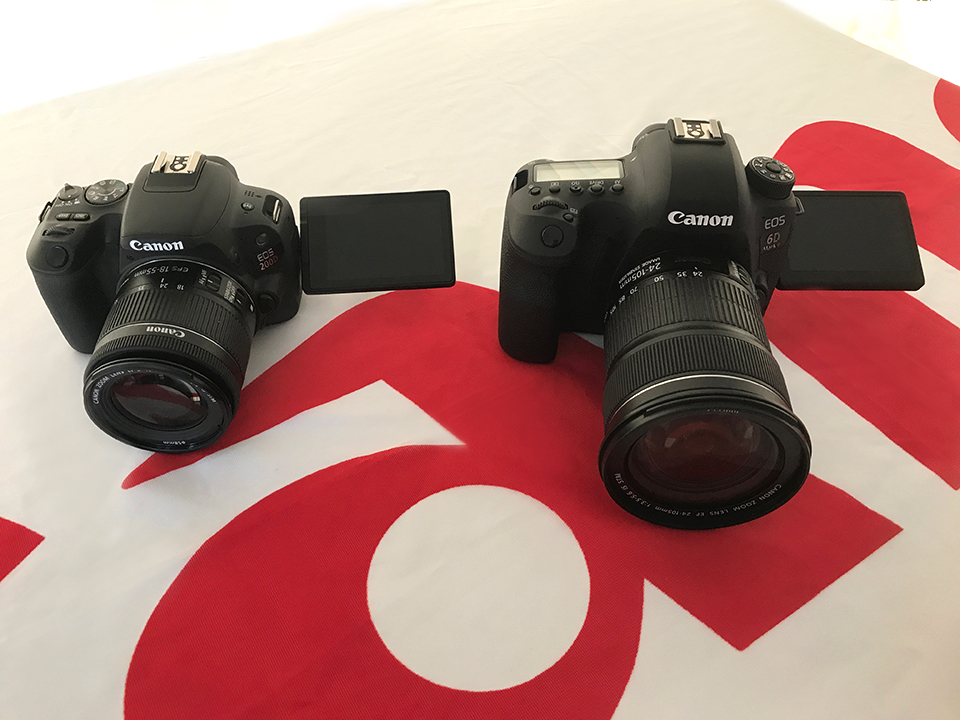
On 29 June, Canon introduced its two new members of the EOS family at Finley het Witte Huis on the Loosdrechtse Plassen: the EOS 200D and EOS 6D Mark II. In this article, our first experiences with these new models.
At this inspiring location, right on the water, we had the opportunity to work with the cameras for a while. Bruno Winnen (Marketing Director Benelux) and Jip Barth (technical specialist at Canon Nederland) gave presentations about Canon's marketing strategy for 2017 and the specifications of the new products.
Live for the Story
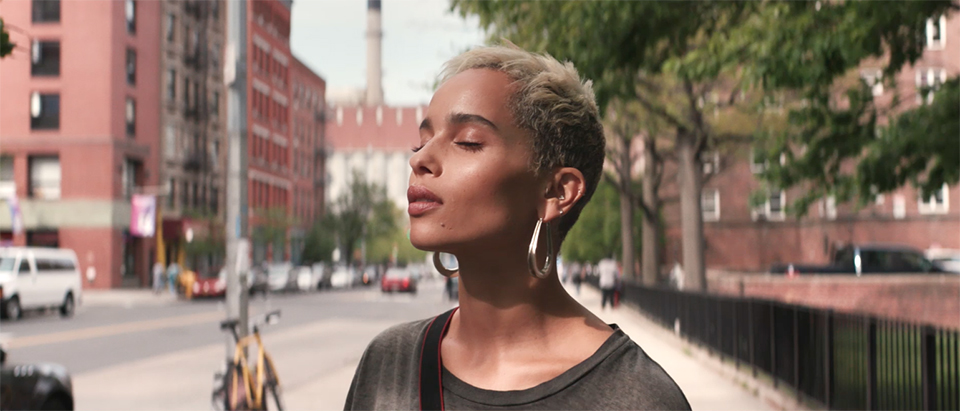
Bruno Winnen talked about Canon's brand campaign Live For The Story. This campaign is a search for the ideal storyteller, someone who travels after the summer for a year, with the aim of capturing 365 inspiring stories in images.
Every day, 200 million photos are uploaded to Facebook and 95 million photos and videos are posted on Instagram. As a result, the art of telling a story is being lost in an ocean full of selfies, cats and avocado brunches.
With this campaign, Canon wants to bring the concept of storytelling back to life. Zoë Kravitz (daughter of the famous Lenny Kravitz) has agreed to assess the candidates for this worldwide job. You can apply via Instagram.
The target group is between 18 and 24 years old. The campaign has been very successful, with around 2,000 people in the Netherlands having already taken part. Until today, you could register by sharing your most memorable summer story on Instagram.
Canon EOS 6D Mark II
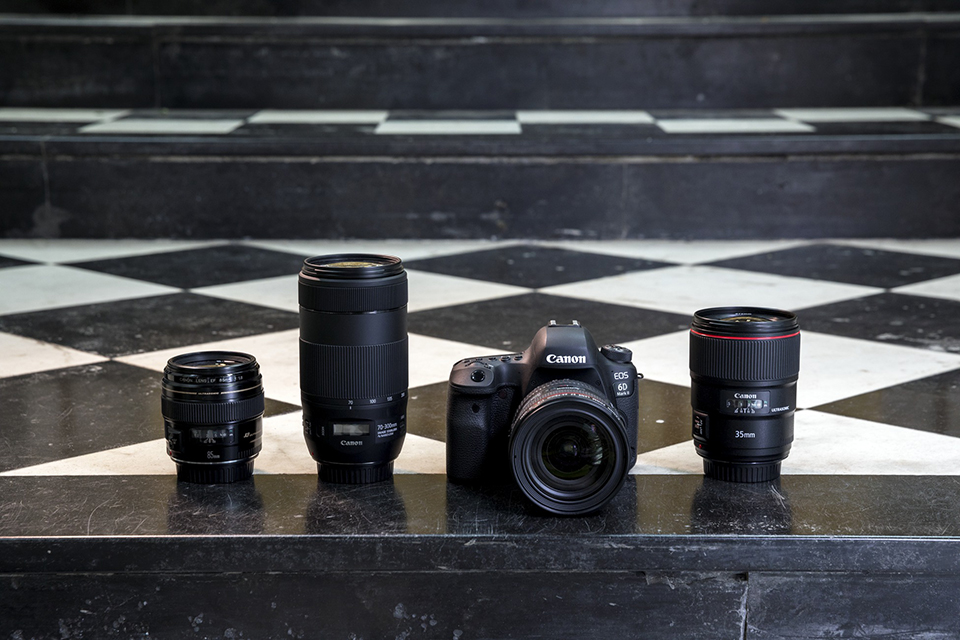
The predecessor, the Canon EOS 6D, was launched in September 2012 as the world's smallest and lightest full-frame DSLR. What has changed compared with the old model:
- A 26.2-megapixel CMOS full-frame sensor (20.2 in the old model) and DIGIC7. A sensitivity of 40,000 ISO (expandable to 102,400). This camera is very interesting for full-frame enthusiasts
- 45 autofocus points (11 in the old model) and 6.5 frames per second (4.5 on the 6D). It also has Live View AF with high-speed Dual Pixel CMOS AF
- A tilting and swivelling touchscreen, making it 5 grams heavier than its predecessor. It does, however, offer a lot of freedom for taking photos from all kinds of difficult angles
- Still no 4K video, but full HD and the option to make time-lapse recordings with preset intervals in 4K. It also has image stabilisation during video recording.
- GPS, Wi-Fi and Bluetooth connectivity for coordination with smartphones. The app for the Wi-Fi connection has been greatly improved and provides a very fast connection, established via Bluetooth. The same app can be used for all types of Canon cameras. The Wi-Fi connection is only established when, for example, you want to download a photo, with Bluetooth waking the camera from sleep mode
- The camera is dust- and splash-proof. The covers of the battery compartment and card slot have sealing material. The wheel axle and other places without sealing material are made of high-quality material to minimise the space between each component. These measures help prevent dust and water droplets from unexpectedly infiltrating the inside of the camera.
Canon EOS 200D
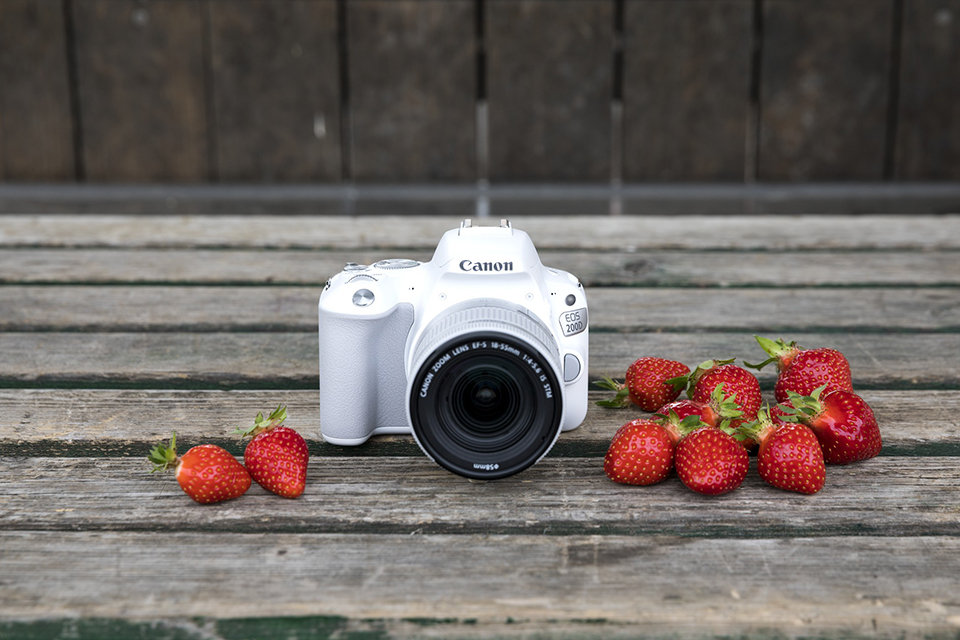
This camera is exactly the bridge between a compact camera or smartphone and the world of DSLR photography. The EOS 200D is designed to take the creativity and image quality of your photos to a higher level.
It is the perfect camera for enthusiastic smartphone photographers looking for their first DSLR. It is very user-friendly and has Wi-Fi and Bluetooth, allowing you to connect it to your smartphone. This makes it very easy to share videos and photos.
The EOS 200D is currently Canon's lightest DSLR with a tilting and swivelling touchscreen with selfie mode. This makes taking photos and operating the camera very easy for beginners. The camera still contains quite a lot of technology, especially for beginning photographers.
Selfie mode automatically provides the optimal settings for a selfie. The skin is softened and the background is blurred. The flash is disabled and only activates when all settings are correct, with Live View enabled, the touchscreen on and the screen turned backwards.
It is equipped with Dual Pixel autofocus with 9 focus points and a 24.2-megapixel APS-C sensor with a DIGIC 7 image processor. You can also keep focusing well with Servo AF in Live View while filming, at 3.5 frames per second thanks to Dual Pixel AF. The processor is extremely fast.
You can shoot video very quietly and smoothly when using a lens with a Stepping Motor (STM).
A nice collection of creative programmes (GUIs) allows you to continue developing with the EOS 200D.
You can work with fairly high ISO values with little noise (25,600, expandable to 51,200), allowing you to take photos in low light without a tripod.
You can quickly turn Wi-Fi on and off without having to dive into the menus. The Wi-Fi button is located on the top of the camera. NFC connects your camera to all compatible smartphones and other devices. Bluetooth provides a permanent connection to the smartphone or remote control (Bluetooth Remote BR-E1) within a range of 5 metres.
Bas Meelker
Bas Meelker (landscape photographer from Groningen, author of 'FOF landscape and architecture' and ambassador for Canon Nederland, Canon Large Format Print and Benro) then told us about his test experiences with the Canon EOS 6D Mark II, which he had tried out the previous evening at the Loosdrechtse Plassen.
The camera feels familiar and the tilting and swivelling screen is very useful, especially if you want to work at different heights. It is a nice, light camera and the battery grip is also very useful. The connection for the remote control is in an easily accessible place.
The same batteries as in the Mark 5 are used, which is also handy. The EOS app works very well and is useful, for example, when you have your camera on a tall tripod and cannot look through the viewfinder yourself. A connection to your smartphone is the answer in that situation.
Because it has built-in GPS, I no longer need to bring and install my own GPS transmitter. It is a pleasant camera to work with.
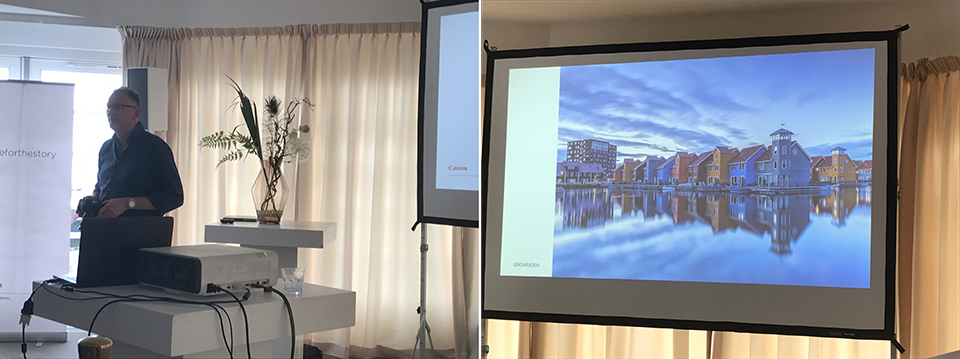
Bas then gave a presentation about his own work. He showed a beautiful series of photos taken mainly in his own surroundings, in the north of the Netherlands.
He often returns to the same places when the lighting conditions are different or better. He showed the huge differences in light, from a flat, uninteresting image to a beautiful picture taken in exactly the same place, in his photos.
He also gives workshops, and I will certainly attend one with him myself. In these workshops, he tries to explain to his students how to create a perfect landscape photo.
It is not a matter of 'seeing it' or having a 'photographic eye', but more about 'recognising' things such as light, patterns and so on, which means drawing on the knowledge and experience you have gained. An encouraging thought!
About the author
Michelle Peeters is fotografe en oprichter van DeuxBleus Fotografie. Michelle herkent het bijzondere in het gewone en het gewone in het bijzondere. Ze heeft zich nooit willen specialiseren en is daardoor van alle markten thuis.
You might also like
-
 Canon EOS 200D and EOS 6D Mark II announced
by Michelle Peeters
-
 Canon 6D Mark II on its way
by Elja Trum
-
 Review of the fantastic Canon EOS R6 Mark II
by Nando Harmsen
-
 Canon introduces the EOS R8 Mark II
by Nando Harmsen
-
 Preview: Canon EOS R5 Mark II
by Elja Trum
-
 Review: Canon EOS 6D Mark II
by Johannes Klapwijk
0 comments
Be the first to share what you think!
Have your say
Please note: Articles older than a week can only be commented on by signed-in visitors.Would you still like to comment? sign in or create a free account.
Become a better photographer every week
A practical photography tip in your inbox every week.
38,764 photography enthusiasts already receive the tips! More about the weekly mail. Or keep up to date via  Facebook.

Elja Trum
Photofacts; everything to do with photography!
Would you like to take better photos and keep up with what is happening in photography? Photofacts publishes articles that teach you something about photography — from a product announcement to a practical shooting tip or a look at a website. Photofacts covers photography every day and is a hobby project of Elja Trum's that got out of hand. The articles are written by a team of volunteer authors. If you would enjoy writing one or more articles for Photofacts, do get in touch.More about PhotofactsPhotofacts is made possible in part by
